
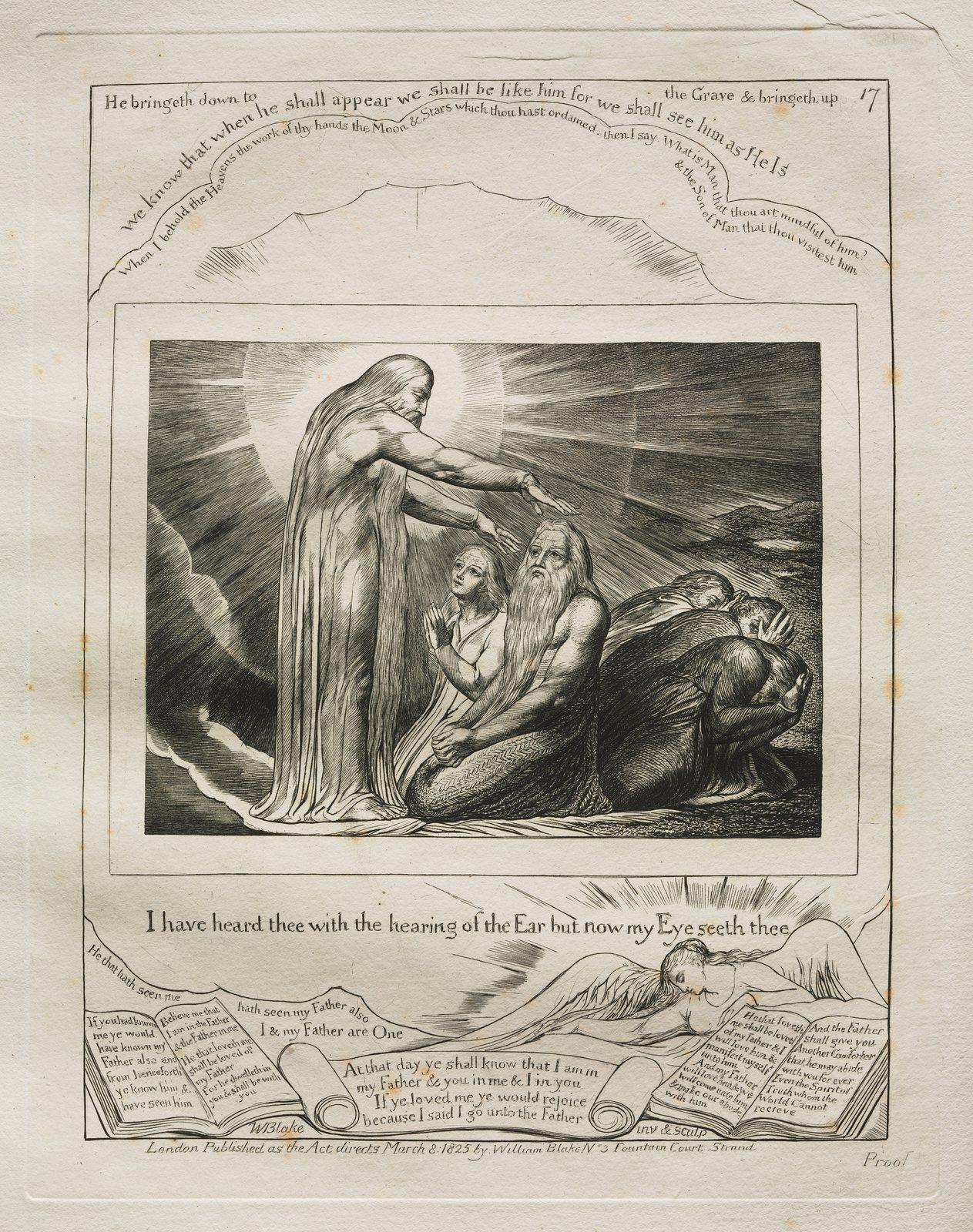
William Blake, I have heard thee with the hearing of the Ear, 1825. CC0.
Job 9 to 33 · Doctrine · Featured Study
The Mediator, the Witness and the Redeemer in Job
Job names three figures who could stand between him and God: a mediator, a witness and a Redeemer.
A man who finds no one to plead for him ends by naming a Redeemer who lives.
But I know that my Redeemer lives, and in the end He will stand upon the earth.
Summary
Who did Job hope would stand between him and God? For Job's Redeemer commentators give three answers: the Son of God, God Himself, or a deliverer within Job's own lifetime. Each answer rests on the words Job chose for his hope, the words for an umpire, a witness and a kinsman.
- Spurgeon preached on Job 9:33 in 1865, under the title The Great Arbitration Case.
- Paul's word for the one mediator is the Septuagint's word for Job's umpire.
- In Job the verb gaal stands in only two verses, the second of them Job's confession of his Redeemer.
Three Figures Job Asks For
Job frames his trouble as a case he cannot bring to court.
Job asks three times, in his replies to his friends, for someone to stand between him and God. In Job 9 he finds no one, in Job 16 he names a witness in heaven, and in Job 19 he names a Redeemer who lives. Ellicott, writing on Job's confession of his Redeemer, holds that Job had already owned God as his judge, umpire, advocate, witness and surety before he named Him Redeemer. Elihu, the young speaker of Job 32 to 37, adds a messenger who pleads for a man.
For He is not a man like me, that I can answer Him, that we can take each other to court. Nor is there a mediator between us, to lay his hand upon us both.The first of the three requests is a lament for what is missing.
From No Mediator to a Redeemer
Five verses name the figure, four in Job's mouth and one in Elihu's.
The figures run from an umpire, to a witness and an advocate, to a kinsman, to a messenger.
- The figure
- An umpire, and there is none
- The figure
- A witness and an advocate
- The figure
- One who pleads with God as for a neighbor
- The figure
- A kinsman-redeemer
- The figure
- A messenger, one mediator in a thousand
Each figure with the verse that names it; the last is Elihu's.
The Umpire Job Could Not Find
The Hebrew word of Job 9:33 names one who argues a case and decides it.
The word rendered mediator comes from the verb yakach (H3198), which James Strong glosses as to be right, to argue, and to decide or convict. The verb stands 59 times in 55 verses. The King James Version renders it daysman here, and Albert Barnes notes that the English word means an umpire or arbiter.
Barnes also notes that the Septuagint, the Greek translation of the Old Testament, renders the word with mesites, mediator. Paul uses the same Greek noun when he writes of one mediator between God and men.
Matthew Poole reads the hand laid on both parties as an umpire's authority, to order both sides in pleading and bind them to his decision. Jamieson, Fausset and Brown add that Job knew of no one on a level with the Almighty.
A Witness in Heaven
Job names a witness on high.
Even now my witness is in heaven, and my advocate is on high.Job's appeal moves from the earth that holds his blood to the heaven that holds his witness.
Two words for a witness stand side by side in the verse. The first, ed (H5707), is the common word, used 70 times. The second, sahed (H7717), stands only here, and the Berean text renders it advocate. Barnes reads the witness as God, to whom Job appeals for his sincerity.
Job 16:20 calls Job's friends his scoffers. In the Hebrew that word comes from the same root as the word for the mediator Elihu names (H3887), which Strong glosses as to scoff, and also to interpret or intercede.
Oh, that a man might plead with God as he pleads with his neighbor!This verse moves the witness from watching to pleading.
The Pulpit Commentary prefers the reading that God Himself would plead for a man with God, and so become a mediator between Himself and man. Jamieson, Fausset and Brown, after Umbreit, read it the same way: God must support Job against God.
One Mediator in a Thousand
Commentators read Elihu's messenger as Elihu himself, a teacher, an angel or the angel of the covenant.
Yet if there is a messenger on his side, one mediator in a thousand, to tell a man what is right for him, to be gracious to him and say, ‘Spare him from going down to the Pit; I have found his ransom,’Elihu answers Job's lack of a mediator from another side.
Jamieson, Fausset and Brown hold that Elihu means himself, the interpreter sent by God whom Job had wished for as his umpire. Benson reads a prophet or teacher who declares God's will to the sick man. The Cambridge Bible reads an angel who explains to a man God's dealings with him. The Pulpit Commentary takes the passage, as it says is generally done, of the angel of the covenant.
Matthew Henry weighed two senses of the word uprightness in the verse.
“His business at such a time is to show unto man his uprightness, that is, God's uprightness, that in faithfulness he afflicts him and does him no wrong, which it is necessary to be convinced of in order to our making a due improvement of the affliction: or, rather, it may mean man's uprightness, or rectitude.”
Matthew Henry · Commentary on the Whole Bible · on Job 33:23Puritan
My Redeemer Lives
Job names his Redeemer goel, the kinsman of the law.
I wish that my words were recorded and inscribed in a book, by an iron stylus on lead, or chiseled in stone forever.The wish marks what follows as the confession Job most wants kept.
The word is goel, from the verb gaal (H1350), which stands 104 times in 84 verses. The law gives the nearest of kin the right to buy back the land of a brother who has grown poor (Leviticus 25:25). Ruth asks Boaz to act as her kinsman-redeemer (Ruth 3:9).
Even after my skin has been destroyed, yet in my flesh I will see God.This is the verse whose Hebrew the readings that follow divide over.
Readers divide over the words in my flesh. The Pulpit Commentary takes them as from the standpoint of the body, at the resurrection, when the Redeemer stands up at the last over Job's dust. Barnes gives the margin's reading, out of my flesh, and Jamieson, Fausset and Brown read a renewed body.
Who Is Job's Redeemer?
Each answer has its holders and its objection.
The Son of GodJohn Gill; Joseph Benson; Jamieson, Fausset and Brown
Gill holds that the Redeemer is the Lord Jesus Christ, the near kinsman to whom the right of redemption belonged. Benson reports that most interpreters, ancient and modern, read the verse of Christ and of Job's resurrection. Jamieson, Fausset and Brown name Jesus Christ as Job's Vindicator.
The objection: Benson himself records the question how Job, in so early an age, could know of the Messiah's coming in the flesh.
God Himself, as Job's vindicatorEllicott
Ellicott reads the Redeemer as God, and notes that Psalm 19:14 and Isaiah 59:20 give God the same title.
The objection: Benson holds that goel, though sometimes used of God, most properly fits Jesus Christ, the near kinsman who took our nature.
A deliverer within Job's lifetimeFriedrich Umbreit, as Jamieson, Fausset and Brown report him
Umbreit reads Job 19:25 to 26 of God appearing as Job's avenger before his death. Benson records that some later interpreters read the passage of Job's restoration in this life.
The objection: Jamieson, Fausset and Brown answer that Job despairs of any restoration in this life (Job 17:15 to 16).
One Mediator Between God and Men
The New Testament names one mediator, who lives to plead for His people.
For there is one God, and there is one mediator between God and men, the man Christ Jesus,Paul names the mediator Job could not find.
Therefore He is able to save completely those who draw near to God through Him, since He always lives to intercede for them.The letter answers Job's wish for one to plead for a man with God.
Sources
Scripture is the Berean Standard Bible.
- James Strong, Exhaustive Concordance of the Bible, entries H3198, H5707, H7717, H3887, H1350 and G3316, with the count of each word in the tagged Hebrew and Greek text.
- On Job 9:33: Albert Barnes, Notes on the Bible; Jamieson, Fausset and Brown; Matthew Poole's Commentary.
- On Job 16:19: Ellicott's Commentary for English Readers; Albert Barnes, Notes on the Bible.
- On Job 16:21: the Pulpit Commentary; Jamieson, Fausset and Brown.
- On Job 19:25: Ellicott's Commentary for English Readers; the Benson Commentary; Jamieson, Fausset and Brown; Gill's Exposition of the Entire Bible; the Pulpit Commentary.
- On Job 19:26: the Pulpit Commentary; Albert Barnes, Notes on the Bible; Jamieson, Fausset and Brown.
- On Job 33:23: Jamieson, Fausset and Brown; the Benson Commentary; the Cambridge Bible for Schools and Colleges; the Pulpit Commentary.
- Matthew Henry, Commentary on the Whole Bible (1710), on Job 33:23.
- Charles Spurgeon, The Metropolitan Tabernacle Pulpit, Sermon No. 661, The Great Arbitration Case (1865), on Job 9:33.
Keep Studying
Read it5
Doctrines1
People and groups3