
Psalm 51:10 · Passage · Repentance
Create in Me a Clean Heart
Psalm 51 is a prayer of nineteen verses in which King David confesses his sin and asks God for mercy and a clean heart.
As Augustine lay dying, his friend Possidius wrote, he had “the shortest penitential Psalms of David” copied and hung on the wall by his bed, and he read them and wept.
Create in me a clean heart, O God, and renew a right spirit within me.
- The passage
- Psalm 51:1 to 19, 2 Samuel 12:1 to 13
- Books
- Psalms, 2 Samuel
- Hold in memory
- Psalm 51:10
Summary
The prayer runs in seven movements, from the plea for pardon to the prayer for Jerusalem. David asks for more than pardon. He wants his record wiped clean, the Spirit kept with him and the joy of salvation given back. Once forgiven, he means to show other sinners the way back to God. The prayer ends with the city whose king had sinned, and with the offerings that will please God again.
- David asks for mercy on the ground of God's loving devotion and compassion, and he pleads no merit of his own.
- He calls his sin a sin against God alone, though Bathsheba and Uriah were wronged as well.
- The clean heart is God's creation, for David asks Him to make what David cannot make.
- God takes no pleasure in burnt offerings given in place of repentance, but He will not despise a broken and contrite heart.
The Psalm and the Night Nathan Came
The heading names the occasion, and Second Samuel tells what passed between the prophet and the king.
What did David ask of God after the prophet named his sin, and what does his prayer teach a sinner who wants to come back? This study of Psalm 51 answers from the psalm itself. The psalm belongs to repentance, the turn of the whole person from sin to God, and it gives that turn its words in prayer.
The study sets the psalm beside the story in 2 Samuel 12 and lays out its movements in a table. It reads the plea for washing, the words of Psalm 51:10 and the sacrifice God accepts, in the order the psalm gives them, and it hears what the church's teachers drew from the prayer. It ends with the tax collector of Luke 18, whose prayer echoes the psalm's first line.
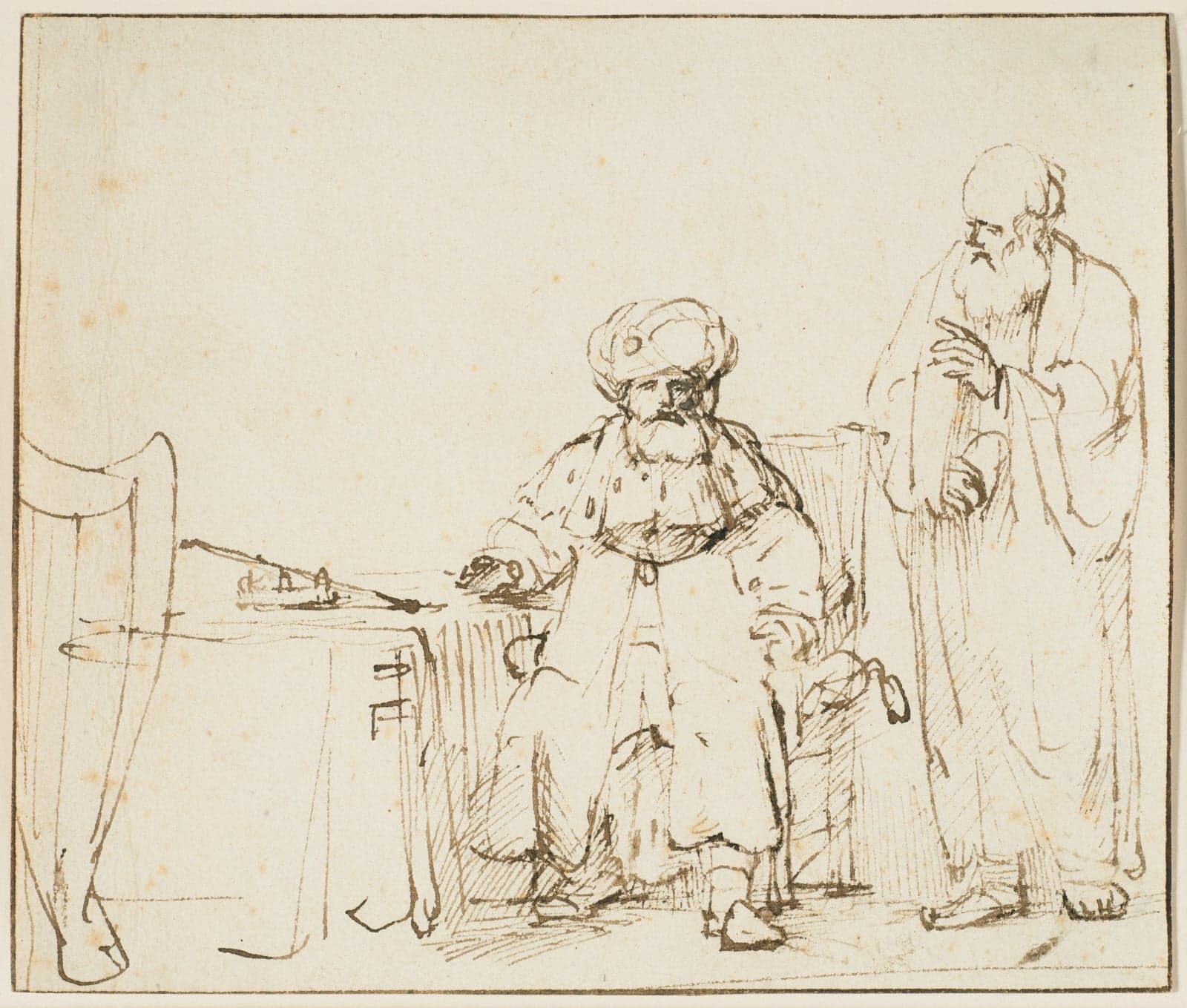
The Berean Standard Bible heads the psalm with its occasion, “When Nathan the prophet came to him after his adultery with Bathsheba.” It is the king's prayer after that visit, which 2 Samuel 12 records.
Seven Movements from Mercy to Zion
Each movement takes two to four verses and is named for what David asks or promises in it.
David asks to be pardoned and washed before he asks for a new heart, and he vows service only after both.
| Movement | Verses | A line of the movement in the Berean text | What David seeks |
|---|---|---|---|
| 1 Mercy | Psalm 51:1 to 2 | Have mercy on me, O God, according to Your loving devotion. | He brings no defence and appeals to who God is. |
| 2 Confession | Psalm 51:3 to 6 | For I know my transgressions, and my sin is always before me. | He hides nothing and accepts the verdict God gives. |
| 3 Washing | Psalm 51:7 to 9 | Hide Your face from my sins and blot out all my iniquities. | He asks to be rid of the stain as well as the guilt. |
| 4 A new heart | Psalm 51:10 to 12 | Restore to me the joy of Your salvation, and sustain me with a willing spirit. | He prays for an inner life made new and held steady. |
| 5 Vows | Psalm 51:13 to 15 | Then I will teach transgressors Your ways, and sinners will return to You. | He promises to turn his own pardon into a lesson for others. |
| 6 The sacrifice | Psalm 51:16 to 17 | For You do not delight in sacrifice, or I would bring it; You take no pleasure in burnt offerings. | He offers his own crushed spirit, the one gift left to him. |
| 7 Zion | Psalm 51:18 to 19 | In Your good pleasure, cause Zion to prosper; build up the walls of Jerusalem. | He turns from himself to pray for the city and its worship. |
Verses 1 to 9, Mercy, Confession and Washing
Paul quoted part of this confession, and the Passover lies behind its prayer for washing.
The first two verses use three Hebrew words for the wrong, pesha for transgressions, avon for iniquity and chattath for sin. They use three verbs for its removal, to blot out, to wash and to cleanse.
Against You, You only, have I sinned and done what is evil in Your sight, so that You may be proved right when You speak and blameless when You judge.The verse is the centre of the confession, where David takes God's side against himself.
Paul asks in Romans 3:3 whether the unbelief of some can “nullify God’s faithfulness,” and in the next verse he answers with the second half of this verse.
Surely I was brought forth in iniquity; I was sinful when my mother conceived me.The verse widens the confession from one act to the nature that produced it.
The Law used hyssop to brush the Passover blood on the doorframes (Exodus 12:22) and to sprinkle the water of cleansing on one made unclean by a death (Numbers 19:18).
Purify me with hyssop, and I will be clean; wash me, and I will be whiter than snow.David asks God Himself to do the cleansing that the priest's hyssop had pictured.
Verse 10, a Heart Created Clean
The prayer for a new heart turns on three Hebrew words and on the memory of Saul.
Bara, to create
55 uses in the canon
The verb bara (H1254) means to create, and it opens the Bible: “In the beginning God created the heavens and the earth,” and David uses it in Psalm 51:10 as a plea.
Tahor, pure
94 uses in the canon
The adjective tahor (H2889) means pure in a physical, ceremonial or moral sense. A psalm says, “The fear of the LORD is pure, enduring forever.” In Psalm 51:10 the Berean text renders it clean.
Ruach nakhon, a firm spirit
217 uses in the canon
Ruach (H7307) is wind and spirit, and nakhon comes from kun (H3559), to stand upright or be established, the word of “My heart is steadfast, O God.”
David had seen the Spirit of the LORD leave a king. Samuel anointed him and “the Spirit of the LORD rushed upon David from that day forward,” while the Spirit of the LORD had departed from Saul (1 Samuel 16:13 to 14).
Cast me not away from Your presence; take not Your Holy Spirit from me.David asks to keep the presence and the Spirit that Saul had lost.
Verses 13 to 19, the Sacrifice God Accepts
After pardon David turns to others, names the one offering he can bring and remembers the city.
David asks God to deliver him from bloodguilt and to open his lips, and he promises praise in return (Psalm 51:14 to 15). John Wesley wrote on Psalm 51:16 in his Explanatory Notes upon the Old Testament (1765) that David’s crimes “were not to be expiated by any sacrifice.”
The sacrifices of God are a broken spirit; a broken and a contrite heart, O God, You will not despise.The verse is the turn of the psalm, where the sacrifice David cannot bring gives way to the one he can.
The last two verses ask God to build up the walls of Jerusalem and look ahead to the day when He will “delight in righteous sacrifices, in whole burnt offerings” (Psalm 51:19).
Teachers on Psalm 51
Four teachers speak to the psalm's confession of sin and to the broken heart it offers.
died 420 · Jerome
Against Jovinianus 2.2
Every person is guilty from birth, as David confessed of himself.
The quotation1 quotation
“But we, according to the epistle of James, ‘all stumble in many things,’ and ‘no one is pure from sin, no not if his life is but a day long.’ For who will boast ‘that he has a clean heart? or who will be sure that he is pure from sin?’ And we are held guilty after the likeness of Adam's transgression. Hence David says, ‘Behold, I was shaped in iniquity, and in sin did my mother conceive me.’ And the blessed Job, ‘Even if I were righteous, my mouth will speak wickedness; even if I were perfect, I will be found guilty. If I wash myself with soap and make my hands ever so clean, yet you will plunge me in the ditch, and even my own clothes will abhor me.’”
Jerome · Against Jovinianus 2.2 · on Psalm 51:5Patristic
died 430 · Augustine of Hippo
Enchiridion 17:65
Repentance is weighed by the depth of sorrow more than by the length of time.
The quotation1 quotation
“Nevertheless, no matter how great our crimes, their forgiveness should never be despaired of in holy Church for those who truly repent, each according to the measure of his sin. And, in the act of repentance, where a crime has been committed of such gravity as also to cut off the sinner from the body of Christ, we should not consider the measure of time as much as the measure of sorrow. For, ‘a contrite and humbled heart God will not despise.’”
Augustine of Hippo · Enchiridion 17:65 · on Psalm 51:17Patristic
1662 to 1714 · Matthew Henry
Commentary on the Whole Bible
Only the breaking of Christ's body atones for sin, and a broken heart is the offering that acknowledges it.
The quotation1 quotation
“The breaking of Christ's body for sin is the only sacrifice of atonement, for no sacrifice but that could take away sin; but the breaking of our hearts for sin is a sacrifice of acknowledgment, a sacrifice of God, for to him it is offered up; he requires it, he prepares it (he provides this lamb for a burnt-offering), and he will accept of it.”
Matthew Henry · Commentary on the Whole Bible · on Psalm 51:17Puritan
1834 to 1892 · Charles Spurgeon
The Treasury of David, Vol. 2
Sin is first an offence against God, and every wrong to a neighbour adds to its weight.
The quotation1 quotation
“Against thee, thee only have I sinned. The virus of sin lies in its opposition to God: the psalmist's sense of sin towards others rather tended to increase the force of this feeling of sin against God. All his wrong doing centred, culminated, and came to a climax, at the foot of the divine throne. To injure our fellow men is sin, mainly because in so doing we violate the law of God.”
Charles Spurgeon · The Treasury of David, Vol. 2 · on Psalm 51:4
Matthew Henry, Charles Spurgeon
The Psalm's First Plea in the Mouth of a Tax Collector
The plea that opens the psalm comes back in a parable Jesus told in Luke 18.
David came to God with no offering that could cover his sin, only his confession and his need, and he asked to be made new. A tax collector in the temple came the same way, with empty hands and a cry for mercy (Luke 18:13). Any sinner may come back to God by that road, pleading nothing but His mercy.
Sources
Scripture is the Berean Standard Bible.
- The Holy Bible, Berean Standard Bible, Psalm 51 with its heading.
- STEP Bible, Translators Brief lexicon of Extended Strongs for Hebrew (Tyndale House, Cambridge), CC BY 4.0.
- Possidius, Life of Saint Augustine, chapter 31, translated by Herbert T. Weiskotten (Princeton, 1919)
- Charles Spurgeon, The Treasury of David, volume 2 (1870), on Psalm 51:4.
- Jerome, Against Jovinianus, book 2, section 2.
- Augustine of Hippo, Enchiridion, chapter 65.
- Matthew Henry, Commentary on the Whole Bible (1710), on Psalm 51:17.
- John Wesley, Explanatory Notes upon the Old Testament (1765), on Psalm 51:16.
Keep Studying
Studies7
In this value5
People and groups11
Doctrines1