
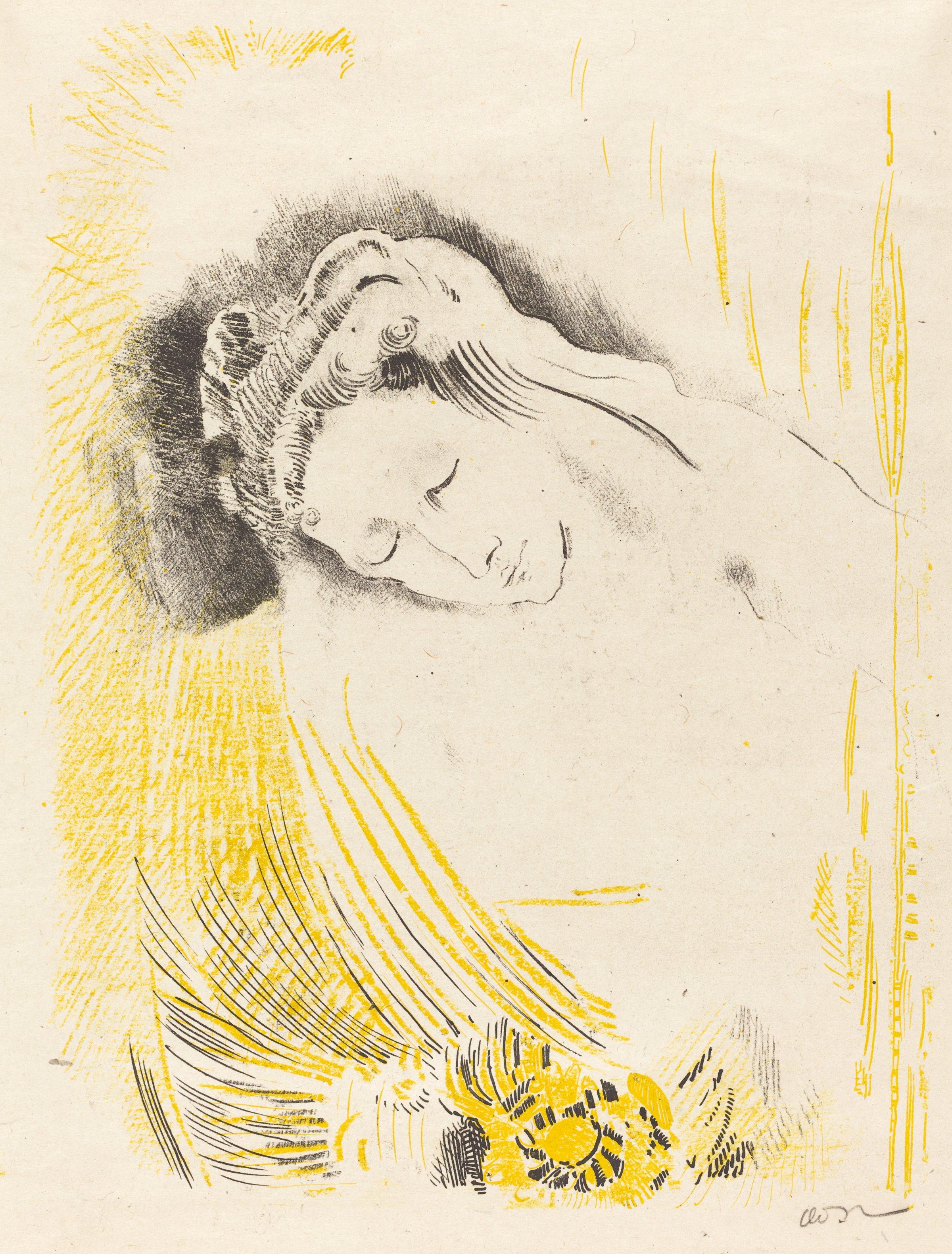
Odilon Redon, La Sulamite, 1897. CC0.
Song of Solomon 6:13 · Person · Featured Study
The Shulammite
The Shulammite is the woman of the Song of Solomon, called by that name in a single verse.
Readers have heard three different origins in her title.
Come back, come back, O Shulammite! Come back, come back, that we may gaze upon you. Why do you look at the Shulammite, as on the dance of Mahanaim?
Come back, come back, O Shulammite! Come back, come back, that we may gaze upon you. Why do you look at the Shulammite, as on the dance of Mahanaim?
- The name means
- She of Shulem, by Delitzsch's reading; the peaceful one, by Strong's dictionary
- Family
- mother: not named (Song of Solomon 3:4); brothers: her mother's sons (Song of Solomon 1:6)
- Places
- Shunem, by the Septuagint's reading, the vineyards, Jerusalem
- First named
- Song of Solomon 6:13 “Come back, come back, O Shulammite! Come back,…”
- Last named
- Song of Solomon 6:13 “Come back, come back, O Shulammite! Come back,…”
Summary
Song of Solomon 6:13 calls the woman of the Song the Shulammite. The Hebrew sets the name with the article, and readers have taken it as a woman of Shunem, as Solomon's name worn by his bride, and as Israel called back to God. The Song itself tells of her brothers, her mother and her vineyards.
- The Hebrew Bible numbers the verse Song of Solomon 7:1.
- The Septuagint renders the name as a woman from Shunem.
- Abishag of 1 Kings 1:3 bore the title the Shunammite.
Where the Name Stands
The daughters of Jerusalem call her by the title, and she answers with it.
Commentators on the verse take her as the bride who speaks through the Song. Albert Barnes calls her the bride in his note on it, and Franz Delitzsch calls her Shulamith again where the bride speaks at Song of Solomon 8:6. The title is the only name the Song gives her.
Her Part in the Song
Eight scenes of the Song give her words or her acts.
She moves from her brothers' vineyards to her beloved's side, loses him and finds him, and answers her brothers that she is a wall.
- Song of Solomon 1:5 to 6She tells the daughters of Jerusalem she is dark from the sun and kept her brothers' vineyardsSong of Solomon 1:5
- Song of Solomon 2:8 to 13She hears her beloved call her to come away, for the winter is pastSong of Solomon 2:8
- Song of Solomon 3:1 to 4She seeks him through the city at night and brings him to her mother's houseSong of Solomon 3:1
- Song of Solomon 4:8 to 5:1Her beloved calls her my bride and a garden locked upSong of Solomon 4:8
- Song of Solomon 5:2 to 8She opens to him and finds him gone, and the watchmen beat herSong of Solomon 5:2
- The daughters of Jerusalem call her back as the ShulammiteSong of Solomon 6:13
- She comes up from the wilderness leaning on her belovedSong of Solomon 8:5
- Song of Solomon 8:8 to 10Her brothers speak of a little sister, and she answers that she is a wallSong of Solomon 8:8
Each scene stands with the verse that opens it, in the Song's order.
She comes up from the wilderness leaning on her beloved, Song of Solomon 8:8 to 10
A Title of Descent
Delitzsch reads the article before the name as the mark of a title.
Delitzsch notes that the Hebrew sets the article before the name, and a pure proper name takes no article. The name is therefore a name of descent, the form Hebrew gives a person of a place or a people. The Cambridge Bible for Schools and Colleges reads it the same way, as the maiden of Shulam.
Strong's Hebrew dictionary glosses the name as peaceful, an epithet of Solomon's queen, and notes that it always carries the article.
Her Family
The Song names her mother, her mother's sons and a little sister by their ties to her.
Her mother bore her and her brothers, and her beloved stands beside her.
| Person | Generation | Tie to the Shulammite |
|---|---|---|
| Her mother | 1 | Bore her; her beloved calls her the favorite of her mother |
| Her mother's sons | 2 | Her brothers, who set her to keep the vineyards |
| The Shulammite | 2 | The woman of the Song |
| The little sister | 2 | The sister her brothers speak of before she is spoken for |
| Her beloved | The king of the Song, whom she calls my beloved |
Her Places
The Song sets her in the vineyards, in Jerusalem and in the wilderness, and her name points to Shunem.
Her name points north to Shunem, and the Song carries her south to Jerusalem.
| Place | What the Song or its readers say |
|---|---|
| Shunem, in Issachar | Eusebius knew a village named Sulem five miles south of Mount Tabor |
| The vineyards | Her brothers set her to keep them |
| Jerusalem | Its daughters stare at her and call her back |
| Mahanaim | The Song sets her beside the dance of Mahanaim, the name Jacob gave the camp of God |
| The wilderness | She comes up from it leaning on her beloved |
Abishag the Shunammite
Delitzsch sets two women of Shunem beside the Shulammite.
The beautiful girl brought to David1 Kings 1:3 to 4; 1 Kings 2:17 to 22
Then they searched throughout Israel for a beautiful girl, and they found Abishag the Shunammite and brought her to the king.It gives the same title to a woman of David's last days.
Delitzsch and the Pulpit Commentary both name Abishag beside the Shulammite, a woman of the same district. After David's death Adonijah asked for Abishag as his wife through Bathsheba, and Solomon answered that she might as well ask the kingdom for him (1 Kings 2:22).
Elisha's hostess2 Kings 4:8 to 12
Delitzsch also names the woman of Shunem who fed Elisha, whom the prophet called the Shunammite woman (2 Kings 4:12). Delitzsch reads the three as women of one town.
Dark, Yet Lovely
Her first words about herself answer the stares of the city women.
I am dark, yet lovely, O daughters of Jerusalem, like the tents of Kedar, like the curtains of Solomon.It is her first word about herself in the Song.
Do not stare because I am dark, for the sun has gazed upon me. My mother’s sons were angry with me; they made me a keeper of the vineyards, but my own vineyard I have neglected.It answers the stares with the cause of her darkness.
Voices on the Shulammite
A bishop of the fourth century and a commentator of the eighteenth wrote on her name.
Ambrose of Milan (died 397)
CONSOLATION ON THE DEATH OF EMPEROR VALENTINIAN 65
Ambrose turned the call of the verse into words to the soul of the emperor Valentinian, whose death he mourned.
“Turn to us, O peaceful soul, that you may show your glory to your sisters and that they may begin to console themselves with the security of your repose and happiness. Turn to us once only, that we may see you, and turn again and hasten with all speed to that great Jerusalem, the city of the saints.”
on Song of Solomon 6:13Patristic
Whose Name Does She Bear?
Readers give three sources for the name, and each has its holders and its objection.
A woman of ShunemFranz Delitzsch; Albert Barnes; the Pulpit Commentary; the Cambridge Bible
Delitzsch reads the name as she of Shulem, the village of Shunem in the tribe of Issachar. Barnes and the Pulpit Commentary take Shulem and Shunem as one place, and the Cambridge Bible holds that the courtiers named her after the village where they found her.
The objection: Spurgeon holds that the Hebrew word is a feminine of Solomon, and that the English rendering misses the meaning.
Solomon's name worn by his brideAdam Clarke; John Gill; Jamieson, Fausset and Brown; Charles Spurgeon
Clarke reads the name as a feminine formed from Solomon's own. Gill holds that a wife commonly bore her husband's name, and reads the bride as the church called by the name of Christ, the true Solomon. Jamieson, Fausset and Brown read the name as the bride of the Prince of Peace, a daughter of peace. Spurgeon preached that the bride bears the King's name, and that as He is the Prince of Peace she is the Daughter of Peace.
The objection: Delitzsch takes the likeness to Solomon's name as the poet's play on a place name.
Israel called back to GodThe Aramaic Targum to the Song of Songs
The Targum is the old Aramaic paraphrase read in the synagogue. Where the Hebrew calls, O Shulammite, the Targum has the LORD call, O assembly of Israel, to return to Him, to Jerusalem and to the house where the law is taught.
Against it, Delitzsch answers that the form of the name stands opposed to the allegorical readings.
A Wall, and One Who Brings Peace
After her brothers speak of a little sister, the woman of the Song speaks of herself.
I am a wall, and my breasts are like towers. So I have become in his eyes like one who brings peace.She gives her last words about herself in the Song.
Sources
Scripture is the Berean Standard Bible.
- The Hebrew text of Song of Songs 7:1, Miqra according to the Masorah (CC-BY-SA)
- Keil and Delitzsch, Biblical Commentary on the Old Testament; Albert Barnes, Notes; Matthew Poole, Annotations; John Gill, Exposition; Jamieson, Fausset and Brown, Commentary (1871); the Cambridge Bible for Schools and Colleges; the Pulpit Commentary, each on Song of Solomon 6:13.
- Strong's Hebrew lexicon, h7759.
- Adam Clarke, Commentary on the Bible, on Song of Solomon 6:13.
- The Aramaic Targum to the Song of Songs, 7:1, with the English of Jay Treat (CC-BY-NC-SA)
- Ambrose of Milan, Consolation on the Death of Emperor Valentinian 65; Matthew Henry, Commentary on the Whole Bible (1710), on Song of Solomon 6:13.
- Charles Spurgeon, The Metropolitan Tabernacle Pulpit, sermon 1794, Return, Return, O Shulamite.
Keep Studying
Read it4
People and groups5
Go further8