
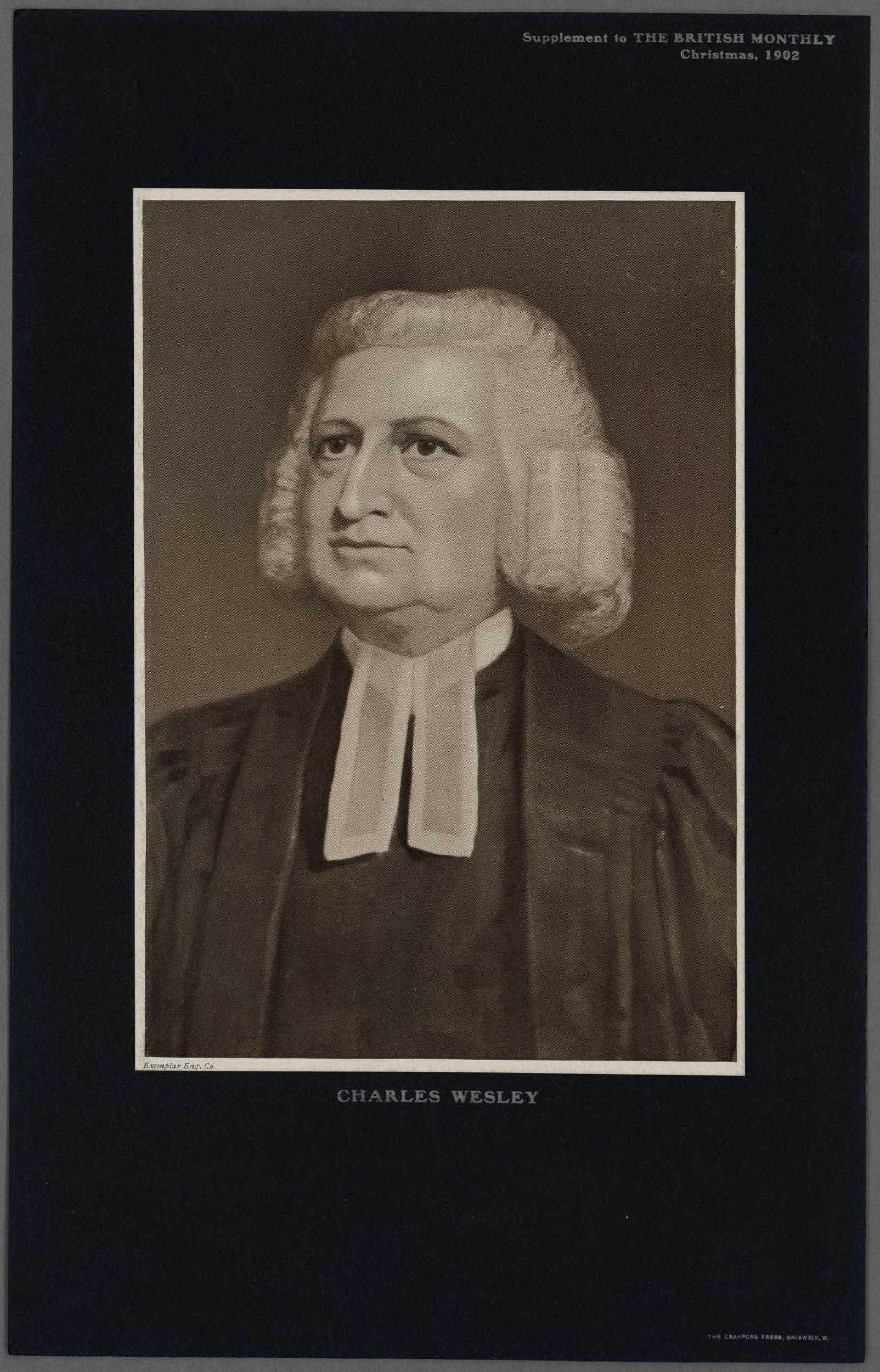
Anonymous, Charles Wesley, 1902. Public domain.
Epworth, Oxford, Georgia and London, to 1788 · Person · Featured Study
Charles Wesley
He found assurance in a London sickroom and wrote the hymns the Methodists sang for the rest of the century.
A sick man in a London workman's house found peace on Whitsunday, and two days later he began a hymn about it.
He put a new song in my mouth, a hymn of praise to our God. Many will see and fear and put their trust in the LORD.
He put a new song in my mouth, a hymn of praise to our God. Many will see and fear and put their trust in the LORD.
- Born
- 18 December 1708, by Jackson's Life (probable)
- Died
- 29 March 1788 in London
- Family
- brother: John Wesley; wife: Sarah Gwynne
- Places
- Epworth, Westminster, Oxford, Frederica, London, Bristol
Summary
Charles Wesley was the youngest son of the rector of Epworth. At Oxford he was among the first of the Holy Club. He sailed to Georgia in 1735 and came home the next year. Back in London he found the peace he had sought, three days before his brother John. He then wrote hymns, preached in the fields and in Newgate, and stayed a priest of the Church of England until his death.
- His own journal tells the week of his conversion day by day.
- His hymns appeared in the books he and John printed.
- He fought his brother's ordinations of 1784 and 1785, which he feared would part the Methodists from the Church.
The Verse He Opened
On Whitsunday he looked into the Scripture and met Psalm 40:3, then Isaiah 40:1.
On Whitsunday, 21 May 1738, Charles was still sick in London. Later that day he rose and looked into the Scripture. He wrote that his eye fell on the words of a new song put in the mouth, and afterward he opened on the comfort of Isaiah 40.
The question of this life is how a discouraged clergyman came home from Georgia and became the poet of the revival. Most of what is known of that turn comes from his own journal.
“Comfort, comfort My people,” says your God.He opened on this verse the same day, after the psalm.
The Life in Order
His journal gives the early years, and his daughter's letter gives the last days.
The turn of his life came in one week of May.
- 1716Sent to school in London at about eightJackson, page 9
- 1726Elected to Christ Church, OxfordJackson, page 13
- May 1729Weekly communion begun with one friendCharles to John, 1729
- 9 March 1736Landed in the colony in Oglethorpe's partyJournal, 1736
- 25 July 1736Gave up his post in GeorgiaJackson, page 71
- 21 May 1738Peace on WhitsundayEarly Journal, page 147
- 12 July 1738First sermon to prisoners awaiting executionJackson, page 162
- 1739Verses of his new faith reach printHymns and Sacred Poems, 1739
- 8 April 1749His wedding day, a Saturday, his brother officiatingJackson, page 525
- About 1756Long journeys ceasedJackson, volume 2, page 135
- 1771Settled in London for goodJackson, volume 2, page 297
- 29 March 1788Death in London; burial at Marylebone on 5 AprilSarah Wesley's letter
Each step of the life stands with its witness.
12 July 1738, 1739, 8 April 1749, About 1756, 1771, 29 March 1788
From Epworth to Marylebone
He tells the turn himself, and his letters and his daughter tell the rest.
Charles was the youngest son of Samuel Wesley, rector of Epworth in Lincolnshire, and his wife Susanna. He went to Westminster School in 1716 under the care of his brother Samuel, and to Christ Church, Oxford, in 1726.
At Oxford in May 1729 he wrote to John that he and a friend had begun to take the sacrament every week. Jackson says the name Methodist was first given about then, while John was away.
Charles Wesley sailed to Georgia with his brother John, and Jackson judged his mission there, like John's, in the main a failure. He resigned as the governor's secretary in July 1736 and came home discouraged.
Back in London he lay ill in the house of John Bray, whom he called a poor ignorant mechanic who knew nothing but Christ. Three days before John's heart was strangely warmed, Charles found the same assurance in a sickroom in London, and reached for a pen.
On 23 May he began a hymn on his conversion and broke off for fear of pride. Bray urged him on, and he finished it. On the night of 24 May his brother was brought in triumph by a troop of their friends, saying "I believe," and they sang the hymn together.
He wrote hymns for the rest of his life. Where John organized the revival, Charles taught it what to sing. He rode the preaching circuits too, standing in fields and sitting with condemned men in Newgate prison, until about 1756.
John married him to Sarah Gwynne of Garth in April 1749. They lived at Bristol and moved to Chesterfield Street in Marylebone in 1771.
Unlike John, he never wanted Methodism to leave the Church of England, and the break between the brothers over it was real. He died an Anglican priest in 1788, dictating one last verse to his wife from his bed.
The Letter of 1785
The younger brother saw a separation coming and asked that it wait until he was dead.
On 1 September 1784 John set apart Thomas Coke and ordained two preachers for America. Charles wrote to him from Bristol on 14 August 1785 and begged him to read again his own Reasons against a Separation of 1758.
He wrote that once John began ordaining in America, his preachers in England would never rest until he ordained them too. He called himself John's natural ally and faithful friend, and asked him to stop before he had quite broken down the bridge.
He also asked John to let him go to his grave first. He wrote, "I am on the brink of the grave. Do not push me in, or embitter my last moments." Jackson prints the letter whole.
In Their Own Words
Five sayings from his journal and his verse, from his conversion to his last illness.
Charles Wesley (1707 to 1788)
The Journal of the Rev. Charles Wesley, M.A., volume I, Wednesday 17 May 1738
A week before his peace
“Who would believe our Church had been founded on this important article of justification by faith alone?”
Methodist
About this saying1 paragraph
He wrote this on 17 May 1738, the day he first read Luther on Galatians.
Charles Wesley
Journal, Sunday 21 May 1738, page 147
Whitsunday
“Still I felt a violent opposition and reluctance to believe; yet still the Spirit of God strove with my own and the evil spirit, till by degrees He chased away the darkness of my unbelief. I found myself convinced, I knew not how nor when; and immediately fell to intercession.”
Methodist
About this saying1 paragraph
He wrote this on 21 May 1738, after Bray read him a psalm in his sickroom.
Charles Wesley
Journal, 24 May 1738, volume I
His brother's night
“Towards ten, my brother was brought in triumph by a troop of our friends, and declared, 'I believe.' We sang the hymn with great joy, and parted with prayer.”
Methodist
About this saying1 paragraph
He wrote this on 24 May 1738, the night John came to him from Aldersgate Street.
Charles Wesley
Hymns and Sacred Poems (1740), In Temptation, page 67
Jesu, Lover of my Soul
“Jesu, Lover of my Soul, Let me to Thy Bosom fly, While the nearer Waters roll, While the Tempest still is high: Hide me, O my Saviour, hide, Till the Storm of Life is past: Safe into the Haven guide; O receive my Soul at last.”
Methodist
About this saying1 paragraph
This hymn stands in Hymns and Sacred Poems of 1740 under the title In Temptation.
Charles Wesley
the lines dictated to his wife, volume 2, page 441
His last verse
“In age and feebleness extreme, Who shall a sinful worm redeem? Jesus, my only hope thou art, Strength of my failing flesh and heart; O could I catch a smile from thee, And drop into eternity!”
Methodist
About this saying1 paragraph
In March 1788 he called his wife to him and asked her to write these lines at his dictation.
The People Around Him
The witnesses name his family, the friends of his turning and the men he argued with.
A workman and a brother stand at the turn of his life.
| Person | Tie to Charles | The witness |
|---|---|---|
| Samuel Wesley the younger | His eldest brother, an usher at Westminster, paid for his schooling. | Jackson, volume 1 |
| John Wesley | The brother he followed to Georgia and argued with over ordination. | The letter of 1785 |
| James Oglethorpe | The governor of Georgia, whose secretary he was. | Journal, July 1736 |
| Peter Böhler | Charles confessed his unbelief to him before Böhler left London. | Journal, 11 May 1738 |
| John Bray | He nursed Charles in his house and read him the psalm on Whitsunday. | Journal, Whitsunday |
| George Whitefield | Charles invited the young servitor to breakfast at Oxford. | Whitefield's Short Account |
| Sarah Gwynne | His wife from 1749 wrote down his last verse. | Jackson, volume 2, page 441 |
| John Berridge | The eccentric vicar of Everton, who lived in his time. | Jackson on the year 1757 |
Sarah Gwynne, John Berridge
The Places of His Life
His life runs from a Lincolnshire rectory to a London churchyard.
After Georgia he lived between Bristol and London.
| Place | What the witnesses say | The witness |
|---|---|---|
| Epworth | His father was rector of this Lincolnshire parish. | Jackson, page 1 |
| Westminster | The school took him at eight. | Jackson on 1716 |
| Oxford | He was a student and tutor of Christ Church for six years and more. | Tyerman, in the moravian-2 brief |
| Frederica | The governor kept his residence on St. Simons Island, where Charles served. | Jackson, page 51 |
| London | The city of his conversion, his first field sermons and his last years. | Journal; Jackson |
| Newgate | He went often to the city prison from July 1738. | Jackson, page 162 |
| Bristol | He kept his household there until 1771. | Jackson on 1771 |
| Marylebone | He lived in Chesterfield Street and lies in the parish churchyard. | Jackson, volume 2, page 445 |
Bristol, Marylebone
The Hymns
His hymns set the doctrine of the revival in verse that a congregation could sing.
The brothers printed Hymns and Sacred Poems in 1739 and again in 1740. The first book carries the hymn that begins "And can it be, that I should gain an interest in the Saviour's blood!" under the heading Free Grace. In the 1739 hymn book its fourth stanza says, "My chains fell off, my heart was free, I rose, went forth, and followed Thee."
The 1740 book carries a hymn for the anniversary of one's conversion that begins "Glory to God, and praise, and love" in its first line. The familiar "great Redeemer's" is a later reading of its seventh stanza, which opens "O for a thousand tongues to sing my dear Redeemer's praise."
The hymns tell, in the first person, how a sinner is set free.
How the Key Verse Was Taught
Theodoret, Jonathan Edwards and Charles Spurgeon read the new song.
Jonathan Edwards (1703 to 1758)
A Faithful Narrative of the Surprising Work of God, page 9
Jonathan Edwards saw a town changed by a work of God.
“This Work of God, as it was carried on, and the Number of true Saints multiplied, soon made a glorious Alteration in the Town; so that in the Spring and Summer following, Anno 1735, the Town seemed to be full of the Presence of God: It never was so full of Love, nor so full of Joy; and yet so full of Distress, as it was then.”
Congregationalist
Charles Spurgeon (1834 to 1892)
The Treasury of David, Vol. 2
Charles Spurgeon heard in the verse the song of the Lord at the Passover.
“And he hath put a new song in my mouth, even praise unto our God. At the passover, before his passion, our Lord sang one of the grand old Psalms of praise; but what is the music of his heart now, in the midst of his redeemed! What a song is that in which his glad heart for ever leads the chorus of the elect! Not Miriam's tabor nor Moses' triumphant hymn over Miriam's chivalry can for a moment rival that ever new and exulting song.”
on Psalm 40:3Particular Baptist
What the Witnesses Leave Open
Readers differ on his birth, the first Methodists, his travels and the hymns.
The year of his birthThomas Jackson; Charles Wesley
Jackson gives 18 December 1708. On 18 December 1736 Charles wrote that he began his twenty-seventh year, and by his own count he was born later than that.
Who began the Holy ClubThomas Jackson; Nehemiah Curnock; John Wesley
Jackson and Curnock begin the club with Charles in 1729, before John came back to Oxford. John Wesley's own accounts begin with his return in November 1729 and name himself first.
Why his travels endedJohn Berridge; Thomas Jackson
Berridge of Everton blamed his marriage. Jackson answers that he had been married seven years by then and still travelled. Jackson thinks the chief reason was the quarrel over the Church of England in the societies, and says no paper of 1757 survives to settle it.
Which hymns are histhe title pages of 1739 and 1740; John Julian
The title pages of those books carry John's name and Charles's together. The giving of these hymns to Charles rests on Julian's Dictionary of Hymnology and on the tradition.
Books to Read Next
The Life of the Rev. Charles Wesley, M.A.
Thomas Jackson · 1841
Jackson's two volumes give his correspondence and the account his daughter wrote of his death.
Read Jackson's first volume free at the Internet ArchiveThe Early Journal of Charles Wesley
Charles Wesley · 1909
This is his own journal of Georgia and of the weeks of his conversion.
Read the Early Journal free at the Internet ArchiveWhat Charles Left
He left a journal of the week the revival began and the hymns the Methodists still sing.
Sources
Scripture is the Berean Standard Bible.
- The Holy Bible, Berean Standard Bible (read 2026)
- Charles Wesley, The Early Journal of Charles Wesley (London: Charles H. Kelly, 1909), and The Journal of the Rev. Charles Wesley, ed. Thomas Jackson, volume 1 (London: John Mason, 1849)
- Thomas Jackson, The Life of the Rev. Charles Wesley, M.A., 2 volumes (London: John Mason, 1841)
- John and Charles Wesley, Hymns and Sacred Poems (London, 1739 and 1740)
- Theodoret of Cyrus, Commentary on the Psalms, on Psalm 40:3.
- Jonathan Edwards, A Faithful Narrative of the Surprising Work of God, page 9.
- Charles Spurgeon, The Treasury of David, volume 2, on Psalm 40:3.
Keep Studying
People and groups7
Doctrines1