
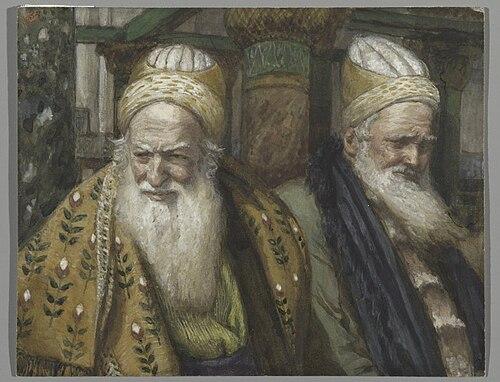
James Tissot, Annas and Caiaphas, 1886 to 1894. Public domain.
John 18:12 to 24 · Person · Featured Study
Annas and Caiaphas
Annas and his son-in-law Caiaphas held the high priesthood between them in the year Jesus was arrested.
They brought Him first to Annas, who was the father-in-law of Caiaphas, the high priest that year.
- Family
- Annas, father-in-law of Caiaphas, in John 18:13: Annas; Caiaphas, son-in-law of Annas, in John 18:13: Caiaphas; kin named with them among the high priest's family, in Acts 4:6: John and Alexander
- Places
- Jerusalem
- First named
- Luke 3:2 “during the high priesthood of Annas and Caiaphas,…”
- Last named
- Acts 4:6 “along with Annas the high…”
Charles Spurgeon judged Annas in some respects more guilty than Pilate.
Summary
On the night of His arrest Jesus was passed from the house of one to the house of the other. By morning He stood at the governor's court.
- Caiaphas gave the council the counsel that John calls a prophecy.
- Readers explain the double title of Luke 3:2 in three ways.
- Readers differ on whether Annas or Caiaphas questioned Jesus in John 18:19 to 23.
Where Annas and Caiaphas Stand
Luke and Acts name the two men together.
during the high priesthood of Annas and Caiaphas, the word of God came to John son of Zechariah in the wilderness.Luke names two men for an office the Law gave to one.
along with Annas the high priest, Caiaphas, John, Alexander, and many others from the high priest’s family.Luke uses the title for Annas again in Acts, which bears on how readers explain Luke 3:2.
Their Turns in the Gospels and Acts
The turns run in the order of the story.
Annas and Caiaphas act against Jesus from the council after Lazarus to the night of His trial.
- The council called after LazarusJohn 11:47 to 48
- The plot in the courtyard of CaiaphasMatthew 26:3 to 4
- The hearing on the night of the arrestJohn 18:13 to 24
- The council at the house of CaiaphasMatthew 26:57 to 64
Each turn with the passage that tells it.
The Hearing in John 18
The high priest questioned Jesus about His disciples and His teaching.
Jesus answered that He had always taught openly in the synagogues and at the temple (John 18:20).
When Jesus had said this, one of the officers standing nearby slapped Him in the face and said, “Is this how You answer the high priest?” Jesus replied, “If I said something wrong, testify as to what was wrong. But if I spoke correctly, why did you strike Me?”John Chrysostom set the plain answer of Jesus against the high priest's deceitful question.
Two High Priests at Once
Wesley, Augustine and Barnes each explain Luke's double name differently.
John Wesley held that Annas was the high priest and Caiaphas his deputy, called the sagan. Augustine taught that the two men took the office year by year in turn, and that the year of the cross fell to Caiaphas.
Albert Barnes held that Caiaphas was the high priest and that Annas kept the title after he was dismissed from the office. Barnes judged that Annas may have led the Sanhedrin.
The House of Annas
The record names four parts of one priestly house.
Annas heads the tree, with his son-in-law, his sons and his kin below him.
Head of the house
- AnnasHigh priest before Caiaphas
Son-in-law to Kin
- CaiaphasSon-in-law, High priest in the year of the cross
- Five sons of AnnasSons, High priests after their father
- John and AlexanderKin, Of the high priest's family
Each member with the generation and the tie the record gives.
Adam Clarke wrote that no other man since Moses had seen five of his sons fill the high priest's office after him. Josephus called Annas a most fortunate man for that reason.
The Places of the Night
Jesus was taken through three places between His arrest in the garden and the morning.
Jesus went from the garden to the high priest's court and on to the Roman governor.
| Place | What happens there | Who stands there |
|---|---|---|
| The garden across the Kidron | The band of soldiers and the officers arrest Jesus and bind Him. | Judas, the soldiers, the officers of the Jews |
| The courtyard of the high priest | Peter warms himself at a charcoal fire and denies Jesus. | Peter, another disciple, the servants and officers |
| The Praetorium | The Jews stay outside so they can eat the Passover. | Pilate, Jesus, the leaders at the door |
The Counsel of Caiaphas
On the night of the arrest John reminds the reader who Caiaphas was.
But one of them, named Caiaphas, who was high priest that year, said to them, “You know nothing at all! You do not realize that it is better for you that one man die for the people than that the whole nation perish.”Caiaphas spoke these words at the council that met after Lazarus was raised.
Caiaphas was the one who had advised the Jews that it would be better if one man died for the people.John ties the night of the arrest back to the council of John 11, so the reader sees the plan being carried out.
Who Questioned Jesus in John 18?
John 18:24 comes after the hearing it seems to explain, and readers order the night two ways.
Annas questioned Jesus, then sent Him to CaiaphasJamieson, Fausset and Brown (1871); Augustine of Hippo, The Harmony of the Gospels 3
Jamieson, Fausset and Brown read the verb of John 18:24 as Annas sent Him, and judged that it places the sending after the hearing. In his Harmony of the Gospels Augustine placed the hearing before the sending, and took it to show that Annas was also high priest.
The objection: Adam Clarke read the sending as already done before the hearing, which puts the questions in the house of Caiaphas.
Caiaphas questioned Jesus, and John 18:24 looks backAdam Clarke, Commentary on the Bible (1832), on John 18:24
Clarke held that John 18:24 belongs straight after John 18:13. If it stands where it is, he wrote, it should be read in brackets as a summary of what was already done, in the sense that Annas had sent Him.
The objection: John gives the sending after the hearing, and Augustine reads the verse in that order.
The Greater Sin
Before Pilate, Jesus spoke of the one who had handed Him over.
Jesus answered, “You would have no authority over Me if it were not given to you from above. Therefore the one who handed Me over to you is guilty of greater sin.”Jesus spoke this to Pilate, and the men who delivered Him to Pilate were the high priests and their council.
At this, the high priest tore his clothes and declared, “He has blasphemed! Why do we need any more witnesses? Look, now you have heard the blasphemy. What do you think?” “He deserves to die,” they answered.The verdict given at the house of Caiaphas is the one the council carried to Pilate.
Sources
Scripture is the Berean Standard Bible.
- Josephus, Antiquities of the Jews 20.9.1 (about AD 94)
- Adam Clarke, Commentary on the Bible (1832), on Acts 4:6 and John 18:24.
- John Wesley, Explanatory Notes upon the New Testament (1755), on John 18:13 and Luke 3:2.
- Charles Spurgeon, Christ Before Annas, Metropolitan Tabernacle Pulpit, Sermon No. 2820 (published 1903)
- Augustine of Hippo, Tractates on John 113, and The Harmony of the Gospels 3, in Thomas Aquinas, Catena Aurea.
- Albert Barnes, Notes on the New Testament (1832 to 1869), on Luke 3:2.
- John Chrysostom, Homilies on the Gospel of John, Homily 83 (fourth century), on John 18:23 to 24.
- Jamieson, Fausset and Brown, Commentary Critical and Explanatory on the Whole Bible (1871), on John 18:24 to 27.
Keep Studying
Studies8
People and groups6
Places1
Symbols1