
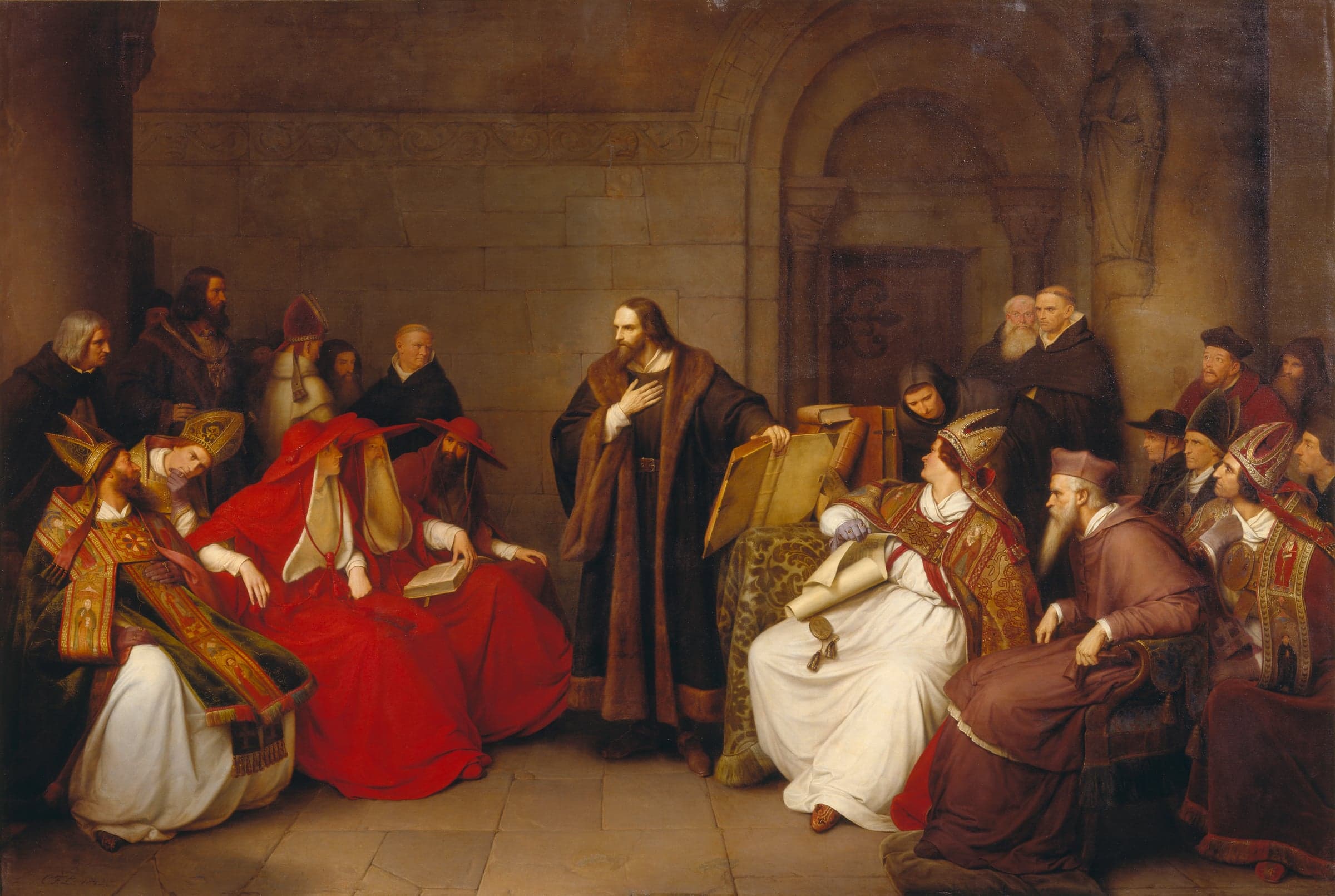
Carl Friedrich Lessing, Jan Hus at Constance, 1842. Public domain.
Prague and Constance, to 1415 · Person · Featured Study
Jan Hus
He was a Czech master of Prague whom the Council of Constance condemned to the fire.
- The name means
- His name means goose.
- Born
- between 1369 and 1375 at Husinec; the authorities differ (proposed)
- Died
- 6 July 1415 at Constance
- Places
- Husinec, Prague, Constance, Gottlieben
The Prague preacher burned at the stake under a promise of safe conduct, singing as the fire was lit.
And God put everything under His feet and made Him head over everything for the church,
Summary
Jan Hus took up the teaching of John Wycliffe and held that Christ alone is the head of the church. He preached it from 1402 at the Bethlehem Chapel. Sigismund promised him safe conduct to the Council of Constance.
- His letters from prison survive, because Peter of Mladenovic kept them and edited them.
- D. S. Schaff calls him in a real sense the precursor of the Reformation.
- The authorities differ by as much as six years on his birth, and the council's own right to break the safe conduct is disputed.
The Head of the Church
He read Ephesians 1 as naming Christ alone the head of the church, and that reading was the charge against him.
The question of this life is why a council that had just deposed a pope burned a preacher for saying the pope was not the church's head. His letters let the reader hear him through the last months.
And He is the head of the body, the church; He is the beginning and firstborn from among the dead, so that in all things He may have preeminence.Hus quotes this verse in The Church to show that Christ is the head of the body.
But Peter and the other apostles replied, “We must obey God rather than men.Hus wrote that to cease preaching at a pope's command would be to disobey God.
The Life in Order
The last nine months can be told almost week by week, from his letters and Mladenovic's account.
From the journey to the fire the life runs nine months.
- 1369 to 1375His birthSchaff (1910), note 649; Schaff (1915); Lutzow (1909)
- 1402He became rector of the university and preacher at BethlehemSchaff, section 44
- 1410The archbishop moved against himSchaff, section 44
- 1412He denounced the indulgences and left the city at the king's askingSchaff, section 44
- 1413His chief book appearedSchaff, section 44
- October 1414He set out for ConstanceSchaff, section 45
- 3 November 1414He reached ConstanceSchaff, section 45
- 28 November 1414He was taken into custodySchaff, section 45
- 24 March to 5 June 1415He lay in chains at GottliebenSchaff, section 45
- 5 to 8 June 1415The council heard him in the Franciscan friarySchaff, section 45
- 6 July 1415The council condemned him, and he was burnedSchaff, section 45; Mladenovic in Lutzow
Each step of the life stands with its witness.
3 November 1414, 28 November 1414, 24 March to 5 June 1415, 5 to 8 June 1415, 6 July 1415
From Bethlehem Chapel to the Devil's Place
He rose through the university and the pulpit of Prague, and he ended before the council.
He was born of poor Czech parents at Husinec in southern Bohemia, and he supported himself at the University of Prague by singing and manual work. In 1402 he was chosen rector of the university, and in the same year he took the Bethlehem Chapel, whose founders required sermons in Czech.
He preached to throngs there, and he preached Wycliffe's conviction that Christ alone is head of the church and that Scripture judges councils.
Archbishop Sbinko first trusted him and then turned. In 1410 he had some 200 manuscript copies of Wycliffe's writings burned in his palace courtyard, and two days later he excommunicated Hus. Hus kept preaching. In 1412 he attacked John XXIII's sale of indulgences for a crusade, and his old friends Stanislaus of Znaim and Stephen Paletz left him. The curia placed the city under interdict, and at the king's asking he left Prague.
In exile he preached in marketplaces and fields under the protection of lords, and he wrote The Church. Sigismund then summoned him to the council. He set out on 11 October 1414 and reached Constance on 3 November.
At Constance he was arrested within the month, kept in chains, and asked only to recant. He lay in a Dominican cell beside the latrines, then in irons at the bishop's castle of Gottlieben. He begged for a public hearing, and in June he got three days of it in the Franciscan friary.
He answered that he could not recant what he had never taught, nor deny what Scripture taught. When Sigismund sent nobles and bishops to him a last time, John of Chlum told him that, if he felt sure of his cause, he should stand fast even to death. He said he would rather be burnt a thousand times than abjure.
He was burned on 6 July 1415, reportedly singing until the fire took his voice. Peter of Mladenovic wrote that he sang with a loud voice, "Christ, son of the living God, have mercy on us". He adds that the wind blew the flames into his face when he began a third time.
A century later Luther, accused of being a Hussite, read Hus's writings and said: "we are all Hussites without knowing it."
Read The Moravian Church, which traces its line to the Bohemian Brethren
The Safe Conduct
Sigismund's promise is the most argued fact of the trial, and the council answered it after the burning.
Sigismund issued the letter on 18 October 1414, after Hus had already set out. Schaff says it was in the ordinary form and that Hus should pass, remain and return without impediment. John of Chlum posted a protest on the cathedral on 24 December, and the king did nothing further.
In September 1415 the council announced that no brief of safe conduct is binding in the case of a heretic. Schaff writes, "all that can be said is that a king did not keep his word." Later Bohemian deputies to Basel asked for carefully prepared safe conducts in their turn.
In Their Own Words
Four sayings and his answer at the stake.
Jan Hus (1372 to 1415)
The Church, chapter 4
Christ alone is the head
“Christ alone is the head of the universal church, which church is not a part of anything else.”
Pre-Reformation reformer
About this saying1 paragraph
He wrote this in chapter 4 of The Church in 1413, in exile from Prague.
The Goose is not yet cooked1 quotation, 1 paragraph
He wrote this from Constance on the Saturday before Martinmas, 1414, and his name means goose.
He deceives no man by a safe-conduct1 quotation, 1 paragraph
He wrote this in letter 79 to his protectors Wenzel de Duba and John of Chlum, which the editors place in the middle or at the end of June 1415.
Hold fast the truth of God1 quotation, 1 paragraph
He wrote this in letter 64 to all the people of Bohemia from the Franciscan friary on 10 June 1415.
His last answer1 quotation, 1 paragraph
At the stake on 6 July 1415 he refused the last offer, and D. S. Schaff gives his reply in this English.
The People Around Him
One king protected him, another failed him, a faithful baron took his hand, and old friends accused him.
His old friends Stanislaus and Paletz became his accusers.
| Person | Tie to Hus | The witness |
|---|---|---|
| John Wycliffe | The sentence calls Hus his disciple, and his writings draw on Wycliffe's. | Schaff, sections 44 and 45 |
| Wenzel | The king of Bohemia called him our beloved and faithful chaplain. | Schaff, section 44 |
| Sigismund | He promised the safe conduct and did not keep it. | Schaff, section 45 |
| Archbishop Sbinko | He trusted him at first and then burned Wycliffe's books. | Schaff, section 44 |
| Stephen Paletz | His old friend badgered him before the commission. | Schaff, section 45 |
| Pierre d'Ailly | The cardinal led the commission and pressed him to abjure. | Schaff, section 45 |
| John of Chlum | This baron stood by him to the end and held out his hand to him. | Schaff, section 45 |
| Peter of Mladenovic | He kept the letters and wrote the account of his death. | Schaff, section 45; Lutzow (1909) |
| Jerome of Prague | He studied at Oxford and died at the stake at Constance. | Schaff, section 44 |
John of Chlum, Peter of Mladenovic, Jerome of Prague
The Places of His Life
His life runs from a Bohemian village through Prague to the shore of Lake Constance.
His last prisons stood within a few miles of each other.
| Place | What the witnesses say | The witness |
|---|---|---|
| Husinec | It was his native village. | Schaff, section 44 |
| Prague | He taught at the university and preached at the Bethlehem Chapel. | Schaff, section 44 |
| Constance | He lodged with a widow at first and was tried and burned there. | Schaff, section 45 |
| The Dominican convent | He lay in a cell by the latrines for three months. | Schaff, section 45 |
| Gottlieben | He was chained there for seventy-three days. | Schaff, section 45 |
| The Franciscan friary | The public hearings of June 1415 took place in its refectory. | Schaff, section 45 |
| The Devil's Place | He was burned on this ground outside the city. | Schaff, section 45 |
What He Held About the Church
He defined the church by God's choosing, and he made Scripture the court over the council.
The Church defines the holy catholic church as the whole company of the predestinate, and it denies that the pope and cardinals are the church. Schaff writes that this definition and his denial of papal infallibility were the content of all but one of the 30 articles against him. He said he would revoke any statement proved untrue by Scripture and good arguments.
How the Key Verse Was Taught
Matthew Henry and Charles Spurgeon read the title he built on.
Matthew Henry (1662 to 1714)
Commentary on the Whole Bible
Matthew Henry read the headship as the comfort of the church.
“The Father loves the Son, and hath given ALL things into his hands. But that which completes the comfort of this is that he is the head over all things to the church; he is entrusted with all power, that is, that he may dispose of all the affairs of the providential kingdom in subserviency to the designs of his grace concerning his church.”
on Ephesians 1:22Puritan
Charles Spurgeon (1834 to 1892)
The Metropolitan Tabernacle Pulpit, Sermon No. 839: “The Head of the Church” (lightly modernized text, CCEL edition)
Charles Spurgeon held this title of Christ in the highest esteem.
“As if to show us that this title of ‘Head of the Church’ is to be held in highest esteem, it is here placed in connection with the loftiest honors of our Lord Jesus. In the same breath the Son of God is styled ‘the image of the invisible God,’ ‘the first-born of every creature,’ the Creator of all existence, and then, ‘the head of the body, the church.’”
on Colossians 1:18Particular Baptist
What the Witnesses Leave Open
Readers differ on his birth, on his debt to Wycliffe, on his doctrine and on what the safe conduct meant.
The year of his birthPalacky, Tomek, Hutton, Lutzow and Schaff
Palacky, Tomek and Hutton hold to 1369. D. S. Schaff, in his book of 1915, holds to about 1373, and Lutzow places it between 1373 and 1375. Schaff's history of 1910 says the exact date is given "with insufficient authority".
How much he owed WycliffeLoserth; D. S. Schaff; Neander; Palacky
Loserth calls The Church "a meagre abridgement of Wyclif's work", and Schaff writes that its first three chapters are little more than extracts. Schaff adds that Hus was not a mere copyist, and he reports that Neander and Palacky rated the debt lower.
Was he a heretic in doctrine?The council, John Foxe and Schaff
The sentence calls him a true, real and open heretic. Schaff writes that he did not formally deny transubstantiation. Foxe wrote that he "neither denied their popish transubstantiation" nor the seven sacraments.
What the safe conduct promisedD. S. Schaff
The plea has often been made that Sigismund meant no unconditional pledge. Schaff writes that this plea is "in the face of the documentary evidence".
Books to Read Next
The Letters of John Hus
Herbert B. Workman and R. Martin Pope, translators · 1904
This volume holds the letters from exile and prison, with Mladenovic's notes.
Read the letters free at the Internet ArchiveThe Church
Jan Hus, translated by David S. Schaff · 1915
This is the English of the book the council condemned.
Read The Church free at the Internet ArchiveThe Life and Times of Master John Hus
Count Lutzow · 1909
Lutzow gives Mladenovic's account of the death in English.
Read Lutzow free at the Internet ArchiveWhat Hus Left
Hus left The Church, his letters and a people who would not forget him. Schaff writes that Hussitism trickled down into modern times, notably through the Moravians of Herrnhut.
Sources
Scripture is the Berean Standard Bible.
- The Holy Bible, Berean Standard Bible (read 2026)
- David S. Schaff, History of the Christian Church, volume 6, sections 44 and 45 (1910)
- David S. Schaff, John Huss: His Life, Teachings and Death (1915)
- The Letters of John Hus, translated by Herbert B. Workman and R. Martin Pope (1904)
- Jan Hus, The Church, translated by David S. Schaff (1915)
- Count Lutzow, The Life and Times of Master John Hus (1909), with Peter of Mladenovic in English.
- Luther to Spalatin, February 1520, in Preserved Smith, The Life and Letters of Martin Luther (1911)
- J. E. Hutton, A History of the Moravian Church (1909)
- Matthew Henry, Commentary on the Whole Bible (1710), on Ephesians 1:22.
- Charles Spurgeon, Sermon 839, The Head of the Church, The Metropolitan Tabernacle Pulpit (1868), on Colossians 1:18.
Keep Studying
Places1
Doctrines1
Church history3