
Psalms 23:1
in Psalms 23The LORD is my shepherd; I shall not want.
BSB
The same verse in ASV and KJV ▾
ASV
Jehovah is my shepherd; I shall not want.
KJV
The Lord is my shepherd; I shall not want.
⋯
This verse in Psalms 23
Commentary
19 notes on this verseHow often have you heard Psalm 23 and not understood it! See how it is applicable to the heavenly sacraments: "The Lord feeds me, and I shall want nothing; he has set me in a place of pasture; he has brought me on the water of refreshment; he has converted my soul. He has led me on the paths of justice for his own name's sake.
This site's exposition
The LORD is my shepherd
on Psalms 23:1-2
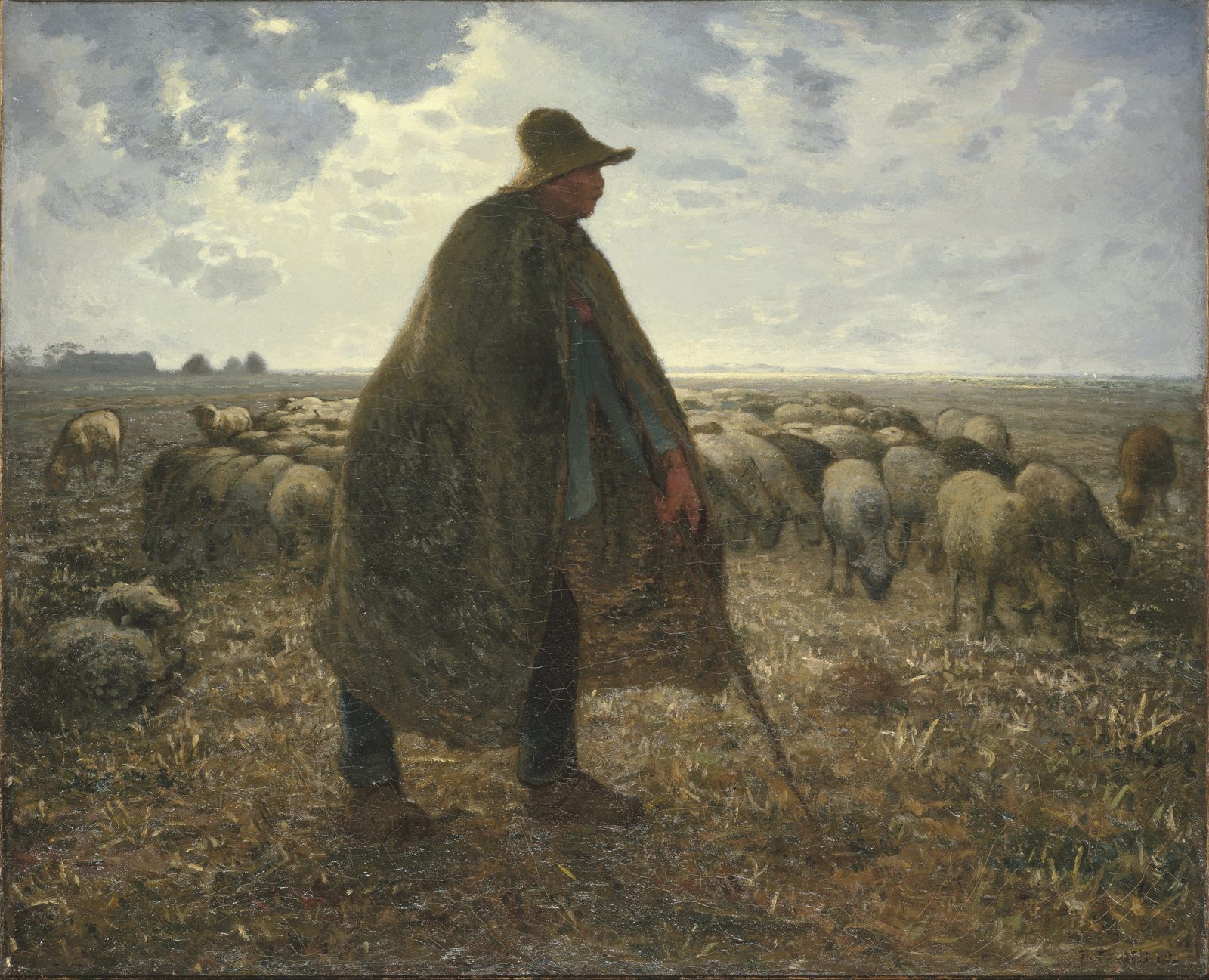
Israel called God the Shepherd of Israel at Psalm 80:1; here one man says the LORD is my shepherd. Green pastures and quiet waters are a shepherd's provision, food and water calm enough for a sheep to drink. The line closes on a settled thing, I shall not want.
The record, by era
The Church Fathers5 voices
The Church speaks to Christ: "The Lord feedeth me, and I shall lack nothing" (ver. 1). The Lord Jesus Christ is my Shepherd, "and I shall lack nothing."
Therefore, He governs you, who carries you. For when you say, The Lord is my shepherd; there is nothing of your own to trust in yourself. Therefore, be careful not to boast of your merits. For there were none, when the Lord came to lift you up. He found you naked, not clothed; wounded, not healthy; lying down, not standing; wandering, not returning. Beware of arrogance, beware; for He who mercifully lifted you from the earth half-dead, carries the humble, but hurls down the proud. When you say fearfully, and walk in innocence: The Lord is my shepherd; you will confidently add, and I shall not want. Because nothing is lacking to those who fear Him; and the Lord will not deprive of good those who walk in innocence.
The Church speaks to Christ: "The Lord feedeth me, and I shall lack nothing" (ver. 1). The Lord Jesus Christ is my Shepherd, "and I shall lack nothing."
A commentator
Hippolytus of RomeFragments from Commentaries on Various Books of Scripture - On Psalm XXII. Or XXIII. · Written before 235.
proposed
And, moreover, the ark made of imperishable wood was the Saviour Himself. For by this was signified the imperishable and incorruptible tabernacle of (the Lord) Himself, which gendered no corruption of sin. For the sinner, indeed, makes this confession: "My wounds stank, and were corrupt, because of my foolishness." But the Lord was without sin, made of imperishable wood, as regards His humanity; that is, of the virgin and the Holy Ghost inwardly, and outwardly of the word of God, like an ark overlaid with purest gold.
We have in the previous psalm the tribulation of the passion. In this one let us receive the joy of the resurrection.
12 more voices on this verse
The Church Fathers2 voices
Having said in the psalm before this, "The needy eat and will be filled, and those who seek him out will praise the Lord," and again, "All the prosperous of the earth ate and adored him," here he suggests the provider of such food and …
Throughout the entire psalm, the speaker is the most faithful Christian, who has been reborn through water and the Holy Spirit, for whom the old age of the first man has been set aside. He gives thanks that he has been brought from the dryness …
The Medieval Church1 voice
Above, the Psalmist, speaking in the person of Christ, spoke much of his tribulation; here he speaks of the remedy by which he is sustained in it. And first he commemorates the benefits by which he is sustained. Second, the power of that sustaining, at …
The Puritans and the Awakening2 voices
The Lord is my shepherd,.... This is to be understood not of Jehovah the Father, and of his feeding the people of Israel in the wilderness, as the Targum paraphrases it, though the character of a shepherd is sometimes given to him, Psa 77:20; but of Jehovah the Son, to whom it is most frequently ascribed, Gen 49:
70, 71 ), and so he knew by experience the cares and tender affections of a good shepherd towards his flock. He remembered what need they had of a shepherd, and what a kindness it was to them to have one that was skilful and faithful; he once ventured his life to rescue a lamb.
quarantine:debris (2026-07-29) — leading-citation-number+unbalanced-parens
The Nineteenth Century7 voices
"The Lord is my shepherd." What condescension is this, that the infinite Lord assumes towards his people the office and character of a Shepherd! It should be the subject of grateful admiration that the great God allows himself to be compared to anything which will set forth his great love and care for his own people. David had himself been a keeper of sheep, and understood both the needs of the sheep and the many cares of a shepherd.
A commentator
Jamieson, Fausset & Brown1802–1910
Commentary Critical and Explanatory on the Whole Bible (1871)
Christ's relation to His people is often represented by the figure of a shepherd (Joh 10:14; 5:4), and therefore the opinion that He is the Lord here so described, and in Ge 48:15; Isa 40:11, is not without some good reason.
"The Lord is my shepherd." What condescension is this, that the infinite Lord assumes towards his people the office and character of a Shepherd! It should be the subject of grateful admiration that the great God allows himself to be compared to anything which will set forth his great love and care for his own people. David had himself been a keeper of sheep, and understood both the needs of the sheep and the many cares of a shepherd. He compares himself to a creature weak, defenceless, and foolish, and he takes God to be his Provider, Preserver, Director, and, indeed, his everything. No man has a right to consider himself the Lord's sheep unless his nature has been renewed for the scriptural description of unconverted men does not picture them as sheep, but as wolves or goats. A sheep is an object of property, not a wild animal; its owner sets great store by it, and frequently it is bought with a great price. It is well to know, as certainly David did, that we belong to the Lord. There is a noble tone of confidence about this sentence. There is no "if" nor "but, " nor even "I hope so;" but he says, "The Lord is my shepherd." We must cultivate the spirit of assured dependence upon our heavenly Father. The sweetest word of the whole is that monosyllable, "My." He does not say, "The Lord is the shepherd of the world at large, and leadeth forth the multitude as his flock, " but "The Lord is my shepherd;" if he be a Shepherd to no one else, he is a Shepherd to me; he cares for me, watches over me, and preserves me. The words are in the present tense. Whatever be the believer's position, he is even now under the pastoral care of Jehovah. The next words are a sort of inference from the first statement—they are sententious and positive— "I shall not want."
A commentator
Charles Spurgeon1834–1892
The Metropolitan Tabernacle Pulpit, Sermon No. 3060: “The Good Shepherd” (lightly modernized text, CCEL edition) · Written before 1892.
proposed
[See Sermon #3006, Volume 52—"THE LORD IS MY SHEPHERD." Sermons on the Parable of the Good Shepherd are as follows—#1877, Volume 32—OUR OWN DEAR SHEPHERD; #1713, Volume 29—OTHER SHEEP AND ONE FLOCK; #995, Volume 17—THE SHEEP AND THEIR SHEPHERD and #2120, Volume 35—THE SECURITY OF BELIEVERS—OR, SHEEP WHO SHALL NEVER PERISH.] DOES not this sound just like poetry or like singing? If you read the entire Psalm through, it is written in such poetic prose that though it is not translated into meter, as it should have been, it reads just like it.
A commentator
Charles Spurgeon1834–1892
The Metropolitan Tabernacle Pulpit, Sermon No. 3060: “The Good Shepherd” (lightly modernized text, CCEL edition) · Written before 1892.
proposed
[See Sermon #3006, Volume 52—"THE LORD IS MY SHEPHERD." Sermons on the Parable of the Good Shepherd are as follows—#1877, Volume 32—OUR OWN DEAR SHEPHERD; #1713, Volume 29—OTHER SHEEP AND ONE FLOCK; #995, Volume 17—THE SHEEP AND THEIR SHEPHERD and #2120, Volume 35—THE SECURITY OF BELIEVERS—OR, SHEEP WHO SHALL NEVER PERISH.] DOES not this sound just like poetry or like singing? If you read the entire Psalm through, it is written in such poetic prose that though it is not translated into meter, as it should have been, it reads just like it. "The Lord is my Shepherd; I shall not want. He makes me to lie down in green pastures; He leads me beside the still waters. He restores my soul: He leads me in the paths of righteousness for His name's sake." It sounds like music for this, among other reasons, because it came from David's heart. That which comes from the heart always has melody in it. When men speak of what they know and from the depths of their souls testify to what they have seen, they speak with what we call, eloquence, for true eloquence is speaking from the soul. Thus David spoke of what he knew—what he had verified all his life—and this rendered him truly eloquent. As "truth is stranger than fiction," so the truth that David spoke is more sweet than even fancy could have imagined. And it has more beauty than even the dream of the enthusiast could have pictured. "The Lord is my Shepherd; I shall not want." How naturally it seems to strike on the ear as uttered by David who had, himself, been a shepherd boy! He remembers how he had led his flock by the waters in the warm summer, how he had made them lie down in shady nooks by the side of the river, how, on sultry days, he had led them on the high hills that they might feel the cool air and how, when the winter set in, he had led them into the valleys that they might be hidden from the stormy blasts.
The Lord is my shepherd - There are two allegories in this Psalm which are admirably well adapted to the purpose for which they are produced, and supported both with art and elegance. The first is that of a shepherd; the second, that of a great feast, set out by a host the most kind and the most liberal. As a flock, they have the most excellent pasture; as guests, they have the most nutritive and abundant fare. God condescends to call himself the Shepherd of his people, and his followers are considered as a flock under his guidance and direction. 1. He leads them out and in, so that they find pasture and safety. 2. He knows where to feed them, and in the course of his grace and providence leads them in the way in which they should go. 3. He watches over them and keeps them from being destroyed by ravenous beasts. 4. If any have strayed, he brings them back. 5. He brings them to the shade in times of scorching heat; in times of persecution and affliction, he finds out an asylum for them. 6. He takes care that they shall lack no manner of thing that is good. But who are his flock? All real penitents, all true believers; all who obediently follow his example, abstaining from every appearance of evil, and in a holy life and conversation showing forth the virtues of Him who called them from darkness into his marvellous light. “My sheep hear my voice, and follow me.” But who are not his flock! Neither the backslider in heart, nor the vile Antinomian, who thinks the more he sins, the more the grace of God shall be magnified in saving him; nor those who fondly suppose they are covered with the righteousness of Christ while living in sin; nor the crowd of the indifferent and the careless, nor the immense herd of Laodicean loiterers; nor the fiery bigots who would exclude all from heaven but themselves, and the party who believe as they do. […]
A commentator
Albert Barnes1798–1870
Notes, Explanatory and Practical, on the Old and New Testaments (1832-1869)
proposed
The Lord is my shepherd - Compare Gen 49:24, “From thence is the shepherd, the stone of Israel;” Psa 80:1, “Give ear, O Shepherd of Israel.” See also the notes at Joh 10:1-14. The comparison of the care which God extends over his people to that of a shepherd for his flock is one that would naturally occur to those who were accustomed to pastoral life. It would be natural that it should suggest itself to Jacob Gen 49:24, and to David, for both of them had been shepherds. David, in advanced years, would naturally remember the occupations of his early life; and the remembrance of the care of God over him would naturally recall the care which he had, in earlier years, extended over his flocks. The idea which the language suggests is that of tender care; protection; particular attention to the young and the feeble (compare Isa 40:11); and providing for their wants. All these things are found eminently in God in reference to his people. I shall not want - This is the main idea in the psalm, and this idea is derived from the fact that God is a shepherd. The meaning is, that, as a shepherd, he would make all needful provision for his flock, and evince all proper care for it. The words shall not want, as applied to the psalmist, would embrace everything that could be a proper object of desire, whether temporal or spiritual; whether pertaining to the body or the soul; whether having reference to time or to eternity. There is no reason for supposing that David limited this to his temporal necessities, or to the present life, but the idea manifestly is that God would provide all that was needful for him always. Compare Psa 34:9, “There is no want to them that fear him.” This idea enters essentially into the conception of God as the shepherd of his people, that all their real wants shall be supplied.
How the passage was read
What the Jewish commentators add
A song of David The Rabbis said: Wherever it says: “A song of David,” he would play [his musical instrument] and afterwards the Shechinah would rest on him. It is a song to bring the holy spirit upon David.
1 more on this passage, in their own words ▾
in green pasture In grassy pastures. Since he commences to compare his sustenance to the pasture of an animal by saying, “The Lord is my shepherd,” “green pastures” is appropriate for the expression, “the Lord is my shepherd.” David recited this psalm in the forest of Hereth (I Sam.:5).
This section is reception history: how the passage was read and kept in the Jewish tradition. Where a reading parts from an essential of the Christian faith, the section says so at that point.
Texts and citation data: Sefaria; each excerpt follows its version’s licence. 4 further sources are cited on this chapter that carry no English text this site may quote or only restate the verse.
The words behind it
4 Hebrew wordsEvery Hebrew word of this verse in the order it stands, with what it means and the door to its own study. The last column counts the times a word stands in the whole Bible: the rarer the word, the more the places it appears belong together.
| Hebrew | Sound | Meaning | Word study | In the Bible |
|---|---|---|---|---|
| יְהוָ֥ה | yahweh | Yahweh | H3068 → | 6520 times |
| רֹ֝עִ֗י | roi | [is] shepherd my | H7462 → | 177 times |
| לֹ֣א | lo' | not | H3808 → | 5168 times |
| אֶחְסָֽר׃ | ʾechsar | I lack | H2637 → | 23 times |
יְהוָ֥הYahweh
yahwehH3068 →6520 times
רֹ֝עִ֗י[is] shepherd my
roiH7462 →177 times
לֹ֣אnot
lo'H3808 →5168 times
אֶחְסָֽר׃I lack
ʾechsarH2637 →23 times
A shaded row is a word that stands 400 times or fewer in the Bible.
The walk
8 stopsEach card is a verse this one points to, and under it the verses that one points to in turn. Where several paths arrive at the same place, that place is listed first: the text keeps returning to it.
Through
Philippians 4:19And my God will supply all your needs according to His glorious riches in Christ Jesus.
it leads to
- 2 Corinthians 9:8–11
And God is able to make all grace abound to you, so that in all things, at all times, having all that you need, you will abound in every good work.
- Psalms 84:11
For the LORD God is a sun and a shield; the LORD gives grace and glory; He withholds no good thing from those who walk with integrity.
- 1 Peter 5:10
And after you have suffered for a little while, the God of all grace, who has called you to His eternal glory in Christ, will Himself restore you, secure you, strengthen you, and establish…
- Psalms 23:1–5
The LORD is my shepherd; I shall not want.
- 1 Timothy 6:17
Instruct those who are rich in the present age not to be conceited and not to put their hope in the uncertainty of wealth, but in God, who richly provides all things for us…
- 2 Corinthians 9:8–11
Through
John 10:11I am the good shepherd. The good shepherd lays down His life for the sheep.
it leads to
- Revelation 7:17
For the Lamb in the center of the throne will be their shepherd. ‘He will lead them to springs of living water,’ and ‘God will wipe away every tear from their eyes.’”
Reached by 2 separate paths from here.
- John 10:14–15
I am the good shepherd. I know My sheep and My sheep know Me,
- John 15:13
Greater love has no one than this, that he lay down his life for his friends.
- Revelation 7:17
Where this verse is studied
On this page
About Psalms
This page draws on 16 works. Open the list of works
This page draws on Adam Clarke, Commentary on the Bible; Albert Barnes, Notes, Explanatory and Practical, on the Old and New Testaments (1832-1869); Ambrose of Milan, On the Sacraments, Book 5, Chapter 3; Arnobius the Younger, COMMENTARY ON THE PSALMS 23; Augustine of Hippo, Exposition on Psalm 23; Augustine of Hippo, SERMON 366:2; Cassiodorus, EXPLANATION OF THE PSALMS 23:1; Charles Spurgeon, The Treasury of David; Charles Spurgeon, The Treasury of David, Vol. 1; Charles Spurgeon, The Metropolitan Tabernacle Pulpit, Sermon No. 3060: “The Good Shepherd” (lightly modernized text, CCEL edition); Hippolytus of Rome, Fragments from Commentaries on Various Books of Scripture - On Psalm XXII. Or XXIII.; Jamieson, Fausset & Brown, Commentary Critical and Explanatory on the Whole Bible; John Gill, Exposition of the Old Testament (1748-1763); Matthew Henry, Commentary on the Whole Bible; Theodoret of Cyrus, COMMENTARY ON THE PSALMS 23:1 and Thomas Aquinas, Exposition on the Psalms of David.