
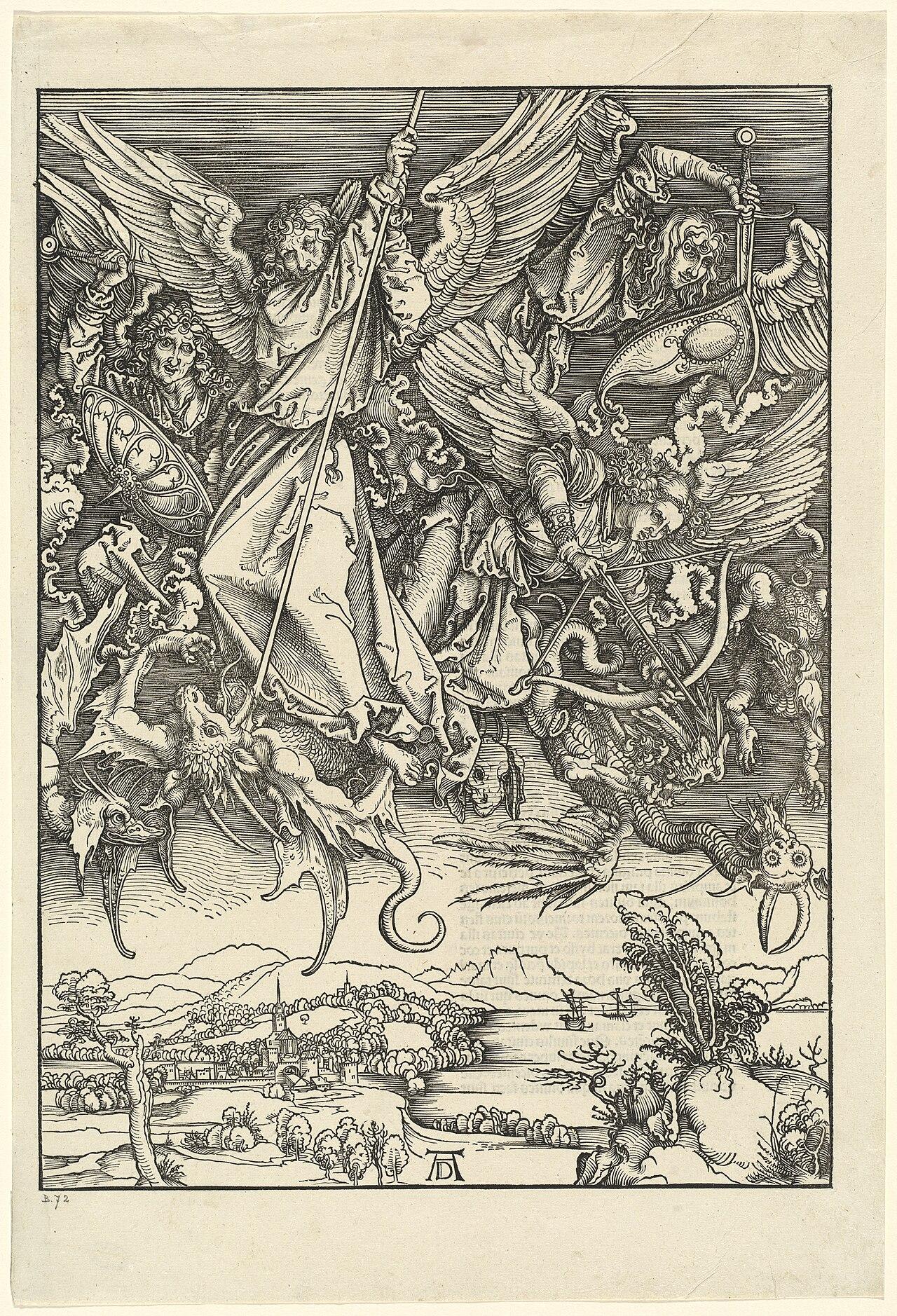
Albrecht Dürer, Saint Michael Fighting the Dragon, 1498. CC0.
Acts 1 to about 155 · Subject · Featured Study
The Word of Their Testimony
Revelation 12:11 names three things by which the brothers conquered the accuser, and the line of witness behind them runs from Acts 1:8 to Polycarp.
Revelation 12 gives the victory over the accuser to people who were killed, and it names their testimony as one of their weapons.
They have conquered him by the blood of the Lamb and by the word of their testimony. And they did not love their lives so as to shy away from death.
They have conquered him by the blood of the Lamb and by the word of their testimony. And they did not love their lives so as to shy away from death.
- Books
- Revelation, Acts
- Hold in memory
- Revelation 12:11, Acts 1:8
Summary
Revelation 12:11 says how the brothers beat the accuser. They had the Lamb's blood, their own testimony, and a readiness to die. Their testimony goes back to Jesus and on to Polycarp.
- Jesus is the faithful witness, and He made the apostles His witnesses.
- Stephen and Antipas died as witnesses.
- Polycarp died about 155, and his church called him a martyr.
The Verses of the Testimony
Revelation 12 names the three grounds of the victory, and Acts and Revelation name the witnesses.
The loud voice in heaven of Revelation 12 explains why the accuser has been thrown down. The other verses show who bore the testimony before John saw it.
The victory
And I heard a loud voice in heaven saying: “Now have come the salvation and the power and the kingdom of our God, and the authority of His Christ. For the accuser of our brothers has been thrown down—he who accuses them day and night before our God.
This announcement follows the war in heaven of Revelation 12:7 to 9, when Michael and his angels fought the dragon.
The witnesses
and from Jesus Christ, the faithful witness, the firstborn from the dead, and the ruler of the kings of the earth. To Him who loves us and has released us from our sins by His blood,
John opens his letter to the seven churches of Asia with this title of Christ.
But you will receive power when the Holy Spirit comes upon you, and you will be My witnesses in Jerusalem, and in all Judea and Samaria, and to the ends of the earth.”
Jesus spoke these last words to the apostles before His ascension, and Luke builds Acts on them.
Acts 1:8BSB
And when the blood of Your witness Stephen was shed, I stood there giving my approval and watching over the garments of those who killed him.’
Paul told this to the Lord in a vision in the temple, and he repeated it to the crowd at Jerusalem after his arrest.
Acts 22:20BSB
I know where you live, where the throne of Satan sits. Yet you have held fast to My name and have not denied your faith in Me, even in the day when My faithful witness Antipas was killed among you, where Satan dwells.
The letter to the church at Pergamum names Antipas and tells nothing more of him.
And when the Lamb opened the fifth seal, I saw under the altar the souls of those who had been slain for the word of God and for the testimony they had upheld.
John sees this when the Lamb opens the fifth seal.
Revelation 1:5, Acts 1:8, Acts 22:20, Revelation 2:13, Revelation 6:9
The Chain of Witness
Each link names a witness and the verse or record that calls him one.
The testimony of the overcomers begins with Jesus the faithful witness and passes through the apostles, Stephen and Antipas to the church of the second century.
- What it adds
- Jesus Christ is the faithful witness, and His blood released us from our sins.
- What it adds
- The apostles will be His witnesses to the ends of the earth when the Spirit comes.
- What it adds
- Stephen is the Lord's witness whose blood was shed at Jerusalem.
- What it adds
- Antipas is the Lord's faithful witness, killed at Pergamum.
- What it adds
- Souls are slain for the word of God and the testimony they upheld.
- What it adds
- The brothers conquer by the Lamb's blood and the word of their testimony.
7The Martyrdom of Polycarp, chapter XIX
- What it adds
- The church at Smyrna calls Polycarp a pre-eminent martyr, about 155.
Seven numbered cards joined by arrows, each with its verse or record and what it adds.
The Greek word for a witness, mártys, and how it came to mean one who dies for Christ, is the subject of its own study.
A Martyrdom Becoming the Gospel
The church at Smyrna wrote of Polycarp's death as a witness that followed the Lord's own.
The church at Smyrna wrote that Polycarp waited to be delivered up, as the Lord had done. In this the Lord showed them “a martyrdom becoming the Gospel.”
Before the proconsul Polycarp declared, “I am a Christian,” and the herald proclaimed three times in the stadium that Polycarp had confessed it.
The letter calls him “a pre-eminent martyr, whose martyrdom all desire to imitate,” and counts him the twelfth martyred in Smyrna, reckoning those of Philadelphia.
In 177 the churches of Vienne and Lyons sent the believers of Asia and Phrygia an account of their own witnesses, and Eusebius copied much of it into his Church History.
Under torture Blandina kept saying that she was a Christian and that nothing vile was done among them. The confessors still living would not let others call them witnesses, and they kept that name for those who had died.
At Carthage, about 203, the procurator Hilarianus asked the young mother Perpetua whether she was a Christian, and she said that she was. Her own account of her imprisonment survives, finished by another hand after her death.
Three Grounds of the Victory
The verse joins the Lamb's blood, the believers' words and their lives held loosely.
The first ground is the blood of the Lamb, the blood by which, in Revelation 1:5, Jesus frees His people from their sins. The accuser's charges meet that blood before they meet the believers.
“Had that blood not been shed, Satan's accusations would have been unanswerable; as it is, that blood meets every charge. SCHOTTGEN mentions the Rabbinical tradition that Satan accuses men all days of the year, except the day of atonement.”
Jamieson, Fausset & Brown · Commentary Critical and Explanatory on the Whole Bible · on Revelation 12:11Reformed
The second ground is the word of their testimony, the same testimony for which the souls of Revelation 6:9 were slain. The third is their readiness to die, which ties the verse to the martyrs of the fifth seal.
Acts 1:8 joins the testimony to power from the Holy Spirit, and John's vision joins it to the willingness to die.
In Their Own Words
Polycarp of Smyrna (died 155)
The Martyrdom of Polycarp, chapter 9
Polycarp would not blaspheme his King.
“Eighty and six years have I served Him, and He never did me any injury: how then can I blaspheme my King and my Saviour?”
Early Church
About this saying1 paragraph
In the stadium at Smyrna, about 155, the proconsul offered Polycarp his liberty if he would revile Christ, and chapter IX of his church's letter records his answer.
Blandina (died 177)
the letter of the churches of Vienne and Lyons, in Eusebius, Church History, 5.1.19
Blandina confessed under torture.
“I am a Christian, and there is nothing vile done by us.”
Martyr
About this saying1 paragraph
Blandina said this at Lyon in 177, as the churches' letter reports her words.
Perpetua of Carthage (182 to 203)
The Passion of Perpetua and Felicity, her own narrative, chapter 2, section 2
Perpetua answered the procurator.
“I am a Christian.”
Early church martyr
About this saying1 paragraph
She wrote this of her hearing before the procurator at Carthage, about 203, in chapter 2, section 2 of the Passion.
The churches of Vienne and Lyons
the letter of the churches of Vienne and Lyons, in Eusebius, Church History, 5.2.3
The confessors kept the name of witness for the dead.
“They are already witnesses whom Christ has deemed worthy to be taken up in their confession, having sealed their testimony by their departure; but we are lowly and humble confessors.”
Church
About this saying1 paragraph
The confessors of Lyon said this in 177 when their brethren called them witnesses.
Martyrs or Every Believer
Commentators differ on whether the verse speaks of the martyrs alone.
Albert Barnes read the verse primarily of the martyr age, when believers by their lives, testimony and sufferings proved the accuser's charges false.
The strongest objection is that the Lamb's blood belongs to every believer, so its victory reaches the living as well as the dead.
Charles Spurgeon preached the verse as every believer's weapon against evil, in Jesus' name and the Spirit's power.
The strongest objection is the third ground, since the verse speaks of people who did not shrink from death, which fits the martyrs most closely.
Books to Read Next
The Martyrdom of Polycarp
The church at Smyrna, in the Ante-Nicene Fathers, volume 1 · 1885
It holds the church of Smyrna's letter on the death of Polycarp, pages 39 to 44.
Free at the Christian Classics Ethereal LibraryThe Testimony Goes On
The faithful witness of Revelation 1:5 is Jesus, and every later witness in the chain spoke of Him. The vision of chapter 12 sets their words beside His blood as the means of the accuser's defeat.
Sources
Scripture is the Berean Standard Bible.
- The Holy Bible, Berean Standard Bible (read 2026)
- The Martyrdom of Polycarp, Ante-Nicene Fathers, volume 1 (originally printed 1885), pages 39 to 44, chapters I, X, XII and XIX.
- Albert Barnes, Notes, Explanatory and Practical (1832 to 1869), on Revelation 12:11.
- Robert Jamieson, A. R. Fausset and David Brown, Commentary Critical and Explanatory on the Whole Bible (1871), on Revelation 12:11.
- Charles Spurgeon, The Metropolitan Tabernacle Pulpit, Sermon No. 2043, The Blood of the Lamb, the Conquering Weapon (1888)
- Eusebius, Church History, book 5, chapters 1 and 2, the letter of the churches of Vienne and Lyons, translated by Arthur Cushman McGiffert, Nicene and Post-Nicene Fathers, second series, volume 1 (1890)
- The Passion of the Holy Martyrs Perpetua and Felicitas, translated by R. E. Wallis, in the third volume of the Ante-Nicene Fathers (1885), chapters 1 and 2.
Keep Studying
People and groups2
Trials of life1
Symbols1
Doctrines1