
Joshua 18:1 to 10 · Place · Featured Study
Shiloh
Shiloh, a town in the hill country of Ephraim, held the Tent of Meeting from Joshua's day to Eli's.
Seven tribes received their land by lot at a hilltop sanctuary north of Bethel.
- Today
- Khirbet Seilun, now Tel Shiloh
- Region
- The hill country of Ephraim, north of Bethel
- Site
- 32.056, 35.290
- First named
- Joshua 18:1
- Last named
- Jeremiah 41:5
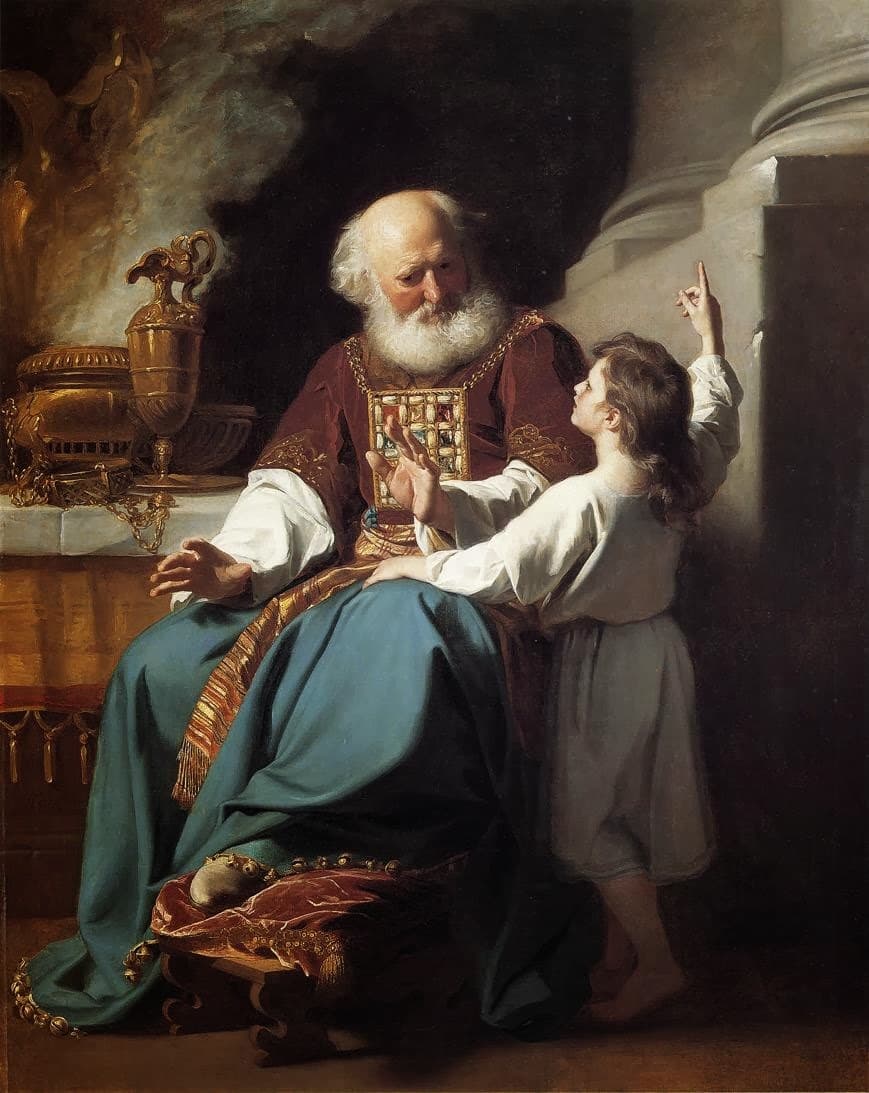
John Singleton Copley, Samuel Relating to Eli the Judgements of God upon Eli's House, 1780. Public domain by date, via Wikimedia Commons (File:Eli and Samuel.jpg).
THE ARTWORKCopley painted the morning of 1 Samuel 3 at Shiloh, when the boy Samuel told the old priest Eli what the LORD had said about his house.
Summary
The congregation set up the Tent of Meeting at Shiloh and Joshua divided the land there by lot, and the ark stayed in the town until Israel carried it out to battle and lost it.
- Shiloh lies north of Bethel, east of the road from Bethel to Shechem, and south of Lebonah, as Judges 21:19 describes it.
- Hannah prayed at the temple there, and the LORD revealed Himself to the boy Samuel there.
- Jeremiah told the people of Jerusalem to go and see what God had done to Shiloh, and warned that the temple would become like it.
Where the Tent of Meeting Stood
The tent moved from the camp at Gilgal to Shiloh once the land was subdued.
Then the whole congregation of Israel assembled at Shiloh and set up the Tent of Meeting there. And though the land was subdued before them,The tent that had travelled with Israel through the wilderness is given its first fixed place in the land.
And Joshua cast lots for them in the presence of the LORD at Shiloh, where he distributed the land to the Israelites according to their divisions.The boundaries of Joshua 18 and 19 all go back to the lots cast in this town.
The land divided at the entrance to the tentJoshua 18:8 to 9 and Joshua 19:51
So the men departed and went throughout the land, mapping it city by city into seven portions. Then they returned with the document to Joshua at the camp in Shiloh.The survey gave Joshua a written record to divide by.
These are the inheritances that Eleazar the priest, Joshua son of Nun, and the heads of the families distributed by lot to the tribes of Israel at Shiloh before the LORD at the entrance to the Tent of Meeting. So they finished dividing up the land.The book closes the division of the land at the entrance to the Tent of Meeting.
Why the tent left GilgalJoshua 18:1
Shiloh off the Road from Bethel to Shechem
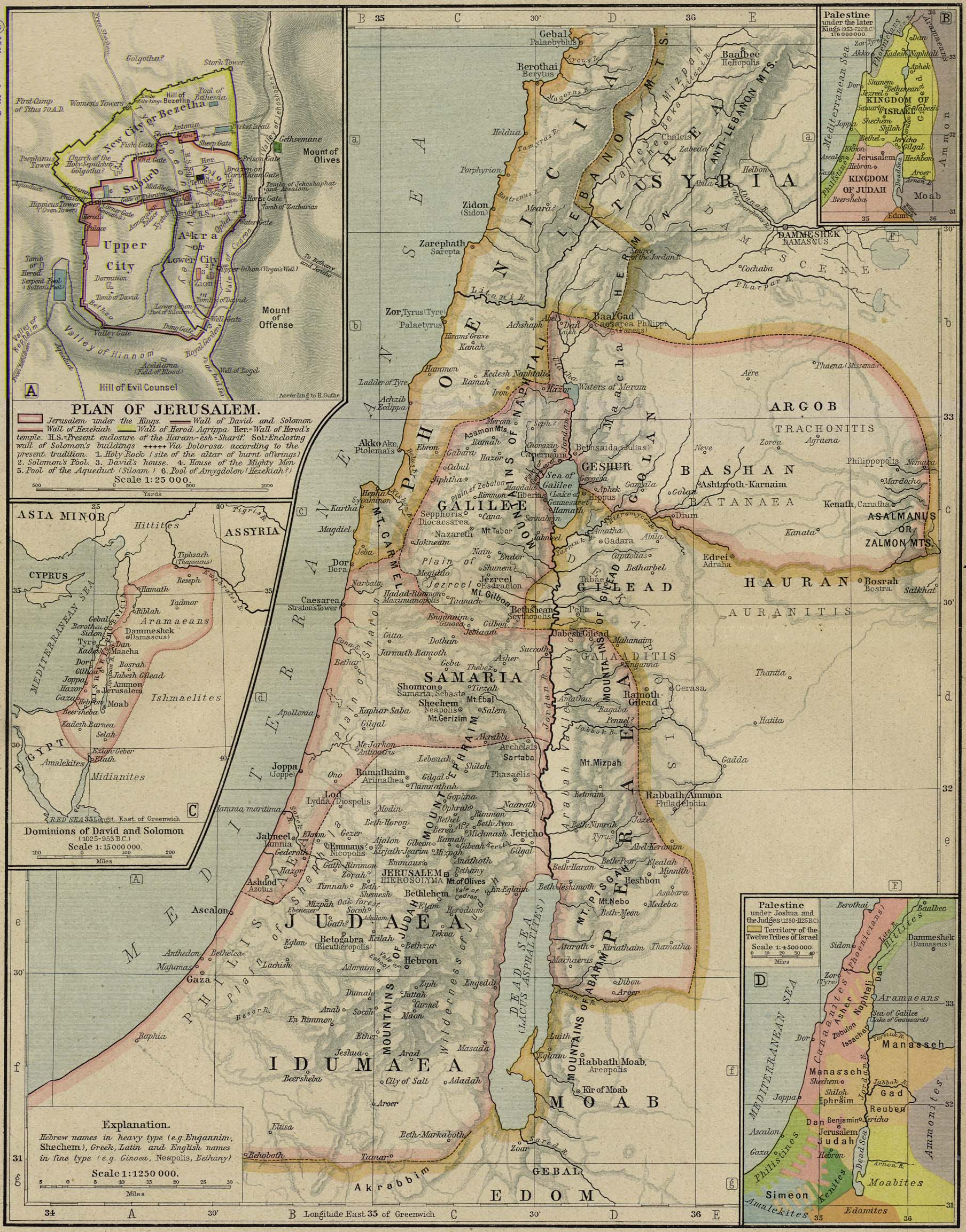
Judges 21:19 places the town by three bearings, and the map draws them.
Shiloh lay just east of the hill road from Jerusalem to Shechem, beyond Bethel.
- Located: the site is known
- The route, in the order the text gives
- 1Jerusalem, A Jebusite town in the days of the judges, passed by on the way north. Judges 19:10
- 2Bethel, Shiloh lies north of Bethel. Judges 21:19
- 3Shiloh, The congregation set up the Tent of Meeting there. Joshua 18:1
- 4Shechem, The road from Bethel goes up to Shechem. Judges 21:19
- 5Gilgal, The camp by the Jordan where Israel first stood in the land. Joshua 4:19
Base map: Reference map of ancient Palestine, Rand McNally reference map (1926), public domain. Each place stands at its place page's coordinates, set on the plate by Jerusalem and Damascus, as the plate prints them.
The road is drawn through the four hill towns in order, and Gilgal, the camp the tent came from, is marked in the valley.
“But look,” they said, “there is a yearly feast to the LORD in Shiloh, which is north of Bethel east of the road that goes up from Bethel to Shechem, and south of Lebonah.”The elders place the town by three bearings, which is how Edward Robinson found it in 1838.
What Happened at Shiloh, in Order
Scripture follows the town from Joshua's tent to Jeremiah's day.
The tent stayed at Shiloh until the ark was lost, and the town outlived the sanctuary.
- After the land was subduedThe congregation sets up the Tent of Meeting at ShilohJoshua 18:1
- The same daysJoshua casts lots for seven tribes in the presence of the LORDJoshua 18:10
- After the warThe congregation gathers at Shiloh against the altar the eastern tribes builtJoshua 22:12
- The age of the judgesThe house of God stands at Shiloh while Dan keeps Micah's imageJudges 18:31
- At the yearly feastThe Benjamites catch wives from the daughters of ShilohJudges 21:21
- Eli's priesthoodHannah prays at the temple1 Samuel 1:9
- Samuel's boyhoodThe LORD reveals Himself to Samuel at Shiloh1 Samuel 3:21
- The battle at EbenezerThe ark is carried from Shiloh and captured, and Eli dies1 Samuel 4:11
- Jeroboam's reignAhijah the prophet lives at Shiloh1 Kings 14:2
- Jeremiah's dayJeremiah warns that the temple will become like ShilohJeremiah 26:6
- After Jerusalem fellEighty men come from Shechem, Shiloh and Samaria with offeringsJeremiah 41:5
Eleven events in order, each with its verse.
Hannah's vow kept at Shiloh1 Samuel 1:9 and 1 Samuel 1:24
So after they had finished eating and drinking in Shiloh, Hannah stood up. Now Eli the priest was sitting on a chair by the doorpost of the temple of the LORD.Hannah's prayer at Shiloh brought Samuel into the house of the LORD.
Once she had weaned him, Hannah took the boy with her, along with a three-year-old bull, an ephah of flour, and a skin of wine. Though the boy was still young, she brought him to the house of the LORD at Shiloh.The vow of 1 Samuel 1:11 was paid at Shiloh, which is how Samuel came to grow up beside the ark.
The word of the LORD to the boy Samuel1 Samuel 3:3 and 1 Samuel 3:21
Before the lamp of God had gone out, Samuel was lying down in the temple of the LORD, where the ark of God was located.The boy's place beside the ark is why the call came to him there.
And the LORD continued to appear at Shiloh, because there He revealed Himself to Samuel by His word.Samuel's call made Shiloh the place where the word of the LORD was heard in Eli's last years.
The ark carried out to battle1 Samuel 4:3 to 22
When the troops returned to the camp, the elders of Israel asked, “Why has the LORD brought defeat on us before the Philistines today? Let us bring the ark of the covenant of the LORD from Shiloh, so that it may go with us to save us from the hand of our enemies.”The question shows Israel treating the ark as a weapon to carry into battle.
Matthew Henry judges what the elders did with the ark.
“And yet indeed they did but make an idol of the ark, and looked upon it to be as much an image of the God of Israel as those idols which the heathen worshipped were of their gods. To worship the true God, and not to worship him as God, is in effect not to worship him at all.”
Matthew Henry · Commentary on the Whole Bible · on 1 Samuel 4:4Puritan
As soon as the ark of God was mentioned, Eli fell backward from his chair by the city gate, and being old and heavy, he broke his neck and died. And Eli had judged Israel forty years.The news of the ark, more than the news of his sons, killed the old priest.
“The glory has departed from Israel,” she said, “for the ark of God has been captured.”Phinehas's widow named her son for the ark that had been taken.
Three Things the Text Says Plainly
The text calls the sanctuary a house, records one visit a year, and puts the loss down to God.
THE SANCTUARY HAD DOORS
The congregation set up a tent at Shiloh in Joshua's day, and by Eli's day the text speaks of a temple with a doorpost and doors that Samuel opened in the morning.
ELKANAH WENT UP ONCE A YEAR
Elkanah went up from his city year after year to worship at Shiloh, where Eli's sons Hophni and Phinehas were priests.
GOD ABANDONED THE TABERNACLE
Psalm 78 names God Himself as the one who left Shiloh.
The Hill Country of Ephraim
Shiloh lay in the hills of Ephraim, north of Bethel on the road from Jerusalem.
Smith's Dictionary of the Bible places Shiloh within the borders of Ephraim. The article's writer, who signs H. B. H., spent his first night north of Jerusalem at Beitin, the old Bethel. The next day he turned right off the highway to Seilun, then rejoined the road to Nablus, the old Shechem, with el-Lubban, the old Lebonah, on his left.
Now there was a man named Elkanah who was from Ramathaim-zophim in the hill country of Ephraim. He was the son of Jeroham, the son of Elihu, the son of Tohu, the son of Zuph, an Ephraimite.Samuel's family came from the same hill country of Ephraim as the sanctuary.
Robinson found a spring fifteen minutes east of the tell, up a narrow valley, with rock-cut tombs in its sides. He thought the dances of the daughters of Shiloh in Judges 21 may have been held near it.
Shiloh in the Written Record and the Ground
Josephus, Jerome, Robinson and two campaigns of excavation each add to what is known of the site.
Jerome finds the ruinRobinson, Biblical Researches, volume 3, page 88
Robinson cites Jerome's commentary on Zephaniah and his epitaph of Paula. In Jerome's day Shiloh lay so utterly in ruins that the foundations of an altar could scarcely be pointed out.
The crusaders then placed Shiloh at Neby Samwil, and monks and pilgrims kept that site until the middle of the sixteenth century.
Robinson finds Seilun in 1838Robinson, Biblical Researches, volume 3, pages 86 to 89
On 14 June 1838 Edward Robinson came to a small tell covered with the ruins of a village, which the local people called Seilun. He took the name and the position together as decisive: Josephus writes the name Siloun, and the place stands east of the road from Bethel to Shechem, an hour south of el-Lubban.
Smith's Dictionary of 1863 calls the identification a striking case of the name, the position and the early writers agreeing.
The excavationsThe Danish seasons and Finkelstein's dig
A Danish team dug the tell in four seasons between 1926 and 1963, and published its finds in 1969. Israel Finkelstein excavated it from 1981 to 1984 and distinguished eight strata, from the Middle Bronze Age to the Byzantine period.
Finkelstein found a settlement of the early Iron Age with pillared buildings and storage jars, and a layer of destruction by fire across the tell. He dates the destruction by radiocarbon to the second half of the eleventh century BC, which is consistent with the defeat of 1 Samuel 4.
What the Text Leaves Unsaid
Scripture never tells how the town came to ruin, or what kind of building stood there.
But go now to the place in Shiloh where I first made a dwelling for My Name, and see what I did to it because of the wickedness of My people Israel.Jeremiah speaks of what God did to Shiloh as something his hearers could still go and see.
No verse says when the sanctuary was first built up around the tent. Smith's Dictionary reports readers who inferred a permanent temple at Shiloh from Judges 18:31, and answers them from God's words to David.
Where Scripture Returns to Shiloh
Psalm 78 and Jeremiah 7 set Shiloh before Israel as the sanctuary God abandoned.
Joshua and 1 Samuel name Shiloh in nine verses each.
The 7 verses that name shiloh as a table
| Book | Verses that name Shiloh | What the book records there | Verse |
|---|---|---|---|
| Genesis | 1 | the word of Genesis 49:10, whose meaning is debated | Genesis 49:10 |
| Joshua | 9 | the tent set up and the land divided by lot | Joshua 18:1 |
| Judges | 4 | the house of God and the yearly feast | Judges 21:19 |
| 1 Samuel | 9 | Hannah, Samuel, Eli and the ark | 1 Samuel 3:21 |
| 1 Kings | 3 | the word against Eli's house and the prophet Ahijah | 1 Kings 2:27 |
| Psalms | 1 | the tabernacle beside the choice of Zion | Psalm 78:60 |
| Jeremiah | 5 | the warning to the temple and the eighty men | Jeremiah 7:12 |
The verses of the Berean text that print the name Shiloh, counted by book, seven books and 32 verses in all.
He abandoned the tabernacle of Shiloh, the tent He had pitched among men.The psalm sets the fall of Shiloh among the judgments of Israel's history.
But He chose the tribe of Judah, Mount Zion, which He loved.The same psalm turns from Ephraim's sanctuary to Mount Zion in Judah.
Jeremiah's sermon at the templeJeremiah 7:12 to 14 and Jeremiah 26:6 to 9
therefore what I did to Shiloh I will now do to the house that bears My Name, the house in which you trust, the place that I gave to you and your fathers.Here the warning reaches the temple in Jerusalem itself.
How dare you prophesy in the name of the LORD that this house will become like Shiloh and this city will be desolate and deserted!” And all the people assembled against Jeremiah in the house of the LORD.The comparison with Shiloh is what turned the crowd against Jeremiah.
The tent of Joseph and Mount ZionPsalm 78:60 to 68
He rejected the tent of Joseph and refused the tribe of Ephraim.Shiloh stood in the land of Joseph's son Ephraim, so this verse turns the psalm away from Shiloh.
The word spoken at Shiloh fulfilled1 Kings 2:27
So Solomon banished Abiathar from the priesthood of the LORD and thus fulfilled the word that the LORD had spoken at Shiloh against the house of Eli.The sentence spoken against Eli's house in 1 Samuel 2 reached its end in Solomon's reign.
Matthew Henry on the Silence before Samuel
Henry asks why the word of the LORD was rare in the years before the call.
He finds the cause in the sanctuary itself.
“Perhaps the impiety and impurity that prevailed in the tabernacle, and no doubt corrupted the whole nation, had provoked God, as a token of his displeasure, to withdraw the Spirit of prophecy, till the decree had gone forth for the raising up of a more faithful priest, and then, as an earnest of that, this faithful prophet was raised up.”
Matthew Henry · Commentary on the Whole Bible · on 1 Samuel 3:1Puritan
Who Ended the Sanctuary at Shiloh
Readers take the end of Shiloh as the Philistines' work after the battle of 1 Samuel 4 or as a later event.
The Philistines, after the ark was taken1 Samuel 4, Psalm 78:60 and Jeremiah 7:12
Israel Finkelstein, in Shiloh: The Archaeology of a Biblical Site (1993), found a burned layer that may follow the Philistine victory of 1 Samuel 4, the view W. F. Albright had proposed. Adam Clarke reads Psalm 78:60 as the loss of the ark to the Philistines.
The objection: no verse narrates the burning of the town, so the link between the battle and the burned layer is an inference from the order of events.
A later endDonald G. Schley, Shiloh, 1989
Donald G. Schley, in Shiloh: A Biblical City in Tradition and History (1989), disputes Albright's conclusion. The town was still lived in when Ahijah the prophet was there in Jeroboam's reign.
The objection: Psalm 78:60 and Jeremiah 7:12 speak of the ruin as already known, and the burned layer is dated to the eleventh century BC.
Books on Shiloh
Two of these four works can be read free online.
Biblical Researches in Palestine, Mount Sinai and Arabia Petraea, volume 3
Edward Robinson · 1841
The journal records the bearings and the ruins Robinson saw on the day he identified the site.
Read at archive.orgA Dictionary of the Bible, volume 3, the article Shiloh
William Smith, editor · 1863
The article sets out the case for the site and the question of a permanent house at Shiloh.
Read at archive.orgShiloh: The Danish Excavations at Tall Sailun, Palestine, in 1926, 1929, 1932 and 1963
Marie-Louise Buhl and Svend Holm-Nielsen · 1969
It is the report of the Danish work at the site, published by the National Museum of Denmark.
In print: find it wherever books are sold.
Shiloh: A Biblical City in Tradition and History
Donald G. Schley · 1989
Schley disputes the view that the Philistines destroyed the city after the battle of 1 Samuel 4.
In print: find it wherever books are sold.
The Greater Tabernacle
Shiloh held the ark for generations and lost it in one day, and the letter to the Hebrews names a greater tabernacle.
But when Christ came as high priest of the good things that have come, He went through the greater and more perfect tabernacle that is not made by hands and is not a part of this creation.Hebrews turns from every earthly tent to the sanctuary where Christ serves as high priest.
Keep studying
Read it4
Studies6