
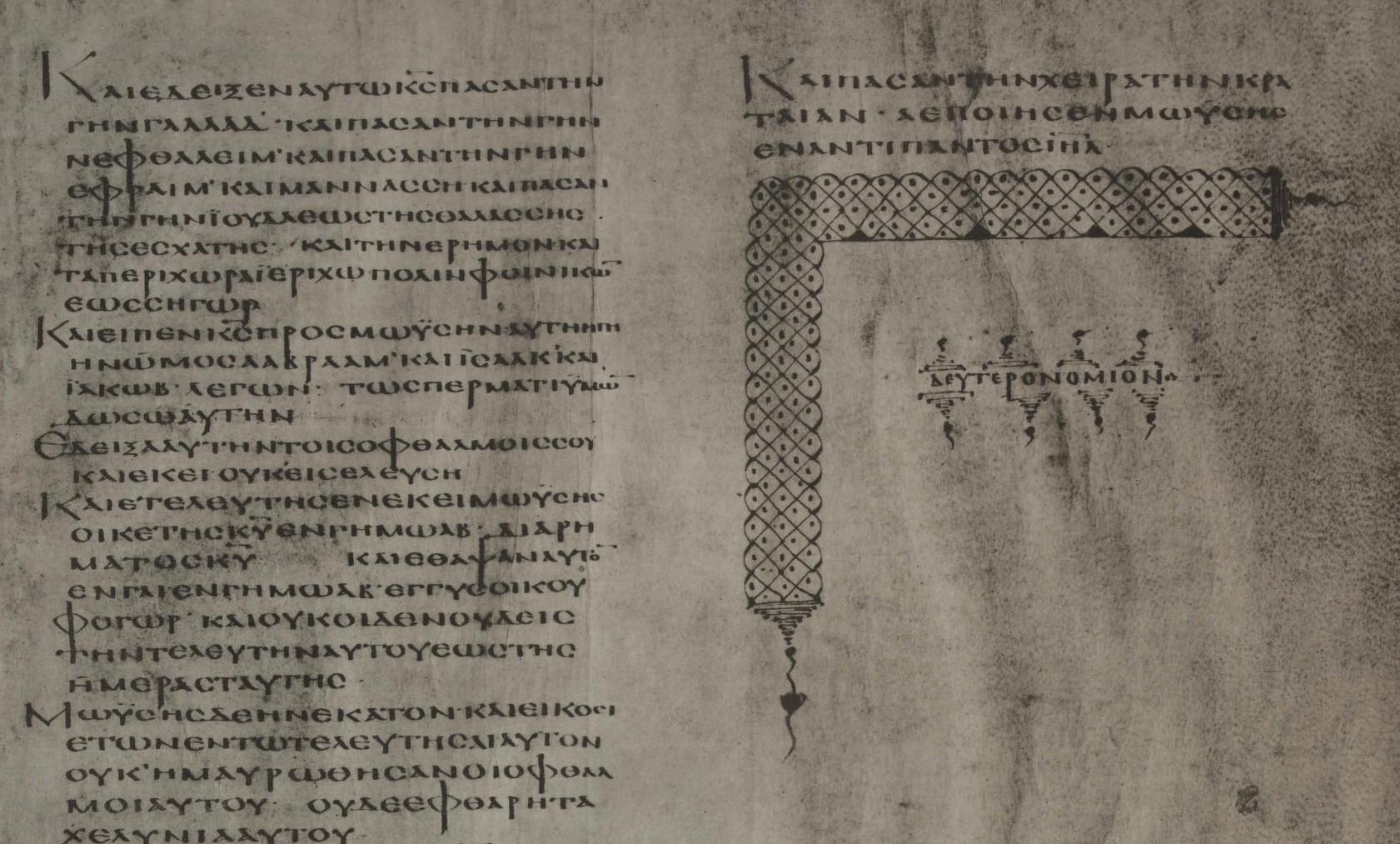
Codex Alexandrinus, the end of Deuteronomy, fifth century. Public domain.
Luke 4:18 and Acts 15:17 · Subject · Featured Study
The Septuagint
The Septuagint is the Greek Old Testament that Luke and Acts quote, begun at Alexandria in Egypt in the third century BC.
Jesus said to them, “These are the words I spoke to you while I was still with you: Everything must be fulfilled that is written about Me in the Law of Moses, the Prophets, and the Psalms.”
- Books
- Luke, Acts
- Hold in memory
- Luke 4:21
When Jesus read Isaiah at Nazareth, Luke gave one clause of the prophet as the Greek translation reads it.
Summary
The Septuagint is the Old Testament in Greek.
- An old Jewish letter tells how it was made at Alexandria.
- Luke and Acts quote it where its words differ from the Hebrew.
- Its witnesses run from desert scrolls to the great codices of the fourth and fifth centuries.
- Christians have long differed on how much authority the translation holds.
Luke and the Greek Old Testament
Jesus reads Isaiah at Nazareth, James quotes Amos at the council in Jerusalem, and a traveller reads Isaiah on the desert road.
The Spirit of the Lord GOD is on Me, because the LORD has anointed Me to preach good news to the poor. He has sent Me to bind up the brokenhearted, to proclaim liberty to the captives and freedom to the prisoners,Isaiah's own line, set beside Luke's account of its reading.
“The Spirit of the Lord is on Me, because He has anointed Me to preach good news to the poor. He has sent Me to proclaim liberty to the captives and recovery of sight to the blind, to release the oppressed,The synagogue at Nazareth hears these words on the Sabbath.
Jamieson, Fausset and Brown, on Isaiah 61:1, say Luke and the Septuagint both read the opening of the prison as the opening of the eyes.
At the council in Jerusalem, James quoted Amos on the rebuilding of the fallen tent of David.
that they may possess the remnant of Edom and all the nations that bear My name,” declares the LORD, who will do this.Amos's own line, set beside James's quotation of it.
so that the remnant of men may seek the Lord, and all the Gentiles who are called by My name, says the Lord who does these thingsJames gives the line as the Greek translation reads it.
Albert Barnes, in his Notes on Acts, says James quotes this verse word for word from the Septuagint.
Adam Clarke, in his Commentary on Acts 15:17, explains the difference by two Hebrew words.
In Hebrew the word for seek differs from the word for possess by one letter, and the word for men differs from Edom by one letter.
Clarke takes it that the Hebrew copy the translators worked from read seek and men.
Both forms of the verse name all the nations that bear the Lord's name.
In His humiliation He was deprived of justice. Who can recount His descendants? For His life was removed from the earth.”The eunuch Philip met in Acts 8 was reading these lines of Isaiah 53.
Barnes says the words of this verse are copied exactly from the Septuagint, which shows that the eunuch was reading it.
Amos 9:12, Acts 15:17, Acts 8:33
From a Desert Scroll to the Great Codices
The oldest of the five was copied about the time of Jesus, and the youngest four centuries later.
Five Greek witnesses to the Septuagint, with their books, dates and holders.
| Witness | Books | Dated | Kept at |
|---|---|---|---|
| The Greek Minor Prophets Scroll (8ḤevXII gr) | the Twelve, in part | about 50 BC to AD 50 | the Israel Antiquities Authority |
| Papyrus 967 | Ezekiel, Daniel, Esther | third century AD | Dublin, Cologne, Madrid and Barcelona |
| Codex Vaticanus | most of both Testaments | about AD 300 to 350 | the Vatican Library |
| Codex Sinaiticus | Old in part, New whole | about AD 330 to 360 | the British Library and three other holders |
| Codex Alexandrinus | most of both Testaments | about AD 400 to 440 | the British Library |
The Greek of the Minor Prophets Scroll has been revised to agree more closely with the Hebrew.
Eusebius, in his Church History, says Origen learned Hebrew and gathered the Greek translations of Aquila, Symmachus and Theodotion beside the Septuagint.
Origen set them in columns opposite each other with the Hebrew text, in the work called the Hexapla.
How the Greek Translation Was Made
The story runs from the king's library at Alexandria to a yearly festival on Pharos.
The Letter of Aristeas is a Jewish work of the second or first century BC.
Its author wrote under a name he did not own, and its story is a tradition rather than a record.
In it Demetrius of Phalerum keeps the king's library at Alexandria.
He tells the king that the laws of the Jews deserve a place there.
The king writes to the high priest at Jerusalem and asks for six elders out of every tribe.
The elders work in a house on the shore of the island of Pharos.
They compare their results and make them agree, and the work is finished in seventy-two days.
Philo of Alexandria, in his Life of Moses, tells the story with a miracle added.
In his telling every translator wrote the same nouns and verbs, as if an unseen prompter had given them their words.
He adds that Jews and many people of other nations sailed to Pharos every year for a festival at the place of the translation.
Augustine, in the City of God, reports the account that the seventy-two worked apart and differed in no word.
The Letter itself has the elders compare their work, so the agreement made apart belongs to the later tellings.
Where the New Testament Follows the Greek in a Number or a Name
Stephen's count of Jacob's household and one name in Luke's genealogy both follow the Greek.
Bede, in his Commentary on Acts, says Stephen's seventy-five follows the Septuagint, where the Hebrew gives seventy.
The Hebrew, the Greek, and Luke and Acts, side by side.
| Where | The Hebrew | The Greek | Luke and Acts |
|---|---|---|---|
| Jacob's household in Egypt | 70 | 75 | 75 |
| Between Arphaxad and Shelah | none | Cainan | Cainan |
Voices on the Septuagint
Matthew Henry, Charles Spurgeon and Chuck Missler on the Greek the apostles read.
Matthew Henry (1662 to 1714)
Commentary on the Whole Bible
Why Luke names Cainan
“But, as to that, it is sufficient to say that the Seventy Interpreters, who, before our Saviour's time, translated the Old Testament into Greek, for reasons best known to themselves inserted that Cainan; and St. Luke, writing among the Hellenist Jews, was obliged to make use of that translation, and therefore to take it as he found it.”
on Luke 3:36Puritan
About this saying1 paragraph
Matthew Henry holds that Luke used the translation his Greek-speaking readers knew.
Charles Spurgeon (1834 to 1892)
The Metropolitan Tabernacle Pulpit, Sermon No. 1919: “The Very Bold Prophecy” (lightly modernized text, CCEL edition)
Paul's bold quotation
“this is the passage which was quoted by the Apostle Paul in the 10th chapter of his Epistle to the Romans. At the 20th verse of that chapter he says—‘Isaiah is very bold, and says, I was found of them that sought Me not; I was made manifest unto them that asked not after Me. But to Israel He says, All day long I have stretched forth My hands unto a disobedient and gainsaying people.’ The Apostle followed the Septuagint translation, but altered the position of the clauses. We learn on Inspired authority that this is a very bold passage.”
on Isaiah 65:1Particular Baptist
About this saying1 paragraph
Charles Spurgeon finds an apostle quoting the Greek and still speaking with inspired authority.
Chuck Missler (1934 to 2018)
Mischievous Angels or Sethites?, Personal Update (Koinonia House), 1 Aug 1997
The sons of God in the Greek
“The strange events recorded in Genesis 6 were understood by the ancient rabbinical sources, as well as the Septuagint translators, as referring to fallen angels procreating weird hybrid offspring with human women-known as the ‘Nephilim.’ So it was also understood by the early church fathers.”
on Genesis 6:1 to 4Calvary Chapel-influenced Independent
About this saying1 paragraph
Chuck Missler counts the Septuagint translators among the first witnesses to how Genesis 6 was read.
The Scriptures Opened
In Luke and Acts the Old Testament read to Jews and Gentiles is often the Greek one.
Then He opened their minds to understand the Scriptures.Luke ends his Gospel with Jesus opening the Scriptures to His disciples.
Sources
Scripture is the Berean Standard Bible.
- The Letter of Aristeas, in R. H. Charles (ed.), The Apocrypha and Pseudepigrapha of the Old Testament, 1913, sections 9 to 11, 39, 301 to 307.
- Philo of Alexandria, On the Life of Moses, book 2, sections 34 to 41, translated by C. D. Yonge.
- Augustine of Hippo, The City of God, book 18, chapters 42 and 43, translated by Marcus Dods, Nicene and Post-Nicene Fathers, first series, volume 2, 1887.
- Eusebius of Caesarea, Church History, book 6, chapter 16, translated by Arthur Cushman McGiffert, Nicene and Post-Nicene Fathers, second series, volume 1, 1890.
- The Westminster Confession of Faith, chapter 1, sections 8 and 9.
- The site's manuscripts table: septuagint-tradition, greek-minor-prophets-scroll, papyrus-967, codex-vaticanus, codex-sinaiticus, codex-alexandrinus.
- Adam Clarke, Commentary on the Bible, 1832, on Acts 15:17.
- Albert Barnes, Notes, Explanatory and Practical, on Acts 8:33 and 15:17.
- Jamieson, Fausset and Brown, Commentary Critical and Explanatory on the Whole Bible, 1871, on Isaiah 61:1 and Acts 7:14.
- Bede, Commentary on Acts, on Acts 7:14.
- Matthew Henry, Commentary on the Whole Bible, 1710, on Luke 3:36.
- Charles Spurgeon, The Metropolitan Tabernacle Pulpit, sermon 1919, The Very Bold Prophecy, 1886.
- Chuck Missler, Mischievous Angels or Sethites?, Personal Update, Koinonia House, 1 August 1997.
Keep Studying
Studies7
People and groups7
Show the next 1 title
Places1
Doctrines6
Subjects1
Go further9
Trials of life1