
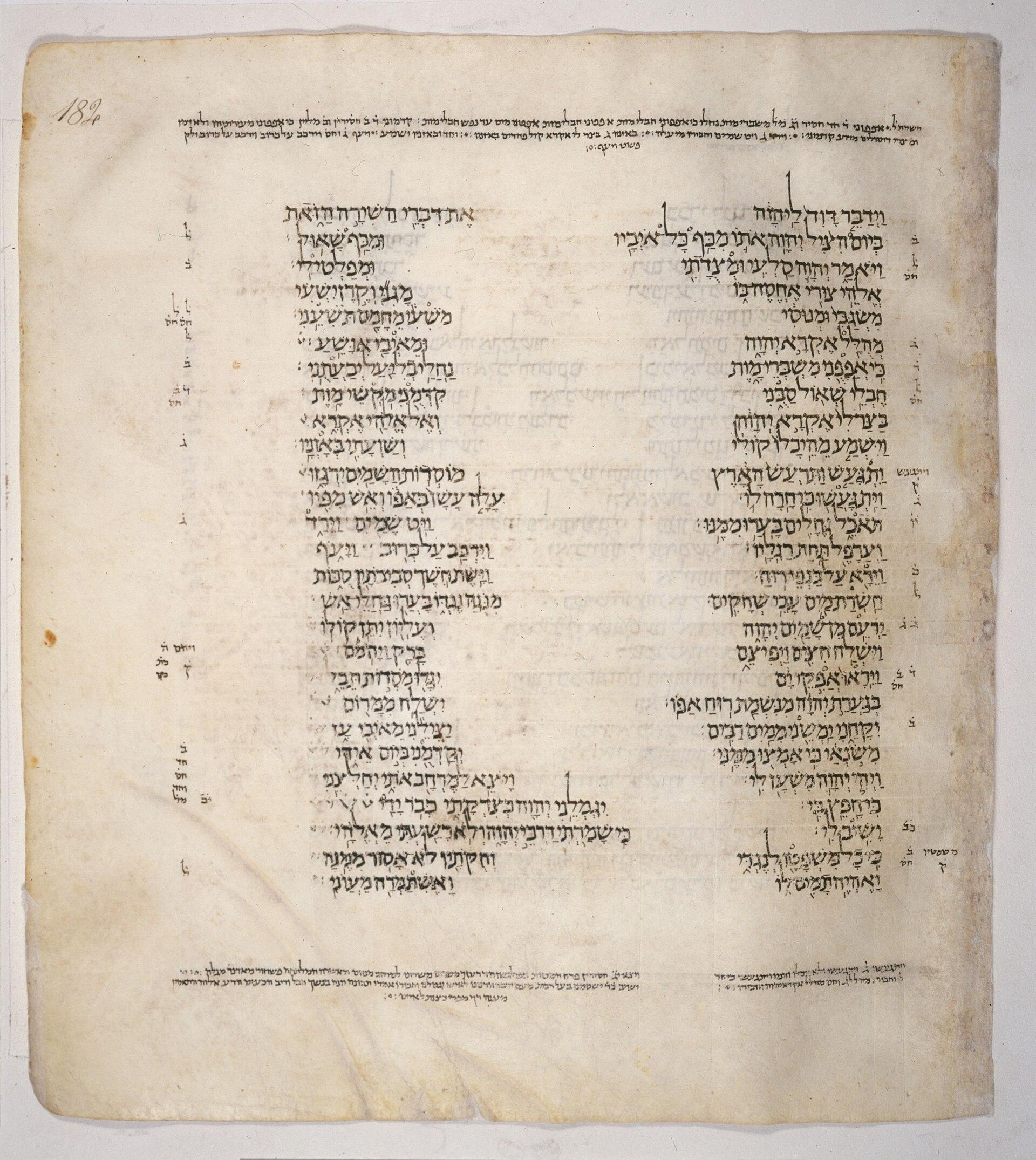
The Leningrad Codex, folio 182a, 1008 to 1011. Public domain.
2 Samuel 22 and Psalm 18 · Passage · Featured Study
The Psalms That Stand Twice
Five passages stand twice in the Hebrew Bible, between Samuel, Chronicles and the Psalter.
Two copies of one psalm part by a word or by a name of God.
And David sang this song to the LORD on the day the LORD had delivered him from the hand of all his enemies and from the hand of Saul.
- The passage
- 2 Samuel 22:1 to 51, Psalm 18:1 to 50, Psalm 53:1 to 6, Psalm 70:1 to 5, Psalm 108:1 to 13, 1 Chronicles 16:8 to 36
- Books
- 2 Samuel, Psalms, 1 Chronicles
- Hold in memory
- 2 Samuel 22:31
Summary
David's song of deliverance stands in his history and again in the Psalter, and four more passages are doubled in the same way. Readers from Origen to Spurgeon noticed the copies, and the Hebrew shows where they agree and where they part.
- Of the 51 verses of 2 Samuel 22, 39 match a verse of Psalm 18 with at least half their Hebrew words in common.
- Psalm 53 repeats Psalm 14 with God, Elohim, in place of the LORD.
- Psalm 70 repeats the last five verses of Psalm 40.
- One psalm is built from the closing halves of two others.
- The song of 1 Chronicles 16 gathers lines that stand in Psalms 105, 96 and 106.
One Song in Two Books
Psalm 18 adds a line of love before the names of the LORD that both copies share.
The Psalms That Stand Twice takes up the places where Scripture gives one psalm in two copies. The question it answers is what the two copies share and where they part. It sets David's song beside its psalm, then the four other doubled passages, with the Hebrew words that differ and the readers who noticed them.
He said: “The LORD is my rock, my fortress, and my deliverer.The song in 2 Samuel opens on the LORD as rock, fortress and deliverer.
I love You, O LORD, my strength.The psalm opens with one line of love before the same names of the LORD.
The Doubled Texts
Eight pairs of passages share most of their Hebrew words verse by verse.
Psalm 108 and Psalm 60 share the most of their words, and 2 Samuel 22 and Psalm 18 the most verses.
| The doubled text | Verses matched | Hebrew words shared |
|---|---|---|
| The LORD is my rock, in 2 Samuel 22:1 to 51 and Psalm 18:1 to 50 | 39 of 51 | 217 of 299 |
| The fool says in his heart, in Psalm 14:1 to 7 and Psalm 53:1 to 6 | 5 of 7 | 49 of 58 |
| Hurry to help me, in Psalm 40:13 to 17 and Psalm 70:1 to 5 | 5 of 5 | 35 of 48 |
| My heart is steadfast, in Psalm 108:1 to 5 and Psalm 57:7 to 11 | 5 of 5 | 27 of 36 |
| God has spoken from His sanctuary, in Psalm 108:6 to 13 and Psalm 60:5 to 12 | 8 of 8 | 58 of 63 |
| Give thanks to the LORD, in 1 Chronicles 16:8 to 22 and Psalm 105:1 to 15 | 15 of 15 | 88 of 100 |
| Sing to the LORD, all the earth, in 1 Chronicles 16:23 to 33 and Psalm 96:1 to 13 | 8 of 11 | 50 of 68 |
| Save us, gather us, in 1 Chronicles 16:34 to 36 and Psalm 106:1, 47 to 48 | 3 of 3 | 26 of 35 |
Sing to the LORD, all the earth, in 1 Chronicles 16:23 to 33 and Psalm 96:1 to 13, Save us, gather us, in 1 Chronicles 16:34 to 36 and Psalm 106:1, 47 to 48
Where Samuel and the Psalm Part
Five verses stand word for word in both copies, and the other matched verses part by one to five words.
Three places where the two copies of David's song part.
| Place in the song | 2 Samuel 22 | Psalm 18 |
|---|---|---|
| The flight on the wind | the verb vayyera, וַיֵּרָא (h7200), at 2 Samuel 22:11 | the verb vayyede, וַיֵּדֶא (h1675), at Psalm 18:10 |
| The shield | six Hebrew words at 2 Samuel 22:36 | eight at Psalm 18:35, with vimincha tis'adeni (h3225, h5582) |
| The last line | migdol, מִגְדּוֹל (h4024), at 2 Samuel 22:51 | magdil, מַגְדִּיל (h1431), at Psalm 18:50 |
You have given me Your shield of salvation, and Your gentleness exalts me.Samuel's line is the shorter of the two.
You have given me Your shield of salvation; Your right hand upholds me, and Your gentleness exalts me.The psalm's line is the longer, and the Berean text renders its two extra words in the middle of the verse.
Psalm 14 and Psalm 53
The two psalms differ most in the name of God and in one verse.
The LORD looks down from heaven upon the sons of men to see if any understand, if any seek God.Psalm 14 names the LORD, YHWH, as the one who looks down.
God looks down from heaven upon the sons of men to see if any understand, if any seek God.Psalm 53 has God, Elohim, in the same place.
The Hebrew has YHWH (h3068) at Psalm 14:2, 4 and 7, and Elohim (h430) at the matching places in Psalm 53:2, 4 and 6. Psalm 53:5 tells of God scattering the bones of those who besieged you, and Psalm 14:5 and 6 tell of God in the company of the righteous.
Adam Clarke, in his Commentary on the Bible (1832), wrote that the whole of Psalm 53, except a few inconsiderable differences, is the same as the fourteenth.
Psalm 70 and Psalm 108
Each of the two psalms changes a word or a line of the psalm it repeats.
Be pleased, O LORD, to deliver me; hurry, O LORD, to help me.Psalm 40:13 names the LORD twice in its plea.
Make haste, O God, to deliver me! Hurry, O LORD, to help me!Psalm 70:1 has God in the first half of the plea and the LORD in the second.
Charles Spurgeon counted Psalm 70 as the second psalm to repeat another, and he read its opening as a cry for haste.
“This is the second Psalm which is a repetition of another, the former being Psalm 53, which was a rehearsal of Psalm 14. The present differs from the Fortieth Psalm at the outset, for that begins with, ‘Be pleased, ‘and this, in our version, more urgently with, Make haste; or, as in the Hebrew, with an abrupt and broken cry, O God, to deliver me; O Lord, to help me hasten. It is not forbidden us, in hours of dire distress, to ask for speed on God's part in his coming to rescue us.”
Charles Spurgeon · The Treasury of David, Vol. 3 · on Psalm 70:1Particular Baptist
My heart is steadfast, O God, my heart is steadfast. I will sing and make music.Psalm 57 says twice that the heart is steadfast.
My heart is steadfast, O God; I will sing and make music with all my being.Psalm 108 says it once and goes on to the music.
Psalm 57:7, Psalm 108:1
What the Text Leaves Unsaid
Neither copy of any doubled psalm names the hand that made the second.
Neither copy of David's song says which came first, and the Psalter says nothing of why a psalm it already holds was written again.
The Song of 1 Chronicles 16
Chronicles sets a song of thanksgiving in David's reign and gives it to Asaph and his brothers.
On that day David first committed to Asaph and his brothers this song of thanksgiving to the LORD:The song that follows draws on three psalms of the Psalter.
Origen of Alexandria named the doubled songs in the prologue to his Commentary on the Song of Songs.
“The sixth song is in 1 Chronicles, where David first established Asaph and his brothers for praising the Lord. The beginning of the song is as follows, ‘Praise the Lord, give thanks to him, and call on his name; make known his purposes among the peoples. Sing to him, sing praises to him, tell of all his wonderful works, which the Lord has done,’ and so forth. It should, however, be known that the song in 2 Samuel is very much like Psalm 18. Furthermore, the first part of the text in 1 Chronicles, up to the place where it says ‘and do my prophets no harm,’ is like Psalm 105, and the latter part of it, following the verse just mentioned, bears a likeness to the first part of Psalm 96, where it says, ‘Sing to the Lord, all the earth,’ up to the place where it says ‘for he comes to judge the earth.’”
Origen of Alexandria · Commentary on the Song of Songs, Prologue 4 · on 1 Chronicles 16:8Patristic
Give thanks to the LORD, for He is good; His loving devotion endures forever. Then cry out: ‘Save us, O God of our salvation; gather and deliver us from the nations, that we may give thanks to Your holy name, that we may glory in Your praise.’ Blessed be the LORD, the God of Israel, from everlasting to everlasting.” Then all the people said, “Amen!” and “Praise the LORD!”The song closes on thanks, a plea to be gathered and a blessing.
Save us, O LORD our God, and gather us from the nations, that we may give thanks to Your holy name, that we may glory in Your praise. Blessed be the LORD, the God of Israel, from everlasting to everlasting. Let all the people say, “Amen!” Hallelujah!The psalm closes on the same plea and the same blessing.
How the Teachers Read It
Albert Barnes read 2 Samuel 22 and Psalm 18 as one song with one commentary.
Albert Barnes (1798 to 1870)
Albert Barnes sent the reader of 2 Samuel 22 to his commentary on Psalm 18 for the verses.
“This song, which is found with scarcely any material variation as Ps. 18, and with the words of this first verse for its title, belongs to the early part of David’s reign when he was recently established upon the throne of all Israel, and when his final triumph over the house of Saul, and over the pagan nations 2Sa 22:44-46, Philistines, Moabites, Syrians, Ammonites, and Edomites, was still fresh 2 Sam. 21. For a commentary on the separate verses the reader is referred to the commentary on Ps. 18.”
Albert Barnes · Notes, Explanatory and Practical, on the Old and New Testaments (1832-1869) · on 2 Samuel 22:1Evangelical
Books to Read Next
Two works name the doubled psalms, one of the third century and one of the nineteenth.
The Treasury of David
Charles Spurgeon · 1869 to 1885
Spurgeon reads every psalm verse by verse and notes where Psalms 53 and 70 repeat others.
READ IT FREE AT CCEL →Commentary on the Song of Songs
Origen of Alexandria · third century
Origen's prologue gives the songs of Scripture in order and names the psalms that stand in Samuel and Chronicles.
The Song Sung Again
The song closes on the house of David.
David's song ends on the promise Nathan carried to him in 2 Samuel 7.
Great salvation He brings to His king. He shows loving devotion to His anointed, to David and his descendants forever.”Its last word, forever, answers the forever of the throne promised in 2 Samuel 7:16.
Sources
Scripture is the Berean Standard Bible.
- The doubled texts compared word by word in their Hebrew.
- The Hebrew words of 2 Samuel 22:11, 2 Samuel 22:36, 2 Samuel 22:51, Psalm 18:10, Psalm 18:35, Psalm 18:50, Psalm 14:2 and Psalm 53:2, with Strong's numbers.
- Albert Barnes, Notes on the Old Testament, on 2 Samuel 22:1.
- Charles Spurgeon, The Treasury of David, volume 3 (1872), on Psalm 70:1.
- Adam Clarke, Commentary on the Bible (1832), on Psalm 53:1.
- Origen of Alexandria, Commentary on the Song of Songs, prologue 4.
Keep Studying
Read it6
Studies19
Symbols1
Subjects1
Doctrines2