
Psalm 4:8 · Subject · Peace
Peace and the Nervous System
Psalm 4:8 names a sleep without fear, and nine published papers describe the body under strain and at rest.
The psalmist slept and woke again with "the myriads set against me on every side" (Psalm 3:6).
I will lie down and sleep in peace, for You alone, O LORD, make me dwell in safety.
- Books
- Psalms, Isaiah, John
- Hold in memory
- Psalm 4:8
Summary
Scripture grounds peace in God, who keeps in peace the mind that trusts in Him and gives His people sleep without fear. Research on the body describes the other side of the matter: how stress, worry and quarrels keep the body roused, and how slow breathing and sleep let it settle. These studies are corroboration and never the ground, and each one measures a narrow thing in a particular group. None of them shows that a verse is true or that a practice brings anyone peace with God.
- In laboratory studies, tasks a person could not control and others could judge raised the stress hormone cortisol most and took longest to recover from.
- Worry and rumination keep the stress response running before and after a stressor, with higher blood pressure, heart rate and cortisol.
- Slow breathing raised heart rate variability in a meta-analysis of 223 studies (Laborde and others, 2022).
- Stress goes with shorter and broken sleep, and lost sleep raises cortisol in turn.
- Polyvagal theory, a popular account of the vagus nerve, is contested, and a 2023 review argues that each of its five premises fails.
Peace Grounded in God
Isaiah and Jesus place peace in God's keeping before any study of the body is read.
Peace and the Nervous System sets the findings of the laboratory beside what Scripture says of peace. Peace is a value Scripture asks of believers and grounds in God, and the papers set beside it measure heart, hormones and sleep in people under strain.
The question this study answers is what the research shows about a body under strain and a body at rest, and what it leaves unshown. Its ground runs from worry and conflict to breathing, the night's rest and the dispute over polyvagal theory.
You will keep in perfect peace the steadfast of mind, because he trusts in You.Isaiah ties the keeping of peace to trust in God, so the source of that peace lies outside the one who is kept.
Peace I leave with you; My peace I give to you. I do not give to you as the world gives. Do not let your hearts be troubled; do not be afraid.Jesus gives His own peace and joins the gift to a command about the troubled and fearful heart.
David's evening psalm names the LORD as the ground of his safety in sleep (Psalm 4:8), and the research describes the body that lies down.
Nine Studies Side by Side
Three of the nine studies are meta-analyses, one is a trial, four are reviews and one states a theory.
The nine papers differ in design and strength, from a theory paper to meta-analyses of hundreds of studies.
| Study | Design and sample | Finding | What it does not show |
|---|---|---|---|
| Dickerson and Kemeny, Psychological Bulletin, 2004 | Meta-analysis of 208 laboratory studies of short stressful tasks | Tasks both uncontrollable and open to others' judgment gave "the largest cortisol and adrenocorticotropin hormone changes and the longest times to recovery" | Stress in daily life outside the laboratory |
| Kiecolt-Glaser and others, Archives of General Psychiatry, 2005 | Crossover trial of 42 healthy married couples in a hospital research unit | Blister wounds healed more slowly after a marital disagreement than after a support talk, and couples high in hostility "healed at 60% of the rate of low-hostile couples" | Effects beyond its sample of 42 married couples |
| Brosschot, Gerin and Thayer, Journal of Psychosomatic Research, 2006 | Review of studies of worry, rumination and anticipatory stress | Worry and rumination "can prolong stress-related affective and physiological activation" | A measured size of the effect; the authors call their support "preliminary" |
| Åkerstedt, Scandinavian Journal of Work, Environment and Health, 2006 | Review of studies of stress and sleep | Found that "stress is closely related to impaired sleep in cross-sectional studies", and that shortened or disturbed sleep raises cortisol | The effects of real work stress over time, where "Much knowledge is still lacking" |
| Porges, Biological Psychology, 2007 | Paper stating a theory | Sets out the theory in its author's words | An independent test of the theory |
| Ottaviani and others, Psychological Bulletin, 2016 | Meta-analysis of 60 studies of healthy people | Worry and rumination went with higher blood pressure, heart rate and cortisol and with lower heart rate variability | Disease outcomes; the blood pressure results showed publication bias |
| Zaccaro and others, Frontiers in Human Neuroscience, 2018 | Systematic review of 15 studies drawn from 2,461 abstracts | Slow breathing raised heart rate variability, with "increased comfort, relaxation" among its reported effects | A settled mechanism, which the authors call "still under debate" |
| Laborde and others, Neuroscience and Biobehavioral Reviews, 2022 | Meta-analysis of 223 studies of voluntary slow breathing | Vagally mediated heart rate variability rose during slow breathing, just after one session and after courses of sessions | Clinical outcomes of illness or health |
| Grossman, Biological Psychology, 2023 | Critical review of the polyvagal theory's five premises | Argues that each premise is "either untenable or highly implausible" | A final verdict on the theory |
Zaccaro and others, Frontiers in Human Neuroscience, 2018, Laborde and others, Neuroscience and Biobehavioral Reviews, 2022, Grossman, Biological Psychology, 2023
Stress That Outlasts Its Cause
Three studies show that the kind of stress and the habit of dwelling on it shape the body's response.
Dickerson and Kemeny found that cortisol rose with some kinds of task and not with others, and they wrote that their findings "contradict the belief that cortisol is responsive to all types of stressors".
Brosschot, Gerin and Thayer named the habit of dwelling on a stress perseverative cognition. Their hypothesis concerns the time around a stress, before it comes and after it has gone, and Ottaviani and her colleagues later pooled the studies that measured it.
Therefore do not worry about tomorrow, for tomorrow will worry about itself. Today has enough trouble of its own.Jesus' command about tomorrow follows His teaching on the birds and the lilies, so it rests on the Father's care for His children.
Quarrels and the Healing Body
A trial in a hospital research unit compared two kinds of conversation between spouses.
Each couple in the trial of Janice Kiecolt-Glaser and her colleagues spent two stays of 24 hours in the research unit, one with a structured talk of support and one discussing a disagreement. The authors read the result as evidence of "the sensitivity of wound healing to everyday stressors".
If it is possible on your part, live at peace with everyone.Paul sets the limit of a believer's duty at what is possible on his own part, since the other party may refuse peace.
Peacemakers who sow in peace reap the fruit of righteousness.James names the harvest that those who sow peace reap, which is righteousness.
Slow Breathing and the Rhythm of the Heart
Two reviews measured what slowing the breath does to heart rate variability.
Laborde and his colleagues measured the heart rate variability that indexes the activity of what they call the parasympathetic nervous system (PNS) in regulating the heart. They concluded that slow breathing "could be advised as a low-tech and low-cost technique" for prevention, "with few adverse effects expected".
Zaccaro and his colleagues linked slow breathing to "parasympathetic activity" and to calmer states of mind in healthy people. The studies measure slow breathing as a technique of the body, and the practices of peace Scripture names are prayer, trust in God and the pursuit of peace with others.
Stress and Sleep
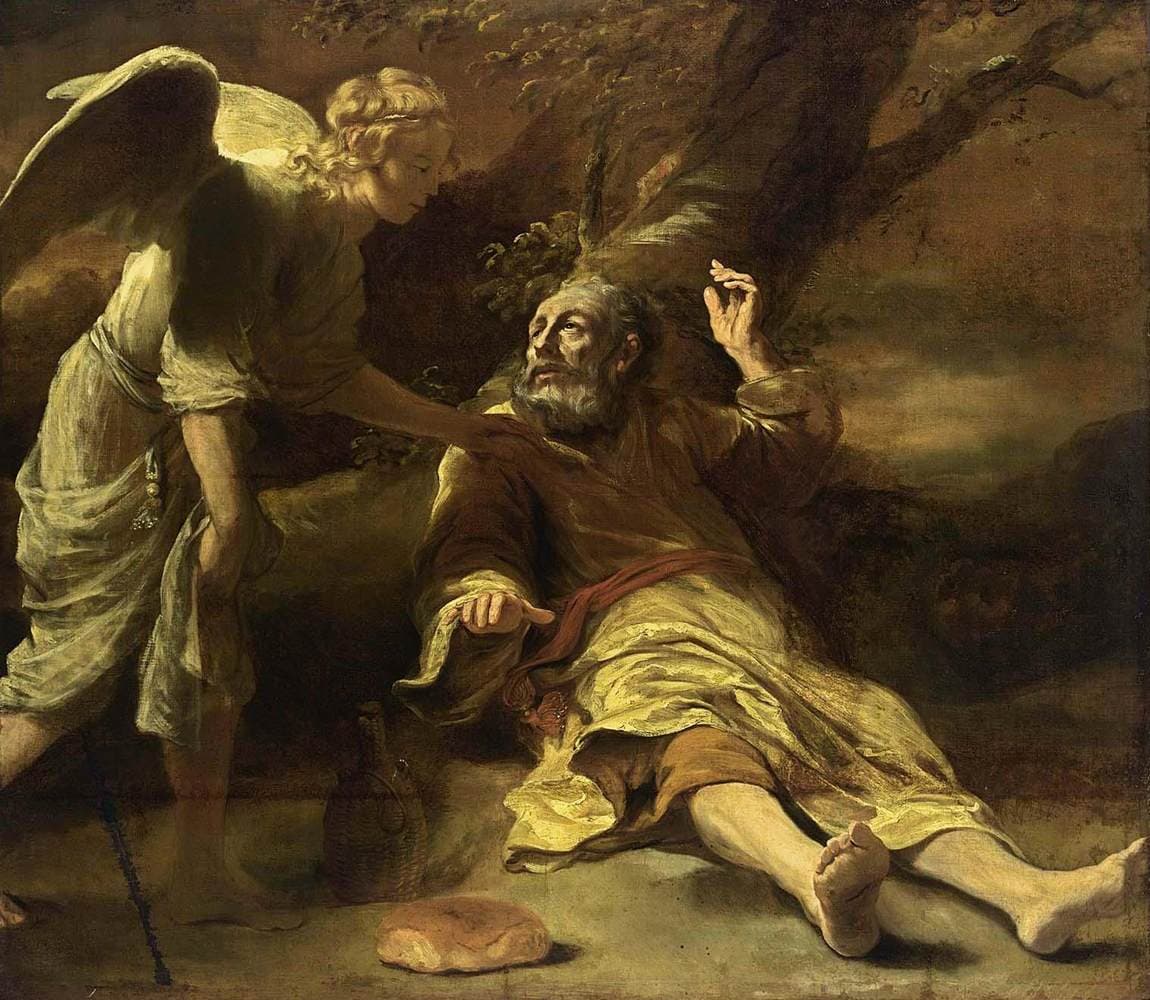
Scripture records sleep given to a prophet in despair and to a king in flight from his son.
Åkerstedt's review found that "the anticipation of high demands or effort the next day seems important" for sleep.
Then he lay down under the broom tree and fell asleep. Suddenly an angel touched him and said, “Get up and eat.” And he looked around, and there by his head was a cake of bread baked over hot coals, and a jar of water. So he ate and drank and lay down again.Before the LORD spoke to Elijah at Horeb, the angel let him sleep and set food beside him.
I lie down and sleep; I wake again, for the LORD sustains me.David's psalm is headed as written when he fled from his son Absalom, so the sleep it records came in danger.
The Limits of the Research
The studies measure groups over hours or days and leave the soul's peace with God unmeasured.
Most of these studies measure groups in laboratories or hospital units over hours or days, and a group's average cannot be read off as one person's state. They describe the body under stress and at rest, and they measure no one's peace with God.
Scripture's promise of peace rests on God, whatever a measure of the body shows on a given day. The studies of thanksgiving and anxiety, with Philippians 4:6 to 7, have their own page.
Voices on Rest and Stillness
Matthew Henry and Charles Spurgeon wrote on the sleep of Psalm 4.
1662 to 1714 · Matthew Henry
Henry stands here for the sleep of Psalm 4, the rest of one who has left his cares with God.
Read the page on Matthew Henry
“It is said of the husbandman that, having cast his seed into the ground, he sleeps and rises night and day, and the seed springs and grows up, he knows not how, Mark iv. So a good man, having by faith and prayer cast his care upon God, sleeps and rests night and day, and is very easy, leaving it to his God to perform all things for him and prepared to welcome his holy will.”
Matthew Henry · Commentary on the Whole Bible · on Psalm 4:8Puritan
1834 to 1892 · Charles Spurgeon
Spurgeon stands here for the same evening psalm.
Read the page on Charles Spurgeon
“Sweet Evening Hymn! I shall not sit up to watch through fear, but I will lie down; and then I will not lie awake listening to every rustling sound, but I will lie down in peace and sleep, for I have nought to fear. He that hath the wings of God above him needs no other curtain. Better than bolts or bars is the protection of the Lord.”
Charles Spurgeon · The Treasury of David, Vol. 1 · on Psalm 4:8
Polyvagal Theory and Its Critic
A popular account of the vagus nerve is disputed in the journal that published its full statement.
Stephen Porges's polyvagal theory relates the autonomic nervous system to behaviour, and it holds that two vagal systems arose in the course of the evolution of the vertebrates.
Paul Grossman's review holds that the theory rests on one measure, respiratory sinus arrhythmia, the change of heart rate with breathing in and out. He calls the use of that measure as the vagal tone itself "a category mistake", confusing an approximate index of a process with the process. The theory therefore stands as a contested hypothesis, and its terms are held as claims under test.
Rest Given by Christ
Matthew records the invitation Jesus gave to the weary and burdened.
The same chapter ends with His words, "For My yoke is easy and My burden is light" (Matthew 11:30).
Come to Me, all you who are weary and burdened, and I will give you rest.The rest Jesus promises is His own to give, and it comes to those who come to Him.
Sources
Scripture is the Berean Standard Bible.
- Sally S. Dickerson and Margaret E. Kemeny, Acute stressors and cortisol responses: a theoretical integration and synthesis of laboratory research, Psychological Bulletin 130, no. 3 (2004): 355 to 391.
- Janice K. Kiecolt-Glaser and others, Hostile marital interactions, proinflammatory cytokine production, and wound healing, Archives of General Psychiatry 62, no. 12 (2005): 1377 to 1384.
- Jos F. Brosschot, William Gerin and Julian F. Thayer, The perseverative cognition hypothesis: a review of worry, prolonged stress-related physiological activation, and health, Journal of Psychosomatic Research 60, no. 2 (2006): 113 to 124.
- Torbjörn Åkerstedt, Psychosocial stress and impaired sleep, Scandinavian Journal of Work, Environment and Health 32, no. 6 (2006): 493 to 501.
- Stephen W. Porges, The polyvagal perspective, Biological Psychology 74, no. 2 (2007): 116 to 143.
- Cristina Ottaviani and others, Physiological concomitants of perseverative cognition: a systematic review and meta-analysis, Psychological Bulletin 142, no. 3 (2016): 231 to 259.
- Andrea Zaccaro and others, How breath-control can change your life: a systematic review on psycho-physiological correlates of slow breathing, Frontiers in Human Neuroscience 12 (2018): 353.
- Sylvain Laborde and others, Effects of voluntary slow breathing on heart rate and heart rate variability: a systematic review and a meta-analysis, Neuroscience and Biobehavioral Reviews 138 (2022): 104711.
- Paul Grossman, Fundamental challenges and likely refutations of the five basic premises of the polyvagal theory, Biological Psychology 180 (2023): 108589.
- Matthew Henry, Commentary on the Whole Bible (1710), on Psalm 4:8.
- Charles Spurgeon, The Treasury of David, vol. 1 (1869) on Psalm 4:8.
Keep Studying
In this value5