
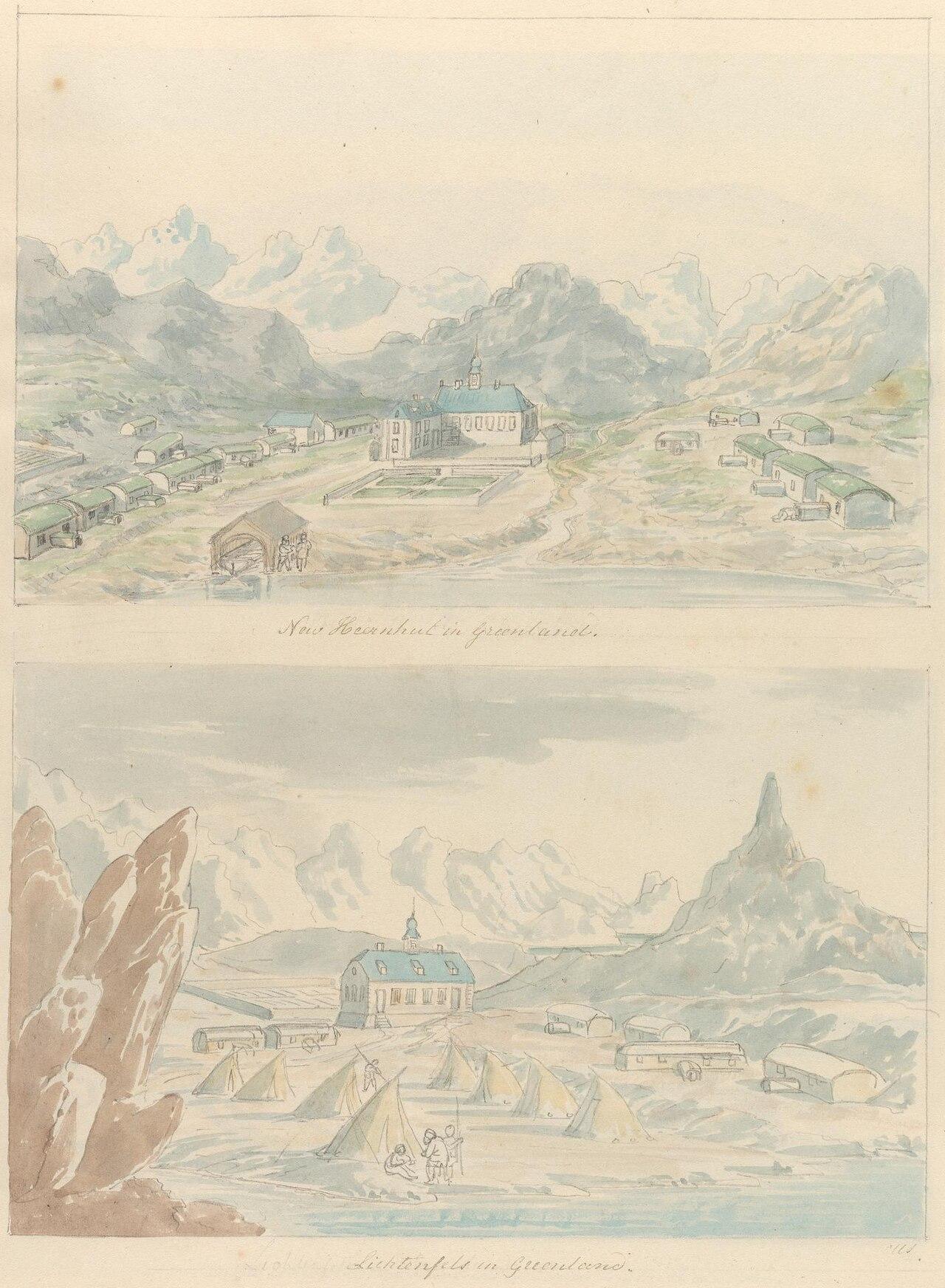
Charles Hamilton Smith, New Herrnhut in Greenland and Lichtenfels in Greenland, Yale Center for British Art, B1978.43.1820(71), public domain (CC0)
Moravia to Herrnhut, 1690 to 1751 · Person · Featured Study
Christian David
He was a Moravian carpenter and lay preacher who brought the first refugees to Zinzendorf's estate.
A carpenter struck his axe into the first tree of Herrnhut and spoke a psalm about a sparrow that had found a home.
Even the sparrow has found a home, and the swallow a nest for herself, where she places her young near Your altars, O LORD of Hosts, my King and my God.
Even the sparrow has found a home, and the swallow a nest for herself, where she places her young near Your altars, O LORD of Hosts, my King and my God.
- Born
- 31 December 1690, at Senftleben in Moravia, by Hutton (probable)
- Died
- 23 February 1751, by Spangenberg (1838) as his store row records it (probable)
- Places
- Görlitz, Herrnhut, Greenland
Summary
He was born in Moravia in 1690 to a Roman Catholic family. He found peace with God in a long illness at Görlitz and went back into Moravia to preach in secret. In 1722 he brought a small band of Protestants out of Moravia, and they built Herrnhut.
- At Herrnhut he was twice drawn into a teaching he later left.
- His account of his own life survives as Wesley wrote it down.
- Wesley and Hutton give the pastor who nursed him two different names.
The Sparrow and the House
Psalm 84 gave him his words at the first tree, and Romans 8 was one of his texts at Herrnhut.
No verse of Scripture names him. Hutton gives the words of Psalm 84 that he spoke on the day the building of Herrnhut began.
The question of this life is how a man who once loathed the name of Christ came to plant the settlement at Herrnhut. His own account to Wesley and the records of Herrnhut answer it.
Therefore, there is now no condemnation for those who are in Christ Jesus.This verse was one of his texts for those who are forgiven but still weak in faith.
The Life in Order
Hutton gives most of the dates, the records of Herrnhut give the eldership, and Wesley gives the visit.
His searching took thirty years, and his work at Herrnhut began in a single summer.
- 1690Birth at SenftlebenHutton
- 1710Belief in the MessiahHutton
- After 1710Public break with RomeHis account
- 1715Army serviceHutton
- 1717Illness at GörlitzHutton
- 1722Flight from MoraviaHutton
- 1722The first tree felledHutton
- 1727Chief Elder by lotMemorial-Days
- 1733To GreenlandHutton
- 1738A visit from EnglandWesley
- 1751DeathSpangenberg
Each step of the life stands with its witness.
1722, 1727, 1733, 1738, 1751
From Senftleben to Herrnhut
He searched among Catholics, Lutherans and Jews before a pastor's daily visits brought him peace.
He grew up a devout Roman Catholic in Moravia and worked as a shepherd. Protestants told him the Pope was Antichrist, and he read the books each side wrote against the other. He told Wesley that he came to loathe the very name of Christ.
He left Moravia and wandered, and some Jews deepened his doubts about the New Testament. He then read the Old Testament through to see whether its prophecies were fulfilled, and he became sure that Jesus was the Christ. He renounced Rome in public at Berlin.
He found the Lutherans of Berlin cold, and he enlisted as a soldier. After six months he went back to his trade. At Görlitz he fell so ill that he could not stir hand or foot for twenty weeks, and the pastor came to him every day. There, he said, the gospel first came with power to his soul.
He married at Görlitz and made it his home for five years. From there he went back into Moravia at the risk of his life to preach to his old Protestant friends. Hutton says they called him the Bush Preacher.
Through Pastor Schäfer and his friend Rothe he met Count Zinzendorf, who offered land at Berthelsdorf to persecuted Protestants. One night in the spring of 1722 he led a small band across the mountains, and they reached Berthelsdorf in June.
The steward Heitz marked out the site, and the first house went up on the Hutberg. He went on bringing people out of Moravia, and he told Wesley that the Catholic authorities set a price on his head. He made eleven trips in all.
In the spring of 1727 the lot placed him at the head of the community's leaders. In 1733 he sailed for Greenland with Matthew and Christian Stach to begin the Moravian mission there.
Two Turns at Herrnhut
The doctrine of election and a preacher named Krüger each led him away for a time.
He told Wesley that a Calvinist friend won him to the doctrine of election and reprobation, and that he won most of the brethren to it. In hard times they began to say that God might have hated them from eternity. Zinzendorf sent him to Pastor Steinmetz, who convinced him that Christ died for all.
The Count then called the settlers to his house, where they met for three days and read the Scriptures together. He said they came to one mind, that God wills all men to be saved.
Hutton tells of a second turn. A preacher named Krüger persuaded many settlers that the Lutheran church was no better than a den of thieves. He followed him for a time, dug his own well and built a house apart from the settlement. Krüger went out of his mind, and the Count stepped in.
In Their Own Words
Two passages of his account as Wesley wrote it down, and a letter to Heitz.
Christian David (1690 to 1751)
His account of his life, as John Wesley wrote it down, in Wesley's Journal for August 1738, page 86
The Papists in the wrong
“I read the Lutheran books writ against the Papists, and the Popish books writ against the Lutherans. I easily saw that the Papists were in the wrong; but not that the Lutherans were in the right.”
Moravian Brethren
About this saying1 paragraph
He told Wesley at Herrnhut, after he had lived there sixteen years, how his doubts began, and Wesley wrote the substance down at once.
Christian David
His account of his life, as John Wesley wrote it down, in Wesley's Journal for August 1738, page 87
By degrees
“Here I found the peace I had long sought in vain; for I was assured my sins were forgiven. Not indeed all at once, but by degrees; not in one moment, nor in one hour.”
Moravian Brethren
About this saying1 paragraph
In the same account he described the peace that came to him while he lay sick.
Christian David
A letter to Mr. Heitz, probably written in the year 1728, in The Memorial-Days of the Renewed Church of the Brethren, Appendix C, page 116
This work begun by himself
“This work begun by himself, here at Herrnhut, has been uninterruptedly advancing, from the first day of its commencement, even to this hour, though amidst many trials, yet with the divine blessing resting on it.”
Moravian Brethren
About this saying1 paragraph
He wrote to the steward Heitz, probably in 1728, about what he had seen at Herrnhut since Heitz left.
The People Around Him
Pietist pastors brought him to faith and to the Count, and Moravian families followed him out.
Each step of his life came through one person who sent him on.
| Person | Tie to him | The witness |
|---|---|---|
| The pastor at Görlitz | He came to his bedside daily, and his name is in question. | Wesley |
| Pastor Schäfer | He brought him to Rothe. | Hutton |
| Rothe | He spoke of him to the Count and became the minister of Berthelsdorf. | His account |
| Count Zinzendorf | The lord of the estate where the refugees settled. | His account |
| The Neissers of Sehlen | Two brothers and their households, the first to follow him. | Hutton |
| John George Heitz | He kept the Count's estate and wrote to him of the new town. | Hutton |
| Matthew Stach | His companion on the voyage north. | Hutton |
| John Wesley | The English visitor who printed his story. | Wesley |
Matthew Stach, John Wesley
He reported the Count's answer when he asked for a place for his friends.
“Let as many as will of your friends come hither; I will give them land to build on, and Christ will give them the rest.”
Nicolaus Ludwig von Zinzendorf · His words to Christian David, as Christian David reported them to John Wesley, in Wesley's Journal for August 1738, page 87Moravian
Heitz's letters record a prayer he made in the first house, that the place be called "the Watch of the Lord" and that those who lived in it should "watch day and night".
Five years later the Brethren began an hourly intercession, and Hutton writes that it is said to have lasted for over a hundred years.
The Places of His Life
His life runs from Moravia through Prussia and Saxony to Greenland.
He crossed the mountains into Moravia and back many times before he settled at Herrnhut.
| Place | What the witnesses say | The witness |
|---|---|---|
| Senftleben, Moravia | His home village. | Hutton |
| Berlin | The city where he joined the Lutherans. | Hutton |
| Stralsund | A siege he saw as a Prussian soldier. | Hutton |
| Görlitz | The town of the Pietist pastors who helped him. | Hutton |
| Sehlen, Moravia | A village of Moravia, home of the Neissers. | Hutton |
| Berthelsdorf and Herrnhut | Zinzendorf's estate, and the hill where the settlers built. | Hutton |
| Greenland | The mission he helped to begin. | Hutton |
What He Preached
Wesley heard him preach four times and wrote down the substance of one sermon.
Three times he described those who are weak in faith, forgiven through the blood of Christ but not yet given a clean heart. He preached it from the Beatitudes, from Romans 7 and 8, and from the apostles between the cross and Pentecost.
His fourth sermon was on the ground of faith. Wesley wrote down its substance, that we are reconciled to God "not by our own works, nor by our own righteousness, but wholly and solely by the blood of Christ". Wesley wrote that this sermon "made such an impression upon me" that he wrote it down when he went home.
How the Key Verse Was Taught
Augustine, Matthew Henry and Charles Spurgeon read the sparrow and the swallow.
Augustine of Hippo (died 430)
Exposition on Psalm 84
Augustine read the two birds as the heart and the flesh finding their home in God.
“You have heard a groan in the winepress, ‘My soul longs and fails for the courts of the Lord:’ hear how it holds out, rejoicing in hope: ‘My heart and my flesh have rejoiced in the living God.’ Here they have rejoiced for that cause. Whence comes rejoicing, but of hope? Wherefore have they rejoiced? ‘In the living God.’ What has rejoiced in you? ‘My heart and my flesh.’ Why have they rejoiced? ‘For,’ says he, ‘the sparrow has found her a house, and the turtle-dove a nest, where she may lay her young’ [Psalm 84:3]. What is this? He had named two things, and he adds two figures of birds which answer to them: he had said that his heart rejoiced and his flesh, and to these two he made the sparrow and turtle-dove to correspond: the heart as the sparrow, the flesh as the dove. The sparrow has found herself a home: my heart has found itself a home. She tries her wings in the virtues of this life, in faith, and hope, and charity, by which she may fly unto her home: and when she shall have come there, she shall remain; and now the complaining voice of the sparrow, which is here, shall no longer be there. For it is the very complaining sparrow of whom in another Psalm he says, ‘Like a sparrow alone on the housetop.’ From the housetop he flies home. Now let him be on the housetop, treading on his carnal house: he shall have a heavenly house, a perpetual home: that sparrow shall make an end of his complaints. But to the dove he has given young, that is, to the flesh: ‘the dove has found a nest, where she may lay her young.’ The sparrow a home, the dove a nest, and a nest too where she may lay her young. A home is chosen as for ever, a nest is framed for a time: with the heart we think upon God, as if the sparrow flew to her home: with the flesh we do good works. […]”
on Psalm 84:3Patristic
Matthew Henry (1662 to 1714)
Commentary on the Whole Bible
Matthew Henry guessed that singing birds were kept in the courts of the tabernacle.
“The word for a sparrow signifies any little bird, and (if I may offer a conjecture) perhaps when, in David's time, music was introduced so much into the sacred service, both vocal and instrumental, to complete the harmony they had singing-birds in cages hung about the courts of the tabernacle (for we find the singing of birds taken notice of to the glory of God, Ps. civ.”
on Psalm 84:3Puritan
Charles Spurgeon (1834 to 1892)
The Treasury of David, Vol. 4
Spurgeon read the verse as the longing of one kept away from the house of God.
“Yea, the sparrow hath found an house. He envied the sparrows which lived around the house of God, and picked up the stray crumbs in the courts thereof; he only wished that he, too, could frequent the solemn assemblies and bear away a little of the heavenly food. And the swallow a nest for herself, where she may lay her young. He envied also the swallows whose nests were built under the eaves of the priest's houses, who there found a place for their young, as well as for themselves.”
on Psalm 84:3Particular Baptist
What the Witnesses Leave Open
His witnesses differ on a pastor's name, on how many came out with him and on who the refugees were.
The pastor at GörlitzWesley's Journal; Hutton
Wesley's record of his account names the pastor who visited him daily as "Pastor Sleder". Hutton, who names two Pietist clergymen at Görlitz, Schäfer and Schwedler, gives the visits to Schwedler. Wesley wrote that he understood most of his words, and that a brother explained the rest in Latin.
How many came out with himHis account to Wesley; Hutton
In his account to Wesley he said that ten followed him at first and ten more the next year. Hutton names the band that left Sehlen on 27 May 1722: Augustin and Jacob Neisser with their wives and children, Martha Neisser and Michael Jaeschke.
Who the refugees wereHutton; the Statutes of Herrnhut, 1729
Hutton writes that "we cannot be sure that they were all descendants of the old Church of the Brethren". The public instrument signed at Herrnhut in August 1729 called the church of the Bohemian and Moravian brethren the one "from whom we are descended".
Books to Read Next
The Works of the Rev. John Wesley, volume III
Wesley, edited by John Emory · 1831
Wesley's Journal for that summer holds his account of his life and the substance of his sermons.
Read the volume free at the Internet ArchiveA History of the Moravian Church
J. E. Hutton · 1909
Hutton's Book Two, chapter 2, is his life up to the founding of Herrnhut.
Read Hutton free at Project GutenbergThe Memorial-Days of the Renewed Church of the Brethren
translated from the German · 1822
The community's own book holds his letter to Heitz and the choice of the elders.
Read the Memorial-Days free at the Internet ArchiveWhat He Left
He left the settlement he helped to build, a mission in Greenland and the account of his conversion that Wesley printed. The Memorial-Days call him "the general and first teacher" of the Brethren in that century.
Sources
Scripture is the Berean Standard Bible.
- The Holy Bible, Berean Standard Bible (read 2026)
- John Wesley, Journal, 1 to 14 August 1738, with Christian David's account and the substance of his sermons, in The Works of the Rev. John Wesley, volume III (New York: J. Emory and B. Waugh, 1831), pages 82 to 88.
- J. E. Hutton, A History of the Moravian Church (London, 1909), Book Two, chapters II, III, VI and VII.
- The Memorial-Days of the Renewed Church of the Brethren, translated from the German (Ashton-under-Lyne: T. Cunningham, 1822), chapter IV and Appendix C.
- August Gottlieb Spangenberg, The Life of Nicholas Lewis Count Zinzendorf, translated by Samuel Jackson (London, 1838), page 408, as the store row of Christian David records it.
- Augustine, Exposition on Psalm 84.
- Matthew Henry, Commentary on the Whole Bible, on Psalm 84:3.
- Charles Spurgeon, The Treasury of David, volume 4, on Psalm 84:3.
Keep Studying
People and groups6
Subjects1