
Leviticus 11 to 15 · Subject · Featured Study
Clean and Unclean
What Leviticus and Deuteronomy teach about food, bodily states and their cleansing, and how Mark 7, Acts 10 and Romans 14 read that teaching.
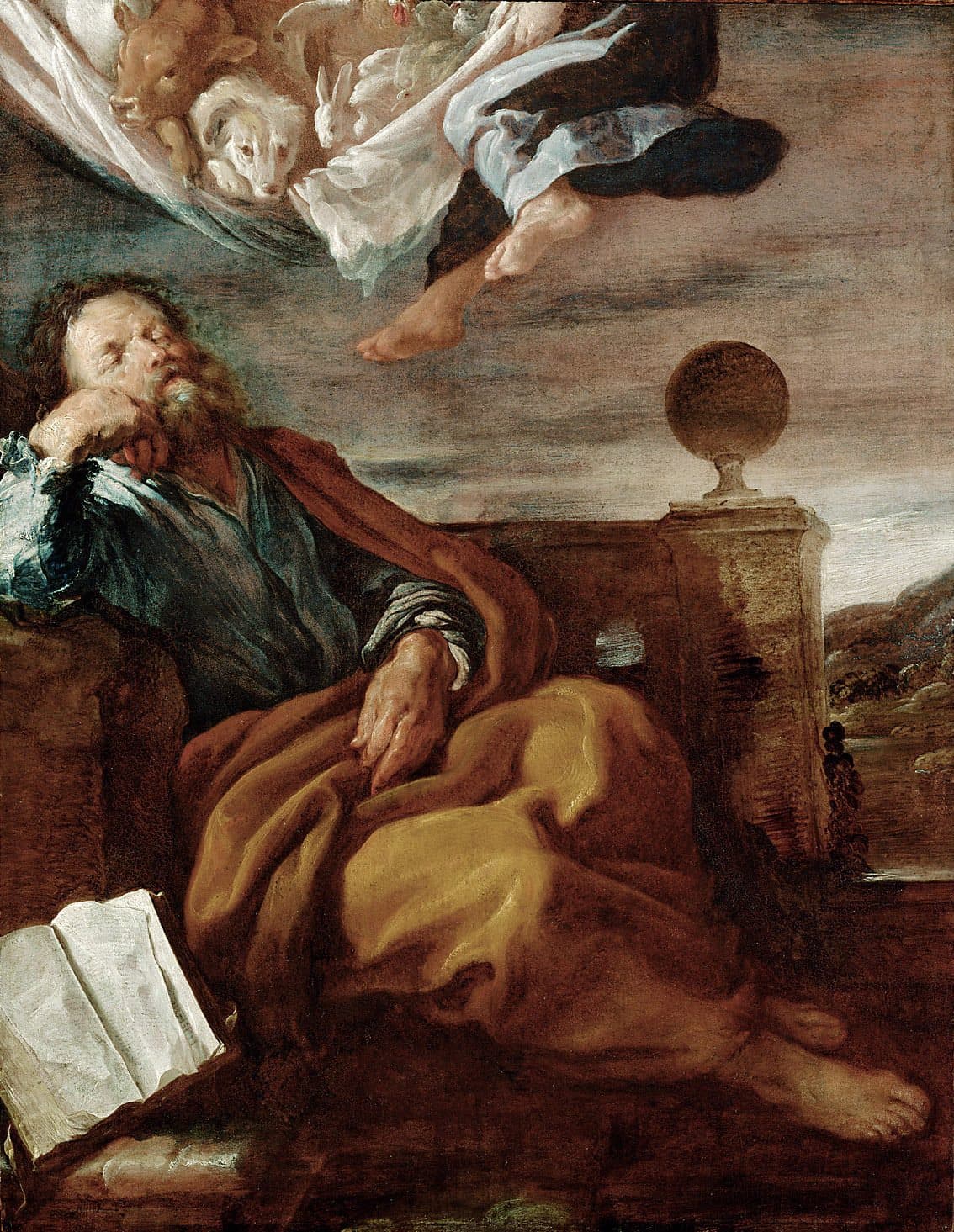
Peter told the voice on the rooftop that he had never eaten anything unclean, and the voice answered that God had made it clean.
Domenico Fetti, Peter's Vision of a Sheet with Animals, about 1619, Kunsthistorisches Museum, Vienna. Public domain, via Wikimedia Commons.
THE ARTWORKFetti painted Peter asleep against a stone parapet in a blue tunic and a red and gold cloak, with an open book at his side. Above him an angel's bare feet trail beneath a white sheet that holds a calf, a dog and a rabbit.
Summary
The Law of Moses named the animals Israel could eat and the states of the body that kept a person from the sanctuary.
- A land animal was clean if it had a split hoof and chewed the cud. A fish was clean if it had fins and scales.
- A carcass made a person unclean until evening. A corpse made a person unclean for seven days.
- Water, time or an offering ended each unclean state.
- An unclean person could not enter the sanctuary. The Law calls no unclean state a sin.
- Jesus taught that food does not defile the heart. Peter's vision taught him to call no person unclean.
Holy and Common, Clean and Unclean
The two pairs the priests were charged to keep apart
The charge to Aaron's sons names two pairs. Holy and common describe what belongs to God and what does not. Clean and unclean describe whether a person or a thing may come near what is holy.
The food laws close on the reason God gives for them. Israel is to be holy because the LORD who brought them out of Egypt is holy.
You must distinguish between the holy and the common, between the clean and the unclean,The LORD speaks this charge to Aaron.
For I am the LORD your God; consecrate yourselves, therefore, and be holy, because I am holy. You must not defile yourselves by any creature that crawls along the ground.The verse adds a ban on every creature that crawls along the ground.
Clean and Unclean Across the Canon
Nine books where the distinction is taught or applied
| Book | What the book adds | Passage |
|---|---|---|
| Genesis | Noah takes clean and unclean animals into the ark | Genesis 7:2 |
| Leviticus | The tests for food, the unclean states and their remedies | Leviticus 11 to 15 |
| Numbers | The law for anyone who touches the dead | Numbers 19:11-12 |
| Deuteronomy | The food laws again, before Israel enters the land | Deuteronomy 14:3-21 |
| Haggai | The priests answer two questions about what touch passes on | Haggai 2:11-13 |
| Mark | Jesus teaches the crowd and then His disciples on what defiles | Mark 7:14-19 |
| Acts | Peter's vision of the sheet and the house of Cornelius | Acts 10:9-28 |
| Romans | Paul tells the strong not to destroy a brother by what he eats | Romans 14:14-20 |
| Hebrews | The heifer's ashes set beside the blood of Christ | Hebrews 9:13-14 |
- Book
- Genesis
- What the book adds
- Noah takes clean and unclean animals into the ark
- Passage
- Genesis 7:2
- Book
- Leviticus
- What the book adds
- The tests for food, the unclean states and their remedies
- Passage
- Leviticus 11 to 15
- Book
- Numbers
- What the book adds
- The law for anyone who touches the dead
- Passage
- Numbers 19:11-12
- Book
- Deuteronomy
- What the book adds
- The food laws again, before Israel enters the land
- Passage
- Deuteronomy 14:3-21
- Book
- Haggai
- What the book adds
- The priests answer two questions about what touch passes on
- Passage
- Haggai 2:11-13
- Book
- Mark
- What the book adds
- Jesus teaches the crowd and then His disciples on what defiles
- Passage
- Mark 7:14-19
- Book
- Acts
- What the book adds
- Peter's vision of the sheet and the house of Cornelius
- Passage
- Acts 10:9-28
- Book
- Romans
- What the book adds
- Paul tells the strong not to destroy a brother by what he eats
- Passage
- Romans 14:14-20
- Book
- Hebrews
- What the book adds
- The heifer's ashes set beside the blood of Christ
- Passage
- Hebrews 9:13-14
The Tests for Food
Leviticus 11 and Deuteronomy 14 give one rule for beasts and one for fish
A land animal could be eaten when it had a split hoof and chewed the cud. The camel, the rock badger and the rabbit chew the cud without a divided hoof. The pig has the hoof without the cud, so each of the four is unclean.
A creature of the water could be eaten when it had fins and scales. Birds are given as a list of the forbidden with no test. Among the winged insects, only those with jointed legs for hopping may be eaten.
You may eat any animal that has a split hoof completely divided and that chews the cud.The rule for every land animal.
Of all the creatures that live in the water, whether in the seas or in the streams, you may eat anything with fins and scales.The rule for the seas and the streams.
The four exceptions
And the pig, though it has a split hoof completely divided, does not chew the cud; it is unclean for you.The last of the four exceptions the chapter names.
What Deuteronomy adds and leaves out
Deuteronomy names ten clean beasts by name, from the ox to the mountain sheep. It forbids every flying insect with no exception for locusts, and it lets an Israelite give or sell a carcass to a foreigner.
You are not to eat any carcass; you may give it to the foreigner residing within your gates, and he may eat it, or you may sell it to a foreigner. For you are a holy people belonging to the LORD your God. You must not cook a young goat in its mother’s milk.The verse gives Israel's holiness as the reason.
Leviticus makes anyone who eats an animal found dead, native or foreigner, wash and stay unclean until evening.
What a carcass touched
A dead creeping thing made unclean any wooden, cloth or leather article it fell on, and that article was rinsed and clean at evening. A clay pot it fell into was broken, while a spring or a cistern stayed clean.
Dry seed stayed clean under a carcass, and seed with water put on it became unclean.
What the Text Says Beside What Is Said
Two common readings, each set against its verse
It is often said that to be unclean was to be sinful. A priest was allowed to defile himself for a dead parent, child or brother. A mother became unclean by giving birth, so the state itself was no sin.
Guilt came when a person who had touched something unclean learned of it, and it was met by confession and an offering.
It is often said that Jesus broke the Law when He touched a leper. He healed the man and then sent him to the priest with the offering Moses commanded.
Then the LORD said to Moses, “Speak to Aaron’s sons, the priests, and tell them that a priest is not to defile himself for a dead person among his people, except for his immediate family—his mother, father, son, daughter, or brother, or his unmarried sister who is near to him, since she has no husband.The law for a priest's mourning.
“See that you don’t tell anyone. But go, show yourself to the priest and present the offering Moses prescribed for your cleansing, as a testimony to them.”Jesus also tells the man to say nothing to anyone.
Washing, Waiting and Offering
Six unclean states and what ended each
A CARCASS
Whoever touched or carried a carcass washed his clothes and was unclean until evening.
AN EMISSION OF SEMEN
A man bathed with water and was unclean until evening.
MENSTRUATION
A woman was unclean for seven days, and anyone who touched her was unclean until evening.
CHILDBIRTH
A mother waited forty days for a son and eighty for a daughter. Then she brought a lamb and a bird, or two birds if she was poor.
A SKIN DISEASE
The afflicted lived outside the camp crying out unclean, and once healed was cleansed with two birds, cedar, scarlet yarn and hyssop.
A CORPSE
Whoever touched the dead was unclean seven days and was sprinkled with water and the heifer's ashes on the third day and the seventh.
The Law gives its own reason for these rules. Uncleanness defiled the tabernacle where God dwelt among His people, and an Israelite who touched a corpse and would not be cleansed was cut off.
You must keep the children of Israel separate from their uncleanness, so that they do not die by defiling My tabernacle, which is among them.The charge is to keep Israel separate from uncleanness so that they do not die.
The offering at Jesus' birth
When the time of purification was complete, Mary and Joseph brought a pair of turtledoves or two young pigeons. That is the offering Leviticus allows a mother who cannot afford a lamb.
When Leviticus was given
The traditional dating places Leviticus in the years 1446 to 1406 BC, the forty years in the wilderness, with Moses as its author.
The purity laws in later Jewish teaching
Later Jewish law set out these chapters in close detail. Rashi's notes on Leviticus 12 cite the Talmud's tractate Niddah, and his notes on Leviticus 13 cite the Mishnah's tractate Negaim on the signs of skin disease.
The Words of the Subject
Eleven Hebrew and Greek words, five of them on cards
TAHOR
The Hebrew adjective for clean means pure, in a physical, ceremonial or moral sense.
TAME
The Hebrew adjective for unclean means foul in a religious sense, and the diseased man cries it twice.
TSARAAT
The Hebrew word the Berean renders as skin disease also marks mildew in garments and houses.
KOINOS
The Greek word Peter uses for impure means common, shared by all or ceremonially profane.
KATHARIZO
The Greek verb to cleanse closes Jesus' teaching on food in Mark 7 and stands again in the voice's answer to Peter.
Five more Hebrew words
Qodesh, holiness, means a sacred place or thing, and chol, common, is its opposite in Leviticus 10:10. Tumah is the noun for uncleanness, which the lexicon defines as religious impurity.
Sheqets, detestable, names the creatures of the water without fins and scales in Leviticus 11:10. Toevah, abomination, stands in the opening line of the food list in Deuteronomy 14:3.
One more Greek word
Akathartos, unclean, is the word Peter sets beside koinos in Acts 10:14. The lexicon gives it a ceremonial sense, a moral sense and the sense of an unclean spirit.
What the Text Leaves Unsaid
Four matters on which the text is silent
Genesis does not say how Noah knew which animals were clean. Leviticus ties its skin disease to no illness a physician would name today.
The Jerusalem council asked the Gentiles to abstain from four things and did not restore the animal lists. The Gospels do not say that Jesus ever ate an unclean food.
What the Distinction Taught
From the tabernacle to the house of Cornelius
Haggai asked the priests two questions about touch. Consecrated meat did not make the food it touched holy, while a man defiled by a corpse made it unclean.
Jesus answered a dispute about unwashed hands by moving defilement from the stomach to the heart.
Peter saw the sheet three times and then explained it at the house of Cornelius. God had shown him to call no man impure or unclean. At the council he said God had cleansed the hearts of the Gentiles by faith.
Paul wrote that nothing is unclean in itself and called food laws a shadow of what was to come.
So Haggai asked, “If one who is defiled by contact with a corpse touches any of these, does it become defiled?” “Yes, it becomes defiled,” the priests answered.The second question and the priests' answer.
Nothing that enters a man from the outside can defile him; but the things that come out of a man, these are what defile him.”The saying the disciples then asked Him about.
He said to them, “You know how unlawful it is for a Jew to associate with a foreigner or visit him. But God has shown me that I should not call any man impure or unclean.Peter's first words in the house of Cornelius.
I am convinced and fully persuaded in the Lord Jesus that nothing is unclean in itself. But if anyone regards something as unclean, then for him it is unclean.Paul adds that a thing is unclean to whoever regards it so.
Five Voices on the Distinction
Clement of Alexandria, Origen, John Wesley, Charles Spurgeon and Jamieson, Fausset and Brown
Clement of Alexandria, in The Instructor, read the split hoof as a sign of justice. He read chewing the cud as turning over the word in the mind.
Origen, in his Commentary on Matthew, held that the food laws of Leviticus and Deuteronomy are not grasped by a surface reading, and he read them through Jesus' words on what enters a man.
John Wesley noted that the animals were forbidden to Israel and were not abominable in their own nature.
Unto you - This clause is added to shew that they were neither abominable in their own nature, nor for the food of other nations; and consequently when the partition-wall between Jews and Gentiles was taken away, these distinctions of meat were to cease.
John Wesley · Explanatory Notes upon the Old Testament · on Leviticus 11:11Evangelical
Charles Spurgeon, in his sermon The Clean and the Unclean, preached on the sheet as a lesson about the nations and about food alike.
THE MOSAIC LAW ATTACHED great importance to meats and drinks: the Christian religion attaches none. The apostle Peter was shown by the vision of a sheet let down from heaven, not only that all nations were now to receive the gospel message, but that all kinds of food were now clean, and that all the prohibitions which had formerly been laid upon them for legal purposes were now once for all withdrawn. A Christian may, if he pleases, put himself under restrictions as to these matters.
Charles Spurgeon · The Metropolitan Tabernacle Pulpit, Sermon No. 499: “The Clean and the Unclean” (lightly modernized text, CCEL edition) · on Leviticus 11:2-3
Jamieson, Fausset and Brown read the voice to Peter as the end of the ceremonial distinctions between Jew and Gentile.
What God hath cleansed, that call not thou common--The ceremonial distinctions are at an end, and Gentiles, ceremonially separated from the chosen people (Ac 10:28), and debarred from that access to God in the visible ordinances of His Church which they enjoyed, are now on a perfect equality with them.
Jamieson, Fausset & Brown · Commentary Critical and Explanatory on the Whole Bible · on Acts 10:15Reformed
Why These Animals, and What Mark 7:19 Says
Two contested questions, each reading with its holders
Readers have given several reasons why God chose these animals, and each reading has its holders.
Health
Jamieson, Fausset and Brown held that the clean animals were the ones whose flesh was freer of harmful matter.
But the animals that may be eaten are those which "part the hoof as well as chew the cud," and this is another means of freeing the flesh of the animal from noxious substances.
Jamieson, Fausset & Brown · Commentary Critical and Explanatory on the Whole Bible · on Leviticus 11:3-7Reformed
The objection: the chapter gives holiness as its reason and names no illness, and Deuteronomy lets the foreigner eat what Israel may not.
Discipline of appetite
John Wesley held that denying lawful appetites trained Israel to refuse what was plainly sinful.
That by bridling their appetite in things in themselves lawful, and some of them very desirable, they might be better prepared and enabled to deny themselves in things simply and grossly sinful.
John Wesley · Explanatory Notes upon the Old Testament · on Leviticus 11:3Evangelical
The objection: a discipline of appetite does not explain why these animals were forbidden and not others.
A boundary from the nations
Leviticus 20 sets the lists of animals beside Israel's separation from the peoples. The food on an Israelite table marked him off from the nations. Wesley's note on Leviticus 11 reads the distinctions as lasting only while that separation stood.
You are to be holy to Me because I, the LORD, am holy, and I have set you apart from the nations to be My own.The call to be holy and the separation from the nations, in one verse.
The objection: the categories already stand in Genesis, before there was an Israel to separate.
The closing words of that teaching are read two ways.
because it does not enter his heart, but it goes into the stomach and then is eliminated.” (Thus all foods are clean.)The last verse of Jesus' answer to His disciples.
Mark declares all foods clean
The Greek participle for cleansing is masculine and nominative, so it agrees with Jesus as the speaker. The Berean prints the words as Mark's comment that Jesus declared all foods clean.
The objection: the dispute was about washing hands, and Matthew closes the same teaching on unwashed hands. Peter later says he had never eaten anything unclean.
These are what defile a man, but eating with unwashed hands does not defile him.”Matthew's account of the same teaching.
Digestion purges the food
The King James reads the words as part of Jesus' own sentence, about the body purging the food. Adam Clarke explains them as the body casting out what does not nourish.
Into the draught - See on Mat 15:17 (note). Purging all meats? - For what is separated from the different aliments taken into the stomach, and thrown out of the body, is the innutritious parts of all the meats that are eaten; and thus they are purged, nothing being left behind but what is proper for the support of the body.
Adam Clarke · Commentary on the Bible · on Mark 7:19Evangelical
The objection: Mark adds comments of his own in this chapter, as when he explains the washings of the Pharisees for his readers.
Cleansed by the Blood of Christ
The rules of clean and unclean taught Israel that no one comes near a holy God as they are. Water, time and the heifer's ashes cleansed the body. Hebrews says the blood of Christ cleanses the conscience so that we may serve the living God.
The call to be holy still stands for those whom Christ has made clean.
So the text asks the reader to come to God through Christ's cleansing and to be holy in all they do, because God is holy.
For if the blood of goats and bulls and the ashes of a heifer sprinkled on those who are ceremonially unclean sanctify them so that their bodies are clean, how much more will the blood of Christ, who through the eternal Spirit offered Himself unblemished to God, purify our consciences from works of death, so that we may serve the living God!The writer reasons from the lesser cleansing to the greater.
But just as He who called you is holy, so be holy in all you do, for it is written: “Be holy, because I am holy.”Peter carries the call of Leviticus 11:44 to the church.
Keep studying
Studies5
Places2