
Deuteronomy 21:22 to 23 · Passage · Featured Study
Hanged on a tree
The law limits the display of an executed criminal to one day and gives God's curse as the reason.
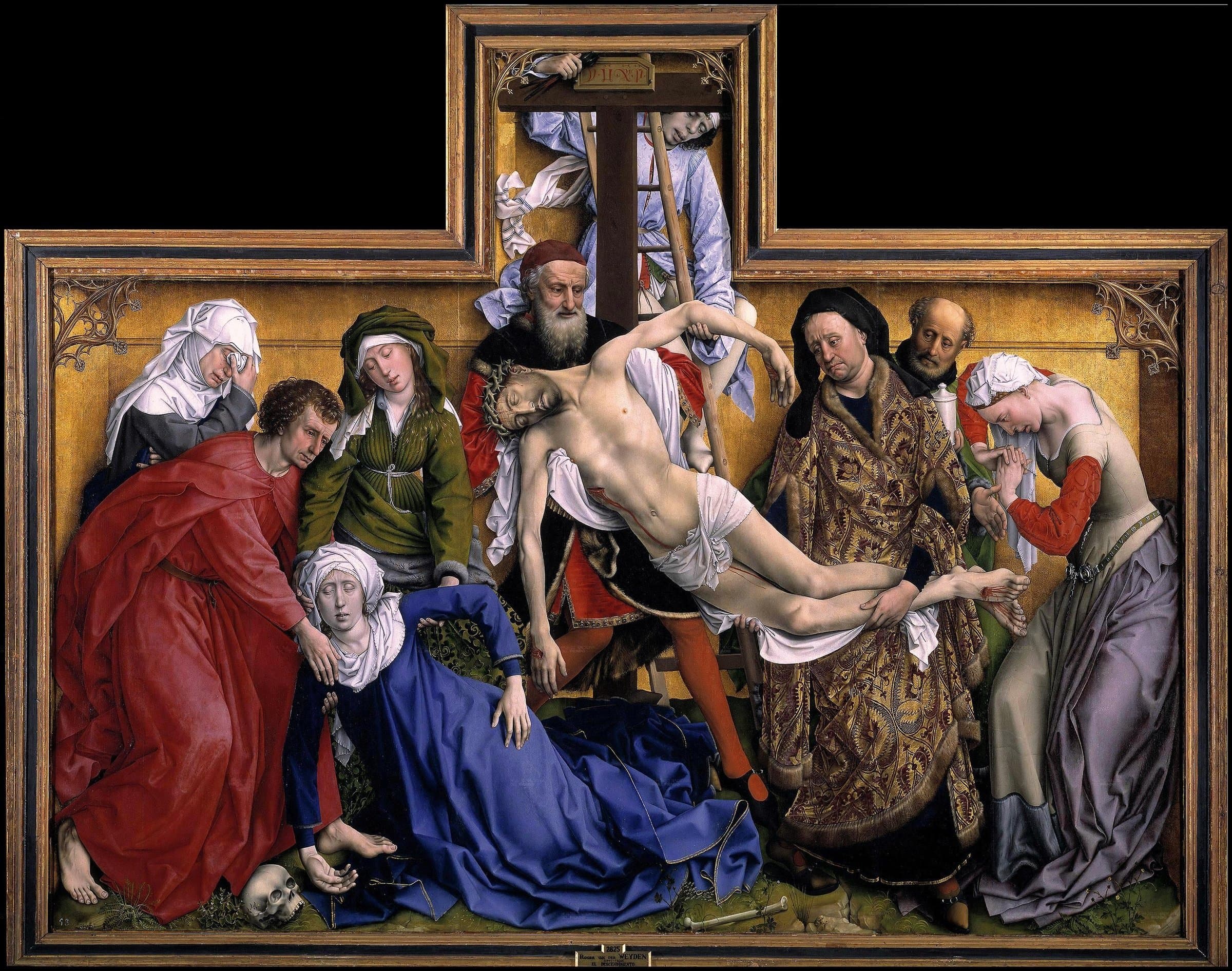
Rogier van der Weyden, The Descent from the Cross, before 1443, oil on panel, Museo del Prado, Madrid. Public domain (made before 1930). Wikimedia Commons, File:Weyden Deposition.jpg.
THE ARTWORKVan der Weyden paints the body of Jesus lowered from the cross by a man on a ladder and two older men, with His mother fallen in a faint beside it.
The Gospel of John records the bodies taken down from the crosses before a High Sabbath under this law.
Summary
The two verses close Deuteronomy 21 and follow the law of the stubborn and rebellious son.
- Esther 9:13 uses the Hebrew words of Deuteronomy 21:22, hang and tree, for the bodies of the ten sons of Haman.
- The Mishnah allows the hanging only for the bodies of the blasphemer and the idolater, and only for a moment.
- Galatians 3:13 quotes the law's reason, and Acts and 1 Peter call the cross of Jesus a tree.
The Law of the Hanged Man
If a man has committed a sin worthy of death, and he is executed, and you hang his body on a tree,The verse gives only the case, and every command of the law falls in the next verse.
you must not leave the body on the tree overnight, but you must be sure to bury him that day, because anyone who is hung on a tree is under God’s curse. You must not defile the land that the LORD your God is giving you as an inheritance.The verse joins the burial to the holiness of the land the LORD gives as an inheritance.
Rashi reads the order of Deuteronomy 21:18 to 23 as a warning that a son whose parents spare him will in the end commit a sin worthy of death by the court.
The Law in Four Parts
An outline of Deuteronomy 21:22 to 23 in four numbered parts.
How the Law Was Kept
The Mishnah and Josephus record how the hanging and the burial were done in the centuries before and after Christ.
Two crimes and a short hanging in the MishnahMishnah Sanhedrin 6:4
The Mishnah, compiled in the land of Israel about AD 190 to 230, records a dispute over whose bodies were hung. Rabbi Eliezer held that the bodies of all who were stoned were hung after death, and the Rabbis held that only the blasphemer and the idolater were hung.
It describes a post set in the ground with a beam across it. The dead man's hands were tied one on the other and he was hung by them. The body was untied almost at once, since a body left hanging overnight broke the command of Deuteronomy 21:23.
The blasphemer and the crucified in JosephusJosephus, Antiquities of the Jews 4.8.6; The Jewish War 4.5.2
Flavius Josephus sets the law among the laws of Moses in Antiquities of the Jews 4.8.6, in William Whiston's translation. The blasphemer is to be stoned, hung on a tree all that day, and then buried in an ignominious and obscure manner.
In The Jewish War 4.5.2 he writes of the siege of Jerusalem. The Jews, he says, took such care of burial that they took down those condemned and crucified and buried them before the going down of the sun.
Bodies Hung in the Old Testament
Four books of the Old Testament tell of bodies hung on a tree.
- GenesisJoseph tells Pharaoh's baker that Pharaoh will hang him on a tree and the birds will eat his flesh (Genesis 40:19).
- JoshuaThe king of Ai (Joshua 8:29) and the five kings of the south (Joshua 10:26 to 27) hang until evening and are taken down at sunset.
- 2 SamuelThe Gibeonites hang seven of Saul's descendants before the LORD, and Rizpah guards the bodies from the birds and the beasts until the rain falls (2 Samuel 21:9 to 10).
- EstherEsther asks the king that the bodies of Haman's ten sons be hanged on the gallows, and he commands it (Esther 9:13 to 14).
The four books in canon order, each with what its account tells.
Matthew Henry asks why the law's limit of one day did not hold for the descendants of Saul.
“He that is thus left hanged is accursed; therefore ordinary malefactors must not be so abused; but therefore these must, because they were sacrificed, not to the justice of the nation, but for the crime of the nation (no less a crime than the violation of the public faith) and for the deliverance of the nation from no less a judgment than a general famine.”
Matthew Henry · Commentary on the Whole Bible · on 2 Samuel 21:10Puritan
What the Law Leaves Unsaid
The law names no crime and covers every offence that carries the death penalty.
It gives no form for the tree or the post, and no length of time for the hanging within the day.
It leaves open whether the curse is the cause of the hanging or its result, and the readings of verse 23 below divide on the words under God's curse.
The Curse Borne on the Tree
The law of the hanged man stands fourth in Paul's argument.
1All who rely on works of the law are under a curse
- Verse
- Galatians 3:10
- The text behind it
- Deuteronomy 27:26
2No one is justified before God by the law
- Verse
- Galatians 3:11
- The text behind it
- Habakkuk 2:4
3The law is not based on faith
- Verse
- Galatians 3:12
- The text behind it
- Leviticus 18:5
4Christ redeemed us by becoming a curse for us
- Verse
- Galatians 3:13
- The text behind it
- Deuteronomy 21:23
5The blessing of Abraham comes to the Gentiles
- Verse
- Galatians 3:14
- The text behind it
- The promise of Galatians 3:8
A chain of five links from Galatians 3:10 to 14, each with the text behind it.
Christ redeemed us from the curse of the law by becoming a curse for us. For it is written: “Cursed is everyone who is hung on a tree.”Paul names the death of Christ on the cross as the hanging the law spoke of.
Paul's quotation leaves out the words of God that stand in Deuteronomy 21:23, as Albert Barnes notes on Galatians 3:13.
It was the day of Preparation, and the next day was a High Sabbath. In order that the bodies would not remain on the cross during the Sabbath, the Jews asked Pilate to have the legs broken and the bodies removed.Barnes notes that a crucified man could live for days, so the Jews asked for the legs to be broken to hasten death before the Sabbath.
The God of our fathers raised up Jesus, whom you had killed by hanging Him on a tree.Peter answers the high priest, who had charged the apostles with making the council responsible for the blood of Jesus (Acts 5:28).
We are witnesses of all that He did, both in the land of the Jews and in Jerusalem. And although they put Him to death by hanging Him on a tree,Peter gives the same account of the death to the household of Cornelius, a Gentile audience.
When they had carried out all that was written about Him, they took Him down from the tree and laid Him in a tomb.Paul joins the cross to the burial in one verse, the order the law of Deuteronomy 21:23 set for a hanged man.
Voices on the Curse and the Cross
Athanasius, Jamieson, Fausset and Brown, J. I. Packer and Matthew Henry read the curse of the tree as borne by Christ.
Why Christ died on a crossAthanasius of Alexandria, on Deuteronomy 21:23
“If any of our own people also inquire, not from love of debate but from love of learning, why he suffered death in no other way except on the cross, let him also be told that no other way than this was good for us and that it was well that the Lord suffered this for our sakes. For if he himself came to bear the curse laid upon us, how else could he have ‘become a curse’ unless he received the death set for a curse? And that is the cross.”
Athanasius of Alexandria · On the Incarnation of the Word 25 · on Deuteronomy 21:23Patristic
A curse in the abstractJamieson, Fausset and Brown, on Galatians 3:13
“Not merely accursed (in the concrete), but a curse in the abstract, bearing the universal curse of the whole human race. So 2Co 5:21, ‘Sin for us,’ not sinful, but bearing the whole sin of our race, regarded as one vast aggregate of sin. ‘Anathema’ means ‘set apart to God,’ to His glory, but to the person's own destruction.”
Jamieson, Fausset & Brown · Commentary Critical and Explanatory on the Whole Bible · on Galatians 3:13Reformed
The curse passes awayJ. I. Packer, on Galatians 3:13
“The curse is the divine condemnation of sin which leads to death. To this curse we lay exposed; but Christ on his cross identified himself with the doom impending on sinners that, through his act, the curse passes away and we go free.”
J.I. Packer · What Did the Cross Achieve? The Logic of Penal Substitution · on Galatians 3:13Reformed Anglican
Sins borne and expiatedMatthew Henry, on 1 Peter 2:24
“Christ was bruised and crucified as an expiatory sacrifice, and by his stripes we are healed. Learn, First, Jesus Christ bore the sins of all his people, and expiated them by his death upon the cross.”
Matthew Henry · Commentary on the Whole Bible · on 1 Peter 2:24Puritan
What God's Curse Means in Verse 23
Two readings divide over whether the hanged man lies under God's curse or brings contempt on God.
The hanged man is cursed by GodPaul, Galatians 3:13; Albert Barnes
Paul's quotation reads the clause as a curse resting on the one hung. Barnes, in his Notes on Galatians 3:13, takes the man executed in this way to be the object of the divine displeasure, so that the body was buried quickly and hidden from view.
The objection: Rashi holds that the Hebrew word for curse in Scripture means holding a person in light esteem and despising him.
The hanged man brings contempt on GodMishnah Sanhedrin 6:4; Rashi
The Mishnah explains the clause as the question of a passer-by: why was this man hung? The answer that he had blasphemed God would bring the name of Heaven into contempt.
Rashi reads the clause as a degradation of the divine King, for man is made in His image and the Israelites are His children. He gives the parable of twin brothers, one a king and one a robber who was hanged, so that whoever saw the gallows thought the king had been hanged. He cites the Talmud at Sanhedrin 46b.
The objection: Paul quotes the clause in Galatians 3:13 as a curse that Christ bore for others.
He Bore Our Sins on the Tree
He Himself bore our sins in His body on the tree, so that we might die to sin and live to righteousness. “By His stripes you are healed.”Peter writes this to servants who suffer unjustly, and he sets Christ's suffering before them as their example (1 Peter 2:18 to 21).
Jesus Christ took the place of the condemned man of Deuteronomy 21, and the reader who trusts Him is called to turn from sin and to live for God.