
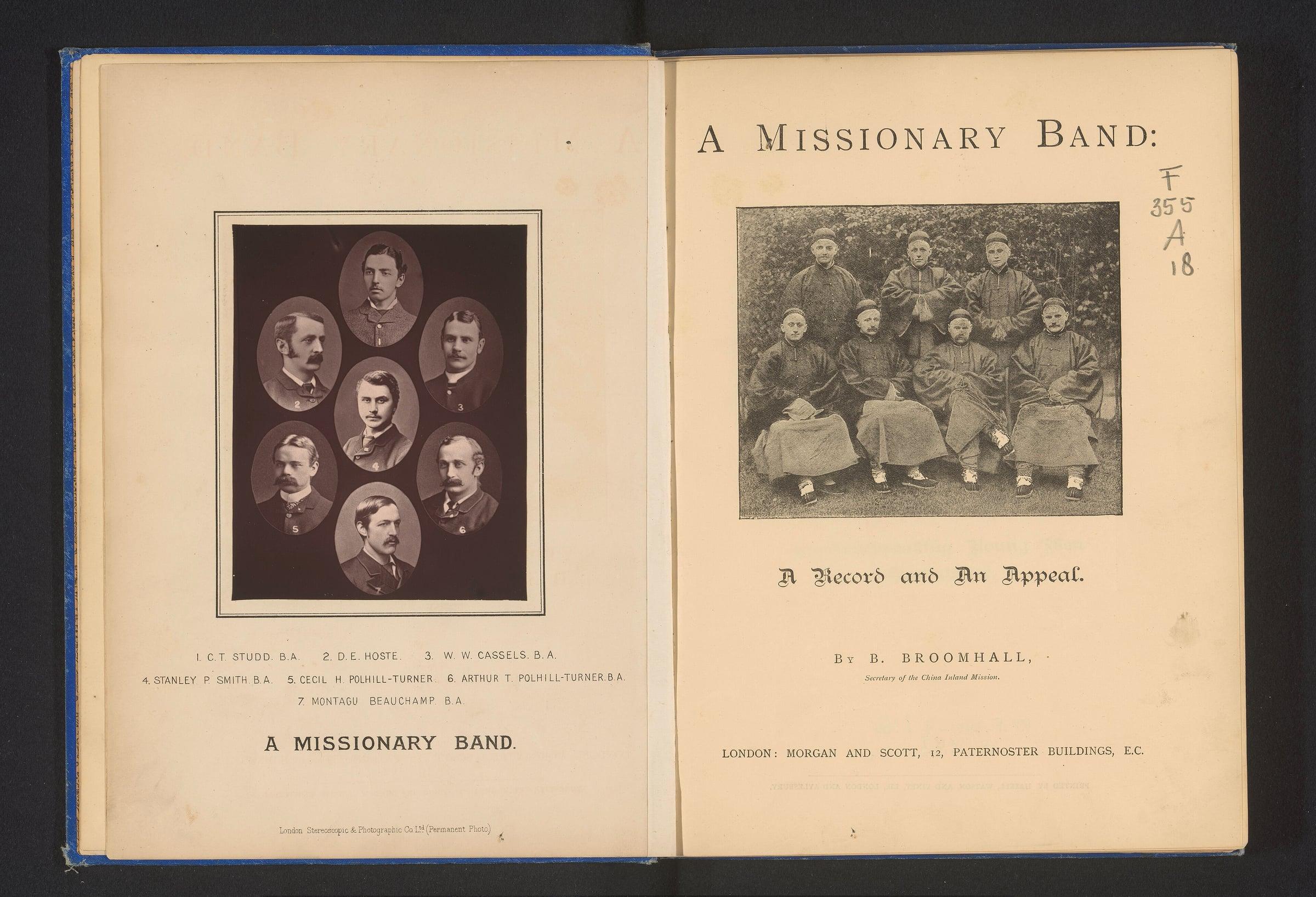
The Cambridge Seven, in Broomhall, A Missionary Band, by 1886. Public domain.
London to Shanghai · Story · Featured Study
The Cambridge Seven
A cricketer, an oarsman, a gunner, a dragoon and three others left London together for inland China.
- Where
- Cambridge, London, Shanghai, Shansi
- Who
- C. T. Studd, Stanley P. Smith, D. E. Hoste, W. W. Cassels
- When
- 5 February 1885
Broomhall, the mission's Secretary, wrote that in one short week the China Inland Mission had been “suddenly lifted into unusual and unexpected prominence, and even popularity”.
And He said to them, “Go into all the world and preach the gospel to every creature.
Summary
The Cambridge Seven went out to inland China with Hudson Taylor's China Inland Mission. Taylor met them at Shanghai in Chinese dress.
- They were first called the Cambridge Band, and the name Cambridge Seven is in print by 1899.
- The issue of China's Millions on their farewell rose from twelve thousand copies to fifty thousand, by the mission's count.
- Broomhall's book on them sold ten thousand copies by his count and fifteen thousand by Marshall Broomhall's.
The Texts They Named
Several of them gave a verse as their reason for going.
Hoste, Smith and Studd each spoke the words of Mark 16:15 at Exeter Hall on their last night in London. That verse stands in the long ending of Mark. Schaff noted that the section is wanting in the two oldest uncial manuscripts, the Sinaitic and the Vatican.
One gives freely, yet gains even more; another withholds what is right, only to become poor.
Smith turned to this proverb, praying that England might learn to scatter.
Anyone who loves his father or mother more than Me is not worthy of Me; anyone who loves his son or daughter more than Me is not worthy of Me;
Studd said this verse answered the one thing that could have kept him, the love of his mother.
Ask Me, and I will make the nations Your inheritance, the ends of the earth Your possession.
Studd said this verse was brought home to him as he and his brother prayed over the decision.
Psalm 2:8BSB
I am not ashamed of the gospel, because it is the power of God for salvation to everyone who believes, first to the Jew, then to the Greek.
Cassels gave this as the reason they were going to China, in the report of his speech.
Romans 1:16BSB
Matthew 10:37, Psalm 2:8, Romans 1:16
The Seven in the Order They Joined
Five took Cambridge degrees, one matriculated with no degree recorded, and Hoste never studied there.
Each man reached the mission by his own road and left a different record.
| The man | Where he came from | When he met the London Council in 1884 | What became of him |
|---|---|---|---|
| Dixon E. Hoste, died 1946 | The Royal Artillery; he never studied at Cambridge | 26 February | General Director of the mission after Hudson Taylor, until 1935 |
| Stanley P. Smith, died 1931 | Trinity College, and stroke of the Cambridge boat in 1882 | 1 April | Out of the mission by 1901, and in Shansi until he died |
| William W. Cassels, died 1925 | St John's College; he was a curate in London | 7 October | Bishop in Western China from 18 October 1895 until he died |
| C. T. Studd, died 1931 | Trinity College, and captain of the Cambridge eleven in 1883 | 4 November | He came home in 1894, worked in India from 1900 to 1906 and died at Ibambi in the Belgian Congo |
| Montagu Beauchamp, died 1939 | He was at Trinity College and rowed stroke in a University trial eight | He joined before the party sailed | With the mission to 1910, and an army chaplain from 1916 to 1921 |
| Cecil Polhill-Turner, died 1938 | Jesus College, no degree recorded, then the 2nd Dragoon Guards | He joined before the party sailed | Home in 1900, Pentecostal from 1908, and head of the Pentecostal Missionary Union from 1909 |
| Arthur Polhill-Turner, died 1935 | Trinity Hall, then Ridley Hall | He joined at the last moment | In Sichuan to 1928 |
From the Corn Exchange to Shanghai
The road ran through a mission that was jeered, a tour of the northern towns and four farewell meetings.
D. L. Moody opened his mission to the University of Cambridge in the Corn Exchange on Sunday 5 November 1882, at the invitation of the Christian Union. W. H. Stone of its committee wrote seventeen years later that 1,700 men in cap and gown were counted in on the first night. Only about a hundred, he says, came on the second.
J. E. K. Studd wrote a letter reminding the university that the evangelists had come by invitation. Stone counted 1,800 at the last service, when 162 men gave in their names to receive a little book.
Smith held a mission at Clapham in February 1884, and Marshall Broomhall dates Cassels's interest in China from it. C. T. Studd named the farewell of Mr. McCarthy of the mission as the meeting that turned him to China.
In the last weeks before they left, Smith and C. T. Studd toured the northern towns with Reginald Radcliffe. The expenses were met outside the mission. At Edinburgh, Dr. Moxey wrote, “Professors and students together were seen in tears”.
The mission arranged three farewell meetings. They stood at Eccleston Street on 30 January, at the Guildhall in Cambridge on 2 February and at the Corn Exchange in Oxford on 3 February. It then put off the departure by a day for a last meeting at Exeter Hall.
The Record's correspondent estimated 1,200 at Cambridge, and Broomhall prints no count for Oxford or for Exeter Hall. Rain fell in sheets on the London night, and an overflow met in the Lower Hall.
They left Victoria Station at ten o'clock the next morning for Brindisi, and they reached Shanghai on 18 March. Each put on Chinese dress before leaving the city. Smith and C. T. Studd later called that dress a matter of taste and noted that the coast stations did not wear it.
Studd and the two Polhill-Turners went up the river for Hanchung on 4 April. Smith, Hoste and Cassels went north by sea a few days later. Hoste wrote later from Kuh-wu that he had been there “without any European companion for now over a month”.
On the Han River, Studd wrote, the party waited for the signs of Mark 16:17 to 18 as at Pentecost. They concluded after some time that they were meant to study. At Hanchung he thought the people took them for “idle fanatics”.
The Story Told in the American Colleges
Word of the party crossed the Atlantic within the year.
C. T. Studd's brother J. E. K. Studd told the story of “The Cambridge Band” at Northfield in the summer of 1885 at Moody's request. Luther Wishard arranged his visits to the college associations. At Cornell, C. K. Ober wrote, a sophomore named John R. Mott “was led by Studd” into a Christian experience.
Ober, a colleague of Wishard, lists the story as the third of three lines that met at the Mount Hermon Conference. Norman Grubb, C. T. Studd's son-in-law, gave it more weight in 1933. He wrote that students in the United States caught the fire and “two of their number began the Student Volunteer Movement”.
Stanley Smith and C. T. Studd After the Band
The mission's history of 1915 leaves out what the record shows of these two men.
Smith's own title page of 1901 calls him formerly of the mission. An article in the Biographical Dictionary of Christian Missions (1998) says he held that not all who had never heard were lost, against the mission's statement. It says that he was asked to resign. In 1915 Marshall Broomhall still wrote of the seven that “the Band is still unbroken”.
Studd came into his money at twenty-five, and Grubb lists gifts of five thousand pounds each to Moody and to George Muller among others. He sailed for Africa on 15 December 1910, and Venn's register dates his Heart of Africa Mission to 1913.
Jonathan Bonk wrote in 1998 that “he proved to be an obstinate and unreasonable leader and colleague, provoking bitter conflict with family, fellow missionaries, and Africans until his death”. Bonk also records that his wife stayed in England, apart from one visit, until she died.
Grubb, who defends him, prints that he dismissed two workers, that others resigned and that some of the home committee did not agree with him. J. Murray writes in the same dictionary that he dismissed his son-in-law Alfred Buxton.
How the Key Verse Was Taught
Four teachers of three different ages on the command to preach to every creature.
Theophylact of Ohrid (died 1107)
Commentary on Mark, on Mark 16:15
Theophylact of Ohrid read the words as a command with no condition on the hearer.
“He did not say: preach only to the obedient, but to every creature, whether they will listen or not.”
Patristic
John Wesley (1703 to 1791)
Journal, Curnock's edition, volume 2 (1909 to 1916), page 218
Wesley took the same reach as his warrant for preaching outside any parish.
“I look upon all the world as my parish; thus far I mean, that, in whatever part of it I am, I judge it meet, right, and my bounden duty to declare unto all that are willing to hear the glad tidings of salvation.”
Evangelical
Charles Spurgeon (1834 to 1892)
The Metropolitan Tabernacle Pulpit, Sermon No. 900: “Preach, Preach, Preach Everywhere!” (lightly modernized text, CCEL edition), the opening
Spurgeon, preaching on the commission, tied the preacher's witness to his own faith.
“It is in proportion to our personal faith in the Gospel that we become competent witnesses for the teaching of it to others.”
Particular Baptist
J.C. Ryle (1816 to 1900)
Expository Thoughts on the Gospels: Mark (lightly modernized text, Grace Gems edition), on Mark 16:15
Ryle drew from the verse that every people has the same need.
“The Lord Jesus would have us know that all the world needs the Gospel. In every quarter of the globe man is the same, sinful, corrupt, and alienated from God.”
Reformed Evangelical
In Their Own Words
Four of the seven, as Broomhall's book of 1887 prints them, on why they went and what they found.
William W. Cassels (1858 to 1925)
Address at Exeter Hall, 4 February 1885, reported in B. Broomhall, The Evangelisation of the World (1887), the report of the meeting
More heroism
“They wanted more heroism in their religion.”
Church of England
About this saying1 paragraph
Cassels's words of 1885 come to us in the third person, as the reporter took them down.
Stanley P. Smith (1861 to 1931)
Address at Exeter Hall, 4 February 1885, in B. Broomhall, The Evangelisation of the World (1887), the report of the meeting
A living Saviour
“We do not go to that far-distant field to speak of doctrine or theory, but of a living, bright, present, reigning Saviour.”
China Inland Mission
About this saying1 paragraph
Smith told the hall in 1885 what the party meant to carry, in the printed report of the meeting.
C.T. Studd (1860 to 1931)
Address at Exeter Hall, 4 February 1885, in B. Broomhall, The Evangelisation of the World (1887), the report of the meeting
And I did not go
“I should not like in the future to look back and say that long, long ago God told me to go into all the world and preach the Gospel to every creature, and I did not go.”
Evangelical
About this saying1 paragraph
In the same hall C. T. Studd said what he would not like to look back on, and the printed report of 1885 carries it in the first person.
Dixon E. Hoste (1861 to 1946)
Letter from Kuh-wu, in B. Broomhall, The Evangelisation of the World (1887), the letters from China
Hallelujah for the cross
“when this wonderful love of God in Christ comes before me, I feel one must shout Hallelujah for the cross! salvation to God and the Lamb.”
China Inland Mission
About this saying1 paragraph
He says in this letter, printed in 1887, that he was never much of a man for shouting.
Who Sent Them, and What Drew the Crowds
Most of the witnesses were friends of the mission, and they differ among themselves.
Did Moody's Cambridge mission send them?3 paragraphs
Tissington Tatlow, General Secretary of the British movement, as Ober quotes him, makes the decision of Studd and Smith “one outcome” of the mission of 1882. Venn's register says that Smith came under its influence. Eugene Stock calls the seven “a fruit, indirectly, of Moody's work”.
Studd's own accounts name Moody and never Cambridge, and Stock places the meetings that moved him in London. Smith was holding a prayer meeting at Repton in 1876, Cassels had been ordained to a London curacy by June 1882, and Hoste was converted at Moody's Brighton mission in December 1882.
Studd gave The Christian's Secret of a Happy Life as the book that led to his surrender, and Stock joins “the Keswick men” to Moody in the Cambridge story.
Did their names draw the crowds?2 paragraphs
B. Broomhall conceded that “the distinctions which our friends had achieved in the athletic world induced young men to assemble in large numbers”. Marshall Broomhall wrote in 1915 that the enthusiasm was “occasioned by the personnel of the party,” and Hugh Price Hughes praised “culture and social position” from the platform at Exeter Hall.
Marshall Broomhall set against the party's fame the earlier workers who opened the unoccupied provinces. Both Broomhalls wrote from inside the mission, so both are interested witnesses.
Which sayings are Studd's?2 paragraphs
Moody Monthly printed “If Jesus Christ be God and died for me, no sacrifice can be too great for me to make for Him” in January 1921 as the motto of his mission, unsigned. Writers tied it to him personally only after his death in 1931.
“Some wish to live within the sound of Church or Chapel bell” is attributed to Studd, and its first print found is Grubb's book of 1933.
Books to Read Next
The Evangelisation of the World
B. Broomhall · 1887
The mission's Secretary prints the farewell meetings and the men's first letters from China.
Read Broomhall free at the Internet ArchiveThe Jubilee Story of the China Inland Mission
Marshall Broomhall · 1915
This history gives the days on which the first four offered and the mission's own account of the band.
Read The Jubilee Story free at the Internet ArchiveW. W. Cassels, First Bishop in Western China
Marshall Broomhall · 1926
This life holds Smith's letter on Repton and his diary of the months before the party left.
Read the life of Cassels free at the Internet ArchiveWhat the Seven Left
Hoste and Cassels stayed inside the mission that sent them, Smith worked on outside it and Studd founded another. Hoste, Smith and Studd had each spoken the same command before they left London.
Sources
Scripture is the Berean Standard Bible.
- The Holy Bible, Berean Standard Bible (read 2026)
- B. Broomhall, The Evangelisation of the World: A Missionary Band: A Record of Consecration and an Appeal, enlarged edition, Fifteenth Thousand (London: Morgan and Scott, 1887)
- Marshall Broomhall, The Jubilee Story of the China Inland Mission (London: Morgan and Scott, 1915)
- Marshall Broomhall, W. W. Cassels, First Bishop in Western China (1926)
- Dr. and Mrs. Howard Taylor, Hudson Taylor and the China Inland Mission: The Growth of a Work of God (1918)
- Eugene Stock, The History of the Church Missionary Society, volume 3 (1899)
- W. R. Moody, The Life of Dwight L. Moody (1900), with W. H. Stone's letter on Cambridge.
- C. K. Ober, Luther D. Wishard (1927), with Wishard's report and a quotation of Tatlow.
- C. T. Studd, The Personal Testimony of Charles T. Studd, in The Fundamentals, volume 3 (Chicago: Testimony Publishing, about 1910), chapter 7.
- Stanley P. Smith, China from Within (London: Marshall Brothers, 1901), the title page.
- Norman P. Grubb, C. T. Studd: Athlete and Pioneer (first published 1933)
- J. Venn and J. A. Venn, Alumni Cantabrigienses, the entries for the seven surnames.
- Jonathan Bonk, "Studd, C. T.", Biographical Dictionary of Christian Missions (1998)
- J. Murray, "Buxton, Alfred", Biographical Dictionary of Christian Missions (1998)
- Biographical Dictionary of Chinese Christianity, the entries for Hoste, Stanley Smith and Cecil Polhill-Turner, the last two from the Biographical Dictionary of Christian Missions (1998)
- Moody Monthly, January 1921 and November 1931.
- Philip Schaff, History of the Christian Church, volume 1, the note on the disputed close of Mark.
- Theophylact of Ohrid, Commentary on Mark, on Mark 16:15.
- John Wesley, Journal, Curnock's edition, volume 2 (1909 to 1916), page 218, the entry of 1739.
- J. C. Ryle, Expository Thoughts on the Gospels: Mark (1857), on Mark 16:15, lightly modernized.
- Charles Spurgeon, The Metropolitan Tabernacle Pulpit, Sermon No. 900 (1869), lightly modernized.
Keep Studying
Read it1
Studies1
People and groups12
Church history3