
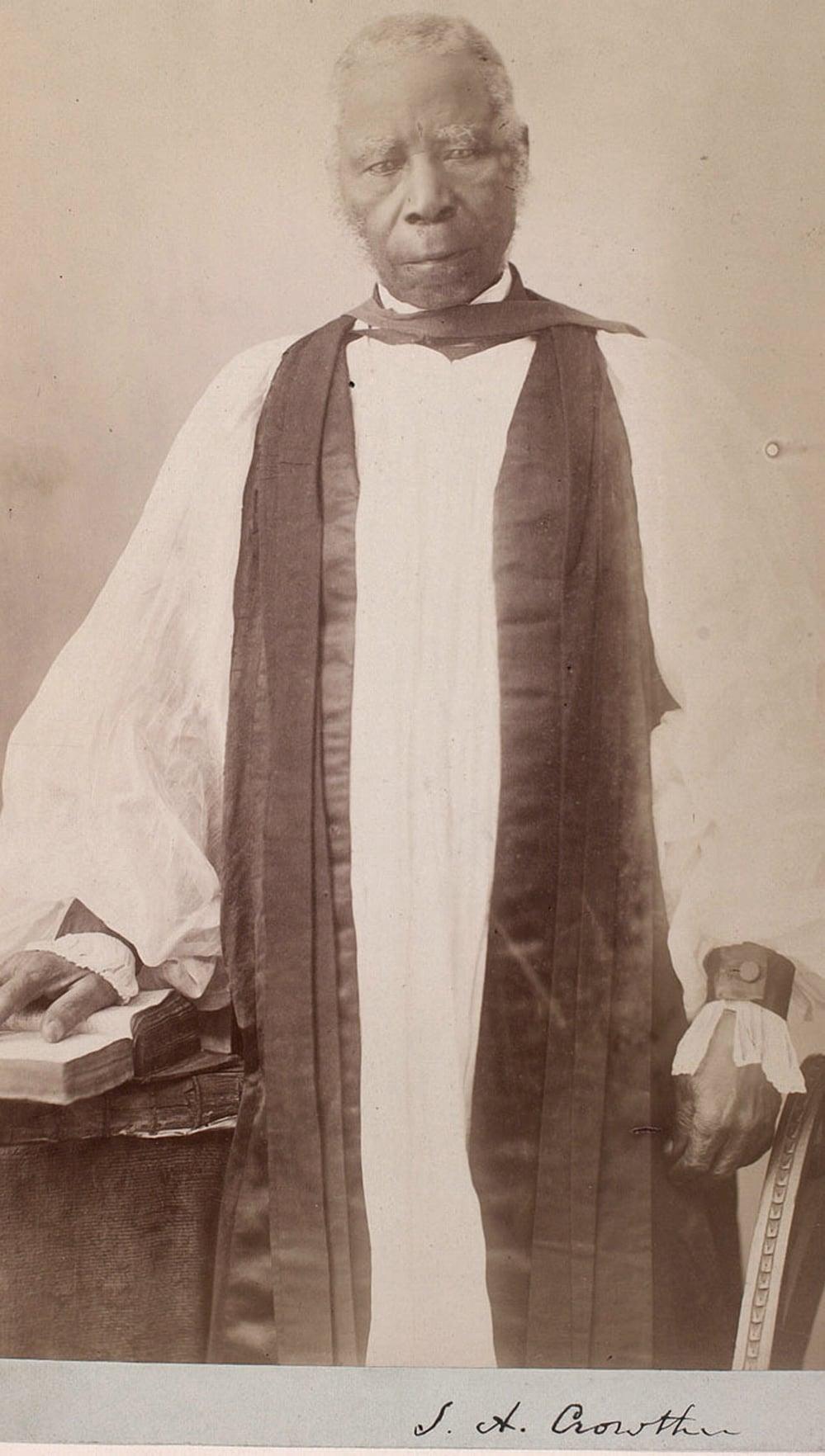
Bishop Samuel Ajayi Crowther, photographer unknown, 1867. Public domain.
Yorubaland, Sierra Leone and the Niger, 1821 to 1891 · Person · Featured Study
Samuel Ajayi Crowther
In 1864 he became the first Bishop of the Niger.
A boy sold from a raided Yoruba town in 1821 met his mother again at Abeokuta twenty-five years later, as a minister of the gospel.
‘Sir,’ the servant replied, ‘what you ordered has been done, and there is still room.’
‘Sir,’ the servant replied, ‘what you ordered has been done, and there is still room.’
- Born
- not recorded; he was a boy when he was taken in 1821 (proposed)
- Died
- 31 December 1891, at Lagos
- Family
- wife: Susanna, born Asano; son: Dandeson Coates Crowther
- Places
- Oshogun, Sierra Leone, Abeokuta, Canterbury, the Niger, Lagos
Summary
Samuel Ajayi Crowther was taken from a slave ship by a British warship in 1822. He was set ashore at Sierra Leone and baptized in 1825. His was the first name on the roll of the college at Fourah Bay. The Bishop of London ordained him in 1843. He then served the Church Missionary Society among the Yoruba and on the Niger.
- He prepared a grammar and vocabulary of the Yoruba language on his voyage to England in 1842.
- He died at Lagos on the last day of 1891, after a crisis in his mission.
- Eugene Stock, the Society's historian, judged both his critics and his rule of the mission.
The Texts of His Journals
He preached his first sermon in Africa on Luke 14, and Psalm 10 was the day's text when his mother found him.
The question of this life is how a rescued slave boy came to stand as a bishop of the Church of England. It also asks what his own society made of his rule. His letter of 1837 and his journals, as Jesse Page prints them, carry the first, and Eugene Stock's history of 1899 carries the second.
But You have regarded trouble and grief; You see to repay it by Your hand. The victim entrusts himself to You; You are the helper of the fatherless.His almanac gave this verse for 21 August 1846, the day his mother came to him at Abeokuta. He wrote that he had never felt its force more.
The Life in Order
Stock summed up the life in a list of years, and Page and Crowther's own journals give the days.
Seventy years ran from the raid to his death at Lagos.
- Early in 1821Foulah raiders took him at OshogunPage; Stock
- 1822HMS Myrmidon took the slaver, and he was landed at Sierra LeonePage; Stock
- 11 December 1825He was baptized by the Rev. J. RabanPage
- 1826 to 1828He was a student at Fourah Bay and then a teacherStock; Page
- 1841First voyage up the NigerPage
- 11 June 1843Ordination in EnglandPage
- 3 August 1846Arrival at AbeokutaPage
- 1857He went up the Niger in the Dayspring to found a missionPage; Stock
- St Peter's Day 1864Consecration at CanterburyPage; Stock
- August 1890A meeting at Onitsha ended in a crisis between the African and English workersStock
- 31 December 1891He died at LagosStock; Page
Each step of the life stands with its witness.
3 August 1846, 1857, St Peter's Day 1864, August 1890, 31 December 1891
From Oshogun to Canterbury
Page tells the life from the raid to the cathedral, and Crowther's letter and journals give his own words on its turns.
Early in 1821 an army of Foulah raiders broke through the six gates of Oshogun, a Yoruba town of about three thousand fighting men. Ajayi, a boy, was taken with his mother and his sister and parted from them. He was exchanged for a horse and sold again on the way to the coast.
In 1822 British warships took the slave ship he was held on, and he was landed at Sierra Leone. He learned to read at the mission school, and the Rev. J. Raban baptized him with the name Samuel Crowther.
When the college at Fourah Bay was founded for training African teachers, his was the first name on its roll. He married Asano, a girl taken like him from a slave ship and taught with him at Bathurst, who was baptized Susanna. In 1841 he went up the Niger with the missionary James Frederick Schön on the government's expedition.
The Society called him to England in 1842. Bishop Blomfield of London ordained him on Trinity Sunday 1843, the first of several African clergy ordained in those years.
He entered Abeokuta with the Yoruba mission in August 1846. Three weeks later his mother came looking for him with his brother, and she became one of the first converts of the mission there. In 1857 he went up the Niger again in the Dayspring to plant the mission on the river.
On St Peter's Day 1864 he was consecrated in Canterbury Cathedral with the new bishops of Peterborough and Tasmania. He held a royal licence for the countries of Western Africa beyond the Queen's dominions. Stock counts ten visits of his to England in seventy years.
In Their Own Words
His letter on the day he was taken and two entries of his journals.
Samuel Ajayi Crowther (died 1891)
Letter to the Rev. William Jowett, Fourah Bay, 22 February 1837, in Jesse Page, Samuel Crowther: The Slave Boy Who Became Bishop of the Niger, chapter 3
The unhappy and blessed day
“From this period I must date the unhappy, but which I am ever taught in other respects to call blessed, day which I shall never forget in my life. I call it an unhappy day, because it was the day on which I was violently turned out of my father's house and separated from my relatives, and in which I was made to experience what is called to be in slavery. With regard to its being called blessed, it was the day which Providence had marked out for me to set out on my journey from the land of heathenism, superstition and vice, to a place where the Gospel is preached.”
Anglican
About this saying1 paragraph
In a letter of 1837, written as a young teacher at Fourah Bay, he told of the day of his capture, and Page prints the passage.
Samuel Ajayi Crowther
Journal, 3 December 1843, in Jesse Page, Samuel Crowther: The Slave Boy Who Became Bishop of the Niger, chapter 6
My first sermon in Africa
“Preached my first sermon in Africa. . . . The novelty of seeing a native clergyman performing divine service excited a very great interest among all who were present.”
Anglican
About this saying1 paragraph
He wrote this in his journal on 3 December 1843, the Sunday after he landed at Sierra Leone as a clergyman.
Samuel Ajayi Crowther
Journal, 21 August 1846, in Jesse Page, Samuel Crowther: The Slave Boy Who Became Bishop of the Niger, chapter 6
She could not believe her own eyes
“When she saw me she trembled. She could not believe her own eyes. We grasped one another, looking at each other with silence and great astonishment, big tears rolling down her emaciated cheeks.”
Anglican
About this saying1 paragraph
In 1846, at Abeokuta, his journal records this meeting.
The People Around Him
The witnesses name his mother, his wife and son, the men who baptized and ordained him, and his critics.
His mother came back into his life at Abeokuta.
| Person | Tie to Crowther | The witness |
|---|---|---|
| His mother | Taken with him in 1821, she found him at Abeokuta in 1846, and he was buried beside her | Page; Stock |
| Susanna, born Asano | His wife | Page |
| Dandeson Coates Crowther | His son, archdeacon in the Delta, whose churches declared their independence after 1890 | Page; Stock |
| J. Raban | The missionary who baptized him in 1825 | Page |
| James Frederick Schön | The missionary who sailed with him in 1841 | Page |
| Bishop Blomfield of London | He ordained him | Page |
| Robinson and Brooke | The young missionaries whom Stock judged too severe in the crisis of 1890 | Stock |
The Places of His Life
His life runs from the Yoruba country to Sierra Leone, to England and back to the Niger.
He returned as a missionary to the country he was taken from.
| Place | What the witnesses say | The witness |
|---|---|---|
| Oshogun | His home town, broken by raiders early in 1821. | Page |
| Sierra Leone and Fourah Bay | He was landed there in 1822, baptized, taught at the college and preached his first sermon. | Page; Stock |
| Islington | He studied at the missionary college in Upper Street and was ordained in 1843. | Page |
| Abeokuta | He met his mother there. | Page |
| Canterbury | The cathedral of his consecration. | Page |
| Onitsha | A meeting there in 1890 began the troubles of his last years. | Stock |
| Lagos | He died there on the last day of 1891. | Stock; Page |
How the Key Verse Was Taught
Gregory the Dialogist, John Bunyan and Charles Spurgeon read the servant's report that there is still room.
Gregory the Dialogist (died 604)
Forty Gospel Homilies, Homily 36
Gregory read the empty places at the supper as room kept for the Gentiles.
“But let us hear what the servant adds after the poor have been brought to the supper: Lord, it is done as you commanded, and still there is room. Many such were gathered from Judea to the Lord's supper, but the multitude that believed from the people of Israel did not fill the place of the heavenly banquet. The throng of Jews has already entered, but there is still room vacant in the kingdom where the multitude of the Gentiles must be received.”
on Luke 14:22Patristic
John Bunyan (died 1688)
Grace Abounding to the Chief of Sinners
Bunyan found in the same words room in heaven for himself.
“These words, but especially those, And yet there is room, were sweet words to me; for truly I thought that by them I saw there was place enough in heaven for me.”
on Luke 14:22 to 23English Puritan
Charles Spurgeon (1834 to 1892)
The Metropolitan Tabernacle Pulpit, Sermon No. 3529: “More Room for More People” (lightly modernized text, CCEL edition)
Charles Spurgeon turned from the guests who refused to the room that their refusal left.
“How delightful it is to observe that the wrath of man becomes tributary to the Glory of God! See an illustration in the parable of the marriage supper. Those persons who were first bid would not come. In order to do the good man of the house a despite, they declined his invitation, they refused to grace his board. Instead of causing his honor to be tarnished, they were, against their own will, the means of increasing his reputation! Had they come, it would only have been said that he made a great feast for his good friends.”
on Luke 14:22Particular Baptist
What Stock Leaves Open
The Society's own historian weighs both sides of the crisis of 1890 and of the Delta churches that followed.
Too severe, or too laxEugene Stock; Robinson and Brooke, as Stock reports them
Stock writes that the meeting at Onitsha in August 1890 "issued in a lamentable crisis", and that the Secretary suspended some African agents in the Society's name. He judges Robinson and Brooke "too severe" and says they were not patient enough with those who, like the bishop, "honestly differed from them".
Stock also calls Crowther "an Eli in exercising discipline too lightly", and he holds that later progress on the Niger was largely due to the young men's action. He writes that Crowther's death "was certainly hastened by anxiety and disappointment".
The Delta churches: secession or self-governmentEugene Stock; the Delta churches under Archdeacon Crowther, as Stock reports them
After the crisis the churches of Bonny and the Delta, under Archdeacon Crowther, declared their independence and raised their own funds. Stock writes that they believed they were carrying out the Society's own policy of self-support and self-government.
Stock adds that, coming just then, the step had more the appearance of a secession than was pleasant, and that it was no secession from the Church of England.
Books to Read Next
Samuel Crowther: The Slave Boy Who Became Bishop of the Niger
Jesse Page · about 1892
Its chapters follow him from Oshogun to the Niger.
Read Page free at the Internet ArchiveThe History of the Church Missionary Society, volume 3
Eugene Stock · 1899
Stock wrote the Society's own history, and his third volume reaches Crowther's death.
Read Stock free at the Internet ArchiveWhat Crowther Left
Crowther left a Yoruba grammar, a mission on the Niger and the churches of the Delta. Stock wrote that the Delta, with its old cruelties ended, stood as a monument to his perseverance.
Sources
Scripture is the Berean Standard Bible.
- The Holy Bible, Berean Standard Bible (read 2026)
- Jesse Page, Samuel Crowther: The Slave Boy Who Became Bishop of the Niger, fourth edition (New York: Fleming H. Revell, about 1892), printing Crowther's letter of 1837 and his journals.
- Eugene Stock, The History of the Church Missionary Society, volume 3 (1899), chapter 89.
- Gregory the Dialogist (Gregory the Great), Forty Gospel Homilies, homily 36, on Luke 14:22.
- John Bunyan, Grace Abounding to the Chief of Sinners.
- Charles Spurgeon, The Metropolitan Tabernacle Pulpit, sermon 3529, More Room for More People (printed 1916), on Luke 14:22.