
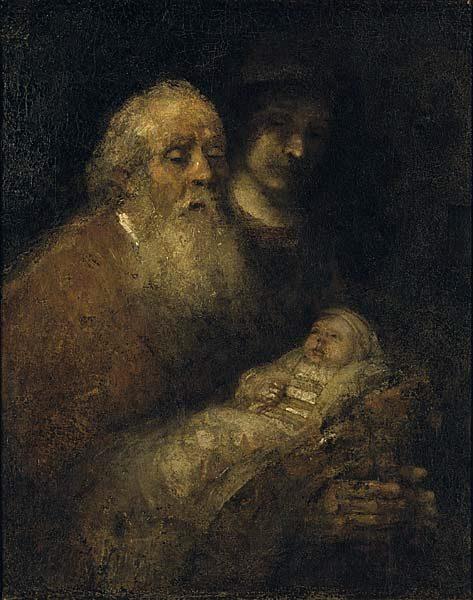
Rembrandt, Simeon's Song of Praise, 1669. Public domain.
Luke 2 to Revelation 22 · Doctrine · Featured Study
The Blessed Hope
Paul calls the glorious appearance of Jesus Christ the blessed hope in Titus 2:13, and John writes that everyone who has this hope purifies himself.
Paul set the Christian life between two appearings of Christ.
as we await the blessed hope and glorious appearance of our great God and Savior Jesus Christ.
- First taught
- Luke 2:25 “Now there was a man in Jerusalem named…”
- Fullest statement
- Titus 2:13 “as we await the blessed hope and…”
Summary
Luke's Simeon pictures a believer who waits, and Peter asks what kind of people those who wait ought to be. The first session of the study guide to John Bevere's The King Is Coming (2026) takes up 1 John 3:2 to 3 and Simeon.
- One Greek verb names Simeon's waiting in Luke and the church's waiting in Paul's letter to Titus.
- Mark 13:32 leaves the hour of the coming with the Father.
- Hebrews 9:28 says Christ will appear a second time to bring salvation to those who wait for Him.
The Hope Paul Names
Paul writes to Titus that grace trains believers while they wait for Christ.
For the grace of God has appeared, bringing salvation to everyone. It instructs us to renounce ungodliness and worldly passions, and to live sensible, upright, and godly lives in the present age,Paul begins with what has already come.
He gave Himself for us to redeem us from all lawlessness and to purify for Himself a people for His own possession, zealous for good deeds.Paul states what the first coming was for.
Charles Spurgeon preached on this passage in 1886 under the title The Two Appearings and the Discipline of Grace. Albert Barnes, in his Notes on Titus 2:13, drew three duties from it: to believe that Christ will return, to wait in expectation without knowing when, and to be ready whenever He comes.
One Hope, From the Temple to the Letters
Eight more texts each add one step to the hope of Christ's appearing.
The waiting runs from the temple in Jerusalem through the letters of the apostles.
- The step
- Anna speaks of the child to those waiting for Jerusalem's redemption
- The step
- Believers who have the Spirit wait for the redemption of their bodies
- The step
- Paul ends a letter with a prayer for the Lord to come
- The step
- A Savior comes from heaven to change the body
- The step
- The coming is a word for mutual encouragement
- The step
- Christ appears a second time, for salvation
- The step
- A new heaven and a new earth are promised
- The step
- Believers keep themselves in God's love as they wait for mercy
Each step with the verse that carries it, in the canon's order.
2 Peter 3:13, Jude 1:21
The Hope That Purifies
John draws purity from the hope, and Peter draws holy conduct from it.
Beloved, we are now children of God, and what we will be has not yet been revealed. We know that when Christ appears, we will be like Him, for we will see Him as He is. And everyone who has this hope in Him purifies himself, just as Christ is pure.John grounds the Christian's present in a future promise.
Since everything will be destroyed in this way, what kind of people ought you to be? You ought to conduct yourselves in holiness and godliness as you anticipate and hasten the coming of the day of God, when the heavens will be destroyed by fire and the elements will melt in the heat.Peter puts a question to his readers and answers it himself.
Peter reasons from the end of the present world to the conduct of the people who expect it. In 2 Peter 3:14 he asks them to be found at peace, spotless and blameless in His sight.
John Bevere writes in the opening note of his study guide that he avoided the end times for most of forty years of ministry. He then tells what the subject did in him when he took it up.
“Far from making me passive or withdrawn, prophecy awakened urgency, purity, and compassion in me.”
John Bevere · The King Is Coming Bible Study Guide (HarperChristian Resources, 2026), A Note from John Bevere, page vCharismatic
Simeon, Who Waited
Bevere's study guide reads Simeon's devotion as the fear of the Lord.
Now there was a man in Jerusalem named Simeon, who was righteous and devout. He was waiting for the consolation of Israel, and the Holy Spirit was upon him. The Holy Spirit had revealed to him that he would not see death before he had seen the Lord’s Christ.Luke introduces Simeon before he meets the child.
Luke's verb for Simeon's waiting is the verb Paul uses for the church's waiting in his letter to Titus. Luke uses it again of the people Anna spoke to in the temple (Luke 2:38).
The guide ties that fear to the insight Simeon had in the temple.
“Simeon held firmly to this virtue, and it enlightened him with insight that others who lacked it didn't possess (see Proverbs 8:13–14).”
John Bevere · The King Is Coming Bible Study Guide (HarperChristian Resources, 2026), Session 1, Study 2, page 15Charismatic
“Sovereign Lord, as You have promised, You now dismiss Your servant in peace. For my eyes have seen Your salvation,Simeon's waiting ends in praise when he holds the child.
J. C. Ryle, in his Expository Thoughts on Luke, drew from Simeon that God keeps a believing people even in the darkest times.
What These Texts Leave Open
These texts give the hope its shape and leave its date unstated.
Readers who differ on the timing of the rapture and on the thousand years share this hope of Christ's appearing.
No one knows about that day or hour, not even the angels in heaven, nor the Son, but only the Father.Jesus speaks of His own coming.
Living Between the Appearings
Peter asks for a mind ready for action, and Bevere names the use of prophecy.
Therefore prepare your minds for action. Be sober-minded. Set your hope fully on the grace to be given you at the revelation of Jesus Christ.Peter's command looks to the day Christ is revealed.
In the same opening note Bevere states the use he sees for prophecy.
“Prophecy isn't meant to produce fear but to anchor faith.”
John Bevere · The King Is Coming Bible Study Guide (HarperChristian Resources, 2026), A Note from John Bevere, page vCharismatic
How the Hope Has Been Taught
Tertullian and Matthew Henry wrote on John's promise that believers will be like Christ.
Tertullian (died 220)
On the Resurrection of the Flesh
Tertullian read John's words as proof that believers are not yet what they will be.
“In like manner John says: ‘And it doth not yet appear what we shall be: we know, however, that when He shall be manifest, we shall be like Him.’ We are far indeed from being already what we know not of; we should, of course, be sure to know it if we were already (like Him).”
on 1 John 3:2Patristic
Matthew Henry (1662 to 1714)
Commentary on the Whole Bible
Matthew Henry joined John's promise to Paul's promise of a changed body.
“Their vile bodies shall be made like his glorious body; they shall be filled with life, light, and bliss from him. When he, who is their life, shall appear, they also shall appear with him in glory, Col. iii. Their likeness to him is argued from the sight they shall have of him: We shall be like him, for we shall see him as he is.”
on 1 John 3:2Puritan
Come, Lord Jesus
The New Testament closes with Christ's promise to come and the church's answer to it.
He who testifies to these things says, “Yes, I am coming soon.” Amen. Come, Lord Jesus!The last prayer of the Bible asks for the hope to be fulfilled.
Sources
Scripture is the Berean Standard Bible.
- John Bevere, The King Is Coming Bible Study Guide (HarperChristian Resources, 2026), companion to The King Is Coming: It's Time to Prepare for the Return of Christ (W Publishing, 2026)
- Charles Spurgeon, The Metropolitan Tabernacle Pulpit, Sermon No. 1894, The Two Appearings and the Discipline of Grace (1886); Albert Barnes, Notes (1832 to 1869), on Titus 2:13.
- J. C. Ryle, Expository Thoughts on the Gospels: Luke (1858), on Luke 2:25; Tertullian, On the Resurrection of the Flesh, on 1 John 3:2; Matthew Henry, Commentary (1710), on 1 John 3:2.
Keep Studying
Read it6
Symbols1
Doctrines9
Values3