
1 Kings 11 to 14 · Person · Featured Study
Jeroboam I and the Divided Kingdom
The first king of the northern kingdom of Israel, from Solomon's building works in Jerusalem to the fall of his house.
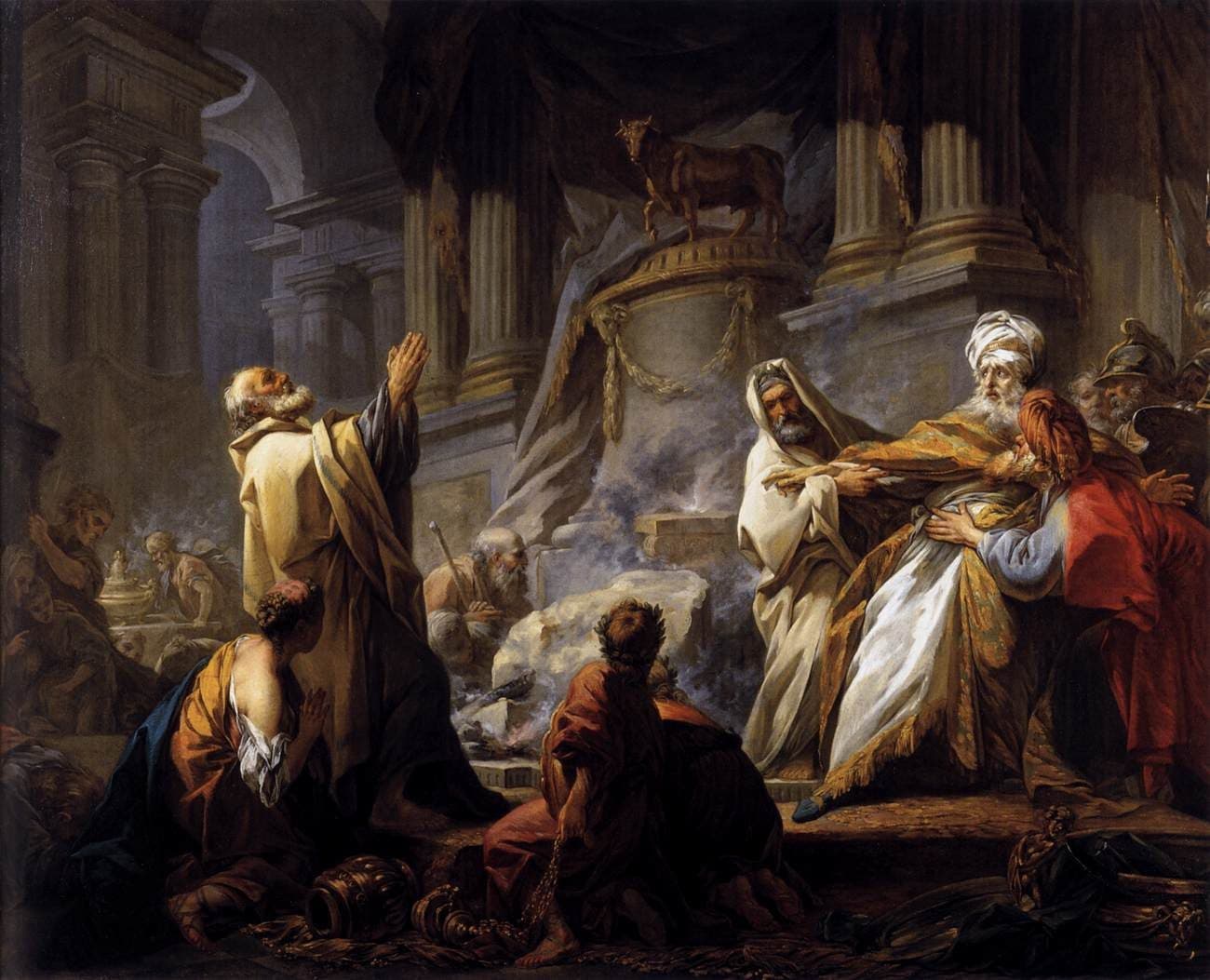
Jean-Honoré Fragonard, Jeroboam Offering Sacrifice for the Idol, 1752, Beaux-Arts de Paris. Public domain, via Wikimedia Commons.
THE ARTWORKFragonard painted the day a man of God from Judah cried out against the altar at Bethel and the altar split apart, with the king held up by his men beneath the calf.
A prophet promised Jeroboam a house as lasting as David's, and he chose a worship of his own making to keep his throne.
Summary
Jeroboam son of Nebat, an Ephraimite in Solomon's service, became king of Israel when the kingdom split after Solomon died.
- He ruled ten tribes, and only Judah stayed with the house of David.
- He reigned twenty-two years and rebuilt Shechem as his seat.
- His house ended in the second year of his son Nadab, as Ahijah had said.
Where Jeroboam Stands in Scripture
His first line and the last time Kings names him
Scripture calls him a mighty man of valor, the servant of Solomon, a man God raised up from among the people, and the king who caused Israel to sin.
Now Jeroboam son of Nebat was an Ephraimite from Zeredah whose mother was a widow named Zeruah. Jeroboam was a servant of Solomon, but he rebelled against the king,His first line: an Ephraimite, a widow's son, and a rebel.
He even pulled down the altar at Bethel, the high place set up by Jeroboam son of Nebat, who had caused Israel to sin. Then he burned the high place, ground it to powder, and burned the Asherah pole.His last: the high place at Bethel, pulled down and burned.
The Reign, Turn by Turn
From the terraces of Jerusalem to the death of his house
- Rises in Solomon's serviceJerusalem, 1 Kings 11:28
- Given ten pieces of Ahijah's cloaka field outside Jerusalem, 1 Kings 11:30-31
- Flees from Solomon to ShishakEgypt, 1 Kings 11:40
- Leads the assembly before RehoboamShechem, 1 Kings 12:3
- Made king over all IsraelShechem, 1 Kings 12:20
- Sets up the golden calvesBethel and Dan, 1 Kings 12:28-29
- His hand withers at the altarBethel, 1 Kings 13:4
- His son Abijah diesTirzah, 1 Kings 14:17
- Defeated by Abijah of JudahMount Zemaraim, 2 Chronicles 13:15
- Dies after twenty-two yearsIsrael, 1 Kings 14:20
- Baasha destroys his whole houseIsrael, 1 Kings 15:29
A table of the turns of his life in the order Kings and Chronicles tell them, each with its verse.
From the Labour Gangs to the Throne
1 Kings 11 to 14 and 2 Chronicles 10 to 13
Solomon saw that the young Ephraimite was industrious and put him in charge of the labour force of the house of Joseph.
On the road out of Jerusalem the prophet Ahijah met him, tore his own new cloak into twelve pieces and gave him ten, because Solomon had turned to other gods.
Solomon sought to kill him, and he fled to Shishak king of Egypt until Solomon died.
At Shechem the tribes asked Solomon's son Rehoboam to lighten their yoke. Rehoboam took three days, set aside the counsel of the old men who had served his father, and followed the young men who had grown up with him. He answered that he would add to the yoke, and ten tribes made Jeroboam their king.
Afraid that the pilgrims to the temple would turn back to the house of David, he gave the north golden calves, shrines and priests of its own.
Prophets came against him twice, at the altar and over his sick son.
When his son Abijah fell ill, Jeroboam sent his wife in disguise to Shiloh with loaves, cakes and a jar of honey, to ask Ahijah what would become of the boy.
Ahijah was old and could not see, but the LORD told him who was coming. He heard her feet at the door and called her by name as the wife of Jeroboam. He told her the boy would die when her feet entered the city, and that the LORD would raise up a king to cut off the house of Jeroboam.
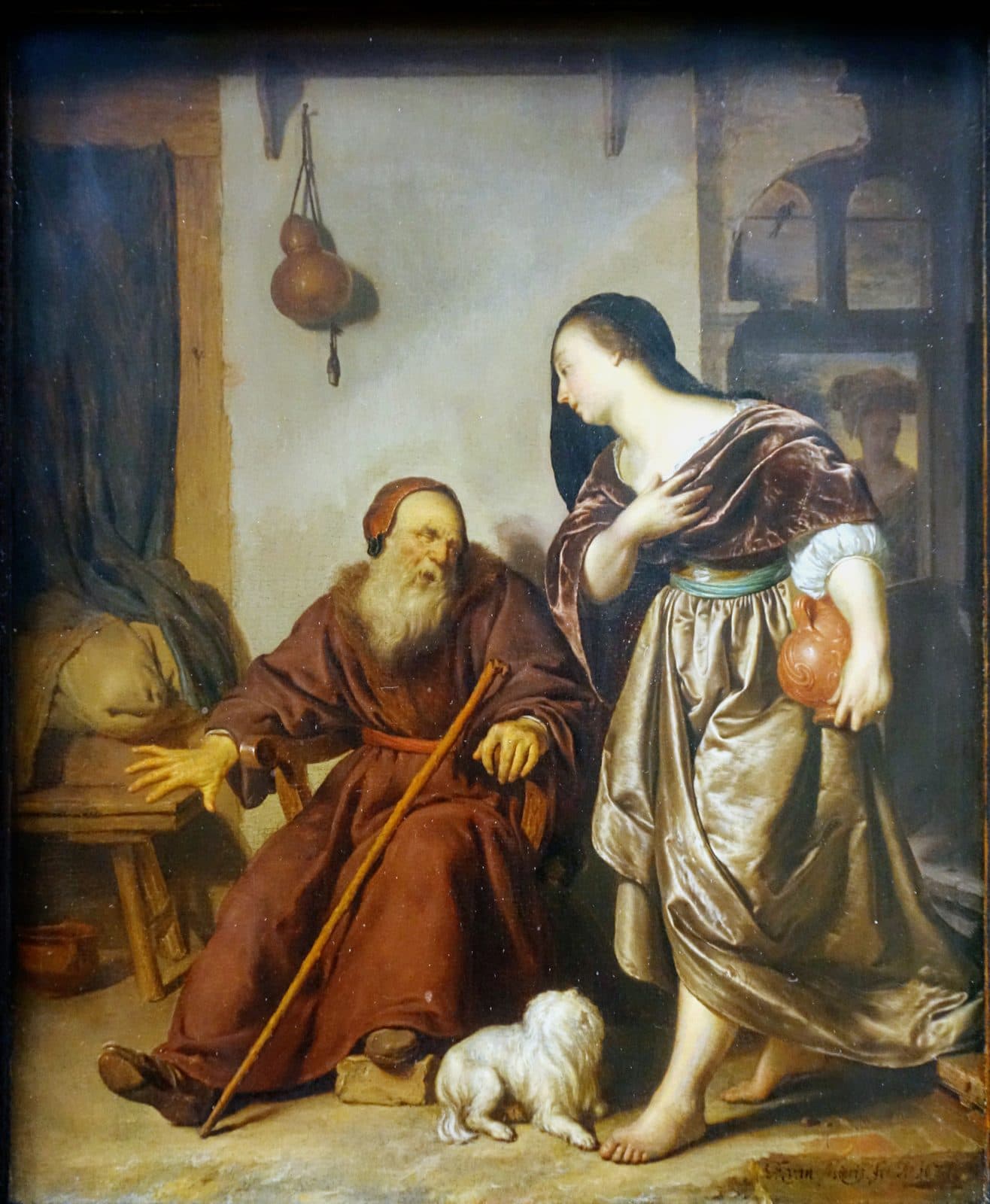
Frans van Mieris the Elder, Jeroboam's Wife and the Prophet Ahijah, 1671, Palais des Beaux-Arts, Lille. Public domain, via Wikimedia Commons.
Mieris painted the visit as a small scene on a wooden panel, the old prophet in his chair and the young woman before him with a jar in her hand.
Ahijah's cloak
and said to Jeroboam, “Take ten pieces for yourself, for this is what the LORD, the God of Israel, says: ‘Behold, I will tear the kingdom out of the hand of Solomon, and I will give you ten tribes.Ten pieces for ten tribes, torn from Solomon's hand.
I will give one tribe to his son, so that My servant David will always have a lamp before Me in Jerusalem, the city where I chose to put My Name.One tribe stays with Solomon's son, so that David will always have a lamp in Jerusalem.
If you listen to all that I command you, walk in My ways, and do what is right in My sight in order to keep My statutes and commandments as My servant David did, then I will be with you. I will build you a lasting dynasty just as I built for David, and I will give Israel to you.The condition attached to the promise.
The assembly at Shechem
and spoke to them as the young men had advised, saying, “Whereas my father made your yoke heavy, I will add to your yoke. Whereas my father scourged you with whips, I will scourge you with scorpions.”Rehoboam's answer: whips for his father, scorpions for him.
When all Israel saw that the king had refused to listen to them, they answered the king: “What portion do we have in David, and what inheritance in the son of Jesse? To your tents, O Israel! Look now to your own house, O David!” So the Israelites went home,The cry of the tribes: what portion do we have in David?
Rehoboam sent Adoram, who was over the forced labour, and all Israel stoned him to death.
When all Israel heard that Jeroboam had returned, they summoned him to the assembly and made him king over all Israel. Only the tribe of Judah followed the house of David.The assembly makes him king over all Israel.
The calves, the priests and the feast
Jeroboam said in his heart, “Now the kingdom might revert to the house of David. If these people go up to offer sacrifices in the house of the LORD at Jerusalem, their hearts will return to their lord, Rehoboam king of Judah; then they will kill me and return to Rehoboam king of Judah.”His reasoning, spoken in his heart.
After seeking advice, the king made two golden calves and said to the people, “Going up to Jerusalem is too much for you. Here, O Israel, are your gods, who brought you up out of the land of Egypt.”The calves, and the words Israel said over Aaron's calf at Sinai.
Jeroboam also built shrines on the high places and appointed from every class of people priests who were not Levites.Shrines on the high places and priests who were not Levites.
On the fifteenth day of the eighth month, a month of his own choosing, Jeroboam offered sacrifices on the altar he had set up in Bethel. So he ordained a feast for the Israelites, offered sacrifices on the altar, and burned incense.A feast in the eighth month, a month of his own choosing.
The man of God from Judah
And he cried out against the altar by the word of the LORD, “O altar, O altar, this is what the LORD says: ‘A son named Josiah will be born to the house of David, and upon you he will sacrifice the priests of the high places who burn incense upon you, and human bones will be burned upon you.’”The word against the altar names Josiah, a king of David's house not yet born.
Now when King Jeroboam, who was at the altar in Bethel, heard the word that the man of God had cried out against it, he stretched out his hand and said, “Seize him!” But the hand he stretched out toward him withered, so that he could not pull it back.The king's hand withers as he points at the prophet.
Then the king responded to the man of God, “Intercede with the LORD your God and pray that my hand may be restored.” So the man of God interceded with the LORD, and the king’s hand was restored to him as it was before.The man of God prays, and the hand is restored.
Even after these events, Jeroboam did not repent of his evil ways, but again he appointed priests for the high places from every class of people. He ordained anyone who desired to be a priest of the high places. And this was the sin of the house of Jeroboam that led to its extermination and destruction from the face of the earth.Even after this he did not turn, and this became the sin of his house.
The word against his house
I tore the kingdom away from the house of David and gave it to you. But you were not like My servant David, who kept My commandments and followed Me with all his heart, doing only what was right in My eyes. You have done more evil than all who came before you. You have proceeded to make for yourself other gods and molten images to provoke Me, and you have flung Me behind your back.God's charge: you were not like My servant David.
All Israel will mourn for him and bury him. For this is the only one belonging to Jeroboam who will receive a proper burial, because only in him has the LORD, the God of Israel, found any good in the house of Jeroboam.The boy alone of the house would be mourned and buried, because God found some good in him.
As she crossed the threshold of the house at Tirzah, the boy died.
Charles Spurgeon preached on the dying boy of 1 Kings 14:13 in the sermon A Bad King's Good Son, and called him the one godly child in the wicked house of Jeroboam.
War with Judah
Chronicles says Abijah of Judah stood on Mount Zemaraim and called on Jeroboam's army not to fight the kingdom of the LORD.
And now you think you can resist the kingdom of the LORD, which is in the hands of David’s descendants. You are indeed a vast army, and you have with you the golden calves that Jeroboam made for you as gods. But did you not drive out the priests of the LORD, the sons of Aaron, and the Levites? And did you not make priests for yourselves as do the peoples of other lands? Now whoever comes to consecrate himself with a young bull and seven rams can become a priest of things that are not gods.Abijah names the golden calves and the priests of things that are not gods.
and the men of Judah raised the battle cry. And when they raised the cry, God routed Jeroboam and all Israel before Abijah and Judah.Judah raised the battle cry, and God routed Jeroboam.
What Kings and Chronicles Set Beside the Sin
Three things a short retelling often drops
THE KINGDOM WAS GOD'S GIFT
Ahijah tells him that God will take him and make him king over all that his heart desires.
JUDAH WAS TOLD NOT TO FIGHT
Shemaiah told Rehoboam's army to go home and not fight their brothers, for this word was from the LORD.
THE LEVITES WENT SOUTH
The priests and Levites left their lands in the north and went to Judah and Jerusalem.
Egypt and the Two Kingdoms
Shishak, the Karnak list and the date
The Shishak who sheltered Jeroboam is the pharaoh Sheshonq, the first king of a new dynasty in Egypt. In the fifth year of Rehoboam he came up against Jerusalem and carried off the treasures of the temple and the palace.
At Karnak he left a relief and a list of the towns he took. James Breasted read in it towns of the northern kingdom as well as of Judah, among them Taanach, Shunem, Beth-shean, Mahanaim and Megiddo. Breasted dated the campaign to about 926 BC, which places Jeroboam's reign in the late tenth century BC.
What Josephus adds
Josephus, writing in the first century, says Jeroboam feared that the people would go up to Jerusalem for the Feast of Tabernacles and return to their first kings. In his telling Jeroboam told the tribes that God is in every place, so they need not go to one city.
Josephus also names the man of God from Judah as Jadon, a name the Hebrew text does not give.
A second account in the Greek
The Greek translation of Kings carries a second telling of Jeroboam's rise after 1 Kings 12:24. In it his mother is named Sarira, he builds a city of that name for Solomon, and the king of Egypt gives him Ano, the elder sister of his own wife, as a wife.
The Hebrew text has none of these details.
The House of Jeroboam
Five people, each with the verse that names the tie
| Person | Tie to Jeroboam | Verse |
|---|---|---|
| Nebat and Zeruah | His father, and his mother, a widow. | 1 Kings 11:26 |
| His wife | Sent in disguise to Ahijah at Shiloh; Kings gives no name. | 1 Kings 14:2 |
| Abijah | His son, who died as a boy and was mourned by all Israel. | 1 Kings 14:1 |
| Nadab | His son, who reigned two years and was killed by Baasha. | 1 Kings 15:25 |
- Person
- Nebat and Zeruah
- Tie to Jeroboam
- His father, and his mother, a widow.
- Verse
- 1 Kings 11:26
- Person
- His wife
- Tie to Jeroboam
- Sent in disguise to Ahijah at Shiloh; Kings gives no name.
- Verse
- 1 Kings 14:2
- Person
- Abijah
- Tie to Jeroboam
- His son, who died as a boy and was mourned by all Israel.
- Verse
- 1 Kings 14:1
- Person
- Nadab
- Tie to Jeroboam
- His son, who reigned two years and was killed by Baasha.
- Verse
- 1 Kings 15:25
The Places of the Reign
Eight places, from Jerusalem to his house at Tirzah
| Place | What happened there | Verse |
|---|---|---|
| Jerusalem | Solomon built the terraces and repaired the wall, and Jeroboam rose in the work. | 1 Kings 11:27 |
| Egypt | His refuge from Solomon, and later the base of Shishak's raid on Jerusalem. | 1 Kings 11:40 |
| Shechem | The tribes met Rehoboam there. | 1 Kings 12:1 |
| Penuel | He built it east of the Jordan. | 1 Kings 12:25 |
| Bethel | One calf, the altar and the eighth-month feast. | 1 Kings 12:32 |
| Dan | The other calf, at the northern edge of the land. | 1 Kings 12:29 |
| Shiloh | Ahijah the prophet lived there. | 1 Kings 14:2 |
| Tirzah | His house when his son died. | 1 Kings 14:17 |
- Place
- Jerusalem
- What happened there
- Solomon built the terraces and repaired the wall, and Jeroboam rose in the work.
- Verse
- 1 Kings 11:27
- Place
- Egypt
- What happened there
- His refuge from Solomon, and later the base of Shishak's raid on Jerusalem.
- Verse
- 1 Kings 11:40
- Place
- Shechem
- What happened there
- The tribes met Rehoboam there.
- Verse
- 1 Kings 12:1
- Place
- Penuel
- What happened there
- He built it east of the Jordan.
- Verse
- 1 Kings 12:25
- Place
- Bethel
- What happened there
- One calf, the altar and the eighth-month feast.
- Verse
- 1 Kings 12:32
- Place
- Dan
- What happened there
- The other calf, at the northern edge of the land.
- Verse
- 1 Kings 12:29
- Place
- Shiloh
- What happened there
- Ahijah the prophet lived there.
- Verse
- 1 Kings 14:2
- Place
- Tirzah
- What happened there
- His house when his son died.
- Verse
- 1 Kings 14:17
Questions the Reign Raises
Three questions answered from their verses
Was the division God's act or Israel's rebellion?
So the king did not listen to the people, and indeed this turn of events was from the LORD, to fulfill the word He had spoken to Jeroboam son of Nebat through Ahijah the Shilonite.Kings gives both answers. The first is that the turn of events was from the LORD.
So to this day Israel has been in rebellion against the house of David.The same chapter calls it a rebellion.
He left Rehoboam to his own folly, and hid from his eyes the things which belonged to his peace, that the kingdom might be rent from him. Note, God serves his own wise and righteous purposes by the imprudences and iniquities of men, and snares sinners in the work of their own hands.
Matthew Henry · Commentary on the Whole Bible · on 1 Kings 12:15Puritan
Why the eighth month?
And Jeroboam ordained a feast on the fifteenth day of the eighth month, like the feast that was in Judah, and he offered sacrifices on the altar; he made this offering in Bethel to sacrifice to the calves he had set up, and he installed priests in Bethel for the high places he had set up.Jeroboam set his feast like the feast in Judah and held it at Bethel.
So he would keep God's feast, not in God's time, which was the fifteenth day of the seventh month, and so onward, Levit xxiii, 34, but on the fifteenth day of the eighth month. And this alteration he made, either, 1. to keep up the difference between his subjects, and those of Judah as by the differing manners, so by the distinct times of their worship.
John Wesley · Explanatory Notes upon the Old Testament · on 1 Kings 12:32Evangelical
Whom did the LORD strike after the war with Judah?
Jeroboam did not again recover his power during the days of Abijah, and the LORD struck him down and he died.Jeroboam did not recover his power in Abijah's days, and the LORD struck him down. Readers have asked whether the one struck down is Jeroboam or Abijah.
The Lord struck him, and he died - Who died? Abijah or Jeroboam? Some think it was Jeroboam; some, that it was Abijah. Both rabbins and Christians are divided on this point; nor is it yet settled. The prevailing opinion is that Jeroboam is meant, who was struck then with that disease of which he died about two years after; for he did not die till two years after Abijah: see 1Ki 14:20; 1Ki 15:9. It seems as if Jeroboam was meant, not Abijah.
Adam Clarke · Commentary on the Bible · on 2 Chronicles 13:20Evangelical
What the Text Leaves Unsaid
Two things Kings does not tell
Kings gives Jeroboam's age at no point in his life.
It says the calves were gold and says nothing of their size or form.
The Sins of Jeroboam
The measure Kings lays on nearly every northern king
Kings judges almost every later king of Israel by one phrase: he walked in the sins of Jeroboam son of Nebat, which he caused Israel to commit.
because of the sins Jeroboam had committed and had caused Israel to commit, and because he had provoked the LORD, the God of Israel, to anger.Ahijah's word fulfilled on his house, for the sins he caused Israel to commit.
When the LORD had torn Israel away from the house of David, they made Jeroboam son of Nebat king, and Jeroboam led Israel away from following the LORD and caused them to commit a great sin. The Israelites persisted in all the sins that Jeroboam had committed and did not turn away from them.The reason Kings gives for the exile of the north.
The refrain, king by king
And Baasha did evil in the sight of the LORD and walked in the way of Jeroboam and in his sin, which he had caused Israel to commit.Baasha, who destroyed his house, walked in his way.
And as if it were not enough for him to walk in the sins of Jeroboam son of Nebat, he even married Jezebel the daughter of Ethbaal king of the Sidonians, and he then proceeded to serve and worship Baal.Ahab went further, as if the sins of Jeroboam were not enough.
Nevertheless, he clung to the sins that Jeroboam son of Nebat had caused Israel to commit; he did not turn away from them.Joram clung to the same sins.
And he did evil in the sight of the LORD and did not turn away from all the sins that Jeroboam son of Nebat had caused Israel to commit.Jeroboam II, the king of the same name, did not turn from them.
How the rabbis read him
The Mishnah, the code of Jewish law compiled in the land of Israel about AD 200, names Jeroboam first of three kings who have no share in the world to come, with Ahab and Manasseh.
The tractate Avot sets him beside Moses. Moses made the many righteous and their righteousness is credited to him; Jeroboam made the many sin and their sin is laid on him.
The Babylonian Talmud, compiled about AD 500, tells that God offered him repentance and a walk in the Garden of Eden with the son of Jesse. Jeroboam asked who would walk first, and when he heard it would be David, he refused.
The prophets on the calf
He has rejected your calf, O Samaria. My anger burns against them. How long will they be incapable of innocence? For this thing is from Israel—a craftsman made it, and it is not God. It will be broken to pieces, that calf of Samaria.Hosea: a craftsman made it, and it is not God.
But never prophesy at Bethel again, because it is the sanctuary of the king and the temple of the kingdom.”In the days of Jeroboam II, Bethel is still the king's sanctuary.
Voices on Jeroboam, Earliest First
From Ephrem the Syrian in the fourth century to Jamieson, Fausset and Brown in 1871
While he prepared to establish the reign which was reserved to him by God according to the predictions of the prophets Shemaiah and Ahijah, Jeroboam thought that nothing could be more useful for his purpose than kindling the hatred of the two opposite parties to …
Ephrem the Syrian · On the First Book of Kings 12:18 · on 1 Kings 12:28Patristic
But when in the temple of our God, that wicked king Jeroboam took away the gifts that his father had laid up and offered them to idols on the holy altar, did not his right hand, which he stretched, wither, and his idols, which he called on, were not able to help him? Then, turning to the Lord, he asked for pardon, and at once his hand, which had withered by sacrilege, was healed by true religion.
Ambrose of Milan · Concerning Virginity 2.5.38 · on 1 Kings 13:4-6Patristic
Three more voices
He was distrustful of the promise of God, could not take his word that, if he would keep close to his duty, God would build him a sure house ( ch. xi. 38 ); but he would contrive ways and means, and sinful ones too, for his own safety. A practical disbelief of God's all-sufficiency is at the bottom of all our treacherous departures from him.
Matthew Henry · Commentary on the Whole Bible · on 1 Kings 12:26-27Puritan
Said, &c. - Reasoned within himself. The phrase discovers the fountain of his error, that he did not consult with God, who had given him the kingdom; as in all reason, and justice, and gratitude he should have done: nor believed God's promise, chap. xi, 38, but his own carnal policy.
John Wesley · Explanatory Notes upon the Old Testament · on 1 Kings 12:26Evangelical
He was a young man of talent and energy, who, having been appointed by Solomon superintendent of the engineering works projected around Jerusalem, had risen into public notice, and on being informed by a very significant act of the prophet Ahijah of the royal destiny which, by divine appointment, awaited him, his mind took a new turn.
Jamieson, Fausset & Brown · Commentary Critical and Explanatory on the Whole Bible · on 1 Kings 11:26-40Reformed
What Were the Calves?
Two readings, each with its holders
Jeroboam presented the calves with the words of Exodus 32, naming the God who brought Israel out of Egypt. Readers have taken the calves two ways.
Images meant to stand for the LORD
Carl Friedrich Keil argued in 1872 that the words borrowed from Sinai show the LORD was worshipped under the image of the calves, and that this was not the worship of Egyptian idols. Matthew Henry had read them the same way a century and a half before.
(1.) He would not be at the charge of building a golden temple, as Solomon had done; two golden calves are the most that he can afford. (2.) He intended, no doubt, by these to represent, or rather make present, not any false god, as Moloch or Chemosh, but the true God only, the God of Israel, the God that brought them up out of the land of Egypt, as he declares,
Matthew Henry · Commentary on the Whole Bible · on 1 Kings 12:28Puritan
The strongest point against it is the text itself: Ahijah calls the calves other gods and molten images, and Chronicles sets them beside goat idols.
Idols of other gods
Jamieson, Fausset and Brown read the calves as figures of the Egyptian ox gods Apis and Mnevis, which Jeroboam came to know in Egypt. Peter Chrysologus preached on them in the fifth century.
Now let us talk also about the second kind of scandal, which, we said, arises from human cleverness.… Jeroboam raised up a scandal. He set up as gods for the people, golden calves—pitiful images—to keep them from seeking the living God, the true temple, God's …
Peter Chrysologus · SERMON 27 · on 1 Kings 12:30Patristic
The strongest point against it is that Jehu, who destroyed Baal worship, kept the calves, which suggests Israel did not count them as Baal.
Books to Read Next
Five works, each free to read
Antiquities of the Jews
Flavius Josephus, tr. William Whiston · c. 94
Josephus retells the division in book 8 and gives Jeroboam's reasons as a speech.
Read at Project GutenbergThe Books of the Kings
Carl Friedrich Keil, tr. James Martin · 1872
Keil comments on 1 Kings 11 to 14 verse by verse, with the Hebrew.
Read at the Internet ArchiveAncient Records of Egypt, volume 4
James Henry Breasted · 1906
Breasted translates the Karnak relief and its list of the towns Shishak took.
Read at the Internet ArchiveThe Septuagint Version of the Old Testament
Lancelot Brenton · 1844
Brenton's English gives the Greek second account of Jeroboam after 3 Kingdoms 12:24.
Read at the Internet ArchiveCommentary on the Whole Bible
Matthew Henry · 1710
Henry traces the motive behind each step of Jeroboam's policy.
Read at CCELOne King Over Them All
Jeroboam took the kingdom God gave him and secured it his own way, and Kings counts the cost to the end. Ezekiel saw the two kingdoms made one nation again under one king and one shepherd, David God's servant. Jesus, the Son of David, calls Himself the good shepherd of one flock.
When a Samaritan woman asked Jesus whether to worship on her mountain or in Jerusalem, He answered that the Father seeks those who worship Him in spirit and in truth. The reign asks the reader to trust God's word over a safer plan, and to worship Him as He has said.
Keep studying
Read it5
Studies11
Doctrines1