
Numbers 21 and Deuteronomy 2 to 3 · An Iconic Story
Sihon and Og
The account of Israel's victories over Sihon of Heshbon and Og of Bashan in Numbers 21:21 to 35 and Deuteronomy 2:24 to 3:17.
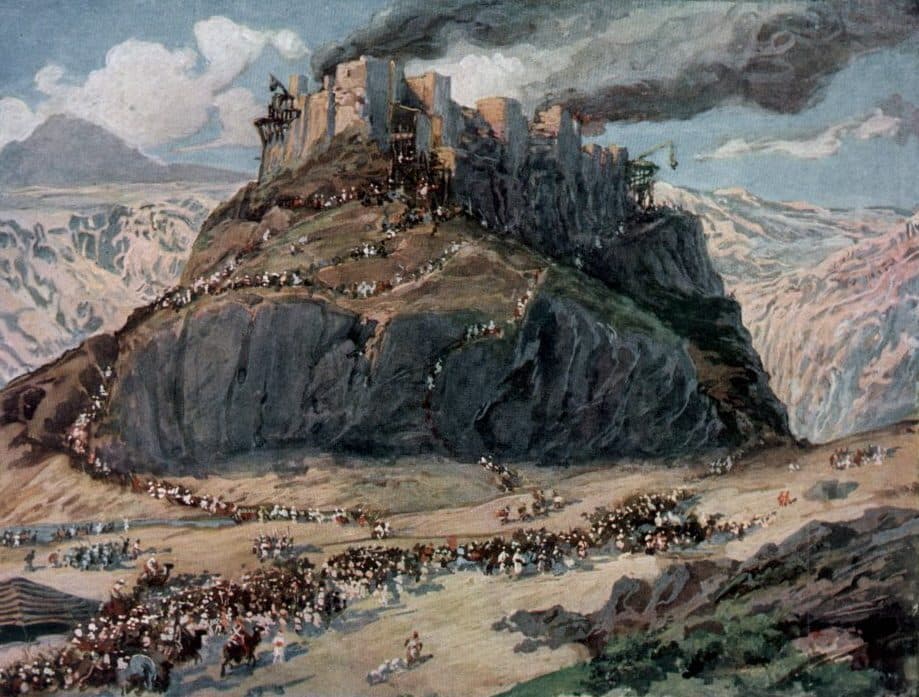
James Tissot, The Conquest of the Amorites, before 1903. Public domain, via Wikimedia Commons.
THE ARTWORKJames Tissot painted Israel's army climbing to a burning hill city of the Amorites. Numbers 21:25 records that Israel took all the Amorite cities and settled in them, Heshbon and its villages among them.
Israel asked Sihon for the use of one road, and his refusal opened the whole land from the Arnon to Mount Hermon to Israel.
Summary
On the way to the Jordan, Israel defeated Sihon, king of the Amorites at Heshbon, and Og, king of Bashan, and took the land east of the Jordan.
- Israel fought two battles, against Sihon at Jahaz and against Og at Edrei (Numbers 21:23 and 21:33).
- When Og fell at Edrei, the last of the Rephaim fell with him (Deuteronomy 3:11).
- Moses gave the land of the two kings to Reuben, Gad and half of the tribe of Manasseh (Numbers 32:33).
- Joshua, Judges, Nehemiah and two psalms recall the two victories.
The Request and the Two Battles
Numbers 21:21 to 35 and Deuteronomy 2:24 to 3:11: the request, the battle at Jahaz and the battle at Edrei
Israel had come to the Arnon, the valley at the southern edge of the Amorite kingdom of Sihon. Moses sent messengers to Sihon at Heshbon and asked for passage through his land.
“Let us pass through your land. We will not cut through any field or vineyard, or drink water from any well. We will stay on the King’s Highway until we have passed through your territory.”The request shows that Israel asked only for passage, so the war began with Sihon's refusal.
Sihon refused and gathered his whole army against Israel in the wilderness. Israel defeated him at Jahaz and took his land from the Arnon to the Jabbok, with Heshbon and all its villages.
Then Israel turned and went up the road to Bashan, and Og its king came out with his whole army to meet them at Edrei.
But the LORD said to Moses, “Do not fear him, for I have delivered him into your hand, along with all his people and his land. Do to him as you did to Sihon king of the Amorites, who lived in Heshbon.”The LORD's word before the second battle makes the first battle its pattern.
Israel struck down Og with his sons and his army and took his land. When Moses tells the account again in Deuteronomy 2 and 3, he adds what Numbers leaves out.
(For only Og king of Bashan had remained of the remnant of the Rephaim. His bed of iron, nine cubits long and four cubits wide, is still in Rabbah of the Ammonites.)The account gives one measure, and it is the measure of Og's bed.
Deuteronomy's account of the two battles, in the versesDeuteronomy 2:26, 2:32 to 33 and 3:4 to 5
So from the Wilderness of Kedemoth I sent messengers with an offer of peace to Sihon king of Heshbon, saying,Moses names the place he sent from and calls the message an offer of peace.
So Sihon and his whole army came out for battle against us at Jahaz. And the LORD our God delivered him over to us, and we defeated him and his sons and his whole army.Moses credits the victory at Jahaz to the LORD.
At that time we captured all sixty of his cities. There was not a single city we failed to take—the entire region of Argob, the kingdom of Og in Bashan. All these cities were fortified with high walls and gates and bars, and there were many more unwalled villages.John Gill, in his Exposition of the Old Testament, reads these walls as an answer to the fears the twelve spies of Numbers 13 had raised in Israel.
The Battles, the Bed and the Land
The events in order, Og's bed drawn to its measures, and the land on a printed atlas plate of 1926
Israel took two kingdoms in twelve steps, from the crossing of the Arnon to the gift of the land.
- Israel is told to cross the Arnonthe Arnon ValleyDeuteronomy 2:24
- Moses sends an offer of peace to Sihonthe Wilderness of KedemothDeuteronomy 2:26
- Sihon refuses and comes out to fightJahazNumbers 21:23
- Israel takes Heshbon and the Amorite citiesHeshbonNumbers 21:25
- Israel lives in the conquered countryeast of the JordanNumbers 21:31
- Spies go to Jazer, and its villages are takenJazerNumbers 21:32
- Israel goes up the road to BashanBashanNumbers 21:33
- Moses is told not to fear Ogbefore the battleNumbers 21:34
- Og falls with his sons and his armyEdreiNumbers 21:35
- Sixty walled cities of Argob are takenArgobDeuteronomy 3:4
- The land goes to Reuben, Gad and half of Manassehthe Arnon to Mount HermonNumbers 32:33
- Moses retells the victoriesafter both battlesDeuteronomy 1:3 to 4
Twelve events from the crossing of the Arnon to Moses' retelling, in the order the text gives them, each with its place and its verse. The text dates only the last (Deuteronomy 1:3 to 4), so the rows are spaced by order without a scale of time.
Og's bed was nine cubits long and four wide, about 4 m by 1.8 m.
2 cubits, about 0.9 m (3 feet)
- The bed of ironDeuteronomy 3:11
- Nine cubits longDeuteronomy 3:11
- Four cubits wideDeuteronomy 3:11
- A man of about four cubits, lying downDeuteronomy 3:11
2 cubits, about 0.9 m (3 feet)
Deuteronomy 3:11 gives the bed's length and width. The man lying beside it is drawn at about four cubits, 1.8 m, from head to feet, and the cubit is taken at about 18 inches.
The plan is drawn from above at one scale, in cubits.
Six landmarks of the account stand on the plate, from Mount Hermon in the north to Mount Nebo in the south.
- Located: the site is known
- Identified: the point stands for an area, or is rounded
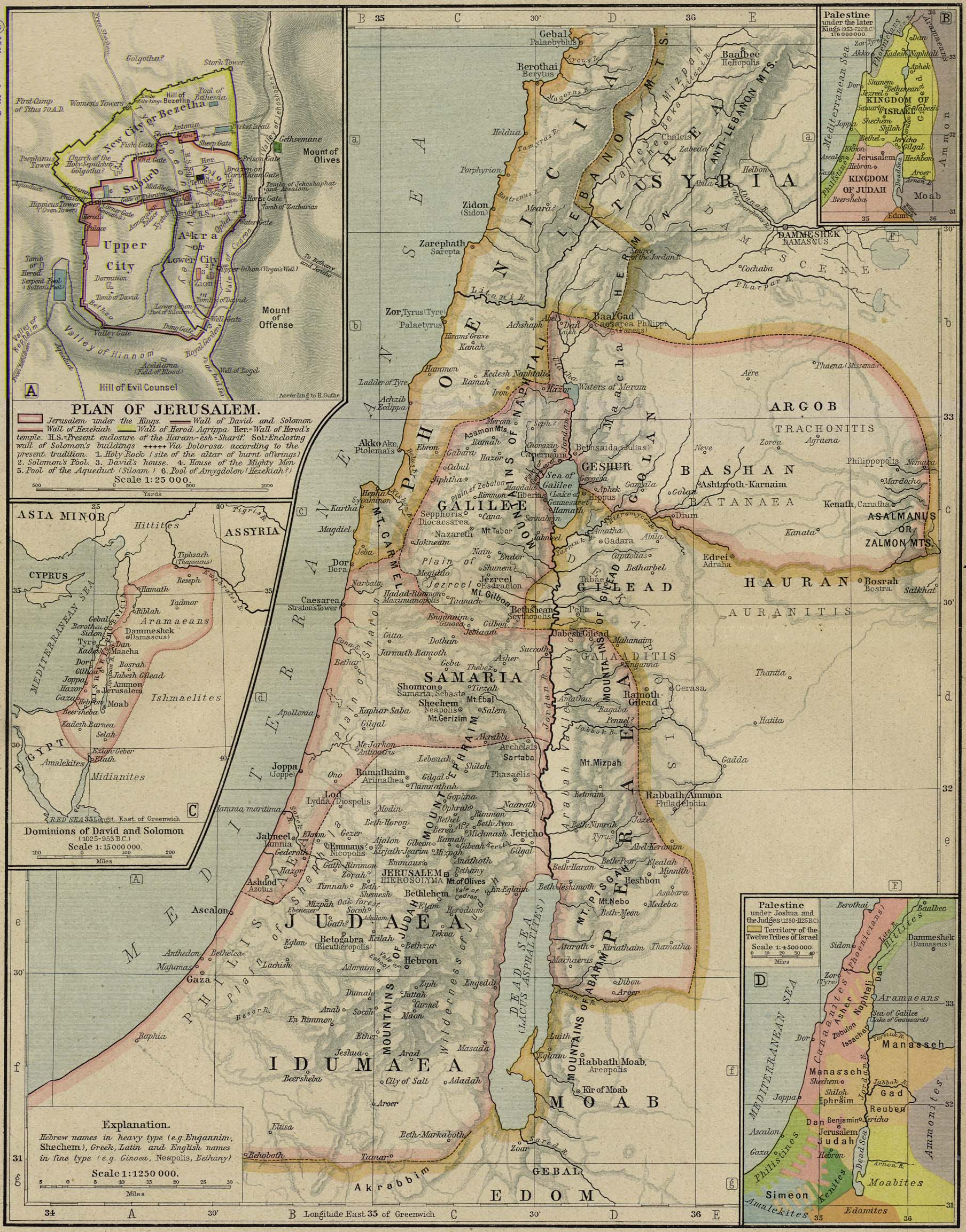
- 1Mount Hermon, The northern limit of the land taken from the two kings Deuteronomy 3:8
- 2Chinnereth, Where the river boundary of Reuben and Gad began in the north Deuteronomy 3:17
- 3Peniel on the Jabbok, The Jabbok was Sihon's northern border, the river Jacob crossed Numbers 21:24
- 4Rabbah of the Ammonites, Og's bed was still kept here Deuteronomy 3:11
- 5The Jordan, The western border of the land of Reuben and Gad Deuteronomy 3:17
- 6Mount Nebo, the top of Pisgah, The slopes of Pisgah lay to the east of the Jordan and the Arabah Deuteronomy 3:17
Base map: Reference map of ancient Palestine, Rand McNally reference map (1926), public domain. Each place stands at its place page's coordinates, set on the plate by Jerusalem and Damascus, as the plate prints them.
The plate is Rand McNally's reference map of ancient Palestine (1926), and it prints Heshbon, Edrei, Dibon, Aroer, the Arnon and the Jabbok by name.
What the Text Says and What the Story Became
Three retellings set beside the verses
“OG WAS NINE CUBITS TALL”
The text measures the bed and gives no height for the man who slept in it.
“ISRAEL ATTACKED SIHON WITHOUT WARNING”
Sihon marched out against Israel in the wilderness after Moses had sent him an offer of peace.
“ISRAEL TOOK MOAB'S LAND”
Sihon had fought a former king of Moab and taken his land as far as the Arnon, so Heshbon was an Amorite city when Israel took it.
Henry on Heshbon's titleMatthew Henry on Numbers 21:26
“The Israelites did not take it out of the hands of the Moabites, they had before lost it to the Amorites, and were constrained to give up their pretensions to it; and, when Israel had taken it from the Amorites, they were under no obligation to restore it to the Moabites, whose title to it was long since extinguished.”
Matthew Henry · Commentary on the Whole Bible · on Numbers 21:26Puritan
Jephthah's answer to Ammon, in the versesJudges 11:21 to 22 and 11:26
Then the LORD, the God of Israel, delivered Sihon and all his people into the hand of Israel, who defeated them. So Israel took possession of all the land of the Amorites who inhabited that country, seizing all the land from the Arnon to the Jabbok and from the wilderness to the Jordan.Jephthah recounts the conquest to the king of Ammon with the borders of Numbers 21:24.
For three hundred years Israel has lived in Heshbon, Aroer, and their villages, as well as all the cities along the banks of the Arnon. Why did you not take them back during that time?His three hundred years date Israel's hold on Heshbon from this conquest.
Sihon's Kingdom and the Land of the Rephaim
The land east of the Jordan from the Arnon to Mount Hermon, and the people Og was the last of
Joshua 12 sets out the two kingdoms by their kings. Sihon lived in Heshbon and ruled north to the Jabbok, and Og lived in Ashtaroth and Edrei and ruled up to Mount Hermon and Salecah (Joshua 12:2 to 5).
Deuteronomy counts Og among the Rephaim, an old people as tall as the Anakites. The Moabites called them Emites and the Ammonites called them Zamzummites (Deuteronomy 2:10 to 11 and 2:20 to 21). In Abraham's day Chedorlaomer had defeated the Rephaites at Ashteroth-karnaim (Genesis 14:5).
Deuteronomy 2:11 counts the Anakites among the Rephaim. A generation earlier the twelve spies Moses sent into Canaan had given the Anakites a name from Genesis 6:4.
We even saw the Nephilim there—the descendants of Anak that come from the Nephilim! We seemed like grasshoppers in our own sight, and we must have seemed the same to them!”The spies' report is the link between the Anakites and the Nephilim of the days before the flood.
To the half-tribe of Manasseh I gave the rest of Gilead and all of Bashan, the kingdom of Og. (The entire region of Argob, the whole territory of Bashan, used to be called the land of the Rephaim.)The verse links Og's kingdom to the Rephaim by its old name.
| The land | Its king | Given to |
|---|---|---|
| From Aroer on the Arnon to the Jabbok, with half the hill country of Gilead | Sihon of Heshbon | Reuben and Gad |
| The Jordan valley from Chinnereth to the Salt Sea | Sihon of Heshbon | Reuben and Gad |
| The rest of Gilead | Og of Bashan | Half of Manasseh, Machir's clan |
| All Bashan and the region of Argob | Og of Bashan | Half of Manasseh, taken by Jair |
Rashi and Sforno on the last of the RephaimRashi on Deuteronomy 3:11 and Sforno on Deuteronomy 3:10
Rashi, the Jewish commentator on the Torah, reads the remnant of the Rephaim as the survivors of the battle at Ashteroth-karnaim in Genesis 14:5. Sforno, another Jewish commentator on the Torah, says Og ruled Bashan because he alone was left of the Rephaim of old, a famous warrior equal in power to all the others together.
Barnes on the JabbokAlbert Barnes on Numbers 21:24
“Jabbok (now Wady Zerka: compare Gen 32:22) runs eastward under Rabbah of the children of Ammon, thence westward, and reaches the Jordan, 45 miles north of the Arnon. It was between Rabbah and Gerasa that it formed the Ammonite boundary.”
Albert Barnes · Notes, Explanatory and Practical, on the Old and New Testaments (1832-1869) · on Numbers 21:24Evangelical
What the Text Leaves Unsaid
The account leaves three questions open, and readers have answered each of them anyway.
Why was the bed in Rabbah?Deuteronomy 3:11
The verse places the bed in Rabbah of the Ammonites and gives no reason. John Wesley offers two guesses in his Explanatory Notes upon the Old Testament (1765). Either the Ammonites took it as spoil in an earlier war with Og, or they asked for it after his death as a monument of his greatness.
Who were the poets of Heshbon?Numbers 21:27 to 30
Numbers quotes a song of the poets on the fire that went out from Heshbon against Moab, and it names neither the poets nor their people. Adam Clarke, in his Commentary on the Bible (1832), takes the lines for a war song made in memory of Sihon's victory over Moab and quoted by Moses.
Why did Israel go up to Bashan?Numbers 21:33
Numbers gives the march north to Bashan in a single clause. Albert Barnes, in his Notes on the Old Testament, observes that the text does not say whether God sent Israel there by express warrant or whether Og and his people provoked the advance.
His Loving Devotion Endures Forever
Scripture remembers the two kings in its prayers and its songs
He struck down great kings His loving devotion endures forever. and slaughtered mighty kings— His loving devotion endures forever. Sihon king of the Amorites His loving devotion endures forever. and Og king of Bashan— His loving devotion endures forever. and He gave their land as an inheritance, His loving devotion endures forever. a heritage to His servant Israel. His loving devotion endures forever.Each king has a line of his own, and the refrain follows every line.
Psalm 135:10 to 12 names the same two kings in its praise, and the Levites of Nehemiah's day confessed the same gift in their prayer.
You gave them kingdoms and peoples and allotted to them every corner of the land. So they took the land of Sihon king of Heshbon and of Og king of Bashan.The prayer counts the two kingdoms among the lands God gave Israel.
Moses made the two victories a promise for the wars to come. He told Joshua that his own eyes had seen what the LORD did to the two kings, and that the LORD would do the same to every kingdom across the Jordan.
Do not be afraid of them, for the LORD your God Himself will fight for you.”Moses gives Joshua the reason he need not be afraid.
Henry on mercies named one by oneMatthew Henry on Psalm 136:19 to 20
“It is good to enter into the detail of God's favours and not to view them in the gross, and in each instance to observe, and own, that God's mercy endureth for ever.”
Matthew Henry · Commentary on the Whole Bible · on Psalm 136:19 to 20Puritan
Spurgeon on the two kingsCharles Spurgeon, Sermon No. 1285 (1876), and The Treasury of David (1885)
Spurgeon preached Psalm 136:17 to 22 under the title Sihon and Og, or Mercies in Detail. He opens on the repetition of the six verses, asks whether it is tedious, and answers that the repeated chime is part of the poem's charm. In The Treasury of David he writes that Sihon could not smite Israel because the Lord smote him, and that Og had to exchange his bedstead of iron for a bed in the dust.
How the Commentators Read the Two Kings
Rashi and Matthew Henry on Sihon, Og and the people who fought them
Rashi on who sent the messengersRashi on Numbers 21:21
Numbers 21:21 says Israel sent the messengers, and Deuteronomy 2:26 says Moses sent them. Rashi reads each verse as supplying what the other holds back, and he concludes from the pair that Moses is Israel, since the leader of a generation counts as the whole generation. He cites the Midrash Tanchuma (Chukat 23).
Rashi on Sihon's refusal and Moses' fear of OgRashi on Numbers 21:23 and Deuteronomy 3:2
Rashi says the kings of Canaan paid Sihon tribute to guard his land against invaders, so Israel's request asked him to give up the purpose of his rule. He also asks why the LORD told Moses not to fear Og and gave no such word about Sihon. His answer is that Moses feared Og's merit, since Rashi takes Og for the escapee who brought Abram the news in Genesis 14:13, after Genesis Rabbah 42:8.
Henry on a people born in the wildernessMatthew Henry on Deuteronomy 2:36
“Most of them were born, and had lived all their days, in a vast howling wilderness, where they knew not what either fields or cities were, had no houses to dwell in, and neither sowed nor reaped; and now of a sudden to become masters of a country so well built, so well husbanded, this made them amends for their long waiting, and yet it was but the earnest of a great deal more.”
Matthew Henry · Commentary on the Whole Bible · on Deuteronomy 2:36Puritan
Henry on the victories under MosesMatthew Henry on Joshua 12:6
“Joshua's services and achievements are confessedly great, but let not those under Moses be overlooked and forgotten, since God was the same who wrought both, and both put together proclaim him the Alpha and Omega of Israel's great salvation.”
Matthew Henry · Commentary on the Whole Bible · on Joshua 12:6Puritan
Where the Readers Divide
Readers divide on two questions: what Og's bed was, and why Sihon and his people fell under the ban.
What Og's bed wasDeuteronomy 3:11
Wesley's Explanatory Notes take the bed as written and give its size as four and a half yards by two. Albert Barnes, in his Notes on the Old Testament, reads its iron as the black basalt of the region. That stone holds about a fifth part iron and was called iron, and bronze was then the common metal for furniture. Jamieson, Fausset and Brown, in their Commentary Critical and Explanatory on the Whole Bible (1871), report that the critics Dathe and Roos read the word as coffin. On that reading Og was wounded in battle, fled to Rabbah, and died and was buried there.
Why the two kingdoms fell under the banGenesis 15:16 and Deuteronomy 2:30
In the fourth generation your descendants will return here, for the iniquity of the Amorites is not yet complete.”The LORD's word to Abram ties Israel's return to the iniquity of the Amorites.
John Gill, in his Exposition of the Old Testament, and Adam Clarke, in his Commentary on the Bible (1832), read the ban as judgement on a people whose iniquity was now full, after Genesis 15:16.
But Sihon king of Heshbon would not let us pass through, for the LORD your God had made his spirit stubborn and his heart obstinate, that He might deliver him into your hand, as is the case this day.Moses gives the LORD's hardening of Sihon as the cause of his refusal.
“Moses herein did neither disobey God, who bade him contend with Sihon, nor dissemble with Sihon; but doubtless it was by divine direction that he did it, that Sihon might be left inexcusable, though God hardened his heart. This may illustrate the method of God's dealing with those to whom he gives his gospel, but does not give grace to believe it.”
Matthew Henry · Commentary on the Whole Bible · on Deuteronomy 2:26 to 29Puritan
The Great Books on This Story
Commentary on the Whole Bible
Matthew Henry · 1710
Henry reads each turn of the account as a preacher and draws its lesson for the reader's faith.
Notes on the Old Testament
Albert Barnes · 1832 to 1869
Barnes does the work of the ground, from the Jabbok and the Arnon to the stone gates of Bashan.
The Treasury of David
Charles Spurgeon · 1885
Spurgeon comments on each king's line of Psalm 136 in turn.
Pentateuch with Rashi's Commentary
Rashi, translated by M. Rosenbaum and A. M. Silbermann · 1929 to 1934
Rashi gathers the readings of the Midrash on the account and names the source of each.
In print: find it wherever books are sold.
The First Land Held
For we have heard how the LORD dried up the waters of the Red Sea before you when you came out of Egypt, and what you did to Sihon and Og, the two kings of the Amorites across the Jordan, whom you devoted to destruction.Rahab at Jericho had heard of the two kings before Israel crossed the Jordan.
The land of Sihon and Og was the first land Israel held, and two and a half tribes settled there before the Jordan was crossed.
The text asks the reader to remember God's mercies one by one, as Psalm 136 does, and to trust the LORD who fights for His people.
“As he said to the Egyptians, Let my people go, so to the Canaanites, Let my people in, that they may serve me. In this God's mercy to them endureth for ever, because it was a figure of the heavenly Canaan, the mercy of our Lord Jesus Christ unto eternal life.”
Matthew Henry · Commentary on the Whole Bible · on Psalm 136:21 to 22Puritan
Keep studying
Symbols1
Peoples and groups1