
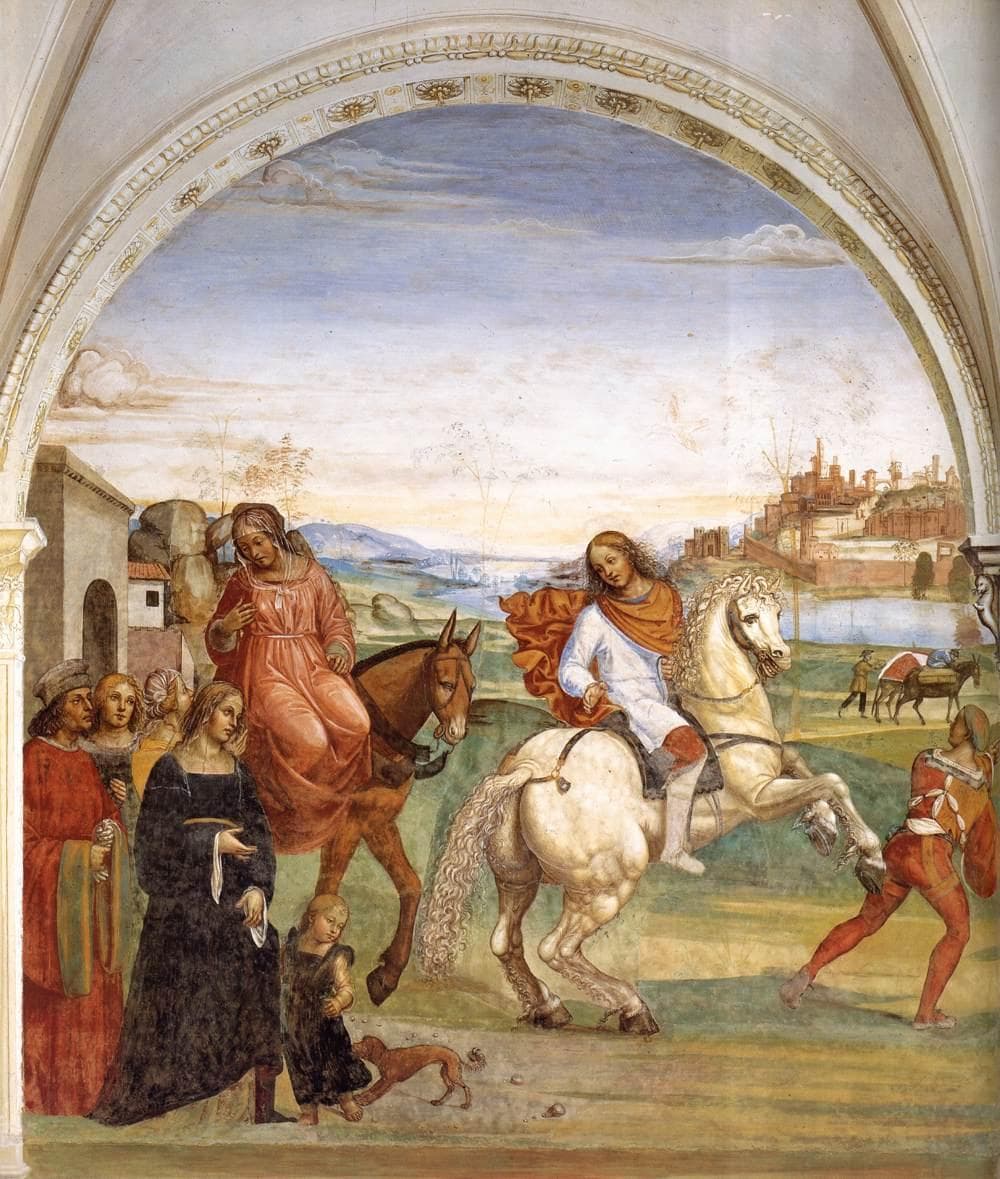
Subiaco and Monte Cassino, sixth century · Story · Featured Study
Benedict and the Rule
A sixth-century abbot of Italy, told from the one book of his life and from his own words.
Gregory the Great names the four disciples who told him Benedict's story: Constantinus, Valentinianus, Simplicius and Honoratus.
- Where
- Nursia, Subiaco, Monte Cassino
- Who
- Benedict, Scholastica, Gregory
- When
- about 529 to 543 (proposed)
Il Sodoma, Benedict Leaves His Parents' House, 1505 to 1508. Public domain.
Seven times a day I praise You for Your righteous judgments.
Summary
Benedict of Nursia left Rome for a cave at Subiaco and later founded the monastery of Monte Cassino. He wrote a rule that sets the monk's day in seven hours of prayer, with work and reading between them.
- His sister Scholastica kept him one night by her prayer.
- Historians dispute how much of the Rule Benedict took from an older rule.
- Its last chapter sends its monks on to the Fathers and calls itself a little rule for beginners.
The Verses the Rule Is Built On
The psalm's seven hours and its midnight, and Paul's word on work.
The Rule takes its hours of prayer from the Psalms and its hours of work from the apostles. Its sixteenth chapter counts “this sacred number of seven” from the psalm of the key verse.
At midnight I rise to give You thanks for Your righteous judgments.The same chapter takes the night office from this verse.
For even while we were with you, we gave you this command: “If anyone is unwilling to work, he shall not eat.”Chapter 48 sets the monks to live by their hands as the apostles did, and this is the apostles' rule of work.
The Places of Gregory's Life of Benedict
From Nursia to the oratory of his death, by the chapters of Gregory's second book.
Benedict moved from the city to a cave, then to a mountain monastery.
| Place | Stage | Chapter |
|---|---|---|
| Nursia and Rome | Birth and schooling | Prologue |
| Subiaco | Three years alone | 1 |
| A monastery near Subiaco, at Vicovaro | The first abbacy | 3 |
| Monte Cassino | The founding | 8 |
| Near the abbey | His sister's last visit | 33 and 34 |
| The oratory at Cassino | His death | 37 |
The Life Told Plainly, From Rome to Cassino
Each scene is Gregory's report.
Benedict “was born in the province of Nursia, of honourable parentage, and brought up at Rome in the study of humanity.” He gave over his book and forsook “his father's house and wealth.”
He went into a desert place called Sublacum, about forty miles from Rome, and lived “in a strait cave” for three years, “unknown to all men, except to Romanus.”
The monks of a nearby monastery asked him to be their abbot. When he held them to their rule, they “agreed to poison his wine,” and Gregory says the glass broke when Benedict blessed it.
At Cassino, on a mountainside, he destroyed the idol of an old temple. “In the temple of Apollo, he built the oratory of St. Martin,” and an oratory of Saint John where the altar had stood.
Edmund Gardner, editor of the Dialogues, dates the founding to 528 or 529.
His sister Scholastica came once a year to see him. One evening he would not stay, and she bowed her head on the table and prayed, and a storm kept him there all night.
Three days later, Gregory says, Benedict saw her soul rise “in the likeness of a dove.”
Ask, and it will be given to you; seek, and you will find; knock, and the door will be opened to you.She asked and was given what her brother refused.
Gregory tells that one night Benedict saw the whole world gathered together under one beam of the sun.
On the sixth day of his last sickness Benedict was carried into the oratory. He received the body and blood of Christ and died standing, his hands lifted up, and he was buried in the oratory of Saint John the Baptist.
What the Rule Orders
Seven hours of praise, a night office, work, reading, guests and three promises.
The Rule opens by calling the monk to return to God by the labour of obedience, having left Him through the sloth of disobedience. Its prologue sets out “to establish a school of the Lord's service.”
The day is kept at “Lauds, Prime, Tierce, Sext, None, Vespers and Compline,” with a night office besides, and the whole Psalter of a hundred and fifty psalms is said every week.
“Idleness is an enemy to the soul,” chapter 48 begins, and the brethren are to work at set times with their hands and at others in holy reading.
Private ownership is “above all to be cut off” from the monastery.
The multitude of believers was one in heart and soul. No one claimed that any of his possessions was his own, but they shared everything they owned.It stands beside chapter 33, which forbids a monk anything of his own.
All guests who come are to be received like Christ Himself, and the Rule gives Christ's own word on the stranger.
For I was hungry and you gave Me something to eat, I was thirsty and you gave Me something to drink, I was a stranger and you took Me in,The Rule's chapter on guests quotes this verse.
The novice promises, in the oratory, “stability, conversion of life, and obedience.”
Chapter 42 has one of the monks read each evening the Conferences of Cassian, as Hunter Blair's bracket names them, “or the lives of the Fathers.”
What the Record Leaves Unsaid
A book of miracles, and no year of death.
Gregory's book is a book of miracles, and the Rule is the firmer witness to what Benedict taught.
Gregory gives no year for Benedict's death. Gardner gives 543, and the Catholic Encyclopedia of 1907 gives 543, calling Totila's visit to Cassino in that year “the only certain date” of his life and taking the year of death from Abbot Tosti.
How the Key Verse Was Taught
Four writers on Psalm 119:164, from the fourth century to the nineteenth.
Ambrose of Milan (died 397)
Concerning Virgins 3.4.18
Ambrose of Milan, writing to virgins, set the psalm's seven times beside the command to watch and pray.
“Frequent prayer also commends us to God. For if the prophet says, ‘Seven times a day have I praised Thee,’ though he was busy with the affairs of a kingdom, what ought we to do, who read: ‘Watch and pray that ye enter not into temptation’?”
Patristic
Augustine of Hippo (died 430)
Expositions on the Book of Psalms, Psalm 119, section 162
Augustine read the psalm's number by the week of creation.
“The words ‘seven times a day,’ signify ‘evermore.’ For this number is wont to be a symbol of universality; because after six days of the divine work of creation, a seventh of rest was added; and all times roll on through a revolving cycle of seven days.”
Patristic
John Cassian (died 435)
Institutes 3.4
John Cassian, writing of the monks of the East, tells how their offices came to number seven.
“‘Seven times a day do I praise Thee because of Thy righteous judgments.’ For by the addition of this service we certainly hold these spiritual assemblies seven times a day, and are shown to sing praises to God seven times in it.”
Patristic
Charles Spurgeon (1834 to 1892)
The Treasury of David, Vol. 6
Charles Spurgeon gives the reading of a preacher of the nineteenth century.
“‘Seven times a day do I praise thee because of thy righteous judgments.’ He laboured perfectly to praise his perfect God, and therefore fulfilled the perfect number of songs. Seven may also intend frequency. Frequently he lifted up his heart in thanksgiving to God for his divine teachings in the word, and for his divine actions in providence. With his voice he extolled the righteousness of the Judge of all the earth. As often as ever he thought of God's ways a song leaped to his lips.”
on Psalm 119:164Particular Baptist
John Cassian, Charles Spurgeon
In Their Own Words
Benedict in his Rule, his sister at the table, and Gregory on the Rule.
Benedict of Nursia (died 548)
The Rule of Saint Benedict, chapter 4, instrument 21
Nothing before Christ
“To prefer nothing to the love of Christ.”
Patristic
About this saying1 paragraph
Benedict sets this among the instruments of good works, in D. O. Hunter Blair's English of 1907.
Benedict of Nursia
The Rule of Saint Benedict, chapter 48
Truly monks
“then are they truly monks, when they live by the labour of their hands, as did our fathers and the Apostles.”
Patristic
About this saying1 paragraph
Benedict wrote this of the brothers' daily labour, in a Rule that Hunter Blair dates about 535.
Gregory the Dialogist (died 604)
Dialogues 2.36
Excellent for discretion
“he wrote a rule for his monks, both excellent for discretion and also eloquent for the style.”
Patristic
About this saying1 paragraph
Gregory the Great, bishop of Rome from 590, judged the Rule after he had told the miracles.
Scholastica
Her answer to Benedict, in Gregory the Great, Dialogues 2.33
I desired our good Lord
“I desired you to stay, and you would not hear me, I have desired our good Lord, and he hath vouchsafed to grant my petition”
Nun
About this saying1 paragraph
Scholastica answered her brother after the storm, as Gregory tells it in the English of 1608, edited by Gardner in 1911.
Gregory the Dialogist, Scholastica
Where Historians Disagree
Benedict's debt to an older rule, and who wrote the Dialogues.
Did Benedict draw on the Rule of the Master?2 paragraphs
John Fortin wrote in 2006 that “the principal source that Saint Benedict used in composing a rule for his monastic community at Monte Cassino was The Rule of the Master.”
Vincent Desprez reported in 2017 a dispute over method. François Masai and Eugène Manning criticized Adalbert de Vogüé, the editor of both rules, for treating them as static documents, and Desprez wrote that “Vogüé's position is now favoured.”
Did Gregory write the Dialogues?1 paragraph
Francis Clark argued in The Pseudo-Gregorian Dialogues (1987) that Gregory did not write them. De Vogüé answered him in 1988: “If Clark believes that the Dialogues are inauthentic, it is, without being pejorative, for ideological reasons.”
Books to Read Next
The Dialogues of Saint Gregory
Gregory the Great, edited by Edmund G. Gardner · 1911
Its second book is the one life of Benedict, in the English of 1608.
Free at the Internet ArchiveThe Rule of Saint Benedict
D. O. Hunter Blair, translator · 1907
It sets the Latin of the Rule beside an English translation, with notes.
Free at the Internet ArchiveWhat Benedict Left
Benedict left a cave for a monastery and wrote down a day of praise, work and reading for the brothers who joined him.
Sources
Scripture is the Berean Standard Bible.
- The Holy Bible, Berean Standard Bible (read 2026)
- Gregory the Great, Dialogues, book 2, the prologue and chapters 1, 3, 8, 33 to 37, in the English of 1608 signed P. W., edited by Edmund G. Gardner (London: Philip Lee Warner, 1911), with Gardner's introduction and notes.
- The Rule of Saint Benedict, the Prologue and chapters 4, 16, 18, 33, 42, 48, 53, 58 and 73, translated by D. O. Hunter Blair (London: Sands, 1907), with his preface and notes.
- Hugh Ford, St. Benedict of Nursia, The Catholic Encyclopedia, volume 2 (New York, 1907)
- John R. Fortin, Saint Augustine's Letter 211 in The Rule of the Master and The Rule of Saint Benedict, Journal of Early Christian Studies (2006), the first page.
- Vincent Desprez, Adalbert de Vogüé et les éditions critiques des règles monastiques anciennes, Revue Mabillon (2017), the abstract.
- Adalbert de Vogüé, Francis Clark and the Gregorian Dialogues (Part One), American Benedictine Review 70, no. 2 (2019), translating his article of 1988, the first page.
- Ambrose of Milan, Concerning Virgins 3.4.18, translated by H. de Romestin, Nicene and Post-Nicene Fathers, series 2, volume 10.
- Augustine, Expositions on the Book of Psalms, Psalm 119, section 162, the Oxford translation condensed by A. Cleveland Coxe, Nicene and Post-Nicene Fathers, first series, volume 8 (print basis 1886)
- John Cassian, Institutes 3.4, translated by Edgar C. S. Gibson, Nicene and Post-Nicene Fathers, second series, volume 11.
Keep Studying
Studies1
People and groups8
Subjects1
Church history2
Trials of life1