
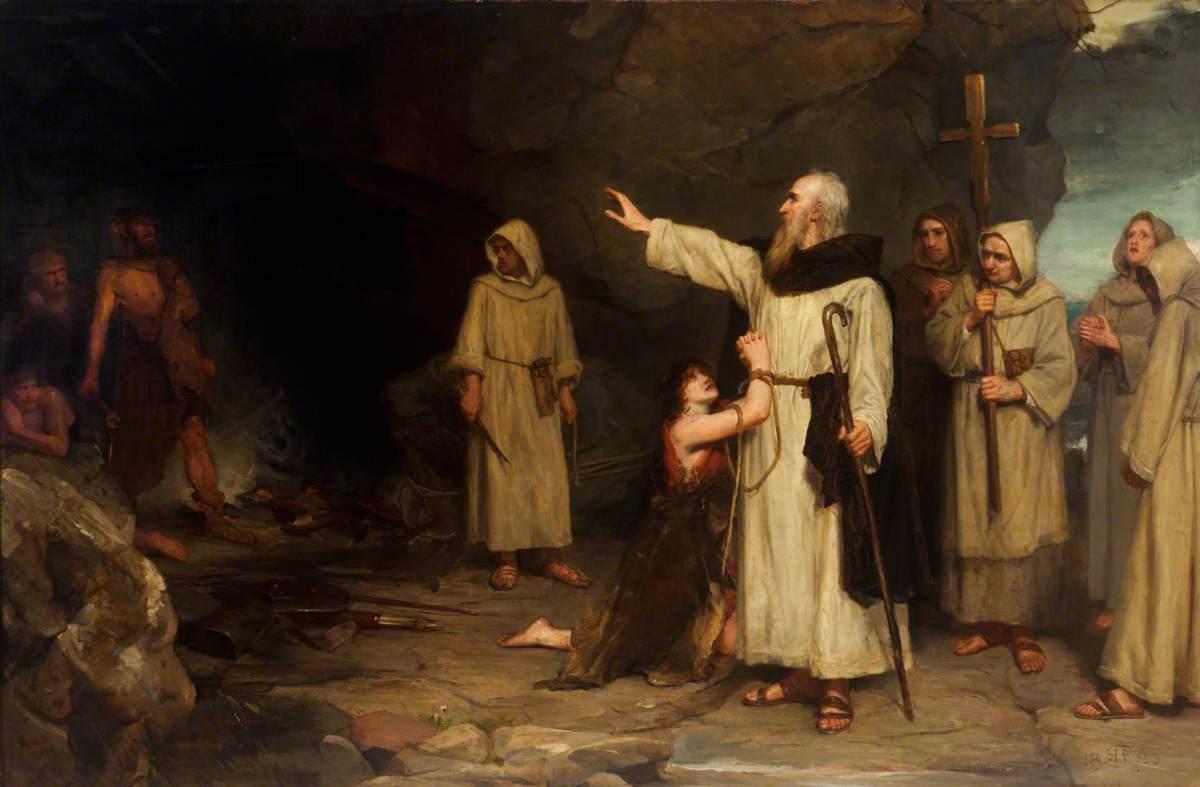
Saint Columba Rescuing a Captive, Robert Herdman, 1883. Public domain.
Ireland and Iona, to 597 · Person · Featured Study
Columba
He left Ireland at forty-one or forty-two and founded the monastery of Iona off the coast of Scotland.
- The name means
- Columba is the Latin for a dove
- Born
- 7 December 521, at Gartan in Ulster, by the Irish record (probable)
- Died
- about midnight of a Saturday in June 597, on Iona (probable)
- Family
- father: Fedilmith; mother: Aethne
- Places
- Gartan, Derry, Durrow, Iona, the River Ness
He laid down his pen at a line of Psalm 34, left the next line to Baithene, and died that night.
Young lions go lacking and hungry, but those who seek the LORD lack no good thing.
Summary
Columba was an Irish noble who founded churches at Derry and Durrow. Bede says he preached to the Picts of the north. He ordained a king of the Irish in Britain. The monks of his island later sent Aidan to the English of the north.
- Adomnan, the ninth abbot of Iona, wrote his Life about a hundred years after his death.
- Irish tradition blames a battle over a copied psalter for his leaving, and Adomnan does not say that.
- Huyshe's edition dates the Book of Kells to the seventh century, though it takes its name from a house he founded.
The Last Line He Copied
Adomnan set the verse beside the one that follows it, and Huyshe points to Joshua at the deathbed.
The question of this life is how much can be known of a man when his only full biographer wrote a century later to honour him. Adomnan gives no list of churches and few dates, and most of his book is prophecies, wonders and visions. He also gives the last day of a copyist at work.
Adomnan says the old man stopped copying at the line on those who seek the Lord. He comments that the next verse fits Baithene, who took up the pen. In Adomnan's account Columba also told his attendant that he would go the way of his fathers.
Come, children, listen to me; I will teach you the fear of the LORD.Adomnan says this next verse suits Baithene, the teacher who took up the work.
Now behold, today I am going the way of all the earth, and you know with all your heart and soul that not one of the good promises the LORD your God made to you has failed. Everything was fulfilled for you; not one promise has failed.Huyshe's text cites this verse for the words Columba used of his own coming death.
The Life in Order
Adomnan and Bede give a few fixed points, and the later Irish record fills in the years.
Adomnan gives his age and the battle, and he gives no year of the calendar for either.
- 7 December 521He was born at Gartan in the north-west of UlsterHuyshe's Summary, from the Irish record
- 545He built a church at DerryHuyshe's Summary, quoting Norman Moore
- 553Durrow, his chief house in Ireland, was foundedHuyshe's Summary; Bede 3.4
- 561The battle of Cooldrevny was foughtHuyshe's Summary; Adomnan, Second Preface
- 563 or 565He sailed from Ireland to BritainAdomnan, Second Preface; Bede 3.4
- By 575He ordained Aedhan king on IonaAdomnan 3.5; Huyshe's Summary
- 575He attended the Convention of Drumceatt in IrelandHuyshe's Summary
- June 597He died in the church on Iona after the midnight bellAdomnan 3.23; Bede 3.4
Each step of the life stands with its witness.
575, June 597
From Gartan to the Isle
Adomnan tells the journeys to the Picts and the last day, and the rest comes from the Irish record.
His father was a chieftain in the north-west of Ulster, and a priest fostered him. Adomnan describes a man who could not pass a single hour without prayer, reading, writing or manual labour.
Adomnan calls his crossing "a pilgrimage for Christ". He sailed in his forty-second year. Iona is a small island, and Bede says it holds about five families by the English reckoning.
He travelled to the fortress of Brude, king of the Picts, on the Ness. Adomnan says the king shut his gates against him, and that when Columba made the sign of the cross on them and knocked, the bolts shot back. From that day, Adomnan says, the king honoured him for the rest of his life.
At that court he asked the druid Broichan to free an Irish slave girl. Broichan refused. Adomnan says the druid fell sick when he kept her and recovered when he let her go. Columba cured him with a white pebble from the river.
Adomnan tells of an angel carrying a book of glass who ordered him to ordain Aedhan king, though he preferred Aedhan's brother. The angel struck him with a scourge and left a mark he bore on his side until he died. He obeyed and laid his hand on Aedhan's head on Iona.
On his last Saturday he blessed the granary and told his attendant Diormit that the day was truly a Sabbath for him. A white horse that carried the milk pails came and laid its head on his breast. He climbed a small hill, blessed the monastery and went back to his hut to copy the Psalter.
When the bell rang at midnight he went to the church ahead of the others. Diormit found him lying before the altar in the dark and lifted his right hand to bless the monks. He could not speak, and he died as he moved that hand.
The Book Behind the Life
Adomnan was the ninth abbot, and he wrote in three books about the prophecies, the wonders and the visions.
Adomnan was abbot of Iona from 679 to 704. He arranged his book by kinds of wonder, with prophetic revelations first, divine miracles second and angelic apparitions third. So the order of the Life is rarely the order of the years.
He anticipated doubt. He told his readers to count nothing he wrote as "doubtful or uncertain", and he said he drew on what stood in writing before his time and on faithful elders. He gives one chain of witness by name, saying Abbot Failbeus heard from King Oswald himself of a vision of Columba before a battle.
The wonders are Adomnan's claims, and they include the beast that he says Columba turned back at the River Ness. In Huyshe's English the creature stands in the river, and the loch is not named.
In Their Own Words
Five sayings as Adomnan reports them, none of them from a writing of Columba's that survives.
Columba (521 to 597)
words reported in Adomnan, Life of Saint Columba, Book 3, Book 3, chapter 23, at the foot of the Psalter page
What follows let Baithene write
“I must stop at the foot of this page, and what follows let Baithene write.”
Irish monastic
About this saying1 paragraph
Adomnan places these words on the last evening, in June 597, at the foot of a page of the Psalter.
Columba
words reported in Adomnan, Life of Saint Columba, Book 3, Book 3, chapter 23, in the granary
A true Sabbath
“In the Sacred Volumes this day is called the Sabbath, which is, interpreted, Rest. And this day is truly a Sabbath day for me, because it is for me the last day of this present laborious life, on which I rest after the fatigues of my labours”
Irish monastic
About this saying1 paragraph
He told Diormit this in the granary on the same day in 597, on a promise of secrecy until he died.
Columba
words reported in Adomnan, Life of Saint Columba, Book 3, Book 3, chapter 23, the white horse
Let him alone
“Let him alone, let him alone, for he loves me. Let him pour out the tears of his bitter lamentation into this my bosom.”
Irish monastic
About this saying1 paragraph
On the road back from the granary that day in 597, Diormit tried to drive the weeping horse away, and Columba stopped him.
Columba
words reported in Adomnan, Life of Saint Columba, Book 3, Book 3, chapter 23, the last charge
His charge to the monks
“These my last words I commend to you, O my sons, that ye have mutual and unfeigned charity among yourselves, with peace”
Irish monastic
About this saying1 paragraph
He gave this charge from the bare rock of his bed that night in 597, and his attendant alone heard it.
Columba
words reported in Adomnan, Life of Saint Columba, Book 2, Book 2, chapter 33
To the druid
“Know, Broichan, know if thou refuse to deliver to me this captive stranger before I return from this province, thou wilt quickly die.”
Irish monastic
About this saying1 paragraph
In the sixth century, at the court of King Brude, he gave this warning to the druid who held an Irish captive.
The People Around Him
Monks, kings and a druid fill the Life, and Adomnan names them in passing.
A monk held him as he died, a monk took up his page, and a king honoured him.
| Person | Tie to Columba | The witness |
|---|---|---|
| Aethne | She was his mother. | Adomnan, Second Preface |
| Fedilmith | He was his father, the son of Fergus. | Adomnan, Second Preface |
| Cruithnechan | This priest was his foster-parent. | Adomnan, Book 3, in Huyshe's Summary |
| Finnian | Columba studied under this bishop as a youth. | Adomnan, Book 2, in Huyshe's Summary |
| Diarmait | This king of Ireland lost the battle of 561, and the later story makes him judge of the copied book. | Huyshe's Summary |
| Brude | Columba came into Britain in the ninth year of his reign. | Bede 3.4 |
| Broichan | This druid was the king's foster-father. | Adomnan 2.33 |
| Aedhan | Columba ordained this king of the Irish settlers in Britain. | Adomnan 3.5 |
| Baithene | This disciple followed him as abbot and as a writer. | Adomnan 3.23 |
| Diormit | This attendant heard his last words and lifted his hand. | Adomnan 3.23 |
Broichan, Aedhan, Baithene, Diormit
The Places of His Life
His houses in Ireland lay to the north and in the midlands, and his journeys ran north up the Great Glen.
Iona was small, and Bede says it had the first place among all his houses.
| Place | What the witnesses say | The witness |
|---|---|---|
| Gartan | The Irish record gives it as his birthplace. | Huyshe's Summary |
| Derry | The Irish record says he built a church there in 545. | Norman Moore, in the Summary |
| Durrow | Its Irish name means the Field of Oaks. | Bede 3.4 |
| Kells | The monastery that gave its name to the Book of Kells was another of his foundations. | Huyshe's Summary |
| Cooldrevny | The battle was fought there, six miles north of Sligo. | Huyshe's Summary |
| Iona | Bede says his body lay there and his successors held the island. | Bede 3.4 |
| The River Ness | He crossed it on his way among the Picts. | Adomnan 2.27 and 2.33 |
| Drumceatt | The convention of 575 met on this long mound near the River Roe. | Huyshe's Summary |
The River Ness, Drumceatt
What Iona Kept
Bede admired its monks and faulted its Easter, and he records that a priest ruled its bishops.
Bede writes that the island's ruler was an abbot and a priest, and that "all the province, and even the bishops" were subject to him. Bede traces this to their first teacher, whom he calls "a priest and monk". He calls this "contrary to the usual method".
Bede also says the monks "employed doubtful cycles" to set the date of Easter, and he records it as a fault of their isolation. He still writes that Columba "left successors renowned for their continence, their love of God, and observance of monastic rules".
Read Benedict and the Rule, another pattern of monastic life
How the Key Verse Was Taught
Basil of Caesarea, John Gill and Charles Spurgeon read the line he copied last.
Basil of Caesarea (died 379)
HOMILIES ON THE PSALMS 16:7 (PS 34)
Basil of Caesarea set the good of seeking God against wealth, which moves like the sea.
“Wealth is unstable and like a wave accustomed to change hither and thither by the violence of the wind.… God himself is absolute Good, and they who seek him will not be without him.”
on Psalm 34:10Patristic
John Gill (1697 to 1771)
Exposition of the Old Testament, on Psalm 34:10
John Gill asked what seeking the Lord requires of the one who does it.
“by prayer, diligently, with their whole heart, and in the sincerity of their souls”
Reformed Baptist
Charles Spurgeon (1834 to 1892)
The Treasury of David, Vol. 2
Charles Spurgeon set the simple believer beside the crafty and the strong.
“The young lions do lack, and suffer hunger. They are fierce, cunning, strong, in all the vigour of youth, and yet they sometimes howl in their ravenous hunger, and even so crafty, designing, and oppressing men, with all their sagacity and unscrupulousness, often come to want; yet simple minded believers, who dare not act as the greedy lions of earth, are fed with food convenient for them. To trust God is better policy than the craftiest politicians can teach or practice. But they that seek the Lord shall not want any good thing.”
on Psalm 34:10Particular Baptist
What the Witnesses Leave Open
Readers differ on the year he sailed, why he went, whether the king believed and what he wrote.
The year he sailedBede; Huyshe's Summary, from Adomnan
Bede gives 565. Adomnan gives the second year after the battle of Cooldrevny and the forty-second of Columba's age, and Huyshe's Summary reckons that as 563.
Bede also gives thirty-two years on the island to Adomnan's thirty-four.
Why did he leave Ireland?Adomnan; the Old Irish Life; the later Irish tradition; Huyshe's Summary
Later Irish tradition says Columba secretly copied a psalter of Abbot Finnian, lost the case before King Diarmait on the ruling "To every cow belongeth her calf", and raised his clan for the battle. It adds that his confessor Laisren sent him away as a penance, to win as many souls as had died.
In his Second Preface Adomnan names the battle only as a date and calls the journey a pilgrimage for Christ. The Summary in Huyshe's edition says the Old Irish Life "says nothing" of the battle story and gives a plain resolve to go on pilgrimage.
Did King Brude become a Christian?Bede; Adomnan; Huyshe's Summary
Bede says Columba "converted that nation to the faith of Christ" and that the Picts gave him the island. Adomnan records no baptism of the king.
The Summary in Huyshe's edition supposes that the Picts were converted and that Brude later confirmed the island to him, with an Irish king, Conall, as the first to allow it.
What did he write?Colgan and Todd; Fowler; the Summary in Huyshe's edition
Adomnan shows him writing in his cell. The Summary says he "is said to have written out more than three hundred copies" of the Vulgate and the Psalter. It reports three Latin hymns that tradition gives him, among them the Altus Prosator, and it quotes J. H. Todd that the hymn is old and Irish.
A colophon of the Book of Durrow names Columba the writer, and Professor Fowler thought that it was copied from an earlier manuscript. The Summary says both Durrow and Kells are now thought to be of the seventh century, after his death.
Books to Read Next
The Life of Saint Columba
Adomnan, translated by Wentworth Huyshe · 1905
This is the full Life in English, with a long Summary of Principal Events.
Read Huyshe free at the Internet ArchiveEcclesiastical History of the English Nation
Bede, translated by A. M. Sellar · 1907
Book 3, chapter 4 gives Bede's account of Columba and of the island.
Read Bede free at Project GutenbergWhat Columba Left
Bede writes that many other monasteries had their beginning through his disciples in Britain and in Ireland, and that the island monastery where his body lay had the first place among them.
Sources
Scripture is the Berean Standard Bible.
- The Holy Bible, Berean Standard Bible (read 2026)
- Adomnan, The Life of Saint Columba, newly translated from the Latin by Wentworth Huyshe, London: George Routledge and Sons (the Internet Archive dates the copy 1905)
- The Summary of Principal Events in the same edition, with its quotations from Norman Moore, John Golden, the Old Irish Life and J. H. Todd.
- Bede, Ecclesiastical History of the English Nation 3.3 and 3.4, translated by A. M. Sellar (1907)
- Basil of Caesarea, Homilies on the Psalms 16:7, on Psalm 34.
- John Gill, Exposition of the Old Testament (1748-1763), on Psalm 34:10.
- Charles Spurgeon, The Treasury of David, volume 2, on Psalm 34:10.
Keep Studying
People and groups9
Places1
Subjects1