

Nehemiah 1–6 · The 52-Day Rebuild · Featured Study
The Wall
A cupbearer weeps for four months before he ever speaks to the king — then prays mid-sentence in the king's own presence, rides out alone by night to see the ruin for himself, and organizes a fractured, mocked, conspired-against community into a wall finished in fifty-two days. The pattern running under every scene is the same: prayer and diligence in the same verse, never one instead of the other.
William Henry Bartlett, Panorama of Jerusalem (1844) — Public domain, via Wikimedia Commons
Summary
Ten scenes walk Nehemiah 1-6 in the order the text gives them, from the burden to the finished wall. A separate section traces Nehemiah 4:17-18's trowel-and-weapon image forward to Spurgeon's magazine, and three keynote Hebrew words close the page.
- Ten scenes are laid out in sequence, each with its own reference and a color running the covenant rainbow
- Nehemiah 4:17-18 is traced forward to Spurgeon naming his magazine The Sword and the Trowel after the same image
- Matthew Henry's own words on 4:17 are quoted in full alongside the image
- Three Hebrew keynote words, chomah, shamar, and zakar, are given their own word cards
- Doorway links carry the reader to the Nehemiah hub, the Ezra hub, and every page tagged prayer or obedience
The Build, Scene by Scene
Nehemiah 1–6, in the order the text gives it
- 1The burdenNehemiah 1:1–4
Nehemiah hears from his brother Hanani that Jerusalem's wall lies broken and its gates burned, and sits down and weeps, fasts, and prays before the God of heaven for days.
- 2Identificational confessionNehemiah 1:6–7
"I confess the sins of the children of Israel, which we have sinned against thee: yea, I and my father's house have sinned" — the paradigm text for confessing a body's sin, not only one's own.
- 3The arrow prayerNehemiah 2:1–8
Four months later, the king asks what Nehemiah wants. "So I prayed to the God of heaven. And I said unto the king..." — prayer inserted mid-sentence, before the answer is given.
- 4The night rideNehemiah 2:11–16
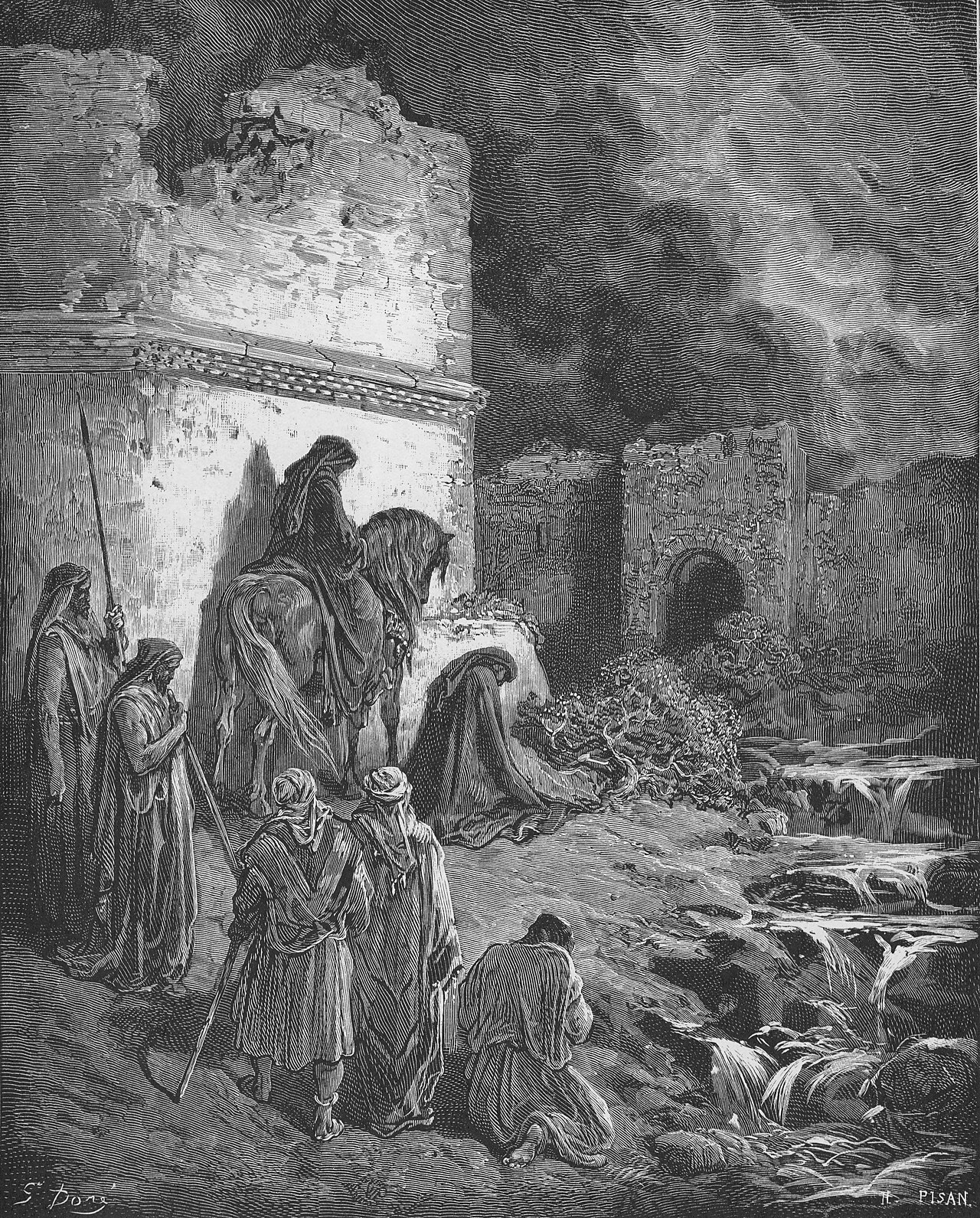
Before announcing anything to the community, Nehemiah rides out by night and surveys the ruined wall and burned gates himself, telling no one what God had put into his heart.
- 5"A mind to work"Nehemiah 2:17–4:6
The community responds to Nehemiah's charge with one line the dossier calls the mobilization keynote: "for the people had a mind to work."
- 6Mockery becomes conspiracyNehemiah 4:1–8
Sanballat, Tobiah, and Geshem move from ridicule ("will they revive the stones out of the heaps of rubbish?") to an armed plot to attack the builders unaware.
- 7Prayer and a watch, one verseNehemiah 4:9
"We made our prayer unto our God, and set a watch against them day and night" — intercession and diligence fused, not sequenced.
- 8One hand on the work, one on the weaponNehemiah 4:16–18
Half the builders bear arms while the other half works; every builder keeps a sword girded even while carrying materials: the source-image for Spurgeon's magazine, below.
- 9The internal crisis resolvedNehemiah 5:1–19
Nobles are lending to starving countrymen against their own fields and children. Nehemiah confronts it as covenant infidelity, not merely economic hardship, and refuses the governor's own food allowance for twelve years as his own model.
- 10The Ono plot, and the finishNehemiah 6:1–16
An assassination meeting is proposed at the plain of Ono and a hired false prophet tries to frighten Nehemiah into sin. He refuses both, and the wall is finished in fifty-two days, so that the surrounding nations "perceived that this work was wrought of our God."
The Sword and the Trowel
4:17–18: the verse behind Spurgeon's magazine
Nehemiah's builders work with a trowel in one hand and a weapon in the other: gospel labor and gospel defense held together, not traded off. Charles Spurgeon named his monthly magazine The Sword and the Trowel (founded 1865) directly from this image: ministry that builds and ministry that guards are one calling, not two.
The same fusion appears one chapter earlier in the book's own words: Nehemiah and his people "made our prayer unto our God, and set a watch against them day and night" (4:9): intercession and vigilance in the same breath, the pattern Dutch Sheets's watchman-prayer teaching reads as its Old Testament case study.
“Thus must we work out our salvation with the weapons of our warfare in our hand; for in every duty we must expect to meet with opposition from our spiritual enemies, against whom we must still be fighting the good fight of faith.”
Matthew Henry, Commentary on the Whole Bible (1710), on Nehemiah 4:17 — public domain
The Keynote Words
the vocabulary of the build
Keep studying
Read it2
By subject
Prayer9 pages
On this page
Places1
Words1
Doctrines1