
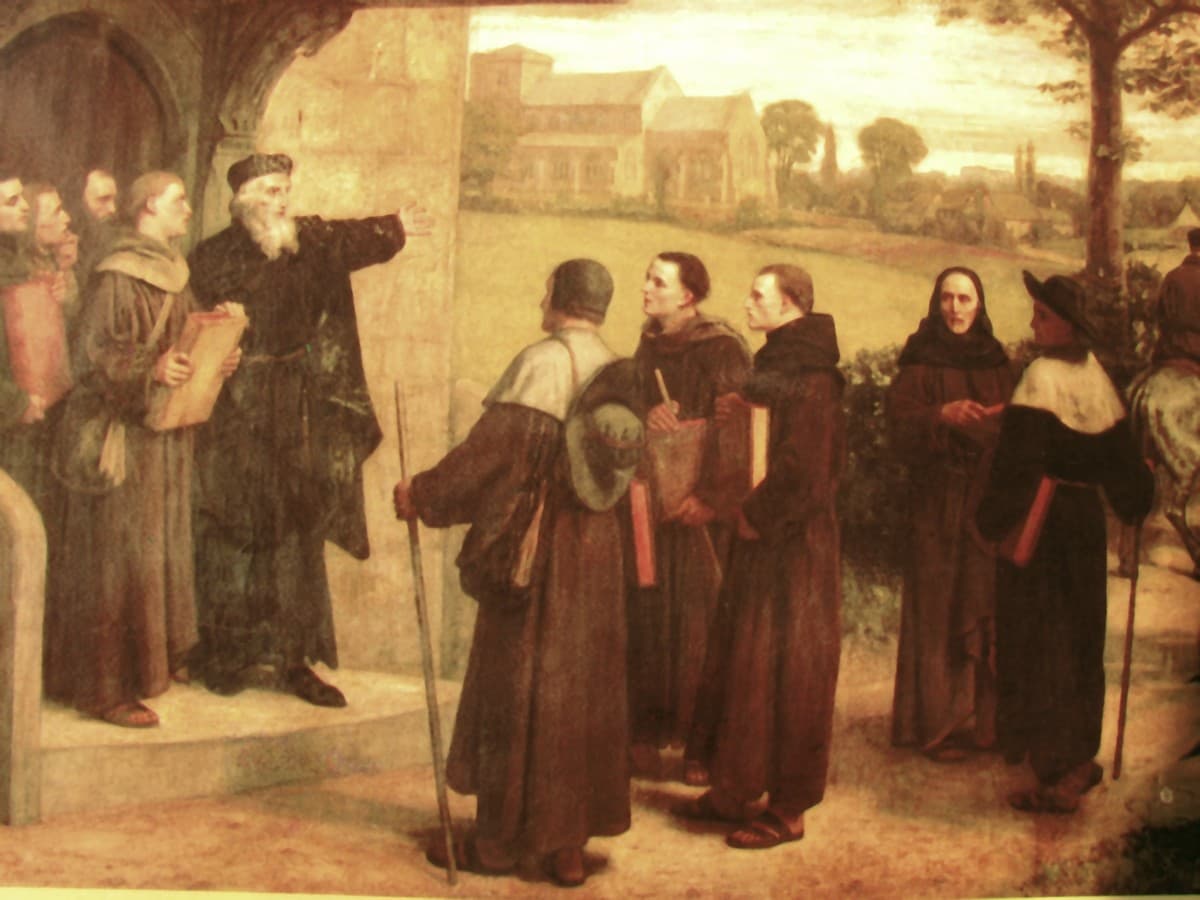
Wycliffe Giving 'The Poor Priests' His Translation of the Bible, William Frederick Yeames, 1835 to 1918. Public domain.
Oxford and Lutterworth, to 1384 · Person · Featured Study
John Wycliffe
He held the parish of Lutterworth from 1374, and a synod in London condemned his teaching in 1382.
- Born
- about 1324 by Leland; Buddensieg and Rashdall prefer 1330 (proposed)
- Died
- 31 December 1384, St. Sylvester's Day, by Walsingham and Lechler (probable)
- Places
- Oxford, Bruges, London, Lutterworth
The Oxford scholar who put the Bible into English a century and a half before it was legal.
The Law of the LORD is perfect, reviving the soul; the testimony of the LORD is trustworthy, making wise the simple.
Summary
He taught theology at Oxford and wrote against the pope's temporal power, then against the doctrine of the sacrament. He pressed for the Bible in English, and his circle made the version that bears his name.
- A council condemned his memory after he had died.
- Scholars have argued over how much of the translation was his own.
- The version was copied by hand, and hundreds of manuscripts remain.
The Law of the Lord
He called Scripture the law of God, in the words of Psalm 19, and he held it was for all people to know.
The question of this life is how a man of the schools came to say that every Christian should read the Bible, and what the church did about it. D. S. Schaff writes that "His own writings give scarcely a clew to the events of his career", so the record comes mainly from his opponents and from court papers.
From infancy you have known the Holy Scriptures, which are able to make you wise for salvation through faith in Christ Jesus.Timothy knew the Scriptures from infancy, and Wycliffe wanted them open to simple people.
All Scripture is God-breathed and is useful for instruction, for conviction, for correction, and for training in righteousness,Schaff reports his teaching that God speaks in all the books.
The Life in Order
The dates come from the records of his livings, his trials and his condemnation.
Almost all that is known of him falls in his last ten years.
- About 1324, or 1330He was born near the village of Wycliffe in YorkshireSchaff (1910), section 40 and note
- 1361He held office at OxfordSchaff, section 40
- 1374The king gave him Lutterworth, and he went to BrugesSchaff, section 40
- 1377He was summoned before Bishop Courtenay at St. Paul'sSchaff, section 40
- 1377The pope moved against himSchaff, section 40
- About 1380His poor priests began to go on foot among the peopleSchaff, section 40
- 1381He turned to the sacramentSchaff, section 40
- May 1382The synod at Blackfriars metGee and Hardy (1896)
- 1384His life ended at LutterworthLechler (1884); Walsingham in Schaff
- 4 May 1415The Council of Constance condemned himSchaff, sections 40 and 45
- 1428His remains were destroyedFuller (1655), in the 1868 edition
Each step of the life stands with its witness.
1381, May 1382, 1384, 4 May 1415, 1428
From Oxford to Lutterworth
He moved from the schools to the court, then to doctrine, then to a parish he could not leave.
John Wycliffe was an Oxford schoolman when he began arguing that Scripture stands above the papacy as the final authority, and that ordinary English people should be able to read it. His studies were at Oxford, and he was master of Balliol in 1361. The king's service took him to Bruges in 1374, and there he came close to John of Gaunt, who protected him for several years.
On his return he preached in Oxford and London against the pope's secular power. In 1377 he stood before Bishop Courtenay at St. Paul's, and the hearing ended in a quarrel between the bishop and Gaunt. Gregory XI condemned 19 sentences from his writings and ordered him held. A message from the widow of the Black Prince stayed his next hearing at Lambeth, and Gregory died in March 1378.
The schism of 1378 opened a new stage, in which he wrote in English as well as in Latin. About 1380 he began sending out his poor priests, and his enemies gave their successors the name of Lollards. The chronicler says they went on foot in long russet gowns of one pattern. In 1381 he attacked the doctrine of the sacrament of the altar, and the court at Oxford condemned the teaching without naming him.
In May 1382 Courtenay, now archbishop, called the synod at Blackfriars, and an earthquake shook its meeting. It condemned 24 articles, and its first was that the substance of bread and wine remains after consecration. His friends at Oxford recanted, and he was forbidden to preach there and retired to Lutterworth.
The Bible that bears his name, translated from the Latin Vulgate by Wycliffe and his circle, was copied by hand and carried across England by those preachers. Knighton's continuator complained that the gospel was "become more common and open to laymen, and women who are able to read, than it is wont to be even to lettered clerks".
He died of a stroke at his parish in Lutterworth, struck while saying mass. Thirty years later the Council of Constance condemned him as a heretic and ordered his body taken out of holy ground. Nothing was done for years, until in 1428 Richard Fleming, Bishop of Lincoln, had the bones dug up, burned, and thrown into the River Swift.
The historian Thomas Fuller saw the picture in it, writing in 1655 that the brook carried the ashes into the Avon, the Avon into the Severn, the Severn into the sea. He closed, "And thus the ashes of Wickliffe are the emblem of his doctrine, which now is dispersed all the world over".
The Bible That Bears His Name
It comes in two versions, it was copied by hand, and it was soon forbidden without a bishop's licence.
Forshall and Madden printed two versions in 1850, and they give the earlier to Wycliffe and his helper Nicholas Hereford and the later to John Purvey. They examined nearly 150 manuscripts of the later version. Lincoln College, Oxford, counts over 250 surviving manuscripts, 20 of them complete Bibles.
Schaff says he knew no Hebrew and probably no Greek and worked from the Latin. Arundel's constitutions of 1407 and 1408 forbade any unlicensed translation, and the reading of any made since his time without a bishop's approval.
His writings on Scripture are plainer than any verdict on his translating. To withhold the Scriptures from the laity he counted a fundamental sin, Schaff reports, and he made them the test of pope and schoolman alike.
In Their Own Words
Four passages, in the English of their editions.
John Wycliffe (1330 to 1384)
On the Truth of Holy Scripture, as Lechler quotes it
He held Scripture to be God's law for every Christian, ranked it over popes and schoolmen, and pressed for its reading by ordinary English people
“Holy Scripture is the faultless, most true, most perfect, and most holy law of God, which it is the duty of all men to learn to know, to defend, and to observe, inasmuch as they are bound to serve the Lord in accordance with it, under the promise of an eternal reward.”
Pre-Reformation reformer
About this saying1 paragraph
This comes from his Latin treatise On the Truth of Holy Scripture, of the fourteenth century, in the English of Lechler's account.
The worldly priest of Rome1 quotation, 1 paragraph
He wrote this in a tract soon after his return from Bruges in 1374, and Schaff gives its words without naming the tract.
Study fast in the New Testament1 quotation, 1 paragraph
He wrote this in Middle English in the fourteenth century, and D. S. Schaff prints it from Matthew's edition of the English works with its spelling lightly kept.
Why the earth shook1 quotation, 1 paragraph
He gave this reading of the Blackfriars earthquake of May 1382, and Schaff cites it from the Select English Works, volume 3, page 503.
The People Around Him
His protectors, his judges, his helpers and one heir make up the circle.
He kept a powerful protector until he attacked the doctrine of the altar.
| Person | Tie to Wycliffe | The witness |
|---|---|---|
| John of Gaunt | He protected him from about 1374 and stood with him at St. Paul's. | Schaff, section 40 |
| William Courtenay | He summoned him in 1377 and called the Blackfriars synod. | Schaff, section 40 |
| Gregory XI | This pope wrote at least five bulls against him. | Schaff, section 40, note 561 |
| Nicholas Hereford | He worked on the earlier version and recanted. | Schaff, sections 40 and 42 |
| John Purvey | He boarded under his roof and revised the version. | Schaff, section 42 |
| John Horn | His assistant for two years gave the account of his death. | Schaff, section 40, note 574 |
| Jan Hus | He took his ideas into Bohemia and died for them. | Schaff, sections 44 and 45 |
| Richard Fleming | This bishop of Lincoln carried out the order on his bones. | Fuller (1655) |
Jan Hus, Richard Fleming
The Places of His Life
His name began in Yorkshire, his work at Oxford, and his ashes ended in the Swift.
His life narrows from the schools and the court to one parish.
| Place | What the witnesses say | The witness |
|---|---|---|
| Wycliffe, Yorkshire | Leland names it and Spresswell as his birthplace. | Schaff, section 40, note 556 |
| Oxford | He studied and taught there. | Schaff, section 40 |
| Bruges | He went there in 1374 on the king's commission. | Schaff, section 40 |
| St. Paul's and Lambeth, London | He was summoned to St. Paul's in 1377 and to Lambeth after it. | Schaff, section 40 |
| Blackfriars, London | The Convocation of Canterbury sat there. | Schaff, section 40 |
| Lutterworth | He held the living from 1374 and died there. | Schaff, section 40 |
| The River Swift | His ashes were thrown into it. | Fuller (1655) |
What He Held About Scripture
He made Scripture the rule for every Christian, and Schaff says he did not state justification by faith.
Schaff writes that in the Trialogus he laid down that where the Bible and the Church do not agree, we must obey the Bible. He also writes that "The doctrine of justification by faith Wyclif did not state", and that Wycliffe denied the doctrine of merit.
How the Key Verse Was Taught
Matthew Henry, John Gill and Charles Spurgeon read the verse that gives his phrase.
Matthew Henry (1662 to 1714)
Commentary on the Whole Bible
Matthew Henry read the psalm's titles as the whole of divine revelation.
“Here are six several titles of the word of God, to take in the whole of divine revelation, precepts and promises, and especially the gospel. Here are several good properties of it, which proves its divine original, which recommend it to our affection, and which extol it above all other laws whatsoever.”
on Psalm 19:7 to 9Puritan
John Gill (1697 to 1771)
Exposition of the Old Testament (1748-1763)
John Gill read the law here as the whole word of God.
“The law of the Lord is perfect,.... By which is meant, not the law of Moses, or the ten commandments, but the ‘doctrine’ of the Lord; as the word תורה, ‘torah’, signifies, even the whole word of God, as in Isa 8:”
on Psalm 19:7Reformed
Charles Spurgeon (1834 to 1892)
The Treasury of David, Vol. 1
Charles Spurgeon read it as the whole rule of sacred writ.
“‘The law of the Lord is perfect;’ by which he means not merely the law of Moses but the doctrine of God, the whole run and rule of sacred Writ. The doctrine revealed by God he declares to be perfect, and yet David had but a very small part of the Scriptures, and if a fragment, and that the darkest and most historical portion, be perfect, what must the entire volume be? How more than perfect is the book which contains the clearest possible display of divine love, and gives us an open vision of redeeming grace.”
on Psalm 19:7Particular Baptist
What the Witnesses Leave Open
Readers differ on how much he translated, on what the church forbade and on three of his dates.
How much of the Bible he translatedForshall and Madden, Knighton, Gasquet and Schaff
Knighton's continuator wrote that Master John Wycliffe translated the gospel, and Forshall and Madden gave the earlier version to him and his circle. Gasquet held that the copies called Wycliffite were "the work of perfectly orthodox sons of Holy Church" and doubted that he translated at all. Schaff answers with Knighton, Hus and Thomas More, and he notes that Wycliffe's own writings do not refer to such a version.
Did the church keep the Bible from the people?Margaret Deanesly; F. A. Gasquet
Deanesly holds that the medieval church restricted lay reading, and of any approved translation for general reading she writes that "there is not the slightest evidence that such a step was ever taken". Gasquet holds that "the ecclesiastical authorities in England so far from prohibiting the English Scriptures, most certainly approved of various copies". Deanesly calls his theory "new to orthodox writers on the subject".
His birth, his death and his bonesLeland, Buddensieg, Rashdall, Walsingham, Lechler, Schaff and Fuller
Leland gives 1324 for his birth, and Buddensieg and Rashdall prefer 1330. Lechler gives 31 December 1384 for his death, and Walsingham's St. Sylvester's Day agrees. Schaff's text prints 29 December beside that same quotation of Walsingham. Fuller sets the burning of the bones in 1428, and Schaff prints 1429.
Books to Read Next
John Wycliffe and His English Precursors
G. V. Lechler, translated by Peter Lorimer · 1884
Lechler tells the whole life and quotes On the Truth of Holy Scripture.
Read Lechler free at the Internet ArchiveHistory of the Christian Church, volume 6
David S. Schaff · 1910
Schaff gives his life, his teaching, his Bible and the Lollards in four sections.
Read Schaff free at CCELThe Lollard Bible
Margaret Deanesly · 1920
Deanesly weighs what the church allowed and forbade and answers Gasquet.
Read Deanesly free at the Internet ArchiveWhat Wycliffe Left
Wycliffe left a shelf of Latin and English writings, the poor preachers and the Bible that bears his name. Copies of it passed through the hands of Lollards and kings, and his teaching reached Prague.
Sources
Scripture is the Berean Standard Bible.
- The Holy Bible, Berean Standard Bible (read 2026)
- David S. Schaff, History of the Christian Church, volume 6, sections 40, 42, 44 and 45 (1910), with his quotations of Walsingham and Wycliffe's English.
- G. V. Lechler, John Wycliffe and His English Precursors, translated by Peter Lorimer (1884)
- Thomas Fuller, The Church History of Britain (1655), book 4, edited by J. Nichols, volume 1 (1868)
- H. Gee and W. J. Hardy, Documents Illustrative of English Church History (1896), the Blackfriars articles.
- Margaret Deanesly, The Lollard Bible (1920), with her English of Knighton's continuator.
- Matthew Henry, Commentary on the Whole Bible (1710), on Psalm 19:7.
- John Gill, Exposition of the Old Testament, on Psalm 19:7.
- Charles Spurgeon, The Treasury of David, volume 1 (1869), on Psalm 19:7.
Keep Studying
Studies1
Places1
Doctrines1
Church history3