
Acts and Paul's Letters · Group · Featured Study
The House Churches
The churches that met in private houses at Jerusalem, Philippi, Corinth, Ephesus, Rome, Laodicea and Colossae, and the houses excavated at Dura-Europos and Capernaum.
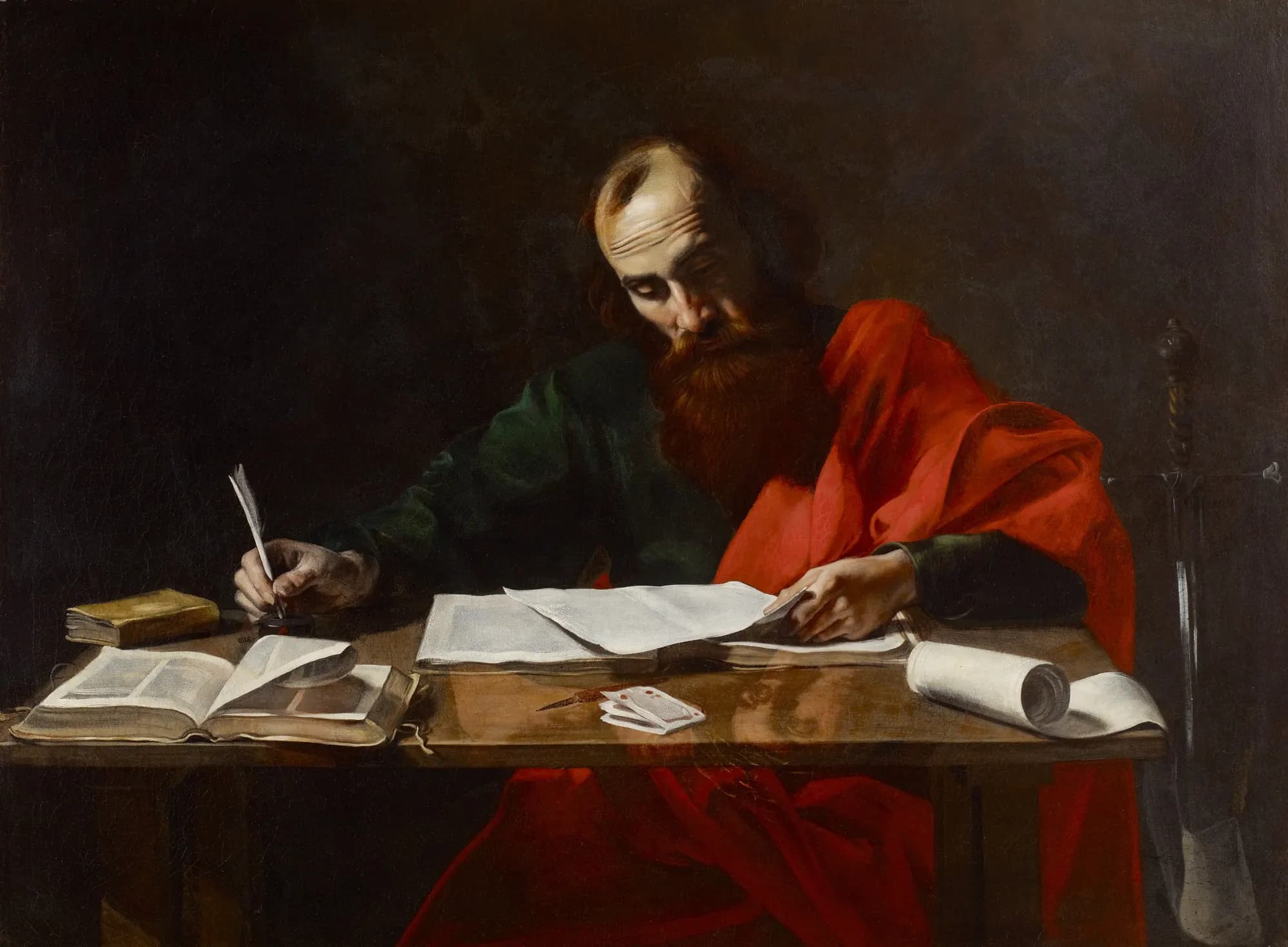
Valentin de Boulogne, Saint Paul Writing His Epistles, about 1618 to 1620, Museum of Fine Arts, Houston. Public domain.
THE ARTWORKValentin painted Paul at his table with a quill, open books and a scroll. The letters Paul wrote were read aloud to churches that met in houses, and four of them greet a church at a named house.
When Peter walked free from Herod's prison, he knocked at the gate of a house where the church was praying.
Summary
The first churches met in their members' houses, and Paul's letters greet four of them by the house: Prisca and Aquila's at Rome and at Ephesus, Nympha's, and Philemon's.
- The Jerusalem church prayed for Peter at the house of Mary, the mother of John Mark.
- Gaius, who had hosted Paul and all the church, sent greetings in Paul's letter to Rome.
- Paul's letters were read aloud to the gathered church and passed on to the next one.
- The best-preserved early Christian meeting place is a house at Dura-Europos, used as a church from about AD 233 to 256.
Four Greetings to a House
Four greetings in Paul's letters, and a prayer meeting in Acts
Four of Paul's letters greet a church by the house it met in. The Berean text gives each the same words, the church that meets at the house.
Greet also the church that meets at their house. Greet my beloved Epenetus, who was the first convert to Christ in the province of Asia.Paul greets the church at the house of Prisca and Aquila in his letter to Rome.
The churches in the province of Asia send you greetings. Aquila and Prisca greet you warmly in the Lord, and so does the church that meets at their house.The same couple send greetings to Corinth with the church at their house.
Prisca and Aquila had come to Corinth from Italy when Claudius ordered all the Jews to leave Rome. A church met in their house in two cities.
Greet the brothers in Laodicea, as well as Nympha and the church that meets at her house.Paul greets Nympha and the church at her house with the brothers in Laodicea.
to Apphia our sister, to Archippus our fellow soldier, and to the church that meets at your house:Paul names the church at Philemon's house among the letter's addressees.
Acts shows the same practice earlier, in Jerusalem. While Peter was kept in prison the church prayed for him. Many had gathered to pray at the house of Mary, the mother of John Mark.
And when he had realized this, he went to the house of Mary the mother of John, also called Mark, where many people had gathered together and were praying.The church prayed at Mary's house on the night Peter came to the gate.
Where the Houses Stood
Nine towns where the New Testament names a house or a room that held Jesus or the church
| Town | The house | Verse |
|---|---|---|
| Capernaum | The home of Simon and Andrew | Mark 1:29 |
| Jerusalem | Mary, the mother of John Mark | Acts 12:12 |
| Philippi | Lydia | Acts 16:40 |
| Corinth | Titus Justus, and later Gaius | Acts 18:7 |
| Troas | An upper room on the third story | Acts 20:8-9 |
| Ephesus | Prisca and Aquila | 1 Corinthians 16:19 |
| Rome | Prisca and Aquila | Romans 16:5 |
| Laodicea | Nympha | Colossians 4:15 |
| Colossae | Philemon, Apphia and Archippus | Philemon 1:2 |
- Town
- Capernaum
- The house
- The home of Simon and Andrew
- Verse
- Mark 1:29
- Town
- Jerusalem
- The house
- Mary, the mother of John Mark
- Verse
- Acts 12:12
- Town
- Philippi
- The house
- Lydia
- Verse
- Acts 16:40
- Town
- Corinth
- The house
- Titus Justus, and later Gaius
- Verse
- Acts 18:7
- Town
- Troas
- The house
- An upper room on the third story
- Verse
- Acts 20:8-9
- Town
- Ephesus
- The house
- Prisca and Aquila
- Verse
- 1 Corinthians 16:19
- Town
- Rome
- The house
- Prisca and Aquila
- Verse
- Romans 16:5
- Town
- Laodicea
- The house
- Nympha
- Verse
- Colossians 4:15
- Town
- Colossae
- The house
- Philemon, Apphia and Archippus
- Verse
- Philemon 1:2
The Hosts
Who opened a house to the church, in the order the texts meet them
MARY, THE MOTHER OF JOHN MARK
Many had gathered at her house in Jerusalem to pray while Peter was in prison, and Peter went there when the Lord brought him out.
LYDIA
A dealer in purple cloth from Thyatira, she urged Paul to stay at her house in Philippi. The brothers met there when he came out of the prison.
TITUS JUSTUS
Titus Justus was a worshiper of God whose house stood next door to the synagogue at Corinth. Paul left the synagogue and went next door to his house.
PRISCA AND AQUILA
Tentmakers like Paul, they hosted a church at Ephesus and at Rome. They took Apollos in and explained to him the way of God more accurately.
GAIUS
He sends greetings in Romans as the man who has hosted Paul and all the church.
PHILEMON, APPHIA AND ARCHIPPUS
Paul writes to all three and to the church at Philemon's house, and he asks Philemon to prepare a guest room for him.
What a House Held
Four things the texts show of a meeting in a house: its size, its meal, its leaders and its letters
THE WHOLE CHURCH GATHERED IN ONE HOUSE
Paul writes of times when the whole church at Corinth comes together, and Gaius hosted all the church.
THE SUPPER WAS EATEN AT A COMMON MEAL
At Corinth the Lord's Supper was eaten at a common meal, and Paul rebukes those who eat ahead while others go hungry.
THE CHURCHES IN THE HOUSES HAD LEADERS
Paul urges the Corinthians to submit to the household of Stephanas and to every fellow worker, and he charges Archippus to complete his ministry.
THE LETTERS WERE READ ALOUD TO THE CHURCH
Paul charges the Thessalonians to have his letter read to all the brothers. He asks the Colossians to pass theirs to the church of the Laodiceans.
The Houses in the Ground
Two excavated houses show what a church in a house looked like
The best-preserved early Christian meeting place is an ordinary private house at Dura-Europos on the Euphrates. It was adapted for worship by knocking two rooms together and adding a baptistery with painted walls. It served as a church from about AD 233 to 256, well over a century after Paul's letters.
At Capernaum, Franciscan excavators working from 1968 found a first-century courtyard house. One of its rooms was plastered in the second half of the first century. The finds in that room change from cooking pots to storage jars and oil lamps.
As soon as Jesus and His companions had left the synagogue, they went with James and John to the home of Simon and Andrew.The house the Capernaum tradition names, where Jesus went from the synagogue.
The plastered room at Capernaum carries graffiti in Greek, Aramaic, Syriac and Latin. A square hall was built around the room in the fourth century, and an octagonal church was built over it in the fifth. No inscription names Peter. The room's identification as the home of Simon and Andrew rests on tradition, and its earliest named witness is the fourth-century pilgrim Egeria.
What the Texts Leave Unsaid
Three matters the texts leave open
The texts give no number for the people who met in any one house.
They set out no order of meeting for a named house. The fullest account is Paul's word to Corinth. When the church comes together, each one has a psalm, a teaching, a revelation, a tongue or an interpretation.
The manuscripts differ on Nympha's house. The Berean text reads Nympha and her house, the King James reads Nymphas and his house, and the American Standard Version reads their house.
A Church of People
What the house churches show about the church
In each of these texts the church is the company of believers, and the house is where they meet. Paul greets Prisca and Aquila and the church at their house in one breath.
Paul and Peter commanded every believer to practice hospitality.
Share with the saints who are in need. Practice hospitality.Paul gives this command to the believers at Rome, where a church met in Prisca and Aquila's house.
Show hospitality to one another without complaining. As good stewards of the manifold grace of God, each of you should use whatever gift he has received to serve one another.Peter sets the command beside the use of every gift to serve one another.
A host's household could hold the first believers of a whole region. Stephanas and his household were the first converts in Achaia, and they devoted themselves to the service of the saints.
Three Voices on the House Church
John Wesley, Jamieson, Fausset and Brown, and Charles Spurgeon
John Wesley reads the bread broken from house to house as the Lord's Supper, kept daily, and the common meals in those houses as eaten in the spirit in which the believers prayed.
Continuing daily - breaking the bread - in the Lord's Supper, as did many Churches for some ages. They partook of their food with gladness and singleness of heart - They carried the same happy and holy temper through all their common actions: eating and working with the same spirit wherewith they prayed and received the Lord's Supper.
John Wesley · Explanatory Notes upon the New Testament · on Acts 2:46Evangelical
Jamieson, Fausset and Brown read from house to house as at home, in a stated place of meeting apart from the temple.
daily . . . in the temple--observing the hours of Jewish worship. and breaking bread from house to house--rather, "at home" (Margin), that is, in private, as contrasted with their temple-worship, but in some stated place or places of meeting. eat their meat with gladness--"exultation." and singleness of heart.
Jamieson, Fausset & Brown · Commentary Critical and Explanatory on the Whole Bible · on Acts 2:46Reformed
Charles Spurgeon pictures a small congregation meeting in one room of Philemon's house.
SOME interpreters have supposed that a small congregation met for worship in a room in Philemon's house and there is a tradition that such was the case for some considerable time. The Churches established by Paul were, at their commencement, for the most part small.
Charles Spurgeon · The Metropolitan Tabernacle Pulpit, Sermon No. 3103: “A Pastoral Visit” (lightly modernized text, CCEL edition) · on Philemon 1:2
Congregation or Household
Two readings of the church at their house, each with its holders
Readers divide over what the church at their house names. Matthew Henry sets the two readings side by side.
Perhaps there was a congregation of Christians that used to meet at their house at stated times; and then, no doubt, it was, like the house of Obed-Edom, blessed for the ark's sake. Others think that the church was no more than a religious, pious, well-governed family, that kept up the worship of God.
Matthew Henry · Commentary on the Whole Bible · on Romans 16:5Puritan
The congregation that met there
On this reading the church is a company of believers who met at the house. Albert Barnes gives it first, since Christians of that time had no houses built for public worship and met in their private dwellings.
The objection, from John Chrysostom: Paul called no house a church save where much piety and fear of God were rooted in it. The name praises the household's faith.
The household that believed
On this reading the household itself is called a church because all in it believed. Chrysostom says Prisca made the house a church by making all in it believers and by opening it to strangers. Theophylact of Ohrid says that all their household members became believers.
The objection: Gaius hosted all the church, and the Corinthian church came together as a whole, which is more than one family.
Gaius, who has hosted me and all the church, sends you greetings. Erastus, the city treasurer, sends you greetings, as does our brother Quartus.One host received the whole church of a city.
Books to Read Next
Three works on the house churches, from the fourth century to the twentieth
Homilies on Romans
John Chrysostom · fourth century
Chrysostom preaches through Romans and reads its greetings to the churches in houses.
La casa di S. Pietro a Cafarnao
Virgilio C. Corbo · 1969
Corbo reports the Franciscan excavation of the insula at Capernaum and the room under the octagonal church.
In print: find it wherever books are sold.
Life Together
Dietrich Bonhoeffer · 1939
Bonhoeffer wrote this book on Christian community from the rule of life of the Finkenwalde seminary.
In print: find it wherever books are sold.
The Church at the Door
The house churches ask the reader to practice hospitality. Mary, Lydia, Prisca and Aquila, Gaius, Nympha and Philemon opened their homes to the church.
Jesus Himself went from the synagogue into the home of Simon and Andrew. He promises to be with two or three who gather in His name.
Keep studying
Places10
Symbols1