
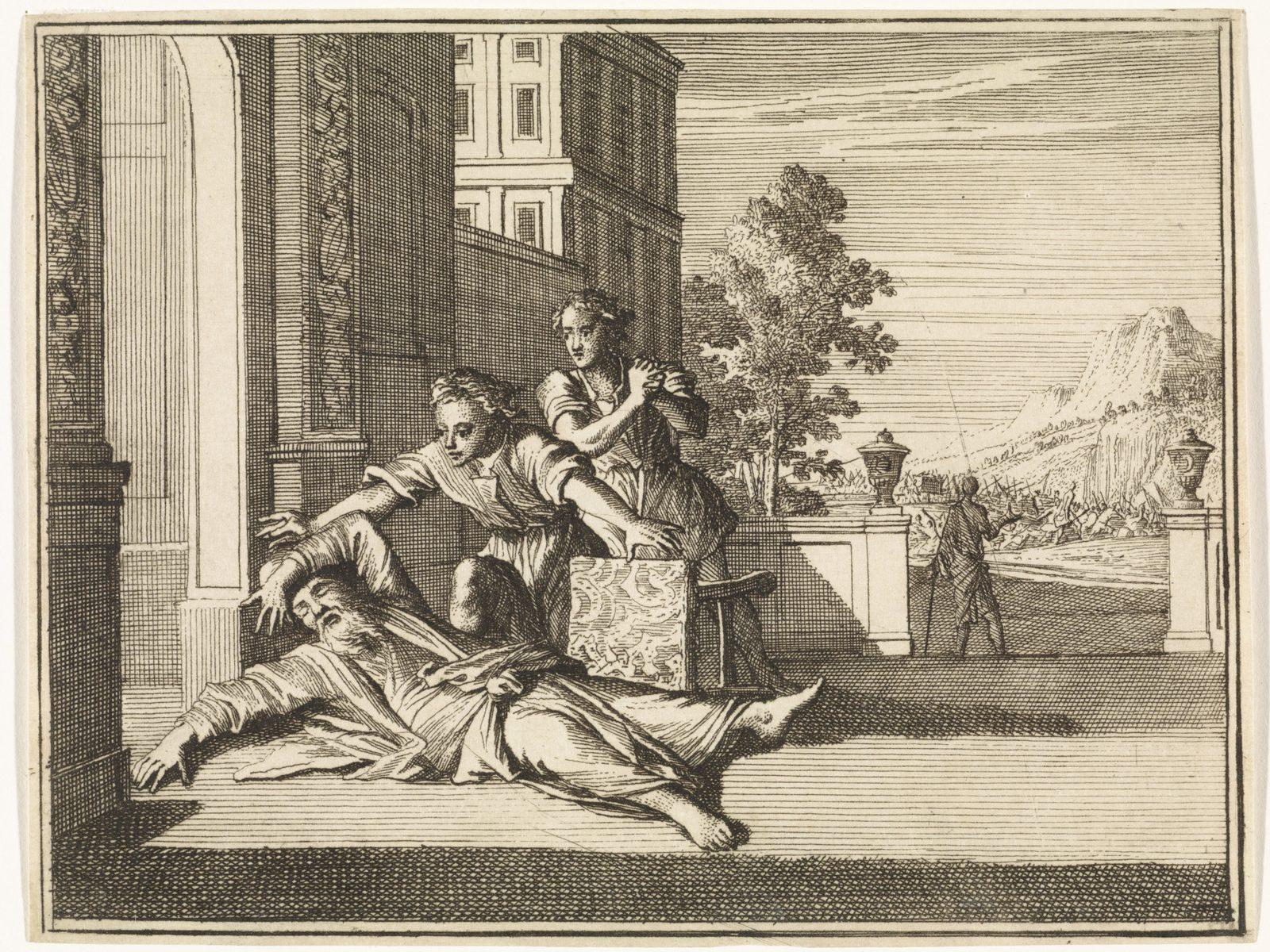
Caspar Luyken, The Death of Eli, 1712. Public domain.
1 Samuel 2 to 4 and 1 Kings 2 · Story · Featured Study
Eli and the house that fell
A man of God foretold the end of Eli's priestly house, and the word ran on until Solomon's reign.
Therefore, the LORD, the God of Israel, declares: ‘I did indeed say that your house and the house of your father would walk before Me forever. But now the LORD declares: Far be it from Me! For I will honor those who honor Me, but those who despise Me will be disdained.
- Where
- Shiloh, Aphek, Nob, Anathoth
- Who
- Eli, Hophni, Phinehas, Samuel, Abiathar
- When
- from the days Eli judged Israel to the start of Solomon's reign
When the messenger named the ark of God, Eli fell backward from his chair and broke his neck.
Summary
Eli was priest at Shiloh and judged Israel forty years. His sons Hophni and Phinehas treated the LORD's offering with contempt, and a man of God told Eli that his house would be cut off and a faithful priest raised up in its place. Both sons died on one day when the ark was taken, and Eli died at the news. The word ran on through his descendants until Solomon removed Abiathar, the last of them to serve.
- The sign of the two sons dying on one day came true at Aphek.
- Doeg killed eighty-five priests of the line at Nob, at Saul's order.
- First Kings names Abiathar's removal as the fulfilment of the word spoken at Shiloh.
- Readers divide on who fulfils the promise of a faithful priest.
The Word Against the House
Eli's sons sinned at Shiloh, and the word against his house fell on them first.
Eli served at Shiloh, where the Tent of Meeting stood. His sons abused their office at the altar, and when Eli heard of it he rebuked them, and they would not listen.
A man of God came to Eli with the LORD's charge and His sentence.
Behold, the days are coming when I will cut off your strength and the strength of your father’s house, so that no older man will be left in your house.Abiathar's removal in 1 Kings 2:27 ends what this verse begins.
The LORD told the boy Samuel the same word in the night, and Eli made Samuel tell him all of it.
So Samuel told him everything and did not hide a thing from him. “He is the LORD,” replied Eli. “Let Him do what is good in His eyes.”Eli answers the sentence on his house in one line.
Israel lost four thousand men to the Philistines and sent for the ark from Shiloh. Hophni and Phinehas came with it, and in the second battle the ark was taken and both of them died.
A Benjamite ran to Shiloh with the news, and Eli died that day. His son's widow gave birth as she was dying.
And she named the boy Ichabod, saying, “The glory has departed from Israel,” because the ark of God had been captured and her father-in-law and her husband had been killed. “The glory has departed from Israel,” she said, “for the ark of God has been captured.”She dies naming the loss Israel has suffered.
The Word and Its Fulfilment
The word ran from Eli's sons to Solomon's sentence.
Seven steps run from Eli's days to Solomon's first year.
- Eli's daysA man of God speaks against the house1 Samuel 2:27
- The battle at AphekThe sign of the two sons comes true1 Samuel 4:11
- The same dayEli dies at Shiloh, and Ichabod is born1 Samuel 4:18 to 21
- Saul's reignAhijah, grandson of Phinehas, wears the ephod1 Samuel 14:3
- David's flightDoeg kills eighty-five priests at Nob1 Samuel 22:18
- The same dayAbiathar alone escapes to David1 Samuel 22:20
- Solomon's first yearAbiathar is sent to Anathoth, and Zadok takes his place1 Kings 2:26 to 35
Two of the seven steps fall on the day of Aphek.
The begging for bread of 1 Samuel 2:36 is the one part no verse records.
| The word | What fulfils it | Who reads it so |
|---|---|---|
| Both sons die on one day | Hophni and Phinehas fall at Aphek | The narrator of 1 Samuel 4 |
| Descendants die by the sword | The killing of the priests at Nob | Josephus, Antiquities 6.12.6 |
| The house removed from the priesthood | Solomon's sentence on Abiathar | First Kings itself |
| A faithful priest raised up | Zadok set in Abiathar's place | John Wesley, Albert Barnes and Matthew Henry |
| The house begging for a priest's bread | Not recorded | None |
Shiloh and the Priest's Portion
The law gave the priests their share and kept the fat for the LORD.
Israel set up the Tent of Meeting at Shiloh in the days of Joshua, and the yearly sacrifices of 1 Samuel 1 were brought there.
The priest is to burn the fat on the altar, but the breast belongs to Aaron and his sons. And you are to give the right thigh to the priest as a contribution from your peace offering.The sons of Eli took more than this, and took it first.
Eli's sons took whatever the fork brought up from the pot, and demanded raw meat before the fat was burned. The text calls their sin severe in the LORD's sight, because they treated His offering with contempt.
Josephus, in his Antiquities of the Jews, says Eli was the first high priest of the family of Ithamar, Aaron's other son. First Chronicles 24:3 later names Ahimelech of the line of Ithamar.
Where the Text Is Silent
The account leaves three things unsaid.
Those Who Honor Me
The rule of 1 Samuel 2:30 runs through the account, and Hebrews answers it.
The man of God told Eli that he honored his sons more than the LORD. The house that despised the LORD's offering lost the priesthood the LORD had given it.
Psalm 78 sings the loss of Shiloh as the LORD's own judgment.
He abandoned the tabernacle of Shiloh, the tent He had pitched among men. He delivered His strength to captivity, and His splendor to the hand of the adversary.The ark taken at Aphek is the strength and splendor given into the adversary's hand.
Hebrews names Jesus as high priest.
For this reason He had to be made like His brothers in every way, so that He might become a merciful and faithful high priest in service to God, in order to make atonement for the sins of the people.Eli's house was cut off for unfaithfulness at the altar.
Voices on the House of Eli
John Wesley, Matthew Henry and Charles Spurgeon wrote on Eli's death and the loss of Shiloh.
Matthew Henry (1662 to 1714)
Commentary on the Whole Bible
Matthew Henry, in his Commentary on the Whole Bible, wrote on the name Ichabod.
“Nothing is more cutting, more killing, to a faithful Israelite, than the want and loss of these. If God go, the glory goes, and all good goes. Woe unto us if he depart!”
on 1 Samuel 4:22Puritan
John Wesley (1703 to 1791)
Explanatory Notes upon the Old Testament
John Wesley, in his Explanatory Notes, observed what it was that killed Eli.
“Thus was the wickedness of those sons of his, whom he had indulged, his ruin. Thus does God sometimes set marks of his displeasure on good men, that others may hear and fear. Yet we must observe, it was the loss of the ark that was his death, and not the slaughter of his sons.”
on 1 Samuel 4:18Evangelical
Charles Spurgeon (1834 to 1892)
The Treasury of David, Vol. 3
Charles Spurgeon, in The Treasury of David, read Psalm 78:60 as the end of Shiloh.
“So that he forsook the tabernacle of Shiloh, the tent which he placed among men. His glory would no more reveal itself there, he left Shiloh to become a complete ruin. At the door of that tent shameless sin had been perpetrated, and all around it idols had been adored, and therefore the glory departed and Ichabod was sounded as a word of dread concerning Shiloh and the tribe of Ephraim. Thus may the candlestick be removed though the candle is not quenched. Erring churches become apostate, but a true church still remains; if Shiloh be profaned Zion is consecrated.”
on Psalm 78:60Particular Baptist
Who Is the Faithful Priest?
Wesley and Barnes name Zadok, and Augustine looks past him to Christ.
Then I will raise up for Myself a faithful priest. He will do whatever is in My heart and mind. And I will build for him an enduring house, and he will walk before My anointed one for all time.The promise stands as the answer to the sentence on Eli's house.
Zadok, who took Abiathar's placeJohn Wesley, Albert Barnes, Adam Clarke and Matthew Henry
John Wesley and Adam Clarke name Zadok, made high priest when Abiathar, the last of Eli's line, was removed. Albert Barnes agrees, and notes that the anointed of the verse points also to the Lord's Christ.
“Zadok is meant rather than Samuel. The High Priesthood continued in the direct descendants of Zadok as long as the monarchy lasted (see 1Ch 6:8-15). Mine anointed - in its first sense obviously means the kings of Israel and Judah Psa 89:20; Zec 4:14. But doubtless the use of the term MESSIAH (Χριστὸς Christos) here and in 1Sa 2:10, is significant, and points to the Lord’s Christ, in whom the royal and priestly offices are united (Zec 6:11-15: see the marginal references).”
Albert Barnes · Notes, Explanatory and Practical, on the Old and New Testaments (1832-1869) · on 1 Samuel 2:35Evangelical
Matthew Henry reads Zadok's appointment as the word fulfilled.
The objection is that Barnes himself says Zadok's line held the office as long as the monarchy lasted, while the verse says for all time.
Christ, the priest the word was moving towardAugustine and Bede
Augustine holds that the prophecy was not fulfilled in Samuel, who was not of the sons of Aaron. He reads Zadok and Abiathar as priests of Aaron's line who came before Christ, in whom the change of the priesthood was fulfilled. Bede, in his Commentary on Samuel, reads the faithful house built for the priest as the Church.
The objection, from Wesley and Barnes, is that 1 Kings 2:35 records Zadok set in Abiathar's place, the fulfilment the text itself gives.
Books to Read Next
All three works are in the public domain, and each has a free copy to read.
Biblical Commentary on the Books of Samuel
C. F. Keil and F. Delitzsch · 1880
Keil traces the high priests from Eli to Abiathar in his introduction.
Read at the Internet ArchiveAntiquities of the Jews, Books 5 to 8
Flavius Josephus, translated by William Whiston · about 93
Josephus follows Eli's family from Shiloh to Solomon's sentence.
Read at Project GutenbergThe City of God, Book 17
Augustine, translated by Marcus Dods · 1887 (the Dods translation)
Chapter 5 sets out the word to Eli in full before Augustine reads it.
Read at New AdventA Priesthood Without End
The house fell as the LORD had said. The priesthood of Eli's house ended, and Christ holds a priesthood that has no end.
But because Jesus lives forever, He has a permanent priesthood. Therefore He is able to save completely those who draw near to God through Him, since He always lives to intercede for them.Hebrews sets the permanent priesthood of Jesus against the priests whom death removed.
Sources
Scripture is the Berean Standard Bible.
- C. F. Keil and F. Delitzsch, Biblical Commentary on the Books of Samuel, T. and T. Clark, 1880.
- James Strong, Exhaustive Concordance of the Bible, 1890, entry H5941.
- Flavius Josephus, Antiquities of the Jews 5.11.5, 6.12.6 and 8.1.3, translated by William Whiston (finished, by Whiston's note, in A.D. 93)
- Augustine, The City of God 17.5, translated by Marcus Dods, Nicene and Post-Nicene Fathers, First Series, volume 2, Buffalo, 1887.
- John Wesley, Explanatory Notes upon the Old Testament, 1765, on 1 Samuel 2:35.
- John Wesley, Explanatory Notes upon the Old Testament, 1765, on 1 Samuel 4:18.
- Albert Barnes, Notes, Explanatory and Practical, on the Old and New Testaments, 1832 to 1869, on 1 Samuel 2:35.
- Adam Clarke, Commentary on the Bible, 1832, on 1 Samuel 2:35.
- Matthew Henry, Commentary on the Whole Bible, 1710, on 1 Kings 2:35.
- Matthew Henry, Commentary on the Whole Bible, 1710, on 1 Samuel 4:22.
- Charles Spurgeon, The Treasury of David, volume 3, 1872, on Psalm 78:60.
- Bede, Commentary on Samuel, 735, on 1 Samuel 2:35.
Keep Studying
Read it4
Symbols1
Doctrines1