
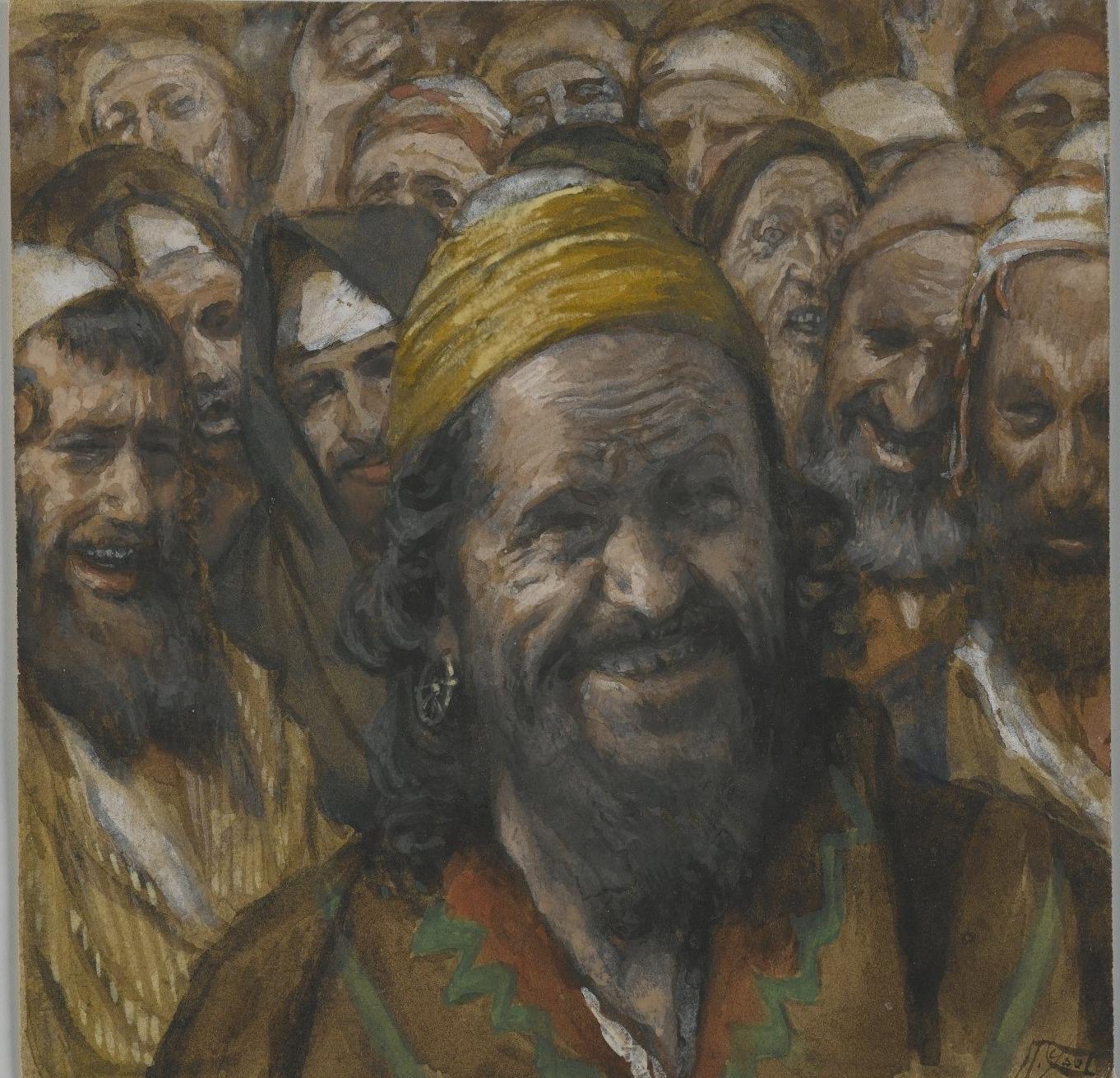
James Tissot, Barabbas, 1886 to 1894. Public domain.
Matthew 27:15 to 26 · Person · Featured Study
Barabbas
Barabbas was the prisoner the crowd chose to have released in place of Jesus at the Passover in Jerusalem.
John's whole account of him is a single verse.
But they all cried out in unison: “Away with this man! Release Barabbas to us!”
- The name means
- Son of Abba, by Strong's dictionary
- Family
- father: not named
- Places
- Jerusalem, the governor's prison
- First named
- Matthew 27:16 “…holding a notorious prisoner named Barabbas.”
- Last named
- John 18:40 “…this man,” they shouted, “but Barabbas!” (Now Barabbas…”
Summary
Barabbas was a rebel held for a rising in Jerusalem in which men were killed. At the feast the governor freed one captive of the people's choosing, and offered Barabbas or Christ, the people asked for Barabbas. Pilate set him free and handed Christ over to be crucified, and Scripture says nothing of Barabbas after that.
- All four Gospels name him.
- Peter recalled the choice in his preaching in Acts 3.
- Some old copies of Matthew call him Jesus Barabbas.
A Notorious Prisoner
Mark and Luke say what he had done, and John names what he was.
And a man named Barabbas was imprisoned with the rebels who had committed murder during the insurrection.Mark tells why he was in prison.
(Barabbas had been imprisoned for an insurrection in the city, and for murder.)It names the crime that made him notorious.
Matthew calls him a notorious prisoner. The Cambridge Bible on John notes that John's word for him is the word for a robber. Matthew uses it of the two men crucified with Jesus (Matthew 27:38). Ellicott adds that it carries the sense of violence that often ends in bloodshed.
The Choice at the Feast
Matthew sets out the choice step by step, from the custom to the release.
The custom gave the crowd a choice, the chief priests swayed it, and Barabbas went free.
- Matthew 27:15The governor's custom at the feast is to release one prisoner the crowd choosesMatthew 27:15
- Matthew 27:16Barabbas is held as a notorious prisonerMatthew 27:16
- Matthew 27:17 to 18Pilate offers Barabbas or Jesus, knowing the accusers acted from envyMatthew 27:17 to 18
- Matthew 27:20The chief priests and elders persuade the crowds to ask for BarabbasMatthew 27:20
- Matthew 27:21Asked which of the two, the crowd answers, BarabbasMatthew 27:21
- Matthew 27:22 to 23Asked what to do with Jesus, they shout, Crucify HimMatthew 27:22 to 23
- Matthew 27:26Barabbas is released, and Jesus is flogged and handed overMatthew 27:26
Mark adds that the chief priests stirred up the crowd (Mark 15:11).
The Name Barabbas
The name is a patronymic, a name taken from a father, and readers have taken it in two ways.
Strong's Greek dictionary glosses Barabbas as son of Abba, and the Expositor's Greek Testament gives son of a father.
Spelled with a double r, the Expositor's adds, the name would mean son of a Rabbi. Jerome records that the Gospel according to the Hebrews read it as son of their teacher.
The Men Around Barabbas
The Gospels name no family, only the men around his release.
He was held with rebels, chosen by the crowd and set free by the governor.
| Person | Tie to Barabbas | Told in |
|---|---|---|
| The rebels | His fellow prisoners from the rising | Mark |
| The chief priests | Stirred up the crowd to ask for him | Matthew, Mark |
| The crowd | Chose him over Jesus | all four Gospels |
| Pontius Pilate | Released him to satisfy the crowd | Mark |
| Jesus | Condemned in his place | all four Gospels |
His Places
Every scene of his story stands in Jerusalem.
His story moves from the city's uprising to a prison and then to the governor's court.
| Place | What happened there | Told in |
|---|---|---|
| Jerusalem | The insurrection took place in the city | Luke |
| The prison | He was held there with the rebels | Mark |
| Before the Praetorium | The crowd gathered there and chose him | John |
The Custom, the Uprising and What Became of Him
Commentators have asked about the custom, the uprising and his fate.
The custom of the feastMatthew 27:15; John 18:39
But it is your custom that I release to you one prisoner at the Passover. So then, do you want me to release to you the King of the Jews?”In John, Pilate offers the release himself.
Matthew calls the release the governor's custom, and John has Pilate call it a custom of the people. Spurgeon took it for an act of grace by Rome toward the Jews. They may have welcomed it at a feast that remembered their own release from Egypt.
Which uprising?Ellicott; the Pulpit Commentary
The Pulpit Commentary says no other account of this rising survives, and that such uprisings were common. Ellicott thinks it probable that Barabbas took part in the riot over Pilate's use of the temple treasure, which Josephus records. That would have made him a hero to priests and people alike.
What became of Barabbas?Meyer; Bengel
Heinrich Meyer writes that nothing further is known of him. Johann Bengel thought it probable that he lived on a long time as a living reminder of the story of Jesus.
The Cry for Barabbas
John gives the crowd's cry, and Peter later puts the exchange to the crowd in Acts 3.
“Not this man,” they shouted, “but Barabbas!” (Now Barabbas was an insurrectionist.)In John the choice is made in one shout.
You rejected the Holy and Righteous One and asked that a murderer be released to you.Peter's words make the choice a charge against his hearers.
Voices on Barabbas
Tertullian and Augustine, two Latin writers of the early church, set the released prisoner beside the condemned Christ.
Tertullian (died 220)
Against Marcion Book IV
Tertullian, arguing against Marcion, set the two prisoners side by side.
“Then Barabbas, the most abandoned criminal, is released, as if he were the innocent man; while the most righteous Christ is delivered to be put to death, as if he were the murderer. Moreover two malefactors are crucified around Him, in order that He might be reckoned amongst the transgressors.”
on Luke 23:25Patristic
Augustine of Hippo (died 430)
TRACTATES ON JOHN 31.11
Augustine, preaching on John, turned from Barabbas to the two thieves beside the cross.
“The robber escaped, Christ was condemned. He who was loaded with criminal accusations received pardon; He who has released from their crimes all who confess Him, was condemned. Nevertheless even the cross itself, if thou considerest it well, was a judgment-seat; for the Judge being set up in the middle, one thief who believed was delivered, the other who reviled was condemned.”
on Mark 15:15Patristic
Was His Name Jesus Barabbas?
A few old copies of Matthew give him the name Jesus, and editors divide over the reading.
Yes: the copies kept his first nameHeinrich Meyer; Charles Ellicott
Meyer reads Matthew 27:17 as Pilate asking the crowd to choose between Jesus Barabbas and Jesus who is called Christ. Ellicott finds considerable evidence for the reading, though short of decisive. He suggests that later reverence for the name of Jesus led copyists to remove it from the robber.
The objection: the Cambridge Bible notes, after Henry Alford, that Matthew 27:20 names him Barabbas alone, which tells against the longer name.
No: a later addition to a few copiesThe Cambridge Bible; the Expositor's Greek Testament
The Cambridge Bible on Matthew says the best editors rightly reject the reading, and on John says no good manuscript supports it. The Expositor's Greek Testament grants that Origen knew copies with the name Jesus, and judges that the reading has little authority.
The objection: Adam Clarke reports the longer name in some manuscripts and in the Armenian and the Jerusalem Syriac versions.
The Righteous for the Unrighteous
Bengel noted that Barabbas was guilty of the very charge laid against Jesus. By the death of the Just One, he wrote, those who deserved death are set free.
For Christ also suffered for sins once for all, the righteous for the unrighteous, to bring you to God. He was put to death in the body but made alive in the Spirit,Peter states the same exchange as the meaning of the cross.
Sources
Scripture is the Berean Standard Bible.
- Strong's Greek lexicon, g912.
- Ellicott's Commentary for English Readers; Heinrich Meyer, Commentary on the New Testament; the Expositor's Greek Testament; the Cambridge Bible for Schools and Colleges; Bengel's Gnomon; the Pulpit Commentary; each on Matthew 27:16, Matthew 27:17 and John 18:40.
- Jerome, Commentary on Matthew, on 27:16; Adam Clarke, Commentary on the Bible (1832) on Matthew 27:16; Tertullian, Against Marcion 4; Augustine of Hippo, Tractates on John 31.11; Charles Spurgeon, sermon 595, Barabbas Preferred to Jesus (1864)
Keep Studying
Read it5