
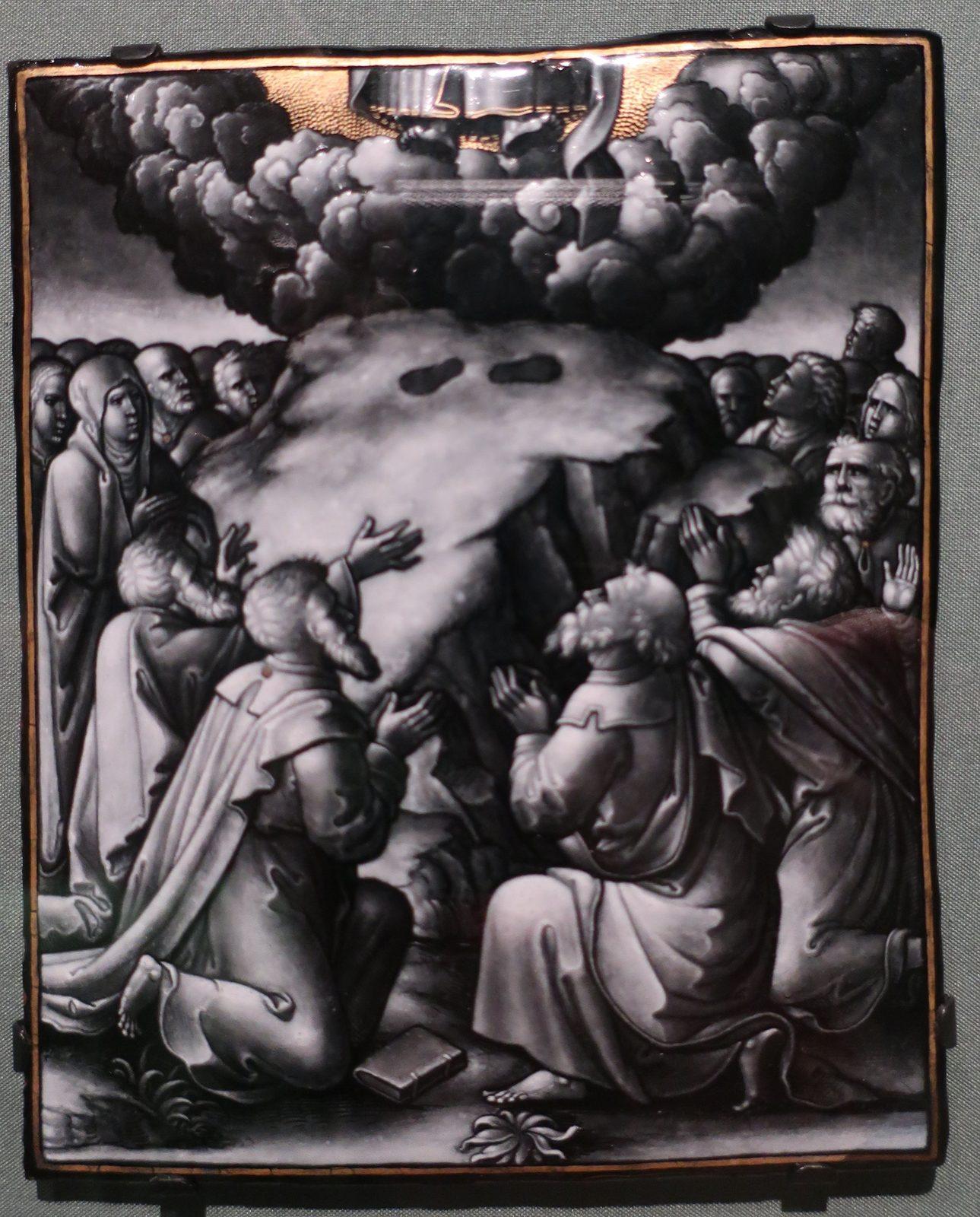
Pierre Reymond, Ascension of Christ, about 1550. Public domain.
Exodus 19:9 · Symbol · Featured Study
The Cloud
The clouds of Scripture surround the LORD and carry Him, and His voice speaks from a cloud.
At Sinai the LORD said why He would come in a cloud.
The LORD said to Moses, “Behold, I will come to you in a dense cloud, so that the people will hear when I speak with you, and they will always put their trust in you.” And Moses relayed to the LORD what the people had said.
- The word
- עָנָן (anan), H6051
- First appears
- Genesis 9:13 “…set My rainbow in the clouds, and it…”
Summary
The cloud marks the LORD's coming in the law, the psalms, the prophets and the Gospels.
- Its Hebrew, Aramaic and Greek words first stand in Genesis, Exodus, Daniel, Matthew and Hebrews.
- A Jewish reader and four Christian readers explain what the cloud hid and what it showed.
- Two links between the clouds of Scripture are left unstated.
The Cloud at Sinai
The LORD went before Israel in a pillar of cloud, and at Sinai He came to them in a dense cloud.
The pillar has a page of its own. The question here is what Scripture says the cloud is for and what it calls it. The answer is given by the LORD's own words at Sinai and by the clouds as His chariot. The first glory seen in a cloud, Rashi on the tent the cloud settled on, five words and two silences complete it.
Exodus 19:9 gives the cloud two purposes. The people are to hear the LORD speak with Moses, and they are to trust Moses from then on. In Hebrew the dense cloud is two words together, ab and anan, and that verse is the first that uses ab. Sinai, the mountain of God, has its own page on what happened there on the third day.
The LORD's Chariot
The psalms and the prophets set the LORD in the clouds.
In each passage the clouds surround the LORD, carry Him or lie beneath Him.
- Psalm 18:11storm clouds a canopy around Him
- Psalm 97:2Clouds and darkness surround Him
- Psalm 104:3making the clouds His chariot
- Isaiah 19:1the LORD rides on a swift cloud
- Nahum 1:3clouds are the dust beneath His feet
Each card gives the Berean words of its passage and opens it in the reader.
Charles Spurgeon, the Baptist preacher of London, writes on Psalm 97:2 in The Treasury of David that every revelation of God must also be an obvelation. By it he means a veiling of God's infinite splendour, without which finite beings could see nothing.
John Chrysostom, in his second homily on Acts, reads the cloud that hid Jesus in Acts 1:9 by Psalm 104:3, the clouds as the LORD's chariot.
The Glory in the Cloud
Rashi reconciles Exodus 40:35 with Numbers 7:89.
And as Aaron was speaking to the whole congregation of Israel, they looked toward the desert, and there in a cloud the glory of the LORD appeared.It stands here because no earlier verse sets the glory in a cloud.
Moses was unable to enter the Tent of Meeting because the cloud had settled on it, and the glory of the LORD filled the tabernacle.It stands here because it is the verse Rashi explains.
Rashi on Exodus 40:35Pentateuch with Rashi's commentary
Rashi, the Jewish commentator of France who lived from 1040 to 1105, rests his answer on the reason the verse gives, that the cloud had settled on the tent. He cites the Sifra, an early rabbinic commentary on Leviticus. In his reading Moses could not enter while the cloud stayed on the tent, and he went in when it had gone.
When Moses entered the Tent of Meeting to speak with the LORD, he heard the voice speaking to him from between the two cherubim above the mercy seat on the ark of the Testimony. Thus the LORD spoke to him.It stands here because it is the verse Rashi sets against Exodus 40:35.
How the glory filled the tabernacle and the temple, with Matthew Henry's reading of the veiled glory, has its own page. Leviticus 16:2 is taught on a page of its own.
The Word Seen in the Cloud
John Wesley and Eusebius of Caesarea each read the cloud as the place where the Word was seen.
John Wesley on Exodus 13:21Explanatory Notes upon the Old Testament
John Wesley, the Methodist preacher, published his Explanatory Notes upon the Old Testament in 1765. On Exodus 13:21 he writes that the appearance of the divine Majesty in the pillar was a precious manifestation of the eternal Word, who was to be made flesh.
Eusebius on Exodus 19:9Proof of the Gospel, book 5
Eusebius, bishop of Caesarea, writes in the Proof of the Gospel that the one who spoke to Moses from the pillar of cloud was the Word of God, the Christ. In his reading the Word was seen in a cloud because the people could not see Him in human shape.
The Words for Cloud
Five of the words for cloud stand on these cards, each with its first verse.
anan
87 uses in the canon
The word means a cloud covering the sky, the nimbus or thunder cloud.
ab
31 uses in the canon
The word means an envelope, darkness or density, and so a scud cloud. It is the cloud of Psalm 104:3 and Isaiah 19:1.
anan, in Aramaic
1 use in the canon
The Aramaic form of the same word stands in Daniel's vision of One like the Son of Man.
nephele
25 uses in the canon
The Greek word means cloudiness, and so a cloud.
nephos
1 use in the canon
The word means a cloud, and Hebrews 12:1 uses it as a figure for a great crowd of witnesses.
The lexicon in full1 paragraph
A sixth word, araphel, gloom as of a lowering sky, is taught on the page of the glory in the house.
What Scripture Leaves Unsaid
The silences concern Noah's covenant and the day Jesus was taken up.
The text leaves two links unstated.
| What the text states | What it leaves unsaid |
|---|---|
| When the rainbow appears in the clouds, God remembers His covenant. | Ezekiel 1:28 likens the glory to a rainbow in a cloud, and no verse joins the clouds of Genesis 9 to the cloud that led Israel. |
| A cloud hid Jesus from the disciples' sight. | Nothing says whether that cloud was the cloud of Sinai. |
Books to Read Next
A commentary on the Psalms and one on the Pentateuch hold two of these readings in full.
The Treasury of David
Charles Spurgeon · volume 4, 1874
Read its note on Psalm 97:2 for the word obvelation in Spurgeon's own words.
Pentateuch with Rashi's commentary
Rashi, translated by M. Rosenbaum and A. M. Silbermann · 1929 to 1934
It is free to read at Sefaria.
READ HIS NOTE ON EXODUS 40:35 →A Voice From the Cloud
Daniel 7:13 is followed through Mark 14:62 to Revelation 1:7 on the page of the Son of Man.
Then a cloud appeared and enveloped them, and a voice came from the cloud: “This is My beloved Son. Listen to Him!”It stands here because, as in Exodus 19:9, the cloud is the place from which God speaks to be heard.
Sources
Scripture is the Berean Standard Bible.
- James Strong, Exhaustive Concordance of the Bible, 1890, entries H6051, H5645, H6050, H6205, G3507 and G3509.
- Charles Spurgeon, The Treasury of David, volume 4, 1874, on Psalm 97:2.
- Matthew Henry, Commentary on the Whole Bible, on Exodus 40:38.
- John Wesley, Explanatory Notes upon the Old Testament, 1765, on Exodus 13:21.
- Eusebius of Caesarea, Proof of the Gospel, 5.14, on Exodus 19:9.
- Rashi (1040 to 1105, France), Commentary on Exodus 40:35, in Pentateuch with Rashi's commentary, translated by M. Rosenbaum and A. M. Silbermann, 1929 to 1934.
- John Chrysostom, Homily on Acts 2, on Acts 1:9, as the Ascension page draws it.
- Sifra, a halakhic midrash on Leviticus, as Sefaria's index describes it.
Keep Studying
People and groups1