

Genesis 1 to Revelation 21 · Symbol · Featured Study
The Sea
A symbol study of sixteen places in canon order, the words yam, tehom and thalassa, and the readings of Leviathan and of the sea that is no more.
God gives the sea a boundary on the third day, and in John's last vision the sea is gone.
- The word
- יָם (yam), H3220
- First appears
- Genesis 1:10 “…gathering of waters He called “seas.” And God…”
Eugène Delacroix, Christ on the Sea of Galilee, 1841. Public domain.
Summary
Scripture uses the sea for the waters God bounded, for the threat that rises against Him and His people, and for the place where He shows that He rules.
- The third day gathers the waters and calls them seas, and the fifth fills them with great creatures.
- Psalm 93 sets the LORD on high above the pounding of the waves.
- Jesus rebukes the wind and the sea on the Sea of Galilee, and the disciples ask who He is.
- Micah says God will cast all our sins into the depths of the sea, and the new earth of Revelation has no sea.
The Seas of the Third Day
Genesis 1:9 to 10, the waters gathered into one place and named.
And God said, “Let the waters under the sky be gathered into one place, so that the dry land may appear.” And it was so. God called the dry land “earth,” and the gathering of waters He called “seas.” And God saw that it was good.The third day's first work is a boundary.
So God created the great sea creatures and every living thing that moves, with which the waters teemed according to their kinds, and every bird of flight after its kind. And God saw that it was good.The verse shows the sea God bounded on the third day as a home for living things He calls good.
In the second verse of the Bible the waters cover everything. From the third day on the sea is a part of the world God made, held where He put it.
Four books return to the line God drew for the sea.
| Book | What the verse says | Verse |
|---|---|---|
| Job | Its proud waves may come this far and no farther. | Job 38:11 |
| Psalms | The waters may never again cover the earth. | Psalm 104:9 |
| Proverbs | The waters would not surpass His command. | Proverbs 8:29 |
| Jeremiah | The sand is an enduring barrier it cannot cross. | Jeremiah 5:22 |
The Storm on the Lake
The storm on the lake in Mark 4 and Matthew 8, as Eugène Delacroix painted it.
Delacroix places the sleeping Christ at one end of the boat and the panic at the other.
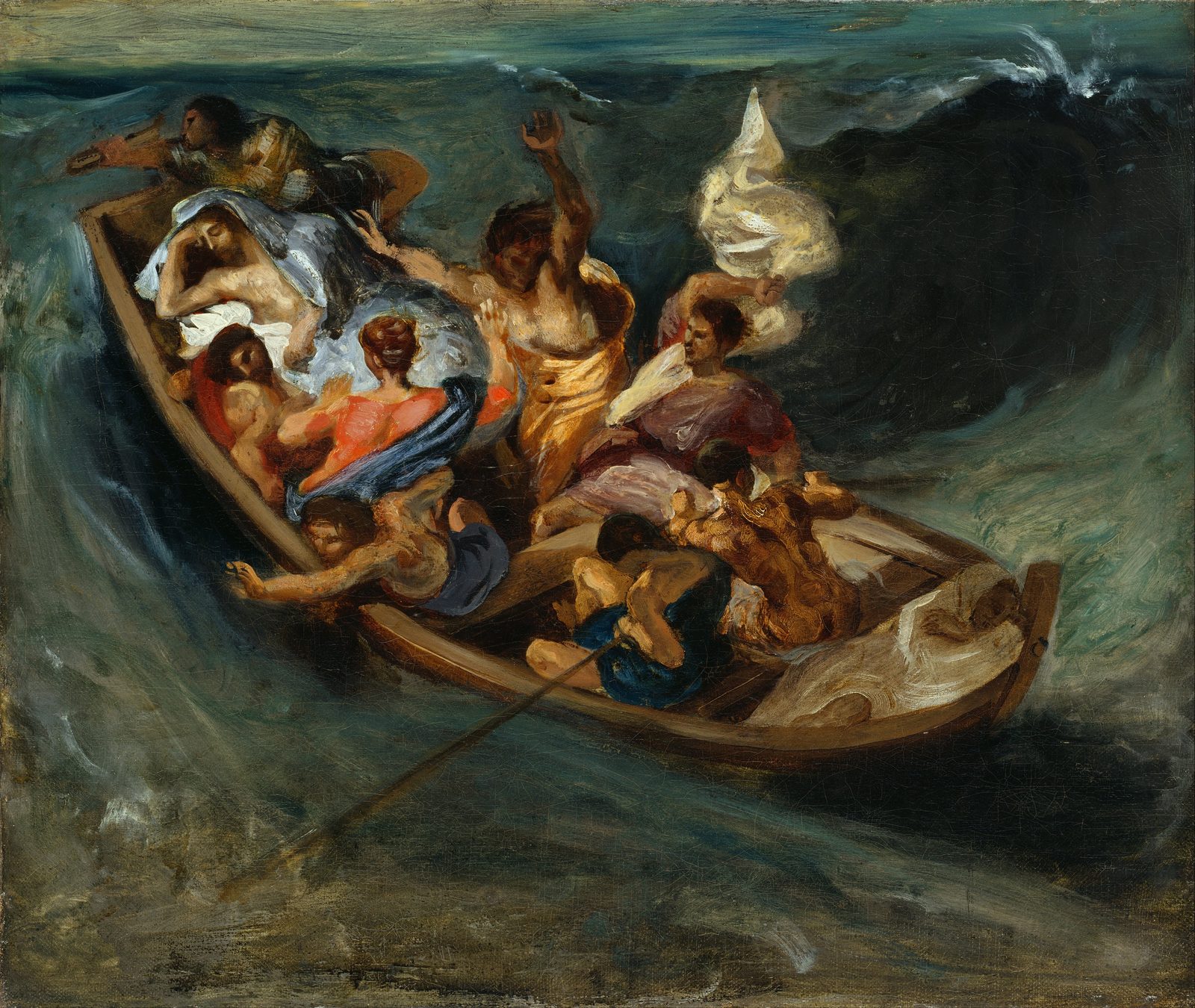
- Christ asleepA figure in white lies with his head on his arm.Mark 4:38
- The cry for helpA man raises his arm over the others.Matthew 8:25
- The breaking waveA crest curls over the boat at the top right.Mark 4:37
- The boatThe hull pitches across the canvas.Matthew 8:24
- The oarOne man strains at a long oar in the water.Mark 4:37
Eugène Delacroix, Christ on the Sea of Galilee, 1841. Public domain.
Five parts of the canvas, each numbered where it stands, with the verse the part answers to.
The Sea Through Scripture
Sixteen places in canon order, from the gathered waters of Genesis to the new earth.
The sea is bounded, divided, stilled and at last taken away.
- Genesis 1The waters gathered and named, Genesis 1:10
- Genesis 22Sand on the seashore, Genesis 22:17
- Exodus 14A road through the sea, Exodus 14:21 to 22
- Exodus 15Horse and rider in the sea, Exodus 15:10
- Job 38Doors and bars for the sea, Job 38:8 to 11
- Psalm 74The heads of Leviathan crushed, Psalm 74:13 to 14
- Psalm 93Mightier than the breakers, Psalm 93:4
- Psalm 107Sailors brought to the harbor, Psalm 107:29
- Isaiah 27The dragon of the sea slain, Isaiah 27:1
- Isaiah 57The wicked like the restless sea, Isaiah 57:20
- Jonah 2Cast into the heart of the seas, Jonah 2:3
- Daniel 7Four beasts from the great sea, Daniel 7:2 to 3
- Micah 7Sins cast into the depths of the sea, Micah 7:19
- Mark 4Silence, be still, Mark 4:39
- Revelation 4A sea of glass before the throne, Revelation 4:6
- Revelation 21The sea was no more, Revelation 21:1
Each stop opens its verse in the reader.
What the Verses Say the Sea Pictures
Four verses that compare something to the sea, and one reading of the sea of glass.
THE NATIONS
Isaiah hears the noise of many peoples as the roar of water.
THE WICKED
The restless water stands for those who have no peace with God.
THE DOUBTER
James compares a divided mind to water driven by the wind.
THE KNOWLEDGE OF GOD
Habakkuk measures the coming knowledge of the LORD by the way water fills the ocean bed.
The doubter, The knowledge of God
The sea of glass as the laverMatthew Henry, on Revelation 4:6
Solomon's temple had a great basin of cast metal that 1 Kings 7:23 calls the Sea. Matthew Henry read the sea of glass before the throne through it.
“As in the temple there was a great vessel of brass filled with water, in which the priests were to wash when they went to minister before the Lord (and this was called a sea ), so in the gospel church the sea or laver for purification is the blood of the Lord Jesus Christ, who cleanses from all sin, even from sanctuary-sins.”
Matthew Henry · Commentary on the Whole Bible · on Revelation 4:6Puritan
Yam, Tehom and Thalassa
Four Hebrew words and one Greek word for the sea, the deep and its creatures, each with its count.
Yam stands 396 times in Strong's concordance and livyathan only 6.
The five counts as a table
| Word | Occurrences |
|---|---|
| yam, sea, H3220 | 396 |
| thalassa, sea, G2281 | 90 |
| tehom, the deep, H8415 | 36 |
| tannin, sea creature, H8577 | 28 |
| livyathan, Leviathan, H3882 | 6 |
With the article, yam names the Mediterranean, the water to the west of Israel.
Tehom is the abyss of Genesis 1:2, the surging mass of water.
What the Text Does Not Say
Four questions about the sea the verses leave open.
The verses tell what God does with the sea and leave its making and its end unexplained.
| What is not said | What the verse does say |
|---|---|
| The source of the waters of the deep | Genesis 1:2 names them and gives them no beginning. |
| The kind of creature Leviathan is | Psalm 104:26 names one Leviathan and says nothing of its kind. |
| How the water of the first earth ends | John says only that the sea was no more. |
| The matter of the sea of glass | It is like glass and as clear as crystal. |
Who Is This?
Psalm 89:9, Mark 4:39 to 41, Micah 7:19 and Jonah 2:3, on the One who rules the raging water.
You rule the raging sea; when its waves mount up, You still them.The psalm gives this power to the LORD alone.
Then Jesus got up and rebuked the wind and the sea. “Silence!” He commanded. “Be still!” And the wind died down, and it was perfectly calm. “Why are you so afraid?” He asked. “Do you still have no faith?” Overwhelmed with fear, they asked one another, “Who is this, that even the wind and the sea obey Him?”The question the men ask has the answer Psalm 89 gives.
Theophylact of Ohrid noticed the order of the rebuke.
“Having awakened, Christ rebukes first the wind, since it is the cause of the agitation of the sea, and then calms the sea as well.”
Theophylact of Ohrid · Commentary on Mark · on Mark 4:39Patristic
Sins in the depthsMicah 7:19 and Jonah 2:3
He will again have compassion on us; He will vanquish our iniquities. You will cast out all our sins into the depths of the sea.Micah turns the place of drowning into the place where guilt is lost.
For You cast me into the deep, into the heart of the seas, and the current swirled about me; all Your breakers and waves swept over me.Jonah prays to the God who threw him into the deep.
Voices on the Sea
Jerome, Andreas of Caesarea and Charles Spurgeon, each with the work named.
died 420 · Jerome
Homily 30, on Psalm 103
A sermon on the psalm reads the ships of verse 26 as souls crossing the world.
The quotation1 quotation
“There the ships shall pass through. Which of us is a strong ship, able to flee from this world, and not be submerged, nor strike upon a rock — but let him have understanding to steer him, that he may be able to be saved?”
Jerome · Homily 30, on Psalm 103 · on Psalm 104:26Patristic
died 614 · Andreas of Caesarea
COMMENTARY ON THE APOCALYPSE 21:1
A commentary on Revelation from about 614 asks what use a sea would be on the new earth.
The quotation1 quotation
“Concerning the sea, it says that ‘the sea was no more.’ For what use is there of a sea when people no longer need to sail it or to acquire by means of it the goods grown in regions lying far away? Moreover the ‘sea’ …”
Andreas of Caesarea · Commentary on the Apocalypse 21:1 · on Revelation 21:1Patristic
1834 to 1892 · Charles Spurgeon
The Treasury of David, Vol. 4
The Treasury of David takes Psalm 93 verse by verse.
The quotation1 quotation
“The Lord on high is mightier than the noise of many waters. The utmost of their power is to him but a sound and he can readily master it, therefore he calls it a noise by way of contempt. When men combine to overthrow the kingdom of Jesus, plot secretly, and by and by rage openly, the Lord thinks no more of it than of so much noise upon the sea beach. Jehovah, the self existent and omnipotent, cares not for the opposition of dying men, however many or mighty they may be.”
Charles Spurgeon · The Treasury of David, Vol. 4 · on Psalm 93:4
Where Careful Readers Differ
Four readings, two of Leviathan and two of the sea that is no more, each with its holders.
Leviathan: the great creature of the seaCharles Spurgeon, The Treasury of David, on Psalm 104:26
“There go the ships. So that ocean is not altogether deserted of mankind. It is the highway of nations, and unites, rather than divides, distant lands. There is that leviathan, whom thou hast made to play therein. Them huge whale turns the sea into his recreation ground, and disports himself as God designed that he should do. The thought of this amazing creature caused the psalmist to adore the mighty Creator who created him, formed him for his place and made him happy in it.”
Charles Spurgeon · The Treasury of David, Vol. 5 · on Psalm 104:26
The objection is Isaiah 27:1, where Leviathan is a serpent God will slay with a sword in that day.
Leviathan: a figure of the enemy of GodAugustine, City of God, book 11; Matthew Henry, Commentary on the Whole Bible, on Isaiah 27:1
“And because God, when he created him, was certainly not ignorant of his future malignity, and foresaw the good which he Himself would bring out of his evil, therefore says the psalm, ‘This leviathan whom Thou hast made to be a sport therein,’ that we may see that, even while God in his goodness created him good, he yet had already foreseen and arranged how he would make use of him when he became wicked.”
Augustine of Hippo · City of God 11.17 · on Psalm 104:26Early Church
“It is emphatically expressed in the original: The Lord with his sword, that cruel one, and that great one, and that strong one, shall punish this unwieldy, this unruly criminal; and it shall be capital punishment: He shall slay the dragon that is in the sea; for the wages of his sin is death.”
Matthew Henry · Commentary on the Whole Bible · on Isaiah 27:1Puritan
The objection is Psalm 104:26, where God formed Leviathan to play in the sea among the creatures He feeds.
The sea gone: its end left openBede, Commentary on Revelation
“And the sea is no more. Whether it will be dried up by that great heat, or whether it will also be transformed for the better, I cannot easily say. We read that there will be a new heaven and a new earth, but not …”
Bede · Commentary on Revelation · on Revelation 21:1Patristic
The objection is that John sets the sea beside the first heaven and earth, which have passed away.
The sea gone: the end of unrestJamieson, Fausset and Brown, Commentary Critical and Explanatory, on Revelation 21:1
Jamieson, Fausset and Brown call the sea the type of perpetual unrest, so its absence means the end of all that troubled the world. The objection is Revelation 4:6, where a sea of glass stands calm before the throne.
Books to Read Next
Three public domain works, each with a free copy to read.
Hexaemeron, Homily 4
Basil of Caesarea · 379
The fourth sermon takes the gathering of the waters on the third day.
Read at New AdventCity of God, Book 11
Augustine of Hippo · fifth century
The seventeenth chapter reads the Leviathan of Psalm 104 as the devil.
Read at New AdventThe Treasury of David
Charles Spurgeon · 1869 to 1885
His notes on the psalms of the sea follow it through the psalter.
Read at CCELThe Sea Was No More
The One who stilled the storm with a word is the One before whom the sea will pass, and the text asks the reader to fear Him more than any storm.
Then I saw a new heaven and a new earth, for the first heaven and earth had passed away, and the sea was no more.This is the first thing John sees after the last judgment.
Sources
Scripture is the Berean Standard Bible.
- James Strong, Exhaustive Concordance of the Bible, 1890, entries H3220, H8415, H8577, H3882 and G2281, with glosses from STEP Bible (Tyndale House, CC BY 4.0)
- Matthew Henry, Commentary on the Whole Bible, 1710, on Revelation 4:6.
- Theophylact of Ohrid, Commentary on Mark, on Mark 4:39.
- Augustine of Hippo, City of God, Book 11, chapter 17, on Psalm 104:26.
- Andreas of Caesarea, Commentary on the Apocalypse, on Revelation 21:1.
- Charles Spurgeon, The Treasury of David, volume 4, 1874, on Psalm 93:4.
- Charles Spurgeon, The Treasury of David, volume 5, 1878, on Psalm 104:26.
- Jerome, Homily 30, on Psalm 103 (104 in the Hebrew numbering), on Psalm 104:26.
- Matthew Henry, Commentary on the Whole Bible, 1710, on Isaiah 27:1.
- Bede, Commentary on Revelation, on Revelation 21:1.
- Jamieson, Fausset and Brown, Commentary Critical and Explanatory on the Whole Bible, 1871, on Revelation 21:1.
- Basil of Caesarea, Hexaemeron, Homily 4.
Keep Studying
Read it1
Studies7
Places1
Symbols6