
Nehemiah 4 · Story · Work and Toil
Building with One Hand
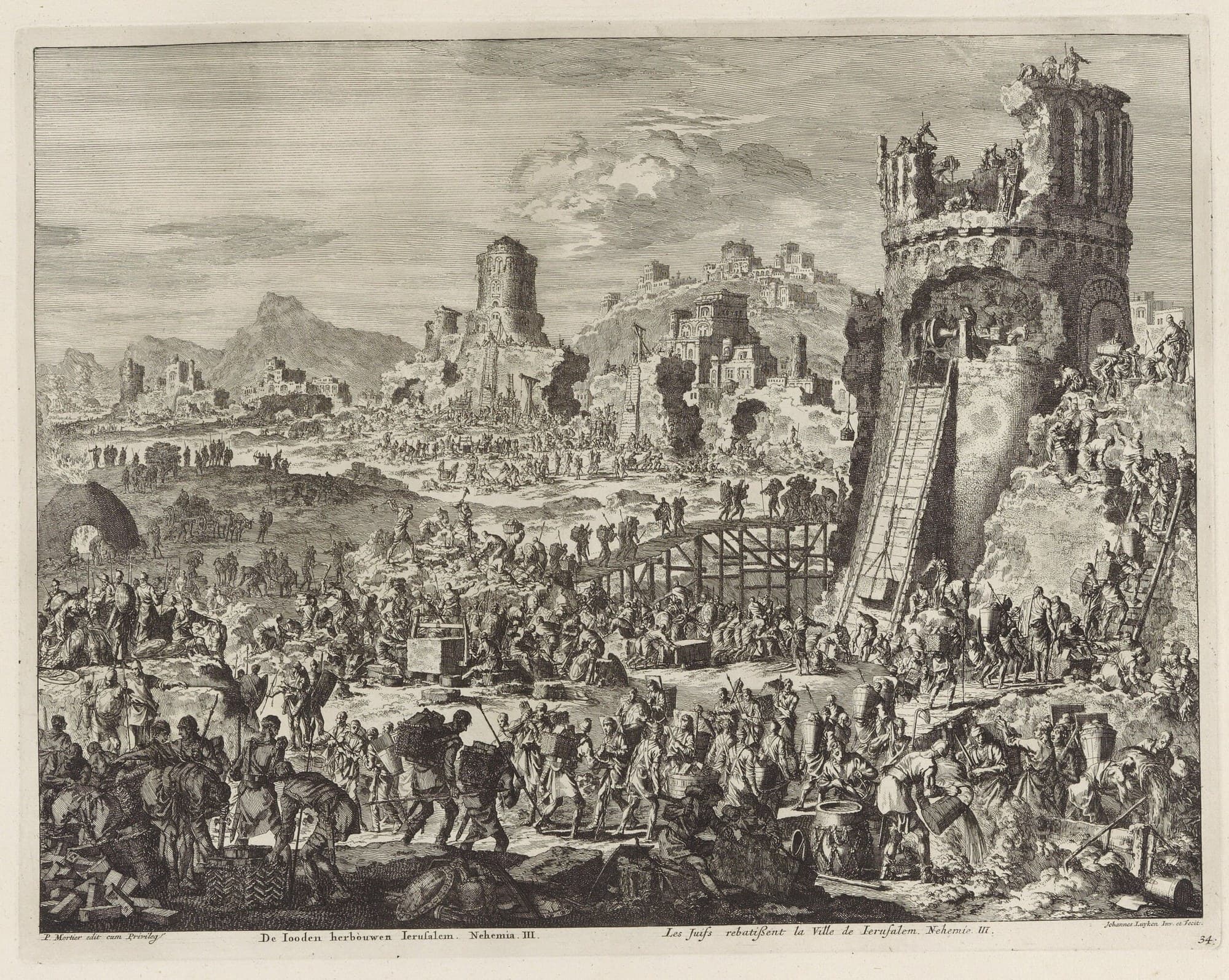
Nehemiah 4 tells how the people of Judah rebuilt the wall of Jerusalem under threat of attack, with a weapon always within reach.
The Jews who lived near the enemy came to Nehemiah ten times over to warn that an attack would come from every side.
who were rebuilding the wall. The laborers who carried materials worked with one hand and held a weapon with the other.
- Where
- Jerusalem
- Who
- Nehemiah
- When
- The twentieth year of King Artaxerxes (Nehemiah 2:1), about 446 BC by Easton's Bible Dictionary (probable)
Summary
Sanballat, Tobiah and their allies first mocked the builders of Jerusalem's wall and then plotted to fall on them. Nehemiah answered with prayer and a guard, and then with an order of work in which half of his servants laboured while the other half stood ready. The carriers kept a weapon in hand and the builders wore swords. The people worked from dawn until dark and spent the nights inside the city.
- Prayer to God and a guard against the enemy were the builders' first answer to the plot, and they kept both until the wall stood.
- The trial came from two sides at once, from enemies who meant to kill the workers and from the weariness of the work itself.
- Older commentators read the carrier's one hand and weapon as a proverb for readiness, as a figure of the believer's warfare, or as a plain report of armed men.
The Wall and Its Enemies
The wall of Jerusalem lay broken when Nehemiah came, and its rebuilding drew enemies from every side.
Building with One Hand is a story of the trial of work and toil, told in Nehemiah 4:15 to 23. It asks how the builders of Jerusalem kept at their labour when they were worn out and threatened with death, and what Nehemiah set beside the work to carry them through.
The study gives the setting of the wall and its enemies, the events of the chapter in the order of the text, and the plan by which half worked and half stood guard. It reads the complaint of the weary burden-bearers and the promise behind Nehemiah's rally call, and it weighs three readings of the weapon held in one hand.
Then I said to them, “You see the trouble we are in. Jerusalem lies in ruins, and its gates have been burned down. Come, let us rebuild the wall of Jerusalem, so that we will no longer be a disgrace.” I also told them about the gracious hand of my God upon me, and what the king had said to me. “Let us start rebuilding,” they replied, and they set their hands to this good work.The rebuilding began as a shared answer to Nehemiah's call, which is why the threat of chapter 4 fell on the whole people.
Chapter 3 lists the builders section by section, beginning with Eliashib the high priest and his fellow priests at the Sheep Gate (Nehemiah 3:1).
In Nehemiah 4:2 Sanballat asked before the army of Samaria, "Can they bring these burnt stones back to life from the mounds of rubble?"
Tobiah the Ammonite added that a fox climbing on what they built would break their wall down (Nehemiah 4:3).
When the gaps began to close, the Arabs, the Ammonites and the Ashdodites joined Sanballat and Tobiah (Nehemiah 4:7). The enemies said among themselves, "Before they know or see a thing, we will come into their midst, kill them, and put an end to the work" (Nehemiah 4:11).
After I had made an inspection, I stood up and said to the nobles, the officials, and the rest of the people, “Do not be afraid of them. Remember the Lord, who is great and awesome, and fight for your brothers, your sons and your daughters, your wives and your homes.”Nehemiah set his people's fear against the greatness of the Lord before any of them went back to the work.
Nehemiah 4 in the Order of the Text
The events run from the first mockery to the nights when no one changed his clothes.
The builders answered each step of the enemies' plot with a new order of work, until the whole company stayed armed by day and by night.
- Sanballat hears of the rebuilding"he was furious and filled with indignation"Nehemiah 4:1
- Nehemiah prays against the scorn"Hear us, O God, for we are despised."Nehemiah 4:4
- The wall is joined to half its height"the people had a mind to work"Nehemiah 4:6
- The enemies plot an attack"conspired to come and fight against Jerusalem"Nehemiah 4:8
- The builders pray and post a guard"So we prayed to our God"Nehemiah 4:9
- The men of Judah lose heart"The strength of the laborer fails"Nehemiah 4:10
- Families stand at the low places"with their swords, spears, and bows"Nehemiah 4:13
- The plot is frustrated"each of us returned to his own work"Nehemiah 4:15
- Half work and half stand armed"the other half held spears"Nehemiah 4:16
- The builders wear swords"his sword strapped at his side"Nehemiah 4:18
- Nehemiah gives the rally call"Our God will fight for us!"Nehemiah 4:20
- The work runs through the daylight"until the stars came out"Nehemiah 4:21
- Everyone sleeps inside Jerusalem"stand guard by night and work by day"Nehemiah 4:22
- No one changes his clothes"even to go for water"Nehemiah 4:23
A timeline of fourteen events in Nehemiah 4, in the order of the text, each with its verse and a phrase of the Berean text.
Families stand at the low places, The plot is frustrated, Half work and half stand armed, The builders wear swords, Nehemiah gives the rally call, The work runs through the daylight, Everyone sleeps inside Jerusalem, No one changes his clothes
Half at the Work, Half on Guard
Once the plot was known, Nehemiah reordered the whole company so that no one worked unprotected.
Nehemiah's own servants were split in two, one half at the work and the other half in armour, and the officers took their stand behind the people of Judah who were building (Nehemiah 4:16).
Nehemiah told the nobles and officials that the people were spread far apart along the wall. The sound of the horn would call them all to one place (Nehemiah 4:19 to 20).
The men who lived outside the city were told to stay the night within it. Albert Barnes, in his Notes, gave the sense of the order as "Let none return to his own village or city at night, but let all take their rest in Jerusalem."
Nehemiah at the Persian Court
Nehemiah served the Persian king before he governed in Judah.
Nehemiah was cupbearer to the king when men from Judah told him that the wall of Jerusalem was broken down and its gates burned with fire (Nehemiah 1:3 and Nehemiah 1:11).
Now in the month of Nisan, in the twentieth year of King Artaxerxes, when wine was set before him, I took the wine and gave it to the king. I had never been sad in his presence,The book dates Nehemiah's request to the king by the year of the king's reign.
Easton's Bible Dictionary (1897) puts his going up to Jerusalem "in the spring of B.C. 446". The Encyclopaedia Britannica of 1911 identifies the king as "apparently A. Longimanus" and dates his reign from 465 to 424 BC.
The Strength of the Burden-Bearer
The complaint of Nehemiah 4:10 names the men who carried the loads and the rubble still to be cleared.
The Hebrew word for the laborer is sabbal (Strong's H5449), which the lexicon glosses "a porter" and counts five times. Its verb, kashal (H3782), is glossed "to totter or waver (through weakness of the legs, especially the ankle)", so the men describe their strength as stumbling under the load.
The failing strength of these burden-bearers is the weariness of body and mind that the trial of stress takes up.
The Promise Behind the Rally Call
Nehemiah's rally call echoed the promise Moses gave Israel at the sea.
The LORD will fight for you; you need only to be still.”Moses gave this promise to a people who could not fight for themselves, and Nehemiah's builders, who could, were given the same trust.
Charles Spurgeon preached on the prayer and the guard of Nehemiah 4:9 in his sermon The Two Guards, Praying and Watching (1892). Of builders who had to build and keep watch at once, he said, "Their case is ours. We have to work for Christ."
So the wall was completed in fifty-two days, on the twenty-fifth of Elul. When all our enemies heard about this, all the surrounding nations were afraid and disheartened, for they realized that this task had been accomplished by our God.The surrounding nations read the finished wall as the work of God, though the builders had laboured and stood guard for every stone.
How Readers Have Taken the One Hand
Readers since the eighteenth century have taken the verse in three ways.
A proverb for readinessJohn Gill and Matthew Henry
John Gill, in his Exposition of the Old Testament (1748 to 1763), held that the verse "is not to be understood strictly and literally". He read it "proverbially, signifying that they were intent on both working and fighting".
Matthew Henry, in his Commentary on the Whole Bible (1710), wrote that it "cannot be understood literally, for the work would require both hands; but it intimates that they were equally employed in both".
Against this reading, the next verse arms the builders, whose work took both hands, in another way (Nehemiah 4:18), so the text itself tells the two tasks apart.
A figure of the believer's warfareJohn Wesley
John Wesley, in his Explanatory Notes upon the Old Testament (1765), wrote that the verse "is to be taken figuratively; being a proverbial speech". He drew from it the lesson, "Thus must we work out our salvation, with the weapons of our warfare in our hands."
His last sentence repeats Henry's nearly word for word, since Henry had written, "Thus must we work out our salvation with the weapons of our warfare in our hand".
Against this reading, Nehemiah 4 states no lesson of the kind and tells of real enemies who planned to come in and kill the builders (Nehemiah 4:11).
A plain report of armed menAdam Clarke
Adam Clarke, in his Commentary on the Bible (1832), read the verse as meaning that "he had his arms at hand, and was as fully prepared to fight as to work".
Against this reading, Matthew Henry judged it probable that the men "changed services at stated hours", taking up the work and the weapon in turn.
Work and Watch
The builders finished their work by keeping at it while they kept watch.
Let us not grow weary in well-doing, for in due time we will reap a harvest if we do not give up.Paul gives the church the charge the builders of Nehemiah 4 kept with their bodies, to go on working when weariness and opposition press.
The book of Nehemiah tells the whole rebuilding, from the report of the broken wall to the dedication of the finished one.
Sources
Scripture is the Berean Standard Bible.
- STEP Bible word index (TAHOT), Tyndale House, CC BY 4.0, the Hebrew words of Nehemiah 4:10 and Nehemiah 4:17 with Strong's numbers.
- STEP Bible, Translators lexicon of Extended Strongs for Hebrew (Tyndale House, Cambridge), CC BY 4.0.
- M. G. Easton, Easton's Bible Dictionary (1897), "Nehemiah".
- "Nehemiah", Encyclopaedia Britannica, eleventh edition, volume 19 (1911)
- Albert Barnes, Notes, Explanatory and Practical, on the Old and New Testaments (1832 to 1869), on Nehemiah 4:22.
- C. H. Spurgeon, The Two Guards, Praying and Watching, Metropolitan Tabernacle Pulpit, sermon 2254 (1892), on Nehemiah 4:9.
- John Gill, Exposition of the Old Testament (1748 to 1763), on Nehemiah 4:17.
- Matthew Henry, Commentary on the Whole Bible (1710), on Nehemiah 4:17.
- Matthew Henry, Commentary on the Whole Bible (1710), on Nehemiah 4:16.
- John Wesley, Explanatory Notes upon the Old Testament (1765), on Nehemiah 4:17.
- Adam Clarke, Commentary on the Bible (1832), on Nehemiah 4:17.
Keep Studying
In this trial6
People and groups8