
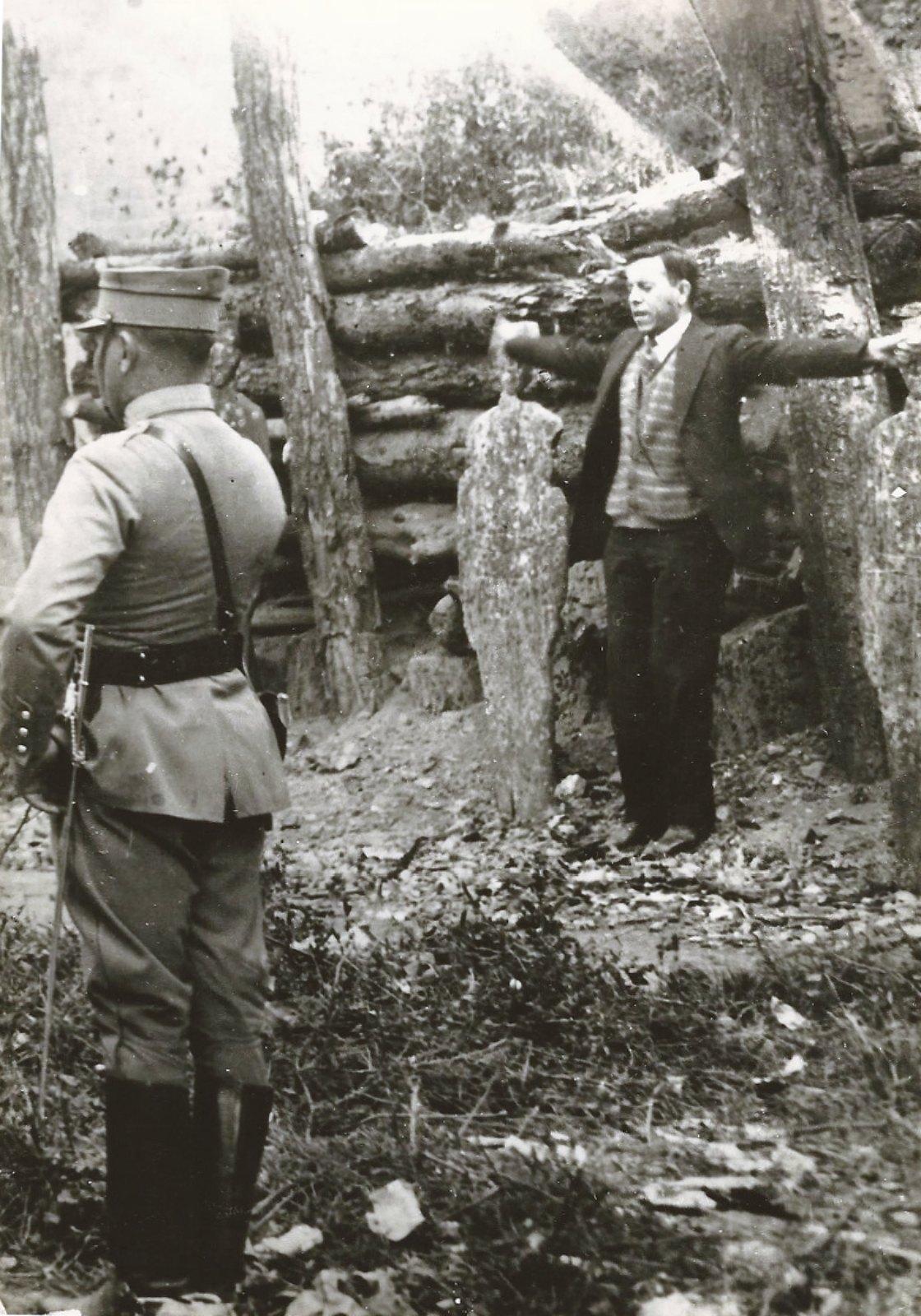
Unknown photographer, Miguel Pro before the firing squad, 23 November 1927, public domain
Mexico from 1926, Spain from 1936 · Story · Featured Study
The Mexican and Spanish Martyrs
Catholic clergy died by the thousands in Spain and in far smaller numbers in Mexico, and forces on the Catholic side killed in both wars.
On 23 November 1927 a firing squad at the Mexico City police inspection shot the Jesuit Miguel Pro without a trial, and the press photographed it.
Then Jesus said, “Father, forgive them, for they do not know what they are doing.” And they divided up His garments by casting lots.
Then Jesus said, “Father, forgive them, for they do not know what they are doing.” And they divided up His garments by casting lots.
- Where
- Mexico City, La Barca, Barbastro, Hernani, Salamanca
- Who
- Miguel Pro, Plutarco Elías Calles, Pius XI, Isidro Gomá, Francesc Vidal i Barraquer, Mateo Múgica, Atilano Coco
- When
- 31 July 1926 to 1939
Summary
Mexico's bishops stopped public worship in protest at a new law, and the Cristeros rose. Antonio Montero counted about 6,800 clergy killed in Spain's war.
- The counts of the dead differ from one historian to the next.
- Catholics in both countries disagreed over how far to back the fighting.
- Rome has since beatified or canonised hundreds of these dead.
The Texts Rome Chose
Three popes read these dead through Scripture.
But you do have a few people in Sardis who have not soiled their garments, and because they are worthy, they will walk with Me in white.
Pius XI said that the clergy of Mexico were worthy, in these words.
He talked and debated with the Grecian Jews, but they tried to kill him.
John Paul II read this of Paul in Jerusalem at the canonisation of the Mexican martyrs in 2000.
Acts 9:29BSB
I have fought the good fight, I have finished the race, I have kept the faith.
Benedict XVI used Paul's farewell to the church on the day of the 498 Spanish beatifications in 2007.
Acts 9:29, 2 Timothy 4:7
Two Wars Side by Side
The same questions get different answers in the two countries, and Julio de la Cueva sets them apart on the part the state played.
In Mexico a state in full power harried the church, and in Spain the killing came as the state's power broke.
| The question | Mexico | Spain |
|---|---|---|
| What came first? | The Calles law, in force 31 July 1926, and the bishops' suspension of public worship that day, by Pius XI. | Burned churches and clergy shot in the earlier 1930s, by De la Cueva. |
| Who killed the clergy? | Soldiers and police under the state, whose part in killing De la Cueva calls less clear than its harassment. | Left militants and workers, by De la Cueva and Maria Thomas. |
| Did the state order it? | Marisol López Menéndez says Calles ordered Pro's death. | De la Cueva says the violence came from an emptied state, and the bishops of 1937 say it was premeditated. |
| How many clergy died? | At least 40 from 1926 to 1934, credited to Brian Van Hove through a finding aid; De la Cueva compares a hundred or so in the Mexican Revolution. | 6,832 by Antonio Montero Moreno, 1961, and 6,733 by Ángel David Martín Rubio. |
| Who killed on the other side? | Cristeros killed passengers and soldiers on the La Barca train, and rebels killed rural teachers in the 1930s. | Nationalist forces shot sixteen clergy and religious in the Basque lands, and soldiers and Falangists killed many people on Majorca. |
| How has Rome named them? | Pro beatified in 1988, and Cristóbal Magallanes and 24 companions canonised in 2000. | 122 beatified in 1992, 233 in 2001, 498 in 2007. |
Mexico: the Law, the War and Father Pro
A law that Pius XI dates to 2 July 1926 brought the suspension of public worship within the month.
Pius XI complained that the Constitution of 1917 limited priests by number and birth, outlawed religious orders and barred priests and religious from elementary schools. The suspension began on the last day of July, when the law took effect, and Catholic rebels called Cristeros took up arms. The state mobilized agrarian militias against them, and Ulices Piña says that rivalry outlasted the war.
On 19 April 1927 Father José Reyes Vega's Cristeros attacked the Guadalajara train near La Barca. Jean Meyer, from participants' testimony, has Reyes Vega, who had lost a brother in the assault, burn the train. Meyer counts 52 soldiers and thirty civilians dead, and the headlines of the official version said the escort and over forty passengers, knifed and burned alive. Barba González, interim governor of Jalisco at the time, wrote in 1967 of no fewer than 250. Juan González Morfín finds the army's story composed to mislead and the League's defence unconvincing. He says the truth can be known only in part.
Luis Segura Vilchis threw bombs at Álvaro Obregón's car that November, and Humberto Pro had just sold him that car. Jesuit Missions says Father Miguel Pro was taken at his father's house on 17 November, and it says there was no semblance of a trial. López Menéndez writes that Calles ordered the execution, and that Roberto Cruz, the police chief, later said so in an interview. In the report of 1928 Cruz, as Obregón's lawyer testified, said he had already received orders and named no one who gave them. Miguel and Humberto Pro, Segura Vilchis and Juan Tirado Arias were shot at the police inspection on 23 November. Excélsior and El Universal printed the pictures. Jesuit Missions says fifteen thousand followed the body and cried for Christ the King.
The bishops and the government came to terms in June 1929. Pius XI wrote in 1932 that bishops, priests and faithful went on being punished, and that one priest was allowed for every 100,000 people in Veracruz. Piña records that rural teachers in the 1930s were assaulted, maimed and murdered by rebels with the help of parish priests. The vicar general of Guadalajara, José Garibi y Rivera, cited a circular of 11 October 1932 forbidding priests to take part.
The last words as reported1 paragraph
Jesuit Missions, an interested Jesuit paper of March 1928, reports that at the wall he called God to witness his innocence, asked mercy on the soldiers and said he forgave his enemies. That report does not give the cry at the wall, and it gives the cry of Christ the King to the funeral crowd. Marisol López Menéndez in 2019 and Dawn Beutner in 2024 give him the cry "¡Viva Cristo Rey!" with his arms raised in a cross, and the source of those two reports was not traced.
How many died in Mexico1 paragraph
The figure most often repeated for the war is about 90,000 dead, with 56,882 federal soldiers and 30,000 Cristeros, which summaries credit to Jean Meyer and Julia Young. It is an estimate, and its method is unchecked here. Summaries credit Brian Van Hove with 4,500 priests before the war and 334 licensed by 1934.
Spain: the Clergy and the Two Zones
Robert Royal says most of the clergy killed in the Republican zone died in the first six months of the war. Nationalist forces killed priests of their own church as well.
De la Cueva records over a hundred religious buildings burned between 11 and 15 May 1931 and 37 clergy killed in October 1934, 33 of them in Asturias. From 19 July 1936 the killing passed all that. Montero counted 6,832 dead in 1961, being 4,184 priests with the bishops among them, 2,365 religious and 283 nuns, and Martín Rubio's later figure is 6,733. In Barbastro 88 percent of the secular clergy died, by De la Cueva.
De la Cueva says the killers seem anarchist where their affiliation is clear, which is nearly beyond dispute in Catalonia and Aragon. He adds that they were anticlericals of any left organization. Maria Thomas, as Julián Casanova reviews her, finds rural and urban male workers the main agents.
At Barbastro revolutionary militia seized the Claretian seminary on 20 July, and the order's record says fifty-one members went to their deaths between 2 and 18 August.
The bishops' Collective Letter of 1 July 1937 denied that the church had sought the war and held the Nationalist triumph the only hope. It answered the charge of a White Terror by saying that every war has its excesses. Forty-three bishops and five vicars signed.
The rebels shot sixteen clergy and religious in the Basque lands from 3 September, by the Hernani historians' list. Some of them were Basque nationalists and some were not. José Ariztimuño, called Aitzol, died at Hernani on 17 October, and soldiers, Falangists and requetés made up the firing squads there. Bishop Múgica of Vitoria protested to the Holy See as prelate of the murdered priests.
Atilano Coco, the only Protestant pastor living in Salamanca, was held from July despite Miguel de Unamuno's requests and shot on 9 December. His church's own investigator still asks whether he died for his faith or his politics.
Josep Massot i Muntaner, the historian of Majorca, says Georges Bernanos's book of 1938 is often unjust and that he knew the repression at first hand. He cites the British consul Alan Hillgarth, a witness favourable to Franco. Hillgarth recorded killings on streets, on roads and in cemeteries, and still judged the authorities relatively lenient. After October, Massot reports, the summary executions reached prisoners against whom nothing could be proved. He names soldiers and Falangists as the killers.
Fourteen or sixteen1 paragraph
Father Urriza, in a defence Cardinal Gomá used, says there were fourteen and that all were tried and guilty of a crime. The Hernani historians add that he had just lost his brother to the Republican side. Those historians reply that the claim of trials is false, and the town where the men died published their book. Gomá wrote on 10 January 1937 that he refused to believe priests had been shot merely for loving their people.
The two who did not sign1 paragraph
Francesc Vidal i Barraquer of Tarragona wrote against the letter three times, and his biographer Muntanyola calls it total disagreement, while Gomá's biographer Granados says he judged it inopportune. Múgica's stated reason was prudence, since he was outside his see.
How the Key Verse Was Taught
Three preachers and commentators on the prayer from the cross.
John Wesley (1703 to 1791)
Explanatory Notes upon the New Testament
John Wesley saw Jesus more concerned for his killers' souls than for his own wounds.
“While they are actually nailing him to the cross, he seems to feel the injury they did to their own souls more than the wounds they gave him; and as it were to forget his own anguish out of a concern for their own salvation. And how eminently was his prayer heard!”
on Luke 23:34Evangelical
Adam Clarke (1762 to 1832)
Commentary on the Bible, Luke 23:34
Adam Clarke weighed what ignorance does and does not excuse.
“If ignorance do not excuse a crime, it at least diminishes the atrocity of it. However, these persons well knew that they were crucifying an innocent man; but they did not know that, by this act of theirs, they were bringing down on themselves and on their country the heaviest judgments of God.”
Methodist
Charles Spurgeon (1834 to 1892)
The Metropolitan Tabernacle Pulpit, Sermon No. 2263, Luke 23:34
Charles Spurgeon set the prayer against what one word from the cross could have done.
“Jesus did not say to those who crucified Him, ‘Be gone!’ One such word and they would have all fled.”
Particular Baptist
In Their Own Words
Those who died, those who fought and those who wrote for the bishops, with the Spanish as written and the English beside it.
Miguel Pro (1891 to 1927)
As reported in "The Execution of Miguel Pro, S.J.", Jesuit Missions, March 1928, the account of the execution
Mercy on you all
“May God have mercy on you all.”
Roman Catholic, Jesuit
About this saying1 paragraph
Jesuit Missions, in March 1928, reports this of Father Pro as he blessed the firing squad.
The Claretian Martyrs of Barbastro
Attributed to a seminarian, August 1936, in the Claretian Ephemeris for 13 August, the seminarians' writings
I will forgive
“As Jesus Christ died on the cross forgiving his enemies, as a martyr I will forgive my enemies with all my heart.”
Roman Catholic
About this saying1 paragraph
The Claretian record gives this line from a Barbastro seminarian in August 1936, without his name.
Pius XI
Iniquis Afflictisque, 18 November 1926, the account of the persecution
In the public squares
“Priests and laymen have been cruelly put to death in the very streets or in the public squares which front the churches.”
Roman Catholic, pope
About this saying1 paragraph
Pius XI wrote this of Mexico in his letter of 18 November 1926.
Liga Nacional Defensora de la Libertad Religiosa
Boletín of 1927, in Juan González Morfín, "El asalto al tren de La Barca y otros cuentos", Tla-melaua 12:45 (2018), the League's bulletin
Hard but lawful
“es un medio lícito de defensa, duro, pero necesario y lícito”
Mexican Catholic lay organization
About this saying1 paragraph
The Cristeros' League said this of attacking passenger trains in 1927: it is a lawful means of defence, hard, but necessary and lawful.
The Spanish Bishops
Carta colectiva, 1 July 1937, the section on the war
An armed plebiscite
“La guerra es, pues, como un plebiscito armado.”
Roman Catholic, Spain
About this saying1 paragraph
The Spanish bishops wrote this in 1937: the war is, then, like an armed plebiscite.
Francesc Vidal i Barraquer
Letter to Cardinal Gomá, 9 July 1937, in José Manuel Alfonso Sánchez, "La Carta colectiva", Papeles Salmantinos de Educación 0 (2001), the letter
Fit for propaganda
“muy propio para propaganda”
Roman Catholic, cardinal
About this saying1 paragraph
Vidal i Barraquer wrote to Gomá on 9 July 1937 that the letter was very fit for propaganda, as Muntanyola quotes him.
What Is Disputed
Each of these questions divides its witnesses.
Was Spain a planned persecution?3 paragraphs
The Collective Letter held that the destruction and the killing of priests were premeditated, and it counted about 6,000 secular clergy and over 300,000 laity dead while calling its own figures premature.
De la Cueva treats the persecution of the clergy as fact and disputes the plan, saying the violence came from an emptied and fragmented state.
Montero answers those who blame the victims' own church that they had the bad luck of the Nationalists' winning, so they drew none of the sympathy the defeated receive.
Was it a crusade?2 paragraphs
Aniceto Castro Albarrán's book of 1938 carries the word in its title, and Bishop Plá y Deniel praised it in 1939.
The Collective Letter uses the word once, to say that Crusades are not the bishops' case here, and the Basque writer Iturralde turned it back on Franco's side.
Were the Cristeros faithful or rebels?2 paragraphs
John Paul II honoured the Mexican priests who kept their ministry and forgave, and Pius XI praised the resistance of the faithful.
The army's bulletin of 1927 called them bandits organized by the bishops, and Morfín and Piña show real killing by rebels, some with parish priests' help, against the hierarchy's order.
Were the terms of 1929 wise?2 paragraphs
Pius XI defended them as taken for the good of souls and then said their promises were broken.
Summaries of the war report that rebels with no seat in the talks felt betrayed, and that the church threatened holdouts with excommunication.
Books to Read Next
El asalto al tren de La Barca y otros cuentos
Juan González Morfín · 2018
González Morfín has weighed every account of the train, in Spanish.
Free at SciELOEl asalto de los cielos
Julio de la Cueva Merino · 2012
De la Cueva compares the anticlerical violence of Spain, Mexico and Russia, in Spanish.
Free at AyerLos martirologios españoles de la Guerra Civil
Alfredo Verdoy · 2009
Verdoy reviews the counts of the clergy from Montero on, in Spanish.
Free at Estudios EclesiásticosWhat the Two Wars Leave
The dead of these two wars have their books and their beatifications. The teachers, the passengers, the Basque clergy and the pastor of Salamanca stand in the same record.
Sources
Scripture is the Berean Standard Bible.
- The Holy Bible, Berean Standard Bible (read 2026)
- Pius XI, Iniquis Afflictisque, 18 November 1926, Vatican English.
- Pius XI, Acerba Animi, 29 September 1932, Vatican English.
- Ulices Piña, "The Different Roads to Rebellion", Letras Históricas 16 (2017)
- Juan González Morfín, "El asalto al tren de La Barca y otros cuentos", Tla-melaua 12:45 (2018), quoting Jean Meyer, La Cristiada 1 (1973), page 173.
- Dawn Beutner, Catholic World Report, 23 November 2024.
- "The Execution of Miguel Pro, S.J.", Jesuit Missions, March 1928.
- Marisol López Menéndez, "El gesto, el cuerpo y la memoria", Historia y Grafía 52 (2019)
- "Cristero War", English Wikipedia, used as a finding aid to its footnotes (Julia Young 2015; Jean Meyer 1973, 1976 and 2004; Brian Van Hove 1994), none of them opened.
- John Paul II, homily, 21 May 2000; John Paul II, homily, 11 March 2001; Benedict XVI, Angelus, 28 October 2007; the Vatican's list of the blesseds.
- Alfredo Verdoy, "Los martirologios españoles de la Guerra Civil", Estudios Eclesiásticos 84:330 (2009), giving Antonio Montero Moreno, Historia de la persecución religiosa en España (Madrid: BAC, 1961)
- Robert Royal, "The New Spanish Martyrs", Arlington Catholic Herald (2000)
- Julio de la Cueva Merino, "El asalto de los cielos", Ayer 88 (2012)
- Julián Casanova, review of Maria Thomas, The Faith and the Fury (2013), The Volunteer, December 2013.
- Claretian Missionaries, Ephemeris, 13 August.
- Carta colectiva de los obispos españoles, Pamplona, 1 July 1937, transcription at todoslosnombres.org.
- José Manuel Alfonso Sánchez, "La Carta colectiva", Papeles Salmantinos de Educación 0 (2001)
- Aizpuru, Apaolaza, Gómez and Odriozola, El otoño de 1936 en Guipúzcoa (Hernani town council, 2007)
- Alfonso Botti, "La Iglesia vasca dividida", Historia Contemporánea 35 (2007)
- elDiario.es, on the search for Atilano Coco, quoting Delgado Cruz and Infante, Nadie preguntaba por ellos.
- Adam Clarke, Commentary on the Bible, on Luke 23:34.
- Charles Spurgeon, The Metropolitan Tabernacle Pulpit, Sermon No. 2263.
- "Els cementiris sagnants de Mallorca", enciclopedia.cat, with Josep Massot i Muntaner named as contributor.
Keep Studying
Read it4
People and groups1
Trials of life1
Go further3