
Genesis 23 to 1 Thessalonians 4 · Subject · Featured Study
Mourning and Burial in Israel
How Israel grieved its dead and laid them in the grave, from Abraham's purchase of a family tomb to the law of the priests and the hope of the resurrection.
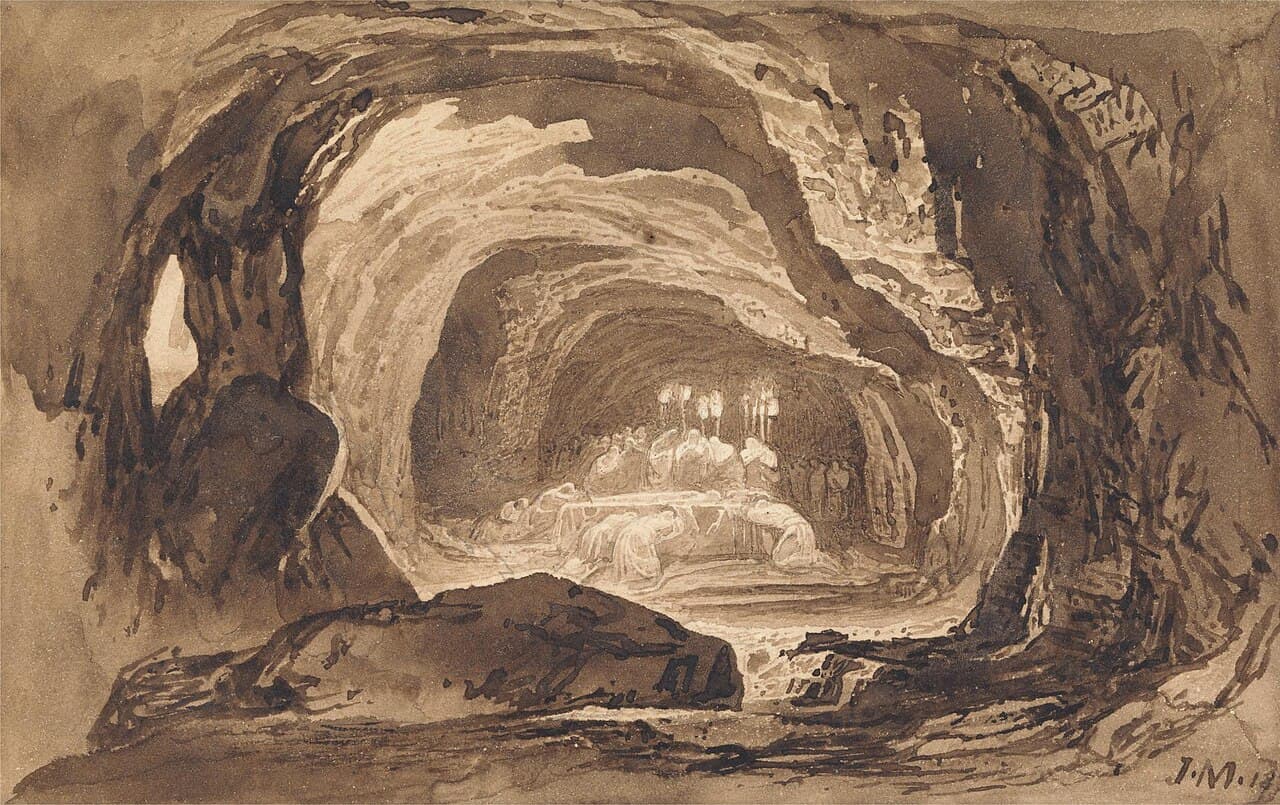
John Martin, Burial of Sarah, brown ink and brown wash on paper, Yale Center for British Art, B1975.4.637, CC0, via Wikimedia Commons
THE ARTWORKJohn Martin drew the cave as a vast arch of rock and set the bier far inside it, where mourners kneel and stand in the light of raised torches.
John Martin drew the burial of Sarah in the cave of Machpelah, the first burial that Scripture narrates.
Summary
Mourning and burial in Israel are the grief, the rites and the graves Scripture records for the dead, with the law that ruled them.
- Abraham bought the cave of Machpelah at Hebron to bury Sarah, and Genesis names six who were laid there.
- Mourners in Scripture wept, tore their clothes, wore sackcloth and fasted, and some kept seven days.
- Egypt embalmed Jacob and mourned him seventy days before his sons carried him to Canaan.
- The law of Moses kept priests from most graves, forbade cutting the body for the dead and made a corpse unclean for seven days.
- Jesus wept for Lazarus, and Paul tells the church to grieve with hope.
Mourning from Sarah to Stephen
Seven passages, from Abraham's grief to the burial of Stephen, give the custom, the law that ruled it and the grief of Jesus and His church.
She died in Kiriath-arba (that is, Hebron) in the land of Canaan, and Abraham went out to mourn and to weep for her.Sarah's is the first death in Genesis for which the text records mourning.
Then Jacob tore his clothes, put sackcloth around his waist, and mourned for his son many days. All his sons and daughters tried to comfort him, but he refused to be comforted. “No,” he said. “I will go down to Sheol mourning for my son.” So his father wept for him.It shows mourning kept for many days with no comfort taken, before any law set a length for it.
Then the LORD said to Moses, “Speak to Aaron’s sons, the priests, and tell them that a priest is not to defile himself for a dead person among his people, except for his immediate family—his mother, father, son, daughter, or brother, or his unmarried sister who is near to him, since she has no husband. He is not to defile himself for those related to him by marriage, and so profane himself.The law limits a priest's contact with the dead to his nearest kin, so the custom of Genesis now has a rule.
You are sons of the LORD your God; do not cut yourselves or shave your foreheads on behalf of the dead, for you are a people holy to the LORD your God. The LORD has chosen you to be a people for His prized possession out of all the peoples on the face of the earth.Where Leviticus 21 rules the priests, this law reaches every Israelite and limits the marks a mourner may make.
Whoever touches any dead body will be unclean for seven days.The law makes a dead body a source of uncleanness for seven days, so every burial touched the purity law.
Jesus wept.Jesus weeps on the way to the tomb of Lazarus, though He is about to call him out of it.
God-fearing men buried Stephen and mourned deeply over him.It shows the church burying and mourning its first martyr openly, as Israel mourned its dead.
The Burials at Machpelah
Six burials in the cave Abraham bought, in the order Genesis records them.
A timeline of the six burials in the cave of Machpelah, each with those who buried the dead and the verse.
Abraham Buys a Grave
Genesis 23 sets out the sale of the cave of Machpelah, from Abraham's request to the deed.
Abraham rose from beside Sarah's body and asked the Hittites for a burial site, calling himself a foreigner and an outsider among them. They offered him the finest of their tombs, but he asked for the cave of Machpelah at the end of Ephron's field, at full price.
Ephron offered the field and the cave as a gift in front of his people. Abraham paid instead, weighing out four hundred shekels of silver by the merchants' standard. The sale was made in the hearing of the Hittites at the gate of the city, and the field, the cave and its trees were deeded to him before them all.
John Wesley notes that this burial place was the first ground Abraham possessed in Canaan and the only land he ever held there.
Rashi on the names Kiriath-arba and MachpelahRashi on Genesis 23:2 and 23:9
Rashi, the eleventh-century French commentator on the Torah, gives two reasons for the name Kiriath-arba, the city of the four. It was named for the four giants who lived there, Ahiman, Sheshai, Talmai and their father, or for the four couples buried there: Adam and Eve, Abraham and Sarah, Isaac and Rebekah, Jacob and Leah.
He reads Machpelah as double, because the cave had a lower and an upper chamber.
(Hebron used to be called Kiriath-arba, after Arba, the greatest man among the Anakim.) Then the land had rest from war.Joshua ties the name to one man, Arba of the Anakim, where Rashi's first reason counts four giants.
The price and the promiseMatthew Henry on Genesis 23:16
Matthew Henry sets the purchase beside the promise of the land.
“Observe, Though all the land of Canaan was Abraham's by promise, yet, the time of his possessing not having come, what he had now occasion for he bought and paid for. Note, Dominion is not founded in grace. The saints' title to an eternal inheritance does not entitle them to the possessions of this world, nor justify them in doing wrong.”
Matthew Henry · Commentary on the Whole Bible · on Genesis 23:16Puritan
Mourning in Canaan and Egypt
The marks of mourning Scripture records, and the rites of Egypt at Jacob's death.
| Mark of mourning | Mourner | Verse |
|---|---|---|
| Weeping | Abraham for Sarah | Genesis 23:2 |
| Tearing the clothes | Reuben at the empty pit | Genesis 37:29 |
| Sackcloth around the waist | Jacob for Joseph | Genesis 37:34 |
| Refusing comfort | Jacob for Joseph | Genesis 37:35 |
| A pillar on the grave | Jacob for Rachel | Genesis 35:20 |
| Loud wailing, then seven days of mourning | Joseph and the Egyptians at Atad | Genesis 50:10 |
| Thirty days of mourning | The house of Israel for Aaron | Numbers 20:29 |
| Fasting seven days | The men of Jabesh for Saul and his sons | 1 Samuel 31:13 |
| Fasting until evening | David for Saul and Jonathan | 2 Samuel 1:12 |
| Walking behind the bier | David for Abner | 2 Samuel 3:31 |
| Shaving the head | Job | Job 1:20 |
| Dust thrown over the head | Job's three friends | Job 2:12 |
| Sitting on the ground seven days | Job's three friends | Job 2:13 |
- Mark of mourning
- Weeping
- Mourner
- Abraham for Sarah
- Verse
- Genesis 23:2
- Mark of mourning
- Tearing the clothes
- Mourner
- Reuben at the empty pit
- Verse
- Genesis 37:29
- Mark of mourning
- Sackcloth around the waist
- Mourner
- Jacob for Joseph
- Verse
- Genesis 37:34
- Mark of mourning
- Refusing comfort
- Mourner
- Jacob for Joseph
- Verse
- Genesis 37:35
- Mark of mourning
- A pillar on the grave
- Mourner
- Jacob for Rachel
- Verse
- Genesis 35:20
- Mark of mourning
- Loud wailing, then seven days of mourning
- Mourner
- Joseph and the Egyptians at Atad
- Verse
- Genesis 50:10
- Mark of mourning
- Thirty days of mourning
- Mourner
- The house of Israel for Aaron
- Verse
- Numbers 20:29
- Mark of mourning
- Fasting seven days
- Mourner
- The men of Jabesh for Saul and his sons
- Verse
- 1 Samuel 31:13
- Mark of mourning
- Fasting until evening
- Mourner
- David for Saul and Jonathan
- Verse
- 2 Samuel 1:12
- Mark of mourning
- Walking behind the bier
- Mourner
- David for Abner
- Verse
- 2 Samuel 3:31
- Mark of mourning
- Shaving the head
- Mourner
- Job
- Verse
- Job 1:20
- Mark of mourning
- Dust thrown over the head
- Mourner
- Job's three friends
- Verse
- Job 2:12
- Mark of mourning
- Sitting on the ground seven days
- Mourner
- Job's three friends
- Verse
- Job 2:13
Pharaoh let Joseph go up to bury Jacob, and the elders of Egypt went with him in a very large procession of chariots and horsemen.
Joseph's farewell to his fatherMatthew Henry on Genesis 50:1
Matthew Henry reads Joseph's kiss on his dead father's face as faith in the resurrection of the body.
“The departed soul is out of the reach of our tears and kisses, but with them it is proper to show our respect to the poor body, of which we look for a glorious and joyful resurrection. Thus Joseph showed his faith in God, and love to his father, by kissing his pale and cold lips, and so giving an affectionate farewell.”
Matthew Henry · Commentary on the Whole Bible · on Genesis 50:1Puritan
Forty days and seventyGenesis 50:2 to 3
And Joseph directed the physicians in his service to embalm his father Israel. So they embalmed him, taking the forty days required to complete the embalming. And the Egyptians mourned for him seventy days.These verses give the two numbers of days that the commentators reckon in different ways.
Adam Clarke, in his Commentary on the Bible, reads the seventy days as the forty of embalming and thirty more in natron.
Jamieson, Fausset & Brown, in their Commentary Critical and Explanatory on the Whole Bible, give thirty days to the process and forty more to the spices. They say the body was then wrapped in linen and laid in a wooden chest.
Deborah's oak and Rachel's pillarGenesis 35:8 to 20
Now Deborah, Rebekah’s nurse, died and was buried under the oak below Bethel. So Jacob named it Allon-bachuth.The burial of a household servant is given a place name of its own.
John Wesley, in his Explanatory Notes upon the Old Testament, says Deborah died so much lamented that the oak she was buried under was called Allon-bachuth, the oak of weeping.
So Rachel died and was buried on the way to Ephrath (that is, Bethlehem). Jacob set up a pillar on her grave; it marks Rachel’s tomb to this day.Like Deborah's oak, Jacob's pillar marks a grave that lies outside the cave of Machpelah.
Adam Clarke, in his Commentary on the Bible, asks whether funeral monuments began with this pillar.
The threshing floor of AtadGenesis 50:10 to 11
When the Canaanites saw the mourning at the threshing floor of Atad, beyond the Jordan, they called it a solemn ceremony of mourning by the Egyptians, and the place was named Abel-mizraim.
Adam Clarke, in his Commentary on the Bible, takes Atad as the name of a man, probably the chief of a clan in that place, and notes that threshing floors stood in the open field.
Rashi gives two reasons for the name, which means thorns. The first is that the place was ringed by a hedge of thorns. The second comes from the rabbis, who drew it from the Talmud's tractate Sotah. The tractate tells how the kings of Canaan hung their crowns on Jacob's coffin until it was ringed with them, as a threshing floor is ringed with thorns.
The Words for Mourning and Burial
Eight Hebrew words of Genesis 23, 37 and 50, with their Strong's numbers and meanings.
EBEL (HEBREW, H60)
A noun for mourning, used three times of the mourning at Atad in Genesis 50:10 to 11.
SAPHAD (HEBREW, H5594)
A verb the lexicon defines as to tear the hair and beat the breast in grief, and so to lament. Genesis 23:2 is its first use in Scripture.
BAKAH (HEBREW, H1058)
A verb meaning to weep, used of Abraham for Sarah and of Joseph over his father's body.
QARA (HEBREW, H7167)
A verb meaning to tear, used of Reuben and of Jacob when they tore their clothes.
SAQ (HEBREW, H8242)
Coarse cloth worn in mourning, and the same word names the sacks in which Joseph's brothers found their silver.
QEVER (HEBREW, H6913)
A grave or tomb, the word of Abraham's request for a burial site and of the tomb Jacob dug for himself.
CHANAT (HEBREW, H2590)
A verb meaning to spice and so to embalm, used of Jacob and of Joseph, and of figs ripening in Song of Songs 2:13.
MAKPELAH (HEBREW, H4375)
The name of the cave and its field, found six times in Scripture and only in Genesis.
The Berean text renders saphad as mourn at Genesis 23:2 and as lament at Genesis 50:10.
What the Text Leaves Unsaid
Three questions Genesis leaves open.
Genesis does not say how long Abraham mourned before he rose to ask for a grave. Adam Clarke, in his Commentary on the Bible, supposes he sat on the ground for some days, as the custom was.
Genesis never narrates Rebekah's death, and her grave is named only in Jacob's charge to his sons.
Genesis gives no reason why Rachel was buried on the way to Ephrath and not in the cave of Machpelah.
Buried in Hope
Hebrews 11 sets the deaths of the patriarchs and of Joseph among the works of faith.
Joseph made the sons of Israel swear to carry his bones up from Egypt when God attended to them. Moses took the bones with him at the exodus, and Joshua 24:32 records their burial at Shechem.
All these people died in faith, without having received the things they were promised. However, they saw them and welcomed them from afar. And they acknowledged that they were strangers and exiles on the earth.Albert Barnes, in his Notes, Explanatory and Practical, on the Old and New Testaments, takes these to be Abraham, Isaac, Jacob and Sarah, four of the six buried at Machpelah.
By faith Joseph, when his end was near, spoke about the exodus of the Israelites and gave instructions about his bones.Joseph's charge about his bones is the one act of his life this chapter names.
The epitaph of those who died in faithCharles Spurgeon on Hebrews 11:13
Charles Spurgeon preached Hebrews 11:13 as the epitaph of all who die believing.
“Believers are a class by themselves, even when they die. It is idle to think that we can mark out a spot in the cemetery where none but saints shall sleep, but yet there is a truth at the bottom of that folly. There is a separation even in death between the righteous and the wicked. The Lord seems to erect a mausoleum in which lie asleep the bodies of His people and He writes this epitaph across the front, ‘THESE ALL DIED IN FAITH.’ As for those who died without faith, they indeed, died.”
Charles Spurgeon · The Metropolitan Tabernacle Pulpit, Sermon No. 1825: “An Inscription for the Mausoleum of the Saints” (lightly modernized text, CCEL edition) · on Hebrews 11:13 to 14
Joseph's bones and the resurrectionJamieson, Fausset & Brown on Hebrews 11:22
Jamieson, Fausset & Brown read Joseph's charge as his hope of the land and of rising again.
“Joseph's eminent position in Egypt did not make him regard it as his home: in faith he looked to God's promise of Canaan being fulfilled and desired that his bones should rest there: testifying thus: (1) that he had no doubt of his posterity obtaining the promised land: and (2) that he believed in the resurrection of the body, and the enjoyment in it of the heavenly Canaan.”
Jamieson, Fausset & Brown · Commentary Critical and Explanatory on the Whole Bible · on Hebrews 11:22Reformed
Grief with hope1 Thessalonians 4:13 to 14
Brothers, we do not want you to be uninformed about those who sleep in death, so that you will not grieve like the rest, who are without hope. For since we believe that Jesus died and rose again, we also believe that God will bring with Jesus those who have fallen asleep in Him.Paul grounds the hope of those who grieve in the death and resurrection of Jesus.
Matthew Henry reads Paul's words as a limit set on sorrow.
“It is to act too much like the Gentiles, who had no hope of a better life after this; whereas we Christians, who have a most sure hope, the hope of eternal life after this, which God who cannot lie hath promised us, should moderate all our joys and our sorrows on account of any worldly thing.”
Matthew Henry · Commentary on the Whole Bible · on 1 Thessalonians 4:13Puritan
Voices on Mourning and Burial
Three teachers on grief and the grave, earliest first.
Ambrose of Milan answers the grief of believers with the common resurrection of the dead.
“All men shall rise again, but let no one lose heart, and let not the just grieve at the common lot of rising again, since he awaits the chief fruit of his virtue. All indeed shall rise again, but, as says the apostle, ‘each in his own order.’ The fruit of the divine mercy is common to all, but the order of merit differs. The day gives light to all, the sun warms all, the rain fertilizes the possessions of all with genial flowers. We are all born, and we shall all rise again.”
Ambrose of Milan · On the Death of Satyrus 2.92-93 · on 1 Thessalonians 4:14 to 15Patristic
Matthew Henry sets Abraham's grief apart from the mourners who went about the streets.
“Abraham's mourning for her; and he was a true mourner. He did not only perform the ceremonies of mourning according to the custom of those time, as the mourners that go about the streets, but he did sincerely lament the great loss he had of a good wife, and gave proof of the constancy of his affection to her to the last. Two words are used: he came both to mourn and to weep.”
Matthew Henry · Commentary on the Whole Bible · on Genesis 23:2Puritan
Jamieson, Fausset & Brown find in the tears of Jesus a grief at the cause of death as well as at death itself.
“But was there nothing in those tears beyond sorrow for human suffering and death? Could these effects move Him without suggesting the cause? Who can doubt that in His ear every feature of the scene proclaimed that stern law of the Kingdom, ‘The wages of sin is death’ (Ro 6:23), and that this element in His visible emotion underlay all the rest?”
Jamieson, Fausset & Brown · Commentary Critical and Explanatory on the Whole Bible · on John 11:35Reformed
Who Was Carried to Shechem?
Two readings of Stephen's words in Acts 7:16, each with its holder.
So Jacob went down to Egypt, where he and our fathers died. Their bones were carried back to Shechem and placed in the tomb that Abraham had bought from the sons of Hamor at Shechem for a price he paid in silver.Stephen names Shechem and the sons of Hamor, where Genesis 23 names Machpelah and Ephron the Hittite.
Stephen ran the history togetherJohn Wesley
John Wesley, in his Explanatory Notes upon the New Testament, holds that Stephen ran quickly over many events and did not stop to recite each one, since his hearers knew them well.
The fathers are the twelve patriarchsJohn Gill
John Gill, in his Exposition of the New Testament, reads the fathers as the twelve sons of Jacob alone, since Jacob himself was buried at Machpelah and not at Shechem.
Reading Further
Four older works on these texts, each with its date.
On the Death of Satyrus
Ambrose of Milan · fourth century
Its second book argues for the rising of the body from 1 Corinthians 15 and from Ezekiel's valley of dry bones.
Commentary on the Whole Bible
Matthew Henry · 1710
His note on Genesis 49:31 reads Jacob's charge to be buried at Machpelah as faith in God's promise of Canaan.
Explanatory Notes upon the Old Testament
John Wesley · 1765
His note on Genesis 25:9 observes that Genesis records no pomp at Abraham's funeral, only the two sons who buried him.
Commentary Critical and Explanatory on the Whole Bible
Robert Jamieson, A. R. Fausset and David Brown · 1871
Its note on Genesis 37:34 says the rent garment and the sackcloth were the common signs of mourning in the East.
The Grave and the Promise
From the cave Abraham bought to the tomb of Lazarus, Scripture mourns the dead openly and buries them with care. Christ wept for Lazarus and rose from His own grave, so the church lays its dead to rest and waits for them to be raised.
These texts ask the reader to weep with those who weep, to honour the bodies of the dead, and to grieve as one who believes that Jesus died and rose again.
Keep studying
Studies3
People10