
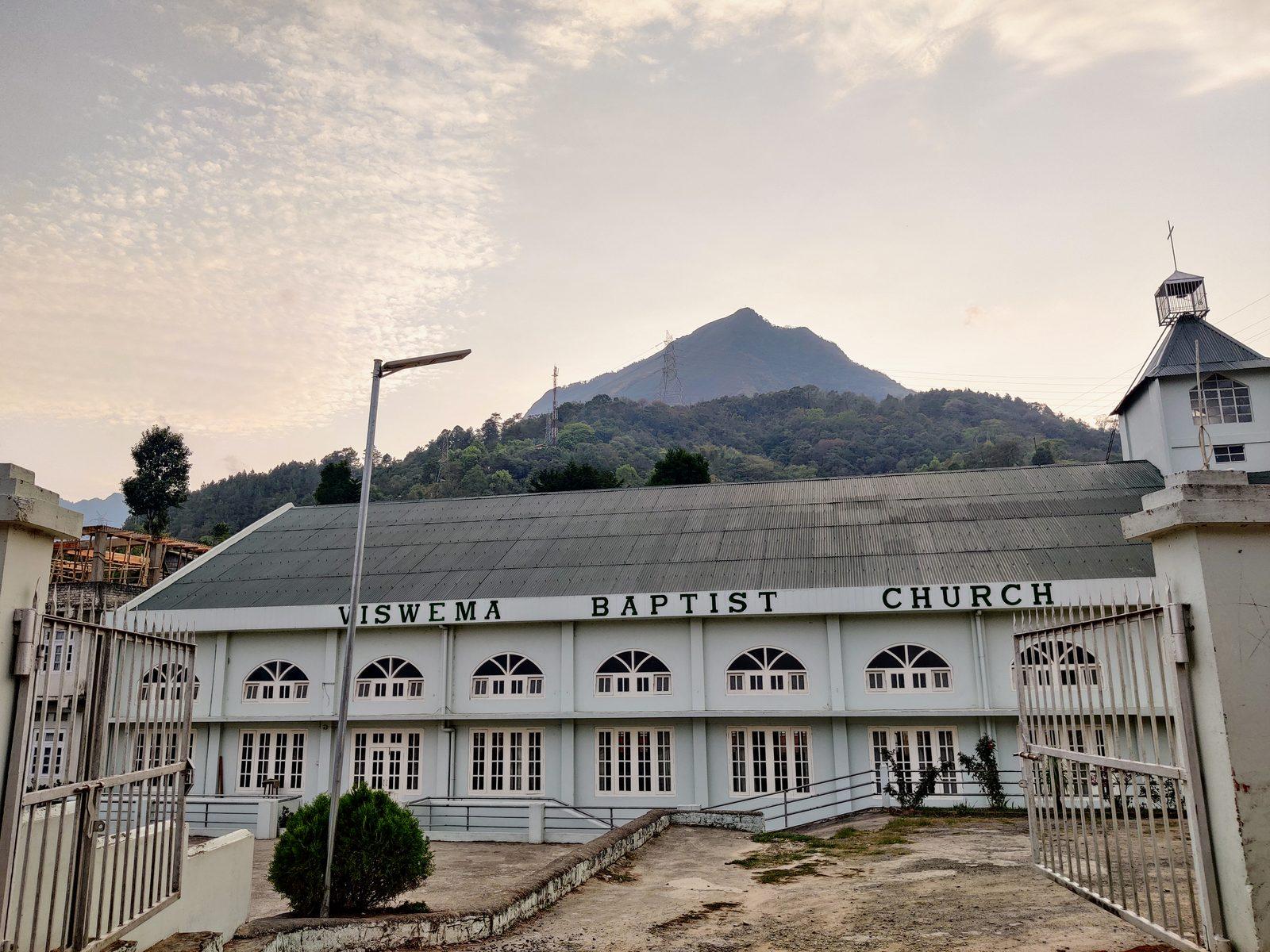
Viswema Baptist Church, RhodiumMedal, 2021. CC BY-SA 4.0.
Nagaland, north-east India, 1976 · Story · Featured Study
Nagaland, 1976
The witnesses are a Yimchung pastor, two local newspapers at the anniversaries, and writers who came later.
- Where
- Changtongya, Muntum, Anaki, Molungkimong
- Who
- Hophong, M. I. Luen, E. W. Clark, Godhula
- When
- From 1976 (probable)
When the doors of his church were locked against him, Hophong says, he stood outside and prayed.
Will You not revive us again, that Your people may rejoice in You?
Summary
Later witnesses report a revival among the Baptists of Nagaland, in north-east India, that broke out in 1976. John Hayward follows it to 1982. They tell of night prayer, confession aloud and people falling to the ground. The Nagaland Baptist Church Council's own site gives it one clause, a widespread revival in the mid 1970s.
- Its fullest witness, Hophong, was a pastor in his 70s when his account was printed.
- Hayward finds twenty years of sporadic revival before it.
- Rev. M. I. Luen wrote a book on it, released in 2016.
The Texts of the Revival
Words from these verses stand in an account of the mission and on the council's own page.
This study asks what can be known of the revival reported in Nagaland in 1976, and from whom. It sets out each witness with what that witness gives, then the story as they tell it, the American Baptist mission that came before and what followed. It then gives their words. Four questions stay open: where it began, whether Billy Graham's crusade prepared it, whether it was against Baptist doctrine and whether the pledge of 10,000 was a council act. No document of 1976 has been read for this study, so its dates rest on later memory.
Therefore go and make disciples of all nations, baptizing them in the name of the Father, and of the Son, and of the Holy Spirit,
An account of the mission gives "go and teach all nations" as the burden of E. W. Clark.
But you will receive power when the Holy Spirit comes upon you, and you will be My witnesses in Jerusalem, and in all Judea and Samaria, and to the ends of the earth.”
The council's mission page uses the words "ends of the earth" for the reach of its mission.
Acts 1:8BSB
The Witnesses and What Each Gives
Six records stand, from a pastor's memory to the council's site.
Four witnesses give 1976 and three places between them, Phillips puts the revival thirteen months later, and the council says the mid 1970s.
| The witness | When it wrote | What it gives |
|---|---|---|
| Hophong, a Yimchung pastor, in Paul Hattaway's book | Printed in 2007 | The latter part of 1976; a meeting at Muntum in October 1976 |
| Nagaland Post, at the fortieth anniversary | 2016 | Fourteen people present at Anaki in 1976 |
| The Morung Express, from a church at Changtongya | 2026 | Changtongya town, in 1976 |
| Beautiful Feet, a popular compiler | Undated | A spiritual awakening week of 13 to 19 September 1976, with no place or person |
| Tim Phillips, an American visitor from 1999 | 2007 | Prayer and fasting from 1976, and revival thirteen months later |
| The Nagaland Baptist Church Council's site | Undated | The mid 1970s, with no place |
The Revival as They Tell It
Hophong gives the fullest account, about thirty years on.
Hophong says revival broke out in many parts of Nagaland, and that he met it at Muntum and came away changed. He describes people who fell to the ground and others who lay prostrate and could not move.
He was threatened, he says, with excommunication from the church and with the loss of his job. Beautiful Feet says church leaders called it contrary to Baptist doctrine and locked their doors, and it names none of them.
Hophong reports that a seven-year-old boy with a terminal illness was instantly healed when he prayed, and no other witness has been found for it. He gives more than one thousand Yimchung baptized in a single day by 1979, which is his own recollection.
Hayward prints Baptist membership data that he says Edwin Orr obtained: 134,682 in 1976 and 220,617 in 1982. No tally is shown, and the council's own figures have not been found. Hayward says the state was largely closed to outsiders at the time, so the revival was internal.
The Mission and the War Before It
A church at Molungkimong keeps the mission's first dates, and the council and the Shillong Agreement give the rest.
E. W. Clark and Mary Mead reached Sibsagar on 30 March 1869. On 6 April 1872 the Assamese evangelist Godhula and his wife Lucy went to live at Molungkimong, and on 22 December that year Clark baptized fifteen there. The church counts that as its founding day.
The council says all foreign missionaries had withdrawn by 1955. Beautiful Feet gives an awakening in 1952 under Rev. Rikum. Wikipedia's table of census data puts the Christian share of the state at 66.76 percent in 1971 and 80.21 percent in 1981, and no source read ties that rise to the revival.
The Shillong Agreement of 11 November 1975 records the underground representatives' decision to accept the Constitution of India, and Rev. Longri Ao sat on its Liaison Committee. Isak Swu and Muivah rejected it, Wikipedia says. No witness read for this study ties the accord to the revival, and the order of the two is all that can be stated.
The Pledge of 1977
The council's own page says that the churches took up mission projects after the revival.
Eastern Mirror dates a covenant by churches of the council, to send 10,000 missionaries, to 15 October 1977 at Pfutsero. It roots the pledge in a congress at Dimapur from 1 to 9 March 1975.
The same paper reports from the Nagaland Missions Movement's data that a little more than 1,000 missionaries are registered. That is the movement's own figure. Phillips said in 2007 that nearly 8,000 had been sent out, and no count stands behind it.
How Revival Was Taught
A commentary on this psalm stands beside a revivalist's memoir and a preacher's denial.
Charles G. Finney (1792 to 1875)
Memoirs of Rev. Charles G. Finney, Written by Himself, p. 444
A memoir of the American revival of 1858 says how far it reached and where it stopped.
“A divine influence seemed to pervade the whole land. Slavery seemed to shut it out from the South.”
Presbyterian and Congregational revivalist
Charles Spurgeon (1834 to 1892)
The Treasury of David, Vol. 4
A commentary of 1874 reads the psalm's question as hope near to certainty.
“Wilt thou not revive us again? Hope here grows almost confident. She feels sure that the Lord will return in all his power to save. We are dead or dying, faint and feeble, God alone can revive us, he has in other times refreshed his people, he is still the same, he will repeat his love. Will he not? Why should he not? We appeal to him—Wilt thou not? That thy people may rejoice in thee.”
on Psalm 85:6Particular Baptist
Duncan Campbell (1898 to 1972)
Hebrides Revival, a recorded address of 1968, in the Revival Library's transcript, part 2
A preacher in 1968 denied that a revival in the Hebrides had begun with him.
“My dear people, I didn't do that. Revival was there before I ever set foot on the island. It began in a gracious awareness of God sweeping through the parish of Barvas.”
Revival witness
In Their Own Words
A pastor who was there gave his memory, a visitor gave the prayer before it and a director gave the pledge after it.
Hophong
His account in Paul Hattaway, From Head-Hunters to Church Planters, pages 87 to 89, printed in The Morung Express, 5 January 2007
A set of rules
“Before that day we didn’t know anything about revival. Christianity to us was a set of rules and prohibitions.”
Baptist
About this saying1 paragraph
Hophong, recalling 1976, says this of his people's faith before Muntum.
Hophong
His account in Paul Hattaway, From Head-Hunters to Church Planters, pages 87 to 89, printed in The Morung Express, 5 January 2007
All at the same time
“In each meeting people were shouting their sins to the Lord, all at the same time.”
Baptist
About this saying1 paragraph
He recalls this of the meetings of those years at their most intense, in an account printed in 2007.
Tim Phillips
Interview, ASSIST News Service, in The Morung Express, 1 January 2007, the interview
Prayer and fasting
“In 1976 in the midst of terrible persecution, Naga Church leaders were distressed about the spiritual condition of the church. They began to pray and fast for revival.”
Other
About this saying1 paragraph
An American who first visited in 1999 gave this account in 2007, and his date for the revival differs from the others.
Wabang Longchari
Interview, Eastern Mirror, 23 October 2018, the interview
Unfinished business
“The primary goal of Go Revival is to remind the Nagas that we have unfinished business with God as we need to fulfil the promise we have made.”
Other
About this saying1 paragraph
The director of Sinai Ministry gave this reason in 2018 for calling the Nagas back to the pledge.
What the Witnesses Leave Open
A church, a church-growth modeller, a popular compiler and a ministry's book hold these readings, and no scholar has been read on them.
Where did it begin?1 paragraph
The Morung Express, from the church's media team, says the movement began in Changtongya town and that the church there was among the first where it took root. Hophong gives Muntum for his own experience and no centre for the whole, and the Post names Anaki without saying what happened there.
Did Billy Graham prepare it?1 paragraph
Hayward reasons that Graham, who preached at Kohima in 1972 to a crowd he gives as over 100,000, called many leaders to training. If they were ready by 1976, as he thinks likely, Graham "was a key catalyst". Among those read, Hayward alone draws that line.
Was it against Baptist doctrine?1 paragraph
Beautiful Feet reports unnamed leaders who held that it was, and their own words have not been found. The notice of Hattaway's book says only that there were no Charismatic churches in Nagaland at the time, and that the visitations came to orderly, conservative Baptist congregations.
Was the 10,000 a council act?1 paragraph
Sinai Ministry's book, through Eastern Mirror, calls it one of the council's most historic actions. The council's own site says the call came from its leaders and was "not the NBCC resolution as such".
Books to Read Next
Nagaland Revival 1976 to 1982
John Hayward, Church Growth Modelling · 2015
Hayward's article gives the figures year by year and fits a model to them.
Read Hayward at Church Growth ModellingFrom Head-Hunters to Church Planters
Paul Hattaway · 2006
Hattaway's book holds Hophong's account, and this extract prints it.
Read the extract in The Morung ExpressWhat the Anniversaries Keep
The church at Changtongya kept the fiftieth anniversary from 11 to 13 September 2026, and its theme was the psalm's question.
Sources
Scripture is the Berean Standard Bible.
- The Holy Bible, Berean Standard Bible (read 2026)
- Paul Hattaway, From Head-Hunters to Church Planters, pages 87 to 89, Hophong's account and the book's notice, extract by ASSIST News Service in The Morung Express, 5 January 2007.
- The Morung Express, from the media team of Changtongya Town Baptist Arogo, 13 September 2026.
- Nagaland Post, report of the fortieth anniversary, 2 August 2016.
- Chet and Phyllis Swearingen, Beautiful Feet, revival story on Nagaland, undated.
- Tim Phillips, interview printed in The Morung Express, 1 January 2007.
- John Hayward, "Nagaland Revival 1976-1982", Church Growth Modelling, 3 April 2015, printing J. Edwin Orr's membership figures.
- Nagaland Baptist Church Council, Nagaland Missions Movement page, undated.
- Eastern Mirror, on the pledge of 10,000 missionaries, 23 October 2018.
- Molungkimong Baptist Church feature, The Morung Express, citing Bowers (1929) and the Baptist Missionary Magazine of 1872.
- The Shillong Agreement, 11 November 1975, text at the South Asia Terrorism Portal.
- Wikipedia, "Christianity in Nagaland" (its table of Census of India data from the Centre for Policy Studies) and "Longri Ao".
Keep Studying
People and groups1
Subjects1
Go further2