
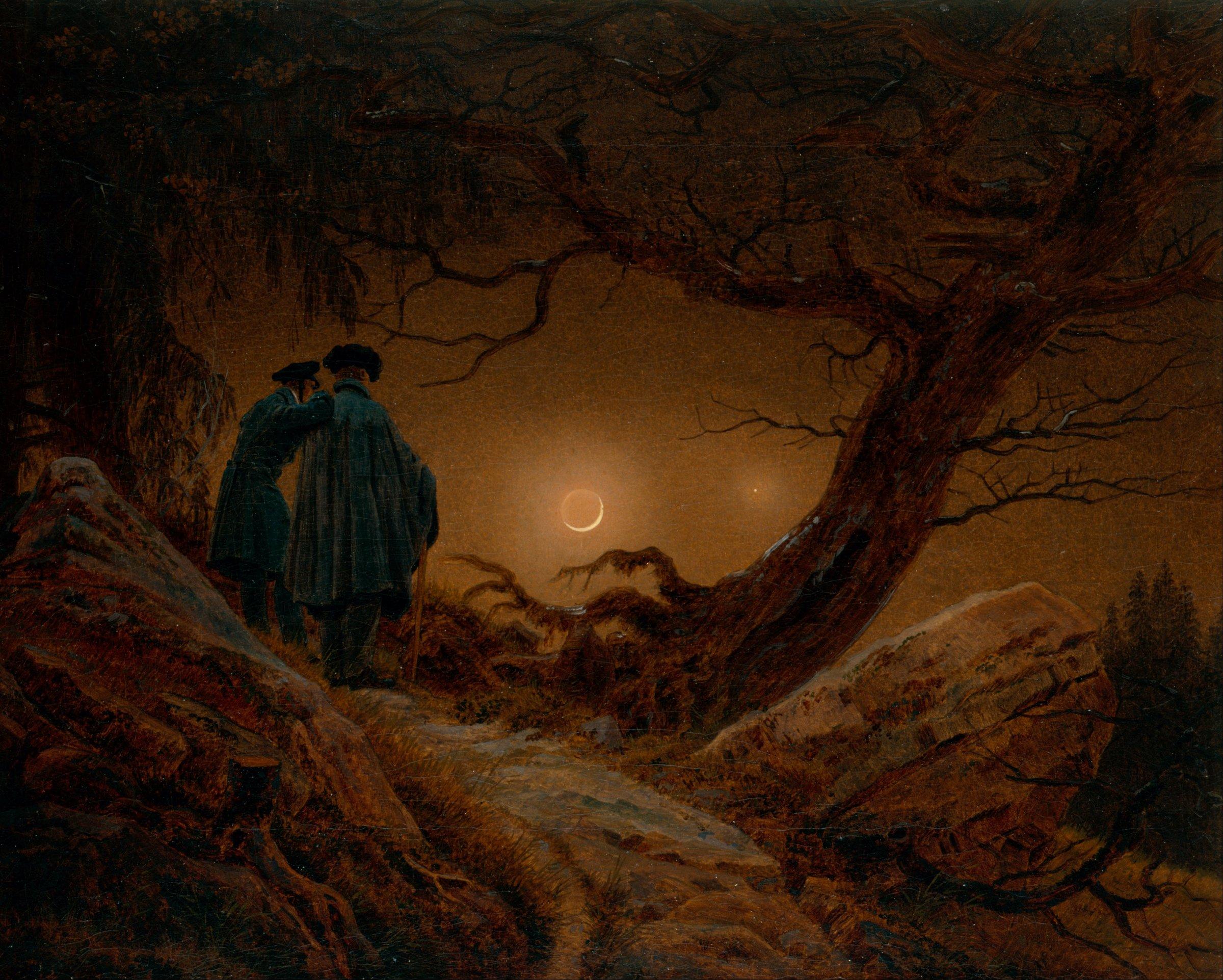
Caspar David Friedrich, Two Men Contemplating the Moon, 1819 to 1820. Public domain.
Psalm 8 · Passage · Featured Study
What Man Is
In Psalm 8 God gives man a crown of glory and a rule over the works of His hands.
You made him ruler of the works of Your hands; You have placed everything under his feet:
- The passage
- Psalm 8:1 to 2, Psalm 8:3 to 5, Psalm 8:6 to 9, Job 7:17 to 18, Psalm 144:3 to 4, Hebrews 2:6 to 9
- Books
- Psalms, Job, Hebrews
- Hold in memory
- Psalm 8:4, Psalm 8:1, Hebrews 2:9
Under the night sky the psalmist asks what man is.
Summary
Psalm 8 opens and closes with the same praise of the LORD's name. Between those lines the singer looks up at the heavens and wonders why God takes thought of humankind.
- Perowne calls man's greatness the principal thought of the psalm.
- In the verse of the crown the Hebrew reads Elohim, and the Greek reads angels.
- Perowne writes that nearly all critics hold the psalm to be David's, and that it gives no note of its time.
Under the Moon and Stars
The sight of the night sky leads the psalmist to his question.
When I behold Your heavens, the work of Your fingers, the moon and the stars, which You have set in place— what is man that You are mindful of him, or the son of man that You care for him?This is the one question the psalm asks.
J. J. Stewart Perowne reads the psalm as the thought of David gazing on the heavens by night. The first feeling is how small man is beside the moon and stars. That feeling gives way to a second, the greatness God has given him.
The Shape of the Psalm
Psalm 8 has five parts, with the question at its centre.
The question of man stands at the centre of the psalm.
| Part | Verses | What it says |
|---|---|---|
| Praise | Psalm 8:1 | The name of the LORD is majestic in all the earth, and His glory is set above the heavens |
| Children | Psalm 8:2 | God has ordained praise from children and infants, and it silences the enemy and the avenger |
| The question | Psalm 8:3 to 4 | Beside the moon and the stars God has set in place, the psalmist asks what man is |
| The crown and the rule | Psalm 8:5 to 8 | Man is made a little lower, crowned, and set over flocks, beasts of the field, birds and fish |
| Praise | Psalm 8:9 | The praise of the opening line is sung once more, word for word, to close the psalm |
The Question Asked Again
Job 7:17 and Psalm 144:3 ask what man is and turn the question other ways.
What is man that You should exalt him, that You should set Your heart upon him, that You attend to him every morning, and test him every moment?In Job the question leads to God's testing of man.
O LORD, what is man, that You regard him, the son of man that You think of him? Man is like a breath; his days are like a passing shadow.In Psalm 144 it leads to the shortness of man's life.
A Little Lower Than God or the Angels
Three readings of one Hebrew word stand side by side.
You made him a little lower than the angels; You crowned him with glory and honor.The Berean text follows the Greek reading here.
The Hebrew word is meʾelohim, from God, built on Elohim (Strong's number 430). The Septuagint, the old Greek translation, has angels, and Hebrews 2:7 quotes the Greek.
Than GodJ. J. Stewart Perowne, after Hengstenberg
Perowne holds that Psalm 8:6 points back to Genesis 1:26, so Psalm 8:5 alludes to man made in the image of God. He cites Hengstenberg's rendering, which lowers man a little beneath a divine station.
Against this reading, Delitzsch notes that in Genesis 1:26 God says let us make man, and he takes the us to join the angels to God.
Than the angelsThe Septuagint, the Targum and Jewish interpreters, as Perowne reports them; the Epistle to the Hebrews
Perowne reports that the Targum and the Jewish interpreters generally read angels with the Septuagint.
Against this reading, Perowne answers that Elohim nowhere means angels, who are called sons of God.
God, with the angels in viewFranz Delitzsch
Delitzsch holds the Greek reading warranted. He judges that David may have thought of God with the angels, so that man is a little less than divine and a little less than angelic.
Against this reading, Perowne takes Elohim without the article to name the divine nature, the godlike.
We See Jesus Crowned
Hebrews 2:9 names the one who wears the crown now.
But we see Jesus, who was made a little lower than the angels, now crowned with glory and honor because He suffered death, so that by the grace of God He might taste death for everyone.Perowne's argument turns on this verse.
Perowne notes that the writer of Hebrews keeps the psalm's word about man and builds his argument on it. In that argument the purpose of man's making is fulfilled only in Jesus.
Perowne adds a note on the Greek words for a little, as Hebrews applies them to Christ. They may refer to time, a little while, though by no means certainly.
Voices on Psalm 8
Charles Spurgeon wrote on the opening line, and Diodorus of Tarsus on the rule over God's works.
Diodorus of Tarsus (died 390)
COMMENTARY ON PSALM 8
Diodorus weighs how far the rule of Psalm 8:6 reaches.
“There is no work of God that is exempt from the authority of the one appointed Lord.”
on Psalm 8:6Patristic
Charles Spurgeon (1834 to 1892)
The Treasury of David, Vol. 1
Spurgeon gives the reason the psalm opens on a cry.
“Unable to express the glory of God, the Psalmist utters a note of exclamation. O Jehovah our Lord! We need not wonder at this, for no heart can measure, no tongue can utter, the half of the greatness of Jehovah. The whole creation is full of his glory and radiant with the excellency of his power; his goodness and his wisdom are manifested on every hand. The countless myriads of terrestrial beings, from man the head, to the creeping worm at the foot, are all supported and nourished by the Divine bounty.”
on Psalm 8:1Particular Baptist
Books to Read Next
Both works are in the public domain, and each has a free copy to read.
The Book of Psalms: A New Translation, with Introductions and Notes, Explanatory and Critical
J. J. Stewart Perowne · 1876
Perowne covers the whole psalm on pages 124 to 132.
Read at the Internet ArchiveBiblical Commentary on the Psalms, volume 1
Franz Delitzsch, translated by Francis Bolton · 1880
Delitzsch sets out his reading of the word on pages 153 to 154.
Read at the Internet ArchiveHow Majestic Is Your Name
After the crown and the rule given to man, the psalm returns to the majesty of the LORD's name.
O LORD, our Lord, how majestic is Your name in all the earth!The praise that framed the question closes it.
Sources
Scripture is the Berean Standard Bible.
- J. J. Stewart Perowne, The Book of Psalms, from the third London edition, Warren F. Draper, 1876, vol. 1, pp. 124 to 132.
- Franz Delitzsch, Biblical Commentary on the Psalms, translated by Francis Bolton, T. and T. Clark, 1880, vol. 1, pp. 153 to 154.
- The Hebrew of Psalm 8:5 with Strong's numbers.
- Charles Spurgeon, The Treasury of David, volume 1, 1869, on Psalm 8:1.
- Diodorus of Tarsus, Commentary on Psalm 8.