

Julius Schnorr von Carolsfeld, Die Bibel in Bildern, 1860. Public domain.
Genesis 1 to Revelation 21 · Symbol · Featured Study
The Heavens
A symbol study of fourteen places in canon order, the words shamayim and raqia, and the readings of the expanse.
The first verse of the Bible names the heavens before it names the earth.
And God said, “Let there be an expanse between the waters, to separate the waters from the waters.” So God made the expanse and separated the waters beneath it from the waters above. And it was so. God called the expanse “sky.” And there was evening, and there was morning—the second day.
- The word
- שָׁמַיִם (shamayim), H8064
- First appears
- Genesis 1:1 “…the beginning God created the heavens and the…”
The first verse of the Bible names the heavens before it names the earth.
Summary
Scripture uses the heavens for the sky God made, for the height of His ways, and for His throne.
- Genesis 1:8 gives the expanse of the second day the name sky, shamayim, the Hebrew word for the heavens.
- Isaiah 55:9 measures God's thoughts by the height of the heavens above the earth.
- Isaiah calls heaven His throne, and John sees a new heaven and a new earth.
The Heavens on the First Page
The Hebrew word and the three places Scripture calls heaven.
The Hebrew word shamayim is plural in form, and Scripture uses it for everything above the ground. Rain falls from the heavens in Genesis 8:2, and in Exodus 20:22 God says He has spoken from them.
And God said, “Let there be an expanse between the waters, to separate the waters from the waters.” So God made the expanse and separated the waters beneath it from the waters above. And it was so. God called the expanse “sky.” And there was evening, and there was morning—the second day.The second day's work is a division and a name.
The Hebrew word shamayim is plural in form, and Scripture uses it for everything above the ground. Rain falls from the heavens in Genesis 8:2, and in Exodus 20:22 God says He has spoken from them.
One word covers the air, the sky of the lights and the dwelling of God.
| What is there | What the verse says | Verse |
|---|---|---|
| The birds | Birds fly above the earth in the open expanse of the sky. | Genesis 1:20 |
| The sun, moon and stars | God sets the lights in the expanse of the sky to shine upon the earth. | Genesis 1:17 |
| The LORD Himself | The heavens and the highest heavens belong to the LORD. | Deuteronomy 10:14 |
The Second Day
The second day as Julius Schnorr von Carolsfeld drew it for Die Bibel in Bildern.
Schnorr drew the second day as a figure dividing a bright sky from the world below it.
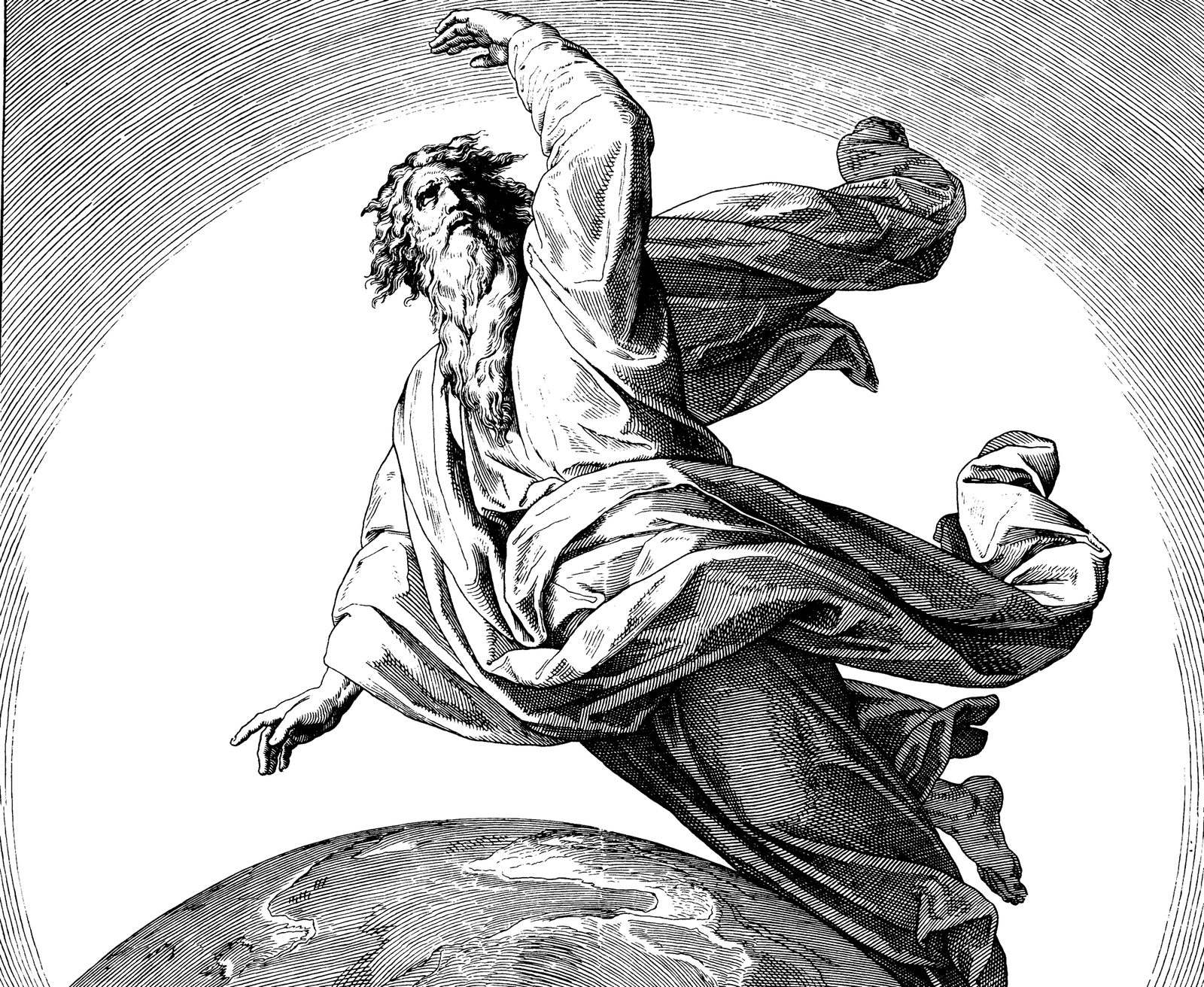
- The rings aboveFine lines circle the edge of the woodcut above the figure.Genesis 1:7
- The raised handOne hand reaches up into the rings.Genesis 1:6
- The open skyA bright circle of sky surrounds the figure.Genesis 1:8
- The world belowThe curve of the globe lies at the foot of the woodcut.Genesis 1:9
Julius Schnorr von Carolsfeld, Die Bibel in Bildern, 1860. Public domain.
Four parts of the woodcut, each numbered where it stands, with the verse the part answers to.
The Heavens Through Scripture
Fourteen places in canon order, from the first verse of Genesis to the new heaven of Revelation.
The heavens are made, opened, passed through and made new.
- Genesis 1The heavens and the earth created, Genesis 1:1
- Genesis 7The floodgates of the heavens opened, Genesis 7:11
- Genesis 11A tower to reach the heavens, Genesis 11:4
- Genesis 28The gate of heaven at Bethel, Genesis 28:17
- 1 Kings 8Solomon's prayer at the temple, 1 Kings 8:27
- Psalm 19The heavens declare the glory of God, Psalm 19:1
- Psalm 104Stretched out like a tent, Psalm 104:2
- Isaiah 55As high as the heavens are above the earth, Isaiah 55:9
- Isaiah 66Heaven is My throne, Isaiah 66:1
- Ezekiel 1The heavens opened at the river, Ezekiel 1:1
- Matthew 3The heavens opened at the Jordan, Matthew 3:16
- 2 Corinthians 12Caught up to the third heaven, 2 Corinthians 12:2
- Hebrews 4A high priest who passed through the heavens, Hebrews 4:14
- Revelation 21A new heaven and a new earth, Revelation 21:1
Each stop opens its verse in the reader.
What the Verses Say the Heavens Do
Four verses that state what the heavens show, and Origen's reading of the first two days.
THEY DECLARE
The psalmist says the heavens speak of God's glory without words.
THEY MEASURE HIS LOVE
The psalmist measures God's loving devotion for those who fear Him by the height of the heavens above the earth.
THEY ARE HIS TENT
The psalmist pictures God spreading the heavens out as a man pitches a tent.
THEY PROMPT DAVID'S QUESTION
David looks at the moon and stars God set in place and asks what man is, that God is mindful of him.
They are His tent, They prompt David's question
Heaven on the first day and the expanse on the secondOrigen, Homilies on Genesis 1.2
“Although God had already previously made heaven, now he makes the firmament. For he made heaven first, about which he says, ‘Heaven is my throne.’ But after that he makes the firmament, that is, the corporeal heaven. For every corporeal object is, without doubt, firm and solid; and it is this that ‘divides the water which is above heaven from the water which is below heaven.’”
Origen of Alexandria · Homilies on Genesis 1.2 · on Genesis 1:8Patristic
Shamayim, Raqia and Ouranos
The two Hebrew words of Genesis 1 and the Greek word of the New Testament, with their counts.
Shamayim stands 421 times and raqia only 17.
The three counts as a table
| Word | Occurrences |
|---|---|
| shamayim, heavens, H8064 | 421 |
| ouranos, heaven, G3772 | 272 |
| raqia, expanse, H7549 | 17 |
Occurrences of the three words in Strong's concordance, on bars from zero.
Strong's glosses raqia as an expanse, the visible arch of the sky.
What the Text Does Not Say
Four questions about the heavens the verses leave open.
The verses name the heavens and leave four things about them unstated.
| What is not said | What the verse does say | Verse |
|---|---|---|
| The number of the heavens | Paul names a third heaven and gives no count of the rest. | 2 Corinthians 12:2 |
| The shape of the expanse | The verses name it and say what it divides. | Genesis 1:6 to 8 |
| The distance to the throne | The verse names the throne and gives it no place or distance. | Isaiah 66:1 |
| How the first heaven passes away | John sees that the first heaven and earth had passed away and gives no account of how. | Revelation 21:1 |
Heaven Is My Throne
Two verses on the throne no heaven can hold.
This is what the LORD says: “Heaven is My throne, and earth is My footstool. What kind of house will you build for Me? Or where will My place of repose be?God asks what house could be built for One whose throne is heaven.
But will God indeed dwell upon the earth? Even heaven, the highest heaven, cannot contain You, much less this temple I have built.Solomon dedicates the temple by saying it cannot contain God.
Stephen quotes Isaiah 66:1 in Acts 7:49, and Jesus forbids swearing by heaven because it is God's throne in Matthew 5:34. Clement of Alexandria answered readers who would take the throne as a place God occupies.
“He has not even built a house for himself! He has nothing to do with space. Even if it is written that ‘the heaven is his throne,’ he is not contained as the words suggest.”
Clement of Alexandria · The Stromata Book 2 · on Isaiah 66:1Patristic
The heavens openedMatthew 3:16 and Acts 7:56
As soon as Jesus was baptized, He went up out of the water. Suddenly the heavens were opened, and He saw the Spirit of God descending like a dove and resting on Him.At the baptism of Jesus the heavens open and the Spirit comes down.
“Look,” he said, “I see heaven open and the Son of Man standing at the right hand of God.”Stephen sees the opened heaven as the council turns on him.
New heavens and a new earthIsaiah 65:17 and 2 Peter 3:13
For behold, I will create new heavens and a new earth. The former things will not be remembered, nor will they come to mind.The prophet speaks the promise in God's own voice.
But in keeping with God’s promise, we are looking forward to a new heaven and a new earth, where righteousness dwells.Peter tells the church what it is waiting for.
Voices on the Heavens
Cyril of Jerusalem, Matthew Henry, Charles Spurgeon and the commentary of Jamieson, Fausset and Brown, each with the work named.
died 386 · Cyril of Jerusalem
Catechetical Lecture 9:5
These lectures taught the creed, and the ninth takes its words Maker of Heaven and Earth.
The quotation1 quotation
“For what fault have they to find with the vast creation of God, who out of the fluid nature of the waters formed the stable substance of the heavens? For God said, ‘Let there be a firmament in the midst of the waters.’ God spoke once for all, and it stands fast, never failing.”
Cyril of Jerusalem · Catechetical Lecture 9:5 · on Genesis 1:6Patristic
1662 to 1714 · Matthew Henry
Commentary on the Whole Bible
The height of the throne in Isaiah 40:22 becomes a word about God's rule on earth.
The quotation1 quotation
“He that has the special residence of his glory in the upper world maintains a dominion over this lower world, gives law to it, and directs all the motions of it to his own glory.”
Matthew Henry · Commentary on the Whole Bible · on Isaiah 40:22Puritan
1834 to 1892 · Charles Spurgeon
The Treasury of David, Vol. 1
This reading calls the heavens the first leaf of the book of nature, the one that gives light to the rest.
The quotation1 quotation
“‘The heavens declare the glory of God.’ The book of nature has three leaves, heaven, earth, and sea, of which heaven is the first and the most glorious, and by its aid we are able to see the beauties of the other two. Any book without its first page would be sadly imperfect, and especially the great Natural Bible, since its first pages, the sun, moon, and stars, supply light to the rest of the volume, and are thus the keys, without which the writing which follows would be dark and undiscerned.”
Charles Spurgeon · The Treasury of David, Vol. 1 · on Psalm 19:1
1802 to 1910 · Jamieson, Fausset & Brown
Commentary Critical and Explanatory on the Whole Bible
The commentary takes the waters over the expanse to be the clouds the air holds up over the seas.
The quotation1 quotation
“firmament--an expanse--a beating out as a plate of metal: a name given to the atmosphere from its appearing to an observer to be the vault of heaven, supporting the weight of the watery clouds. By the creation of an atmosphere, the lighter parts of the waters which overspread the earth's surface were drawn up and suspended in the visible heavens, while the larger and heavier mass remained below. The air was thus ‘in the midst of the waters,’ that is, separated them; and this being the apparent use of it, is the only one mentioned, although the atmosphere serves other uses, as a medium of life and light.”
Jamieson, Fausset & Brown · Commentary Critical and Explanatory on the Whole Bible · on Genesis 1:6Reformed
Charles Spurgeon, Jamieson, Fausset & Brown
Where Careful Readers Differ
Three readings, two of the expanse and one of the count of the heavens, each with its holders.
The expanse as a vault over the earthCosmas Indicopleustes, Christian Topography, Book 10
Cosmas Indicopleustes, a traveller of Alexandria who later wrote as a monk, built his account of the shape of the world on verses such as Isaiah 40:22.
“He made therefore the heaven, not a sphere, as those vain babblers conceive—for He did not make a rolling sphere, but, as the prophet says: Who hath made the heaven as a vaulted chamber and stretched it out as a tent to dwell in; for …”
Cosmas Indicopleustes · The Christian Topography, Book 10 · on Isaiah 40:22Patristic
The objection is Genesis 1:20, where birds fly in the open expanse, and Isaiah's own words, which set the curtain and the tent beside grasshoppers as figures.
The expanse as the open space of the airBasil of Caesarea, Hexaemeron 3; Adam Clarke on Genesis 1:6
Adam Clarke, in his Commentary on the Bible, held that raqia means an expanse or space and faulted the Latin firmamentum for giving the word the sense of something solid. Basil of Caesarea made the same point about its matter long before him.
“And surely we need not believe, because [the firmament] seems to have had its origin, according to the general understanding, from water, that it is like either frozen water or some such material that takes its origin from the percolation of moisture, such as is a crystalline rock.”
Basil of Caesarea · HEXAEMERON 3.4 · on Genesis 1:6Patristic
The objection is Ezekiel 1:22, where the expanse over the living creatures gleams like crystal, and Job 37:18, which speaks of skies like a mirror of bronze.
Three heavens or one way of speakingJohn Wesley and Adam Clarke on Deuteronomy 10:14
John Wesley, in his Explanatory Notes upon the Old Testament, reads Deuteronomy 10:14 as the airy and starry heaven and the highest or third heaven, the one Paul names in 2 Corinthians 12:2. Adam Clarke, in his Commentary on the Bible, notes that every word of the phrase is plural in Hebrew. He writes that a scheme of atmosphere, planets and the home of the blessed explains very little.
Behold, to the LORD your God belong the heavens, even the highest heavens, and the earth and everything in it.Both commentators read the same verse, the heavens and the highest heavens.
Books to Read Next
Three public domain works, each with a free copy to read.
Hexaemeron, Homily 3: On the Firmament
Basil of Caesarea · 379
It is the third of the nine sermons Basil preached on the six days of Genesis 1.
Read at New AdventCatechetical Lecture 9
Cyril of Jerusalem · fourth century
Section 5 of the lecture takes up the firmament of Genesis 1:6.
Read at New AdventChristian Topography, Book 10
Cosmas Indicopleustes · sixth century
The book gathers the passages Cosmas used for his vaulted heaven, in the 1897 English translation.
Read at tertullian.orgThe One Who Came Down From Heaven
Jesus asks Nicodemus in John 3:12 how he will believe if He tells him about heavenly things.
No one has ascended into heaven except the One who descended from heaven—the Son of Man.The next verse gives His standing to speak of them, because He came down from heaven.
Sources
Scripture is the Berean Standard Bible.
- James Strong, Exhaustive Concordance of the Bible, 1890, entries H8064, H7549 and G3772, with glosses from STEP Bible (Tyndale House, CC BY 4.0)
- Origen of Alexandria, Homilies on Genesis 1.2, on Genesis 1:8.
- Clement of Alexandria, The Stromata, Book 2, on Isaiah 66:1.
- Cyril of Jerusalem, Catechetical Lecture 9.5, on Genesis 1:6.
- Basil of Caesarea, Hexaemeron, Homily 3.4, on Genesis 1:6.
- J. W. McCrindle, introduction to The Christian Topography of Cosmas, an Egyptian Monk, 1897.
- Cosmas Indicopleustes, The Christian Topography, Book 10, translated by J. W. McCrindle, 1897, on Isaiah 40:22.
- Matthew Henry, Commentary on the Whole Bible, 1710, on Isaiah 40:22.
- Jamieson, Fausset and Brown, Commentary Critical and Explanatory on the Whole Bible, 1871, on Genesis 1:6.
- Charles Spurgeon, The Treasury of David, volume 1, 1869, on Psalm 19:1.
- Adam Clarke, Commentary on the Bible, 1832, on Genesis 1:6.
- Adam Clarke, Commentary on the Bible, 1832, on Deuteronomy 10:14.
- John Wesley, Explanatory Notes upon the Old Testament, 1765, on Deuteronomy 10:14.
Keep Studying
Read it1
Symbols7