
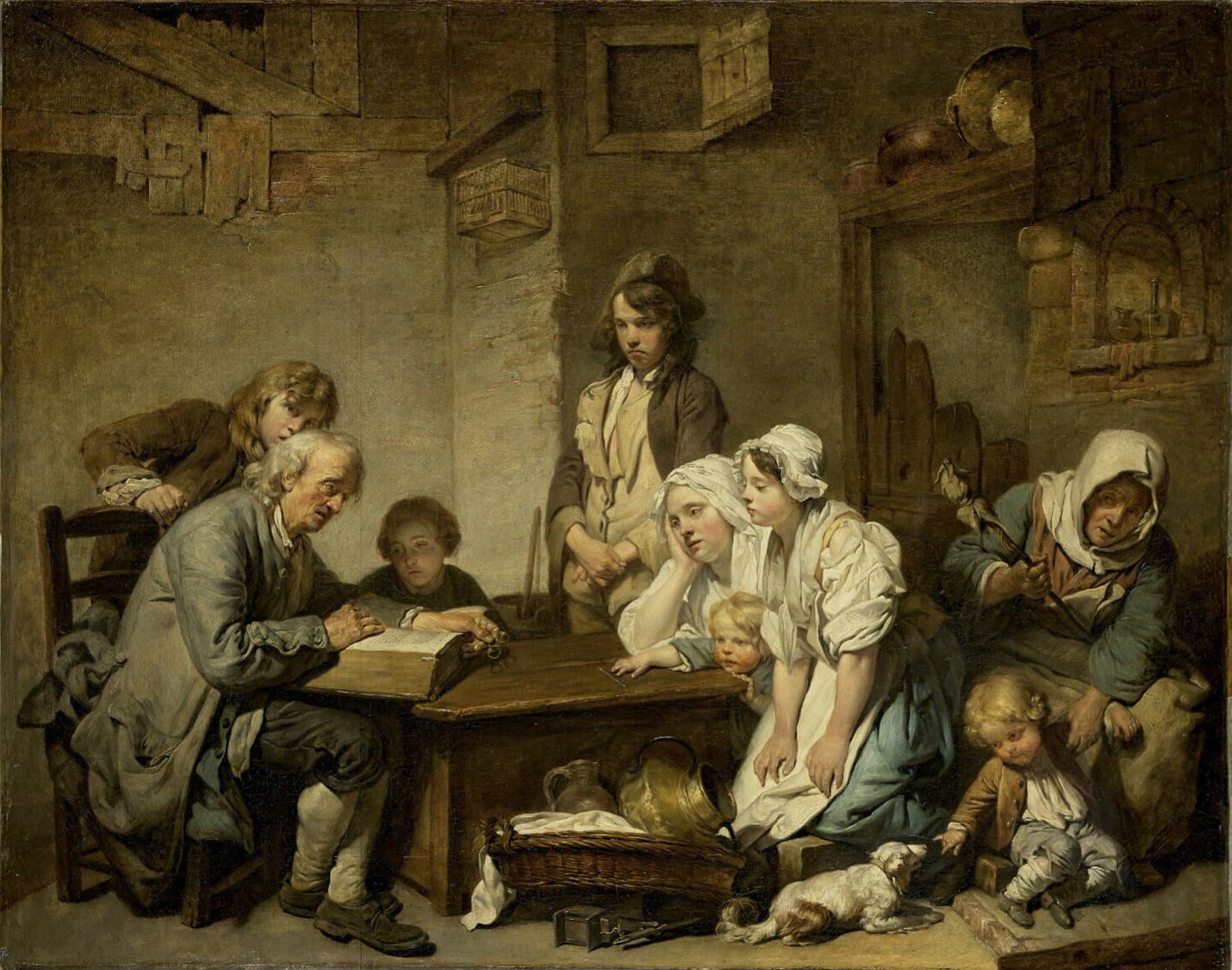
Proverbs 22:6 · Passage · Parenting and Its Trials
Train Up a Child
Proverbs 22:6 speaks to parents in a proverb, and Deuteronomy 6:4 to 9 speaks to them in the law of the covenant.
Proverbs 22:6 is missing from the Septuagint, and the Greek copies that carry it took it from the later version of Theodotion.
Train up a child in the way he should go, and when he is old he will not depart from it.
- The passage
- Proverbs 22:6, Deuteronomy 6:4 to 9, Deuteronomy 6:20 to 25
- Books
- Proverbs, Deuteronomy
- Hold in memory
- Deuteronomy 6:6 to 7
Summary
In Deuteronomy 6 what parents teach is the covenant itself, the confession of the one LORD and the love owed to Him with the whole heart, soul and strength. The teaching runs through the ordinary hours of a household's day. Interpreters still differ on what the child's way is in Proverbs 22:6 and on how firmly the proverb's second line can be held by a parent.
- Proverbs 22:6 belongs to the collection headed “The proverbs of Solomon”, which runs from Proverbs 10:1 to 22:16.
- Deuteronomy 6:6 puts the words on the parents' own hearts before Deuteronomy 6:7 has them taught to the children.
- When a child asks what the commands mean, Deuteronomy 6:20 to 25 has the parent tell how the LORD brought Israel out of Egypt.
A Saying of Solomon
The Hebrew line of the proverb has eleven words, and its readers weigh each phrase.
Train Up a Child asks what Scripture gives a parent who wants a child to walk with God, and what it says about how that child will turn out. It belongs to parenting in its trials, where the charge to raise a child meets the fear that the child will go another way.
The study reads Proverbs 22:6 phrase by phrase and sets out the charge of Deuteronomy 6:6 to 9 clause by clause. It gives the household's question and answer in Deuteronomy 6:20 to 25. It also sets out the readings of “the way he should go” and of the proverb's second line, each with the people who hold it and the objection to it.
The sayings around Proverbs 22:6 speak of a good name, of rich and poor, of the prudent and the simple, and of the mocker who must be driven out (Proverbs 22:1 to 10). After the collection ends, Proverbs 22:17 opens a new section with “Incline your ear and hear the words of the wise”.
The first word is the command “train”, followed by “the youth”, a word for a boy from infancy to adolescence. Then comes “on the mouth of his way”. The second half joins the verb “he will be old” to the verb “he will turn aside”, which it negates.
The Charge of Deuteronomy 6
The verbs of the charge are teach, speak, tie, bind and write.
Each clause of Deuteronomy 6:6 to 9 names a place where the words are kept, from the heart to the town gate.
| Clause | The Berean words | Where the words go |
|---|---|---|
| The heart | “These words I am commanding you today are to be upon your hearts.” (Deuteronomy 6:6) | Into the parent first |
| The teaching | “And you shall teach them diligently to your children” (Deuteronomy 6:7) | From the parent to the children |
| The hours of the day | “speak of them when you sit at home and when you walk along the road, when you lie down and when you get up” (Deuteronomy 6:7) | Into every part of the day |
| The hand and the forehead | “Tie them as reminders on your hands and bind them on your foreheads.” (Deuteronomy 6:8) | Onto the body |
| The doorposts and the gates | “Write them on the doorposts of your houses and on your gates.” (Deuteronomy 6:9) | Onto the house and the town |
The verb of “teach them diligently” is shanan, whose sense in Strong's dictionary is to point or sharpen. The road of Deuteronomy 6:7 is derek, the same word as the way of Proverbs 22:6.
“Though the words alone without the things will do us no good, yet we are in danger of losing the things if we neglect the words, by which ordinarily divine light and power are conveyed to the heart.”
Matthew Henry · Commentary on the Whole Bible · on Deuteronomy 6:6Puritan
Matthew Henry, on Deuteronomy 6:7, cited a remark of Bishop Patrick. Moses, Patrick observed, “thought his law so very plain and easy that every father might be able to instruct his sons in it and every mother her daughters”.
When Your Son Asks
The chapter moves from the confession of the LORD to the answer a parent gives a child.
The Hebrew of Deuteronomy 6:20 says the son will ask “tomorrow”, a word for the time to come. The parent's answer runs on to the land the LORD swore to give and to the commands kept “that we may always be prosperous and preserved” (Deuteronomy 6:23 to 24).
Charles Spurgeon preached on this passage in “Brought Out to Be Brought In”, Sermon No. 2511 (1897). He said there that “the first duty towards the child belongs to the parent”.
The Way He Should Go
Interpreters read “his way” as the way of the LORD, as the way of youth, or as the start of the child's path.
The way of the LORDJohn Gill
John Gill, in his Exposition of the Old Testament (1748 to 1763), took the way “As Abraham trained up his children, and those born in his house, in the way of the Lord”.
The objection: the Hebrew says “his way”, a way that belongs to the child, and the verse does not name the LORD.
The way of youthFranz Delitzsch
Franz Delitzsch, in the Keil and Delitzsch commentary on the Old Testament (1857 to 1878), read the phrase as “after the measure” of the child's way. He meant “the nature of the child as such”. He wrote, “The instruction of youth, the education of youth, ought to be conformed to the nature of youth”. He set aside two other readings, the child's future calling, which he gave to Bertheau among others, and “his individual nature”, which he gave to Elster.
The objection: Matthew Henry read the verse against the child's own bent. He wrote, “Train them up, not in the way they would go (the bias of their corrupt hearts would draw them aside), but in the way they should go”.
The opening of the child's pathAdam Clarke
Adam Clarke, in his Commentary on the Bible (1832), rendered the clause “Initiate the child at the opening (the mouth) of his path”. He took it to mean the moment a child begins to walk alone and to choose.
The objection: Delitzsch read the same Hebrew phrase as a measure, as in Genesis 43:7, and gave it no sense of an opening.
Promise or General Truth
Commentators since the eighteenth century have taken the second line of Proverbs 22:6 as a promise to claim or as a rule with exceptions.
A promise to the parents of the covenantClarence Bouwman
Clarence Bouwman, in his article on Proverbs 22:6, “The Training of the Child”, in Una Sancta (1997), read the verse from God's covenant with Abraham and his descendants in Genesis 17:7. He concluded, “This text is not a general truth; it is a promise from the Lord to the parents of Israel”.
The objection: Henry wrote that “Many indeed have departed from the good way in which they were trained up; Solomon himself did so”. First Kings 11:4 says that when Solomon grew old his wives turned his heart after other gods.
A truth that holds with exceptionsJohn Gill and John Wesley
Gill read the second line as true “not easily, nor ordinarily; there are exceptions to this observation”. John Wesley, in his sermon “On the Education of Children” (Sermon 95), wrote, “We must not imagine that these words are to be understood in an absolute sense”. He called the verse “a general, though not an universal, promise”.
The objection: Bouwman held that Solomon wrote the proverb from God's promises to Abraham's descendants, so its second line rests on God's word.
Children and Grandchildren
Moses names the aim of the teaching in the chapter's second verse.
so that you and your children and grandchildren may fear the LORD your God all the days of your lives by keeping all His statutes and commandments that I give you, and so that your days may be prolonged.Moses states the purpose before he gives the charge, so every clause of Deuteronomy 6:6 to 9 serves this end.
Sources
Scripture is the Berean Standard Bible.
- STEP Bible, Translators Amalgamated Hebrew Old Testament, the tagged text (Tyndale House, Cambridge), CC BY 4.0.
- Matthew Henry, Commentary on the Whole Bible (1710), on Deuteronomy 6:6 and 6:7.
- Matthew Henry, Commentary on the Whole Bible, volume 3 (Job to Song of Solomon), on Proverbs 22:6.
- Charles Spurgeon, Brought Out to Be Brought In, The Metropolitan Tabernacle Pulpit, Sermon No. 2511 (1897), on Deuteronomy 6:20.
- John Gill, Exposition of the Old Testament (1748 to 1763), on Proverbs 22:6.
- Franz Delitzsch, Biblical Commentary on the Proverbs of Solomon, in C. F. Keil and F. Delitzsch, Biblical Commentary on the Old Testament (1857 to 1878), on Proverbs 22:6.
- Adam Clarke, Commentary on the Bible (1832), on Proverbs 22:6.
- Clarence Bouwman, The Training of the Child, an article on Proverbs 22:6, in Una Sancta (1997)
- John Wesley, Sermon 95, On the Education of Children, in the text of the 1872 edition of his Works.
Keep Studying
Studies1
In this trial7
People and groups8
Doctrines2