
1 Samuel 25 · Women of Scripture · Featured Study
Abigail
Scripture names Abigail's understanding before her beauty, and after the LORD struck her husband Nabal she became David's wife.
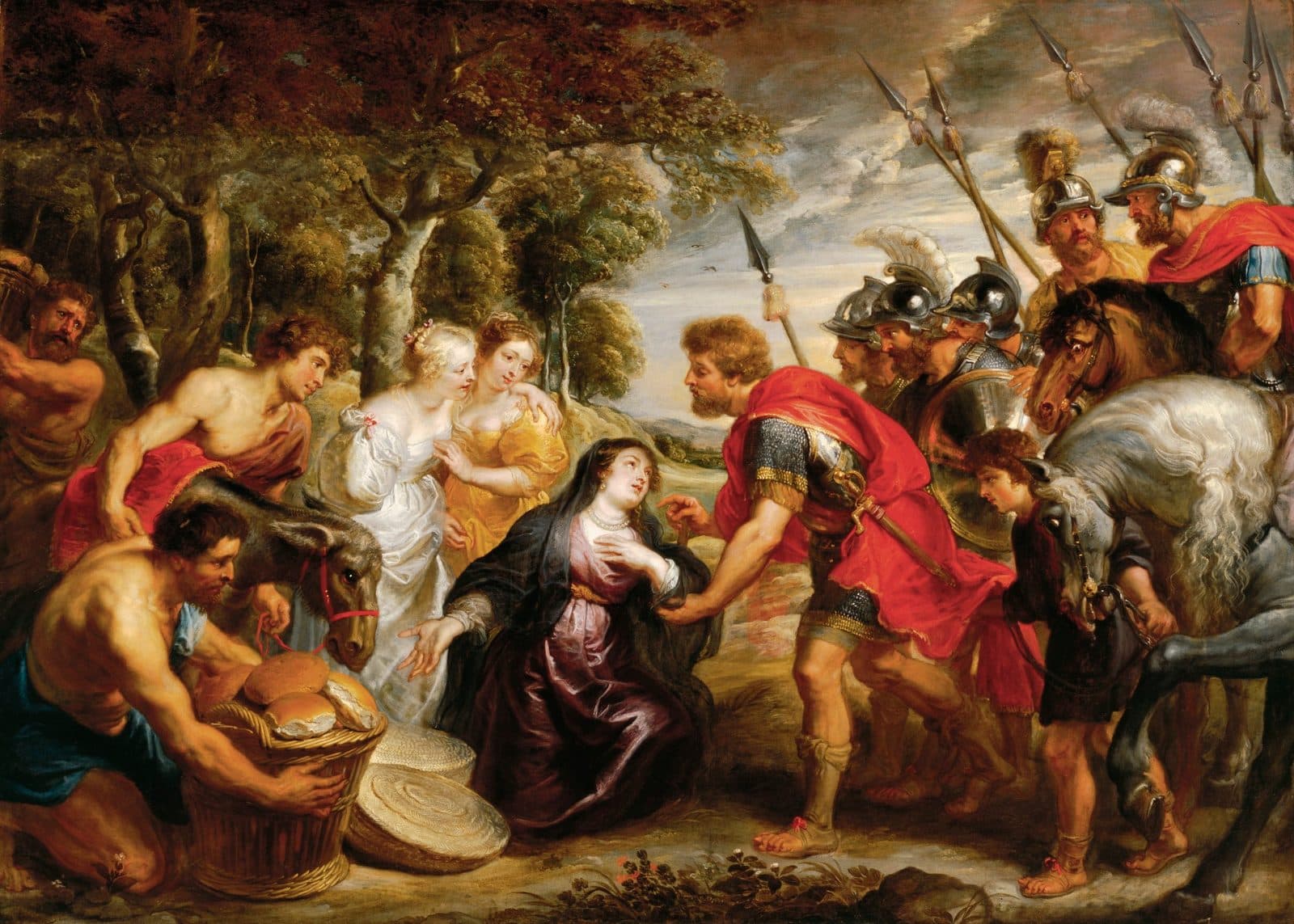
Peter Paul Rubens, The Meeting of David and Abigail, 1625-1628. Public domain.
THE ARTWORKRubens works at full Baroque scale, the canvas nearly two and a half meters wide, to hold David's armed company and Abigail's approach in one sweep of movement and color. It is the meeting itself: the gifts already offered, the sword not yet sheathed, the moment before David answers her and calls off what he came to do.
A rich fool insults a king-to-be at his own feast. While her husband drinks, Abigail rides out alone to stop the massacre he has earned, and turns David back from bloodguilt with one of Scripture's longest recorded speeches by a woman.
Summary
Abigail's rescue is told in six beats. The first three are the setup at Nabal's feast, her speech to David quoted at length, and where the retelling drifts from what the text says. The last three are the true context of the feast and her approach, what Scripture leaves silent, and what the moment shows of Christ.
- A card grid corrects six common drifts, like the bundle of life (25:29) being a this-life image of God's protection, not a promise of eternal salvation.
- Abigail's full speech (25:24-31) is quoted at length: one of the longest recorded speeches by a woman in Scripture.
- Named silences include Abigail's age and origin, why she was married to a man the text calls evil in his dealings, and whether Nabal's name was given at birth.
- The Christ-ward reading is presented as a reflection on the shape of the text, not a settled New Testament type.
- Commentators quoted include Spurgeon's Sermon 3037 and the public-domain floor: Ellicott, Poole, Gill, Barnes, Jamieson-Fausset-Brown, Keil and Delitzsch.
A Fool, a Feast, and a Coming Sword
1 Samuel 25:2-22, the setup told plainly
Nabal of Maon was very rich and hard in all his dealings, and his wife Abigail had both understanding and beauty. At his sheep-shearing feast, a customary season of generosity, David sent ten young men to ask for provisions, reminding Nabal that David's men had guarded his flocks in the wilderness without taking a thing.
His name was Nabal, and his wife’s name was Abigail. She was an intelligent and beautiful woman, but her husband, a Calebite, was harsh and evil in his dealings.Her understanding is named before her beauty. Everything Abigail does next follows from the first half of this verse, not the second.
Nabal answered with contempt, refusing men he called strangers the bread, water, and meat he had prepared for his own shearers.
But Nabal asked them, “Who is David? Who is this son of Jesse? Many servants these days are breaking away from their masters. Why should I take my bread and water and the meat I have slaughtered for my shearers, and give them to these men whose origin I do not know?”He had the means and the customary occasion to be generous. His refusal was not poverty speaking; it was character.
David swore to kill every male in Nabal's household by morning, and rode out with four hundred armed men.
And David said to his men, “Strap on your swords!” So David and all his men put on their swords, and about four hundred men followed David, while two hundred stayed with the supplies.This is the sword the rest of the chapter is racing to stop.
One of Nabal's servants, seeing what was coming, warned Abigail that her husband was too wicked for anyone to reason with.
Now consider carefully what you must do, because disaster looms over our master and all his household. For he is such a scoundrel that nobody can speak to him!”The warning goes to Abigail, not to Nabal. The household already knows who can act.
The Ride, the Speech, and the Rescue
1 Samuel 25:18-31 · intelligence and speed, then one of Scripture's longest speeches by a woman
Abigail moved fast. She gathered bread, wine, dressed sheep, roasted grain, raisins, and fig cakes, loaded them on donkeys, and rode out to meet David before his four hundred men could arrive, without telling her husband.
Then Abigail hurried and took two hundred loaves of bread, two skins of wine, five butchered sheep, five seahs of roasted grain, a hundred clusters of raisins, and two hundred cakes of figs. She loaded them on donkeysReal provisions, gathered and moving before David's men can close the distance. This is speed and planning, not a gesture.
When she met him, she dismounted and fell on her face before him, the period's highest gesture of submission before an armed party.
When Abigail saw David, she quickly got off the donkey, fell facedown, and bowed before him.Jamieson-Fausset-Brown: this dismounting was the highest token of respect a person could give a superior.
Then she spoke, a structured argument that takes the blame, names the offense honestly, warns of the guilt David is about to incur, and predicts his future house, in that order. She began by taking on herself what was not legally hers to bear.
She fell at his feet and said, “My lord, may the blame be on me alone, but please let your servant speak to you; hear the words of your servant.She asks that the guilt fall on her. Read since the earliest commentary as a real, costly self-offering, not a diplomatic formula.
Now, my lord, as surely as the LORD lives and you yourself live, the LORD has held you back from coming to bloodshed and avenging yourself with your own hand. May your enemies and those who seek harm for my lord be like Nabal.She names the exact danger: bloodguilt, and avenging himself with his own hand.
Please forgive your servant’s offense, for the LORD will surely make a lasting dynasty for my lord, because he fights the LORD’s battles. May no evil be found in you as long as you live. And should someone pursue you and seek your life, then the life of my lord will be bound securely by the LORD your God in the bundle of the living. But He shall fling away the lives of your enemies like stones from a sling.Her prophetic word over him, and the image she asks God to keep him by: bound up safe, like a valuable wrapped in a bundle, kept in this life in the LORD's own hand.
then my lord will have no remorse or guilt of conscience over needless bloodshed and revenge. And when the LORD has dealt well with my lord, may you remember your maidservant.”She names what he will become, “ruler over Israel,” and asks only to be remembered.
“Dismounting in presence of a superior is the highest token of respect that can be given; and it is still an essential act of homage to the great.”
Jamieson, Fausset & Brown · Commentary Critical and Explanatory on the Whole Bible, on 1 Samuel 25:24Evangelical
“Impute Nabal's sin to me; and, if thou pleasest, punish it in me, who here offer myself as a sacrifice to thy just indignation.”
Matthew Poole · A Commentary on the Holy Bible, on 1 Samuel 25:24 (Benson Commentary reads the verse in nearly identical language)
Six Places the Retelling Drifts
what 1 Samuel 25 says, against what the story has become
NABAL'S NAME IS HIS CHARACTER
The wordplay belongs to the text itself: Nabal means fool, and the verse names his conduct to match before he ever speaks.
HER INTERVENTION IS INTELLIGENCE AND SPEED
The text credits her good understanding first, then shows her acting decisively the moment she is warned: gathering real provisions and riding out before four hundred armed men can arrive. Her speech is a structured legal and prophetic argument, not an emotional appeal.
HER PLEA TO BEAR THE GUILT IS A COSTLY SELF-OFFERING
Poole and Benson read the phrase identically: she offers herself as a sacrifice to David's just indignation, asking that Nabal's guilt be transferred to her. It is Abigail putting her own body between David's sword and her husband's household.
DAVID'S BLESSING NAMES BLOODGUILT, NOT INCONVENIENCE
David blesses her advice and blesses her for keeping him that day from shedding blood. The commentary tradition is unanimous: this was a genuine rescue from a sin David was actively en route to commit.
NABAL'S DEATH: THE LORD'S ACT, A NATURAL MEANS NAMED UNDERNEATH
The text says the LORD struck Nabal and he died. Several public-domain commentators supply the likely physical mechanism without denying the theological claim: the text holds both together, God's judgment worked through Nabal's own body and habits.
THE BUNDLE OF LIFE IS A THIS-LIFE IMAGE
Ellicott is precise: the words do not refer primarily to eternal life with God in heaven, but to the safe preservation of the righteous on this earth. Abigail asks God to keep David's life the way a precious thing is wrapped and kept safe.
David's blessing, Nabal's death and the bundle of life in the commentatorstwo verses, four commentators
Blessed is your discernment, and blessed are you, because today you kept me from bloodshed and from avenging myself by my own hand.David's own words: kept from bloodguilt, from avenging himself with his own hand.
About ten days later, the LORD struck Nabal dead.About ten days later. Nabal's death is presented as the LORD's own act.
“These words could not fail to appease David's wrath. In his reply he praised the LORD for having sent Abigail to meet him.”
Keil & Delitzsch · Biblical Commentary on the Old Testament, on 1 Samuel 25:32-33
“His violent anger at hearing it brought on a fit of apoplexy to which he was disposed by the drunken revel.”
Albert Barnes · Barnes' Notes on the Bible, on 1 Samuel 25:38Evangelical
“His death was a divine judgment none the less that a partly natural cause may be assigned for it.”
Geneva Study Bible · on 1 Samuel 25:38
“The words do not refer primarily to eternal life with God in heaven, but only to the safe preservation of the righteous on this earth in the grace and fellowship of the Lord.”
Charles Ellicott · Ellicott's Commentary for English Readers, on 1 Samuel 25:29
The Sheep-Shearing Feast, and the Approach to an Angry King
the customs behind the scene
Shearing season was a recognized, festive occasion in ancient Israel, comparable to a harvest feast, when a flock-owner's wealth was on public display and generosity toward workers and neighbors was the expected custom. Nabal's version was excessive even by that generous standard.
When Abigail returned to Nabal, there he was in the house, holding a feast fit for a king, in high spirits and very drunk. So she told him nothing until morning light.A feast like a king's, and Nabal drunk. Abigail tells him nothing until morning.
“A scale of regal luxury.”
Cambridge Bible for Schools and Colleges · on 1 Samuel 25:36
“Like the feast of a king; both for the number of dishes on his table and of guests at it, though only on the account of sheep shearing.”
John Gill · Gill's Exposition of the Entire Bible, on 1 Samuel 25:36Reformed
What David's men were owed, and the shape of Abigail's approachthe custom of the feast and the order of her plea
David's men had functioned as an informal protective wall around Nabal's flocks in the wilderness, the kind of unpaid service that customarily earned reciprocal hospitality at exactly this kind of feast. Nabal's refusal was a public breach of that custom, not merely rudeness to a stranger. And Abigail's approach to David, dismounting and prostrating herself before he could speak, follows a recognizable shape for meeting an angry man with power. It runs honor first, then confession, then appeal, then blessing, and the text preserves that pattern in full rather than summarizing it.
What the Text Doesn't Say
told without varnish: the silences are named, never filled
Was 'fool' Nabal's name from birth?genuinely uncertain
Keil and Delitzsch and Gill both flag this as an open question rather than a settled fact: was Nabal his given name, or a surname he earned by his conduct? The text does not say.
“His name was Nabal (i.e., fool): this was hardly his proper name, but was a surname.”
Keil & Delitzsch · Biblical Commentary on the Old Testament, on 1 Samuel 25:3
“Which signifies a ‘fool’; one would think his parents should not give him this name.”
John Gill · Gill's Exposition of the Entire Bible, on 1 Samuel 25:3Reformed
How did a woman of good understanding come to be married to him?nothing at all
The text gives no account of Abigail's age, her family origin, or how the marriage came to be. Nothing explains why a woman the text calls wise was matched to a man it calls evil in his dealings.
Abigail at Ziklag, and inside David's household1 Samuel 30:5
After Nabal's death, David sent for Abigail and she became his wife, one of several wives he had already taken or would take. The text records this plainly, without holding it up as an ideal. Later, at Ziklag, she was among the wives taken captive by the Amalekites while David and his men were away.
David’s two wives, Ahinoam of Jezreel and Abigail the widow of Nabal of Carmel, had been taken captive.Abigail is rescued along with the rest of the camp when David pursues and recovers everyone. Her story continues inside his larger, difficult household, not at the wedding.
What became of her after this?thin, and no more is invented
She is named among David's wives at Hebron and as the mother of his son Chileab, or Daniel (2 Samuel 2:2, 2 Samuel 3:3 and 1 Chronicles 3:1). Then the text says nothing more of her directly. It also does not tell us whether Abigail and David ever discussed the prophecy she spoke over him once he actually became king. None of this is filled in here; it is named as silence.
Where She Points in Christ
a reflection on the shape of the text, not a settled New Testament type
Abigail's central act, standing between an offender and a righteous man's wrath and taking the blame that was not legally hers, is a genuine peacemaking pattern. She turns away David's anger by absorbing it, not by arguing that Nabal deserved mercy. She does not merely negotiate peace from a safe distance. She rides into the path of the coming judgment and puts her own body and her own confession of guilt between the offender and the sword.
Blessed are the peacemakers, for they will be called sons of God.The blessing on peacemakers describes exactly what Abigail does at the pass before David's four hundred men.
God made Him who knew no sin to be sin on our behalf, so that in Him we might become the righteousness of God.He who knew no sin bore what was not His to bear. The shape of Abigail's act, an innocent party interposing herself to bear an offense and avert deserved judgment, is the shape the New Testament gives to Christ's own work.
How firmly this reading is helda typological reflection
This reading is presented as a legitimate typological observation drawn from the shape of the text itself: interposition, self-offered guilt, averted bloodshed. It is not an NT-warranted type the way Boaz's kinsman-redemption is; it belongs here as a Christ-ward reflection, named as such, rather than settled doctrine.
How the Commentators Read Her
Spurgeon on the speech that kept a king from bloodguilt
“She pleaded far better than any man could have done”Charles Spurgeon, Sermon 3037
Spurgeon preached this sermon at the Metropolitan Tabernacle, Newington, on January 13, 1870, from the text 1 Samuel 25:32-33. He takes David's own blessing over Abigail as his title-line.
“I expect Abigail pleaded far better with David for Nabal than any man could have done, for she was a woman of understanding and her beaming countenance caught the eyes of the hasty and angry warrior.”
Charles Spurgeon · Sermon 3037, "Christians Kept From Sin," Metropolitan Tabernacle, Newington, January 13, 1870, on 1 Samuel 25:32-33
Read the Great Books
four works that have carried this teaching, one free to read online
Metropolitan Tabernacle Pulpit, Sermon 3037
Charles Spurgeon · 1870
“Christians Kept From Sin,” preached straight from David's blessing over Abigail, is the source of the Spurgeon quotation under How the Commentators Read Her.
READ IT FREE AT CCEL →Biblical Commentary on the Old Testament
Keil & Delitzsch · 19th century
The most careful reading of David's answer and of Nabal's name as an open question rather than a settled fact.
Commentary Critical and Explanatory on the Whole Bible
Jamieson, Fausset & Brown · 1871
The note that recovers what Abigail's dismounting actually meant: the highest gesture of homage a person could offer.
Gill's Exposition of the Entire Bible
John Gill · 18th century
Gill reads both ends of the chapter with care: Nabal's odd name and the true scale of his feast.
Kept From Coming to Shed Blood
So Abigail hurried and got on a donkey, and attended by five of her maidens, she followed David’s messengers and became his wife.Abigail becomes David's wife. Her story does not end at the wedding; it continues into his household at Ziklag and beyond.
A rich fool refused a customary kindness and named the price with his own mouth. His wife rode out with what he should have given freely, took the blame that was not hers, and turned a future king back from a sin he was actively riding toward. David never drew the sword. Ten days later Nabal was dead by the LORD's own act, and Abigail, the woman of good understanding, went on to share David's house, his danger at Ziklag, and the long, difficult story that followed.
Keep studying
Read it1
People8
Places1