
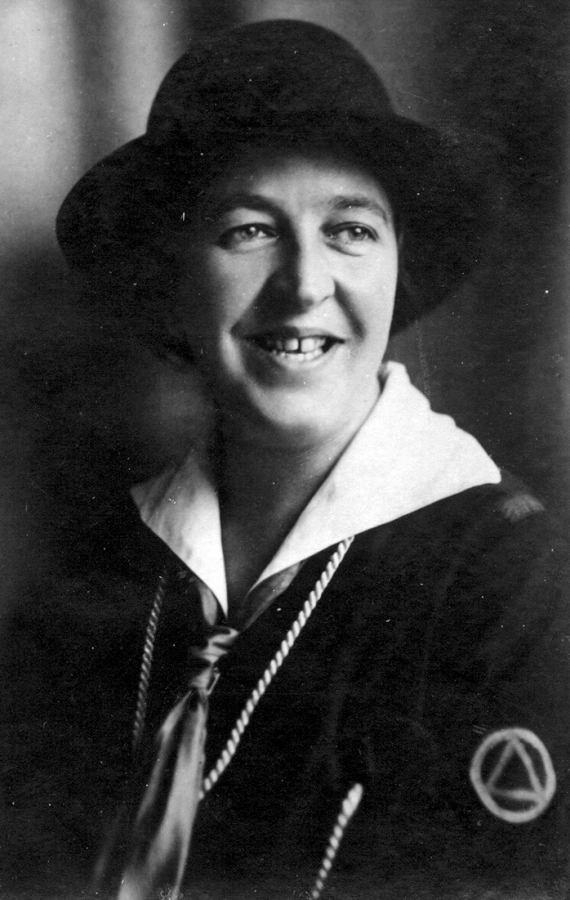
Corrie ten Boom in scouting uniform, unknown photographer, about 1921. Public domain.
Haarlem, Ravensbrück and the world, 1892 to 1983 · Person · Featured Study
Corrie ten Boom
She was a Dutch watchmaker whose family hid Jews in their home in Haarlem under the German occupation.
Behind a false wall in her bedroom, six people stayed hidden through the raid that sent her family to prison.
You are my hiding place. You protect me from trouble; You surround me with songs of deliverance. Selah
You are my hiding place. You protect me from trouble; You surround me with songs of deliverance. Selah
- Born
- 15 April 1892
- Died
- 15 April 1983
- Family
- Father: Casper ten Boom, watchmaker; Mother: Cornelia ten Boom; Sister: Betsie ten Boom, who died at Ravensbrück; Brother: Willem ten Boom; Sister: Nollie ten Boom
- Places
- Amsterdam, Haarlem, Scheveningen, Vught, Ravensbrück, Bloemendaal, Orange, California
Summary
Corrie ten Boom was born in Amsterdam in 1892 and grew up in the family shop in Haarlem. She became the first licensed woman watchmaker in Holland. After the raid she, her father and her sister Betsie were sent to prison. Only she came home.
- Her family had prayed in that house for the Jews since 1844.
- The museum says the family and its friends saved about 800 people.
- After the war she went to more than sixty countries.
The Texts of the House
Her family's prayer for Jerusalem and the psalmist's hiding place stand behind her story.
After the war she met a former guard of the camp, and that meeting is told in Corrie ten Boom and the Guard.
Pray for the peace of Jerusalem: “May those who love you prosper.The museum says the family prayed for the peace of Jerusalem in this house for a hundred years and three generations.
The Life in Order
The dates stand on the museum's pages, her own Prison Letters and The Hiding Place.
She was in prison and camp for ten months of 1944.
- 1837The shop openedMuseum timeline
- 15 April 1892BirthMuseum timeline
- 1897To HaarlemMuseum timeline
- 1921Into the shopMuseum timeline
- Spring 1943The hiding beganMuseum timeline
- 28 February 1944The raidMuseum history
- 29 February to 5 June 1944ScheveningenPrison Letters
- After June 1944The campsMuseum history
- 28 December 1944ReleasePrison Letters
- 1971The book printedCopyright page
- 15 April 1983DeathMuseum history
Each step of the life stands with its witness.
29 February to 5 June 1944, After June 1944, 28 December 1944, 1971, 15 April 1983
From the Watch Shop to Ravensbrück
A watchmaker's daughter kept the family trade, opened the house to the hunted and came back alone from the camp.
She was born Cornelia Arnolda Johanna ten Boom on Good Friday of 1892, about a month early, while her father kept a watch shop in Amsterdam. The family moved in 1897 to the house in Haarlem where her grandfather Willem had opened his shop. When her mother died in 1921 she went into the shop full-time.
In the spring of 1943 the family began to hide Jews in the house. A man she knew only as Mr. Smit came to look at the secret room, and he approved it. The museum says five or six people were usually living there in secret from then until the raid. It gives an estimated 800 Jews and other refugees saved in the war by the family and the co-workers of the group around the house.
In February 1944 the family was betrayed, and the security police raided the house. More than thirty people were arrested, among them her father Casper, Betsie and Corrie, and her brother Willem, her sister Nollie and her nephew Peter. The six in the secret room were two Jewish men, two Jewish women and two members of the underground, and they were freed forty-seven hours later.
Casper died in Scheveningen prison ten days after his arrest. The sisters were moved to Vught and then to Ravensbrück in Germany, where Betsie died at fifty-nine. Corrie was set free at the end of that year.
After the war she worked in a home for the recovery of victims at Bloemendaal and then travelled; the museum says she visited more than sixty countries in over thirty years. She died at Orange, California, on her ninety-first birthday.
In Their Own Words
Two lines from The Hiding Place of 1971 and one from her Prison Letters of 1975.
Corrie ten Boom (1892 to 1983)
The Hiding Place, with John and Elizabeth Sherrill (Guideposts Associates, 1971), the page not shown in the search text
The key to the future
“Today I know that such memories are the key not to the past, but to the future.”
Dutch Reformed
About this saying1 paragraph
She wrote this in 1971, in The Hiding Place, of the memories of her early life in the house.
Corrie ten Boom
The Hiding Place, with John and Elizabeth Sherrill (Guideposts Associates, 1971), the page not shown in the search text
Love larger than walls
“And so I learned that love is larger than the walls which shut it in.”
Dutch Reformed
About this saying1 paragraph
She wrote this in The Hiding Place of 1971, of the years before the war, when the family's care went out beyond the house.
Corrie ten Boom
Corrie ten Boom's Prison Letters (Carmel, N.Y.: Guideposts, 1975), the page not shown in the search text
Set free
“through a miracle, I was set free, just one week before all women my age and older were put to death.”
Dutch Reformed
About this saying1 paragraph
In her Prison Letters, printed in 1975, she wrote of her release from Ravensbrück at the end of 1944.
The People Around Her
The witnesses name three generations of the family, a helper she knew by one name and the two writers of her book.
Her father and her sister died in the year of the raid.
| Person | Tie to Corrie | The witness |
|---|---|---|
| Willem ten Boom | Her grandfather | Museum timeline |
| Casper ten Boom | Her father, the watchmaker of the house | Museum pages |
| Cornelia ten Boom | Her mother, who died at sixty-three | Museum timeline |
| Betsie ten Boom | Her sister and fellow prisoner | Museum history |
| Willem and Nollie ten Boom | Her brother and sister | Museum history |
| Mr. Smit | The man who examined and approved the hiding place | The Hiding Place |
| John and Elizabeth Sherrill | Wrote The Hiding Place with her | Copyright page |
The Places of Her Life
Her life ran from Amsterdam to the house in Haarlem, through three prisons and camps, and out to the world.
The house in the Barteljorisstraat stood at the centre of her life.
| Place | What the witnesses say | The witness |
|---|---|---|
| Amsterdam | Her birthplace | Museum timeline |
| Haarlem | The house and shop in the Barteljorisstraat, the family's home from 1837 to 1945 | Museum pages |
| Scheveningen | The prison where she was held and where her father died | Prison Letters; Museum history |
| Vught | The camp in the Netherlands the sisters were sent to next | Museum history |
| Ravensbrück | The women's camp in Germany | Museum history |
| Bloemendaal | Where she worked after the war | Brown, Corrie |
| Orange, California | Where she died | Museum history |
A House That Prayed for Israel
The museum ties the hiding of 1943 to a century of the family's prayer for the Jewish people.
In 1844, inspired by the minister Witteveen, her grandfather began a prayer group to pray for the Jewish people and the peace of Jerusalem. The museum calls this an unusual idea among Christians of that time and says he taught his children to pray for the Jews.
Her father spent much time with his Jewish friends and joined them on their holy days. The museum says the history of the family testifies of their love for the Jewish people and their commitment to them.
How the Key Verse Was Taught
Readers from the fourth century to the nineteenth heard the psalm as a prayer for shelter.
Athanasius of Alexandria (296 to 373)
FESTAL LETTERS 14:1
Athanasius read the verse in its Greek form as a prayer to be delivered from those who surround.
“He caused a light to shine at the prayer of the psalmist, who said, ‘My Joy, deliver me from those who surround me’; this being indeed true rejoicing, this being a true feast, even deliverance from wickedness, to which a person attains by thoroughly adopting an upright conversation and being approved in his mind of godly submission toward God.”
on Psalm 32:7Patristic
John Gill (1697 to 1771)
Exposition of the Old Testament (1748-1763)
John Gill read the hiding place as God's shelter in time of trouble.
“Thou art my hiding place,.... In time of trouble; see Psa 27:5; so Christ is said to be, Isa 32:”
on Psalm 32:7Reformed
Charles Spurgeon (1834 to 1892)
The Treasury of David, Vol. 2
Charles Spurgeon heard in the short sentences of the verse a personal claim upon God.
“Thou art my hiding place. Terse, short sentences make up this verse, but they contain a world of meaning. Personal claims upon our God are the joy of spiritual life. To lay our hand upon the Lord with the clasp of a personal ‘my’ is delight at its full. Observe that the same man who in the fourth verse was oppressed by the presence of God, here finds a shelter in him. See what honest confession and full forgiveness will do! The gospel of substitution makes him to be our refuge who otherwise would have been our judge.”
on Psalm 32:7Particular Baptist
What the Witnesses Leave Open
The accounts differ on the cause of her release and on her age at the time.
The cause of her releaseCorrie ten Boom; the front matter of a 1971 printing; a film guide
In her Prison Letters she says she was set free through a miracle, one week before all women her age and older were put to death. The front matter of the 1971 printing for the Billy Graham Evangelistic Association says that she put her release down to a clerical error. A later guide to Christian films speaks of a clerical error and of her fellow prisoners killed a month after her release.
Her age when she came outThe Hiding Place; the Corrie ten Boom House
In The Hiding Place she gives her age at the release desk as fifty-two, which agrees with her birth in April 1892. The museum's history page gives her age at release as fifty-three.
Books to Read Next
The Hiding Place
Corrie ten Boom with John and Elizabeth Sherrill · 1971
She tells of the family, the hiding, the prisons and the camp.
In print: find it wherever books are sold.
Corrie ten Boom's Prison Letters
Corrie ten Boom · 1975
Her letters from prison give her own dates for Scheveningen and her release.
In print: find it wherever books are sold.
Amazing Love
Corrie ten Boom · 1977
In this short book she sets her release ten days after Betsie's death.
In print: find it wherever books are sold.
What Corrie ten Boom Left
She left her books and the house in Haarlem, which has been an open home for visitors since 1988.
Sources
Scripture is the Berean Standard Bible.
- The Holy Bible, Berean Standard Bible (read 2026)
- The Corrie ten Boom House, Haarlem, "The history of the Ten Boom Family" (timeline)
- The Corrie ten Boom House, Haarlem, "The History of the museum" and "The museum".
- Corrie ten Boom with John and Elizabeth Sherrill, The Hiding Place (Chosen Books, Guideposts Associates and Barbour printings; World Wide Publications for the Billy Graham Evangelistic Association; all 1971)
- Corrie ten Boom's Prison Letters (Carmel, N.Y.: Guideposts, 1975)
- Corrie ten Boom, Amazing Love (Christian Literature Crusade, 1977)
- Joan Winmill Brown, Corrie: The Lives She's Touched (World Wide Pictures special edition)
- 99 Amazing Books and Films Inspired by the Bible.
- Athanasius, Festal Letters 14.1, on Psalm 32:7.
- John Gill, Exposition of the Old Testament (1748 to 1763), on Psalm 32:7.
- Charles Spurgeon, The Treasury of David, volume 2, on Psalm 32:7.
Keep Studying
Studies1
Church history1
People and groups1