
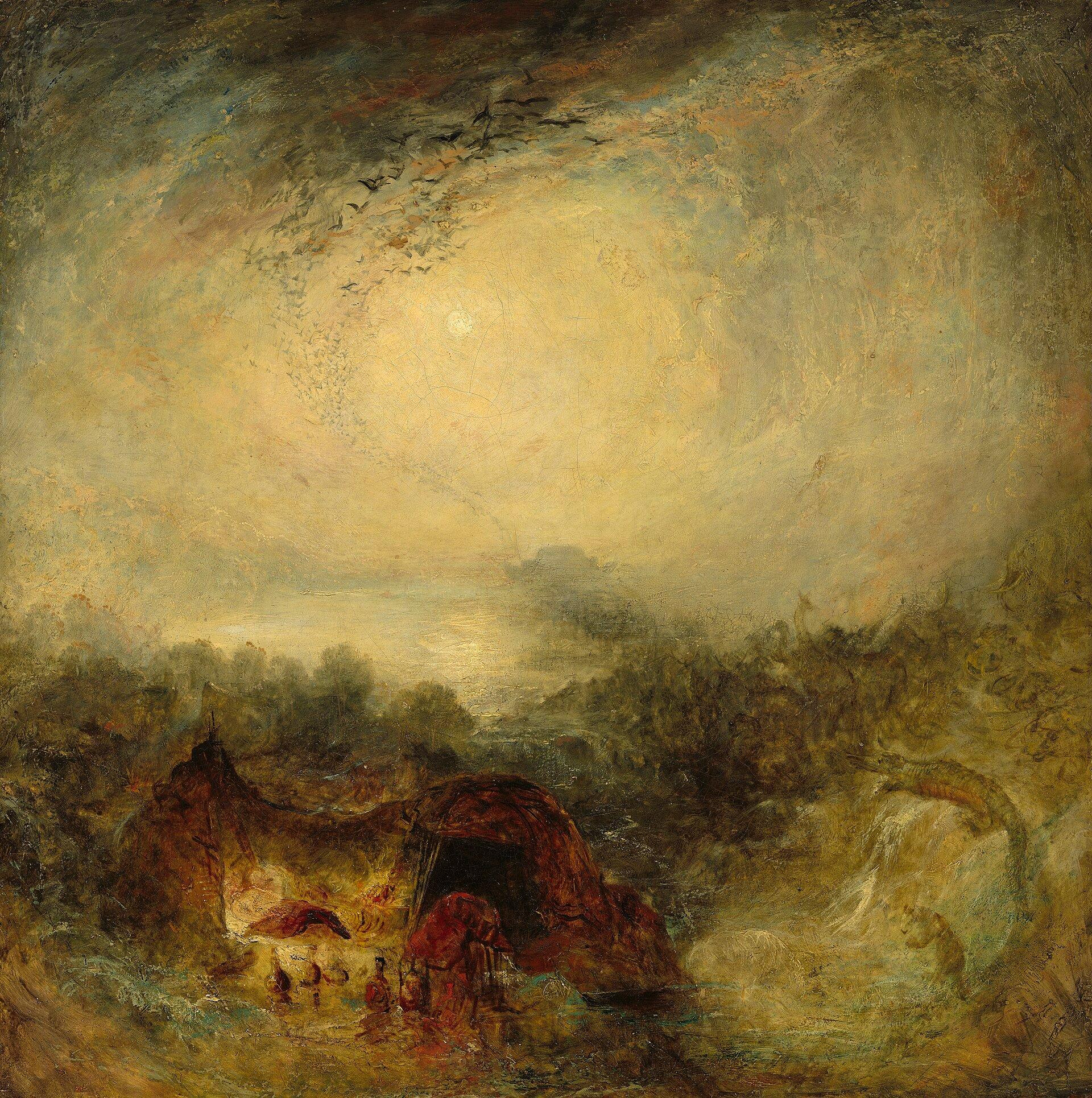
J. M. W. Turner, The Evening of the Deluge, about 1843. Public domain.
2 Peter 3 · Passage · Featured Study
The Scoffers and the Day of God
The last chapter of 2 Peter answers scoffers who doubted Christ's return and tells believers how to live until the day of God.
Peter answers the mockers with the flood, a thousand years and the patience of God.
But in keeping with God’s promise, we are looking forward to a new heaven and a new earth, where righteousness dwells.
- The passage
- 2 Peter 3:1 to 18, Genesis 7:11
- Books
- 2 Peter, Genesis
- Hold in memory
- 2 Peter 3:9
Summary
This chapter closes Peter's second letter. Peter meets a scornful question with an argument from the world's own past and from the character of God. Then he turns to his readers and tells them to stand firm and to grow.
- The chapter answers one question and ends with one charge.
- Its saying about a day and a thousand years has been read two ways since the second century.
- The oldest Greek copies and the King James Version end 2 Peter 3:10 with different words.
Where Is the Promise?
The scoffers of the last days argued from the world as they saw it.
Most importantly, you must understand that in the last days scoffers will come, scoffing and following their own evil desires. “Where is the promise of His coming?” they will ask. “Ever since our fathers fell asleep, everything continues as it has from the beginning of creation.”This is the question the whole chapter answers.
John Wesley noted in his Explanatory Notes upon the New Testament that the scoffers do not even deign to name Christ.
Beloved, this is now my second letter to you. Both of them are reminders to stir you to wholesome thinking by recalling what was foretold by the holy prophets and commanded by our Lord and Savior through your apostles.The opening sets the letter's purpose before the scoffers appear.
How Peter Answers the Scoffers
Each part of the chapter meets a part of the scoffers' case.
The five parts of 2 Peter 3, each with Peter's point and the claim it meets.
| Verses | Peter's point | What it answers |
|---|---|---|
| 2 Peter 3:3 to 4 | Peter names the scoffers and quotes them. | The claim the chapter answers |
| 2 Peter 3:5 to 7 | God's word made the world, judged it by water, and keeps it for fire. | That nothing has ever changed |
| 2 Peter 3:8 to 9 | God does not count time as people do, and His delay is patience. | That the promise has been forgotten |
| 2 Peter 3:10 to 13 | The day will come like a thief, and a new heaven and earth will follow. | That the day will never come |
| 2 Peter 3:14 to 18 | Believers are to be found at peace, stand guard and grow in grace. | How believers should wait |
The Letter and Its Writer
Eusebius and Jerome each wrote that the early church doubted this letter.
Simon Peter, a servant and apostle of Jesus Christ, To those who through the righteousness of our God and Savior Jesus Christ have received a faith as precious as ours:Its opening line is the letter's own claim about who wrote it.
Eusebius wrote in his Church History that he had learned the second epistle of Peter did not belong to the canon.
Yet it had seemed profitable to many, he added, and was used with the other Scriptures.
Later in the same work he placed it among the disputed writings that many nevertheless recognized.
Jerome wrote in De Viris Illustribus that many did not hold the second letter to be Peter's, because its style differs from the first.
Consider also that our Lord’s patience brings salvation, just as our beloved brother Paul also wrote you with the wisdom God gave him. He writes this way in all his letters, speaking in them about such matters. Some parts of his letters are hard to understand, which ignorant and unstable people distort, as they do the rest of the Scriptures, to their own destruction.The verse shows how Peter regarded Paul's writings.
Water, Fire and the Patience of God
Peter sets the flood beside the fire to come and explains why the day waits.
But they deliberately overlook the fact that long ago by God’s word the heavens existed and the earth was formed out of water and by water, through which the world of that time perished in the flood.Peter answers a claim about the world with the world's own history.
In the six hundredth year of Noah’s life, on the seventeenth day of the second month, all the fountains of the great deep burst forth, and the floodgates of the heavens were opened.This is the event Peter points to.
And by that same word, the present heavens and earth are reserved for fire, being kept for the day of judgment and destruction of ungodly men.This verse completes the comparison Peter draws with the flood.
Matthew Henry's comment on this verse is addressed to the scoffers themselves.
“Let therefore the scoffers, who laugh at the coming of our Lord to judgment, at least consider that it may be. There is nothing said of it in the word of God but what is within reach of the power of God, and, though they still should laugh, they shall not put us out of countenance; we are well assured that it will be, because he has said it, and we can depend upon his promise.”
Matthew Henry · Commentary on the Whole Bible · on 2 Peter 3:7Puritan
The Lord is not slow in keeping His promise as some understand slowness, but is patient with you, not wanting anyone to perish but everyone to come to repentance.Peter names God's reason for the waiting.
John Wesley, on 2 Peter 3:15, read the Lord's long patience as a means of saving many more souls.
2 Peter 3:7, 2 Peter 3:9
Where Readers Differ
Readers differ on what 2 Peter 3:8 measures and on the last words of 2 Peter 3:10.
Beloved, do not let this one thing escape your notice: With the Lord a day is like a thousand years, and a thousand years are like a day.Irenaeus and Jamieson, Fausset and Brown read this saying in two ways.
A thousand years as a measure of the world's agesIrenaeus, Against Heresies, book 5
Irenaeus read the saying as a key to the length of history.
“For in as many days as this world was made, in so many thousand years shall it be concluded. And for this reason the Scripture says: ‘Thus the heaven and the earth were finished, and all their adornment. And God brought to a conclusion upon the sixth day the works that He had made; and God rested upon the seventh day from all His works.’ This is an account of the things formerly created, as also it is a prophecy of what is to come. For the day of the Lord is as a thousand years; and in six days created things were completed: it is evident, therefore, that they will come to an end at the sixth thousand year.”
Irenaeus · Against Heresies Book 5 · on 2 Peter 3:8Patristic
Justin Martyr, writing before him, connected the same saying with Adam, who did not live a thousand years.
The objection: Charles Spurgeon, preaching on this verse in 1862, rejected the inference that each day of creation stands for a thousand years.
A thousand years as God's view of timeJamieson, Fausset and Brown, Commentary Critical and Explanatory
Jamieson, Fausset and Brown read the verse as a word about God, for whom no delay is long. A thousand guineas, they wrote, are as a single penny to a man of countless riches.
The objection: Irenaeus took the same words to fix the length of the world, so for him they say more than that God is patient.
Laid bare, or burned up2 Peter 3:10 in the manuscripts
But the Day of the Lord will come like a thief. The heavens will disappear with a roar, the elements will be destroyed by fire, and the earth and its works will be laid bare.Its last clause differs between the oldest manuscripts and the Received Text.
The older reading has a Greek word meaning will be found. The NET Bible's note gives it by far the best support among the manuscripts and prefers it on both external and internal grounds.
Edward D. Andrews, in his notes for the Updated American Standard Version, holds that this reading gave rise to the others, as scribes tried to clarify a hard text.
The other reading says the earth and its works will be burned up. The fire that melts the elements then burns the earth as well, and the clause reads plainly.
It stands in the printed Greek texts of Stephanus in 1550 and Scrivener in 1894 and in the RP Byzantine Majority Text of 2005. The King James Version and the NASB of 1995 translate it.
The NET note grants that many scholars find the older reading so hard that they call it nonsensical. It also notes that the easier readings cannot explain how the harder one arose.
Among modern versions, the ESV renders the older reading as exposed and the current NASB as discovered.
Holy Lives While We Wait
The chapter ends with holiness, watchfulness and growth.
Since everything will be destroyed in this way, what kind of people ought you to be? You ought to conduct yourselves in holiness and godliness as you anticipate and hasten the coming of the day of God, when the heavens will be destroyed by fire and the elements will melt in the heat.This is where the argument turns to the readers.
John Wesley read the hastening of 2 Peter 3:12 as earnest desire and fervent prayer.
Therefore, beloved, since you already know these things, be on your guard so that you will not be carried away by the error of the lawless and fall from your secure standing. But grow in the grace and knowledge of our Lord and Savior Jesus Christ. To Him be the glory both now and to the day of eternity. Amen.These are the last words Peter wrote in the letter.
Sources
Scripture is the Berean Standard Bible.
- John Wesley, Explanatory Notes upon the New Testament (1755), on 2 Peter 3:4, 3:12 and 3:15.
- Matthew Henry, Commentary on the Whole Bible (1710), on 2 Peter 3:7.
- Irenaeus, Against Heresies, book 5, chapter 28, in the Ante-Nicene Fathers, volume 1.
- Justin Martyr, Dialogue with Trypho, chapter 81, in the Ante-Nicene Fathers, volume 1.
- Jamieson, Fausset and Brown, Commentary Critical and Explanatory on the Whole Bible (1871), on 2 Peter 3:8.
- Charles Spurgeon, God's Estimate of Time, The Metropolitan Tabernacle Pulpit, sermon 447 (1862)
- Eusebius of Caesarea, Church History, book 3, chapters 3 and 25, in the Nicene and Post-Nicene Fathers, second series, volume 1.
- Jerome, De Viris Illustribus, chapter 1.
- The NET Bible, the translators' note on 2 Peter 3:10.
- Edward D. Andrews, the witnesses of 2 Peter 3:10, Updated American Standard Version notes (2023)
- 2 Peter 3:10 in the printed Greek texts and in the King James Version, the NASB of 1995, the current NASB and the ESV.
Keep Studying
Go further7