
Matthew 6:34 and Psalm 4:8 · Subject · Anxiety
Sufficient for the Day
Matthew 6:34 closes Jesus' teaching against worry in the Sermon on the Mount, and Psalm 4:8 is a prayer for lying down at night.
Adam Clarke counted more than thirty explanations of the Greek word that the Lord's Prayer uses for daily bread.
Therefore do not worry about tomorrow, for tomorrow will worry about itself. Today has enough trouble of its own.
- Books
- Exodus, Matthew, Psalms
- Hold in memory
- Lamentations 3:22 to 23, Psalm 4:8
Summary
Scripture teaches the anxious to live one day at a time under God's provision. God gives what each day needs, and He asks His people to receive it from Him day by day and to leave tomorrow in His hands. The psalms and the prophets turn that rule into a practice that runs from the first prayer of the morning to the last of the night.
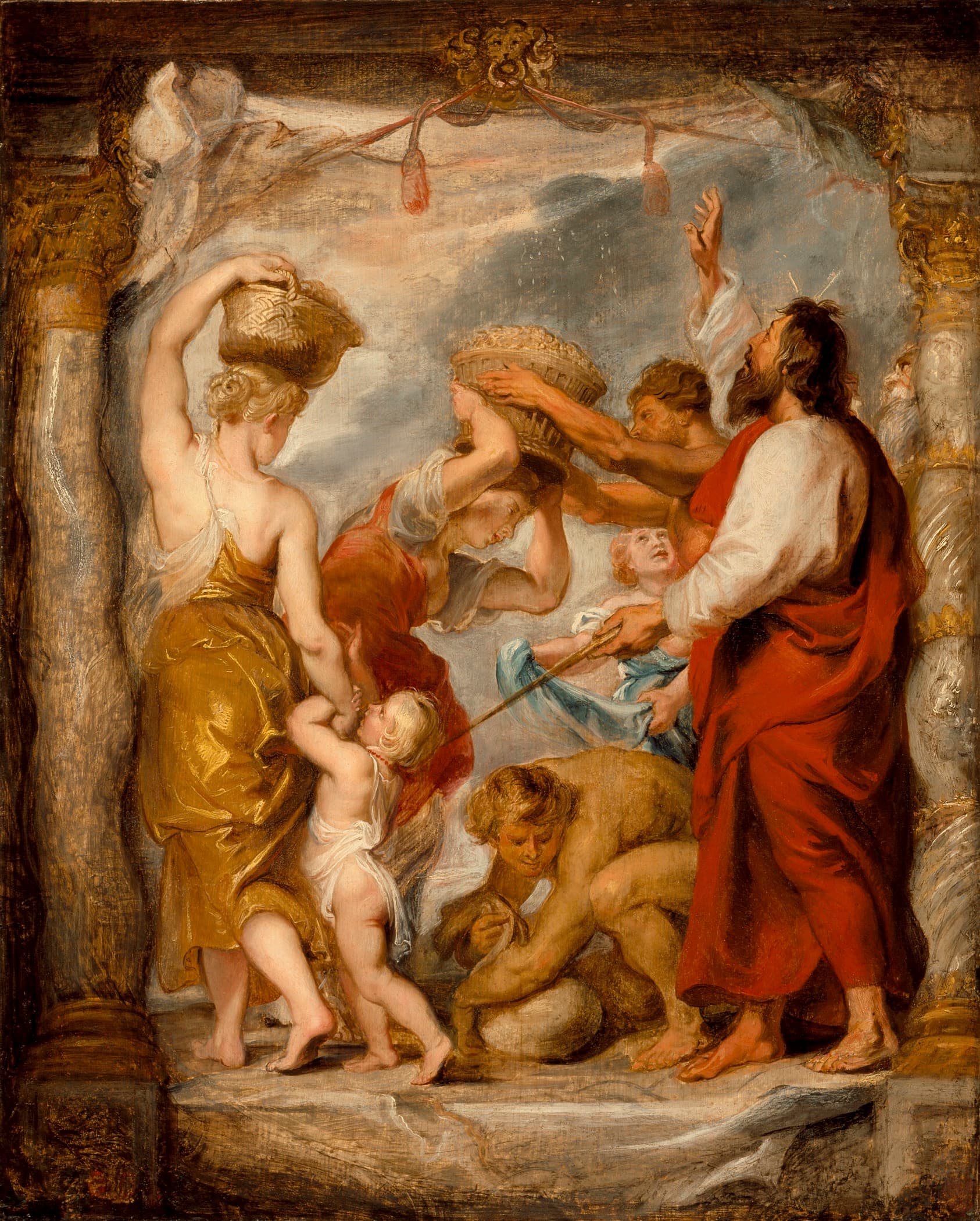
- In Exodus 16 the LORD gave enough manna for each day, and what was kept overnight spoiled, except the double portion gathered for the Sabbath.
- The Lord's Prayer teaches disciples to ask for bread one day at a time.
- Psalm 68:19 blesses the Lord who bears His people's burden day by day.
- Lamentations 3:22 to 23 says that the LORD's mercies never fail and are new every morning.
One Day at a Time
The rule of the manna opens the practice of one day at a time.
Anxiety lives in tomorrow, in the meals, the bills and the troubles that have not yet come. Scripture answers it with a practice as much as a command, and it sets the believer's needs, prayers and rest inside the bounds of a single day. One day at a time is the practice Scripture gives in the trial of anxiety.
This study asks what Scripture gives a person to do when worry about tomorrow presses in. It sets out the rule of the manna, a day's practice from morning to night with its verses, and the day as Proverbs and the letters name it. It then turns to the petition for bread, to the teachers who taught one day at a time, and to the early readings of the petition's rare adjective.
Then the LORD said to Moses, “Behold, I will rain down bread from heaven for you. Each day the people are to go out and gather enough for that day. In this way I will test whether or not they will follow My instructions.Every later text of the practice builds on this first lesson.
Then Moses said to them, “No one may keep any of it until morning.” But they did not listen to Moses; some people left part of it until morning, and it became infested with maggots and began to smell. So Moses was angry with them.Manna kept against tomorrow spoiled by morning, and the spoiling taught Israel the rule of the day.
On the sixth day the people gathered twice as much, and what they kept for the Sabbath stayed fresh until morning (Exodus 16:22 to 24).
Matthew 6:34 is the key verse of this practice.
One Day's Practice
The Psalms supply six of the nine rows, and Lamentations, Exodus and the Lord's Prayer the other three.
Scripture gives each part of the day its own word, from mercies new in the morning to sleep in safety at night.
| Time of day | The practice | The verse | The words of the verse |
|---|---|---|---|
| Morning | Remember the mercies given new for this day | Lamentations 3:22 to 23 | Because of the loving devotion of the LORD we are not consumed, for His mercies never fail. They are new every morning; great is Your faithfulness! |
| Morning | Lay the day's requests before God and wait for Him | Psalm 5:3 | In the morning, O LORD, You hear my voice; at daybreak I lay my plea before You and wait in expectation. |
| Morning | Gather what this day needs and no more | Exodus 16:21 | Every morning each one gathered as much as was needed, and when the sun grew hot, it melted away. |
| Through the day | Ask the Father for this day's bread | Matthew 6:11 | Give us this day our daily bread. |
| Through the day | Bring the day's burden to the Lord who carries it | Psalm 68:19 | Blessed be the Lord, who daily bears our burden, the God of our salvation. Selah |
| Through the day | Cry out to God at any hour | Psalm 55:17 | Morning, noon, and night, I cry out in distress, and He hears my voice. |
| Evening | Search the heart in stillness before sleep | Psalm 4:4 | Be angry, yet do not sin; on your bed, search your heart and be still. Selah |
| Night | Lie down in the LORD's safety | Psalm 4:8 | I will lie down and sleep in peace, for You alone, O LORD, make me dwell in safety. |
| Waking | Rise sustained by the LORD | Psalm 3:5 | I lie down and sleep; I wake again, for the LORD sustains me. |
Evening, Night, Waking
The Day from Proverbs to the Letters
Proverbs, Matthew and the letters each bound the believer's care within the present day.
Do not boast about tomorrow, for you do not know what a day may bring.The wise man's warning rests on what no one knows, which is the reason the day's practice leaves tomorrow alone.
But seek first the kingdom of God and His righteousness, and all these things will be added unto you.Jesus sets the first thing to seek just before He speaks of tomorrow, so the day's practice begins with God's kingdom before its needs.
Therefore we do not lose heart. Though our outer self is wasting away, yet our inner self is being renewed day by day.Paul measures the renewal of the inner self by days, the same measure the manna kept.
But exhort one another daily, as long as it is called today, so that none of you may be hardened by sin’s deceitfulness.The letter calls believers to encourage one another while it is still today, since today is the only day in hand.
Come now, you who say, “Today or tomorrow we will go to this or that city, spend a year there, carry on business, and make a profit.” You do not even know what will happen tomorrow! What is your life? You are a mist that appears for a little while and then vanishes. Instead, you ought to say, “If the Lord is willing, we will live and do this or that.”James carries the practice of one day at a time into the planning of business and travel.
2 Corinthians 4:16, Hebrews 3:13, James 4:13 to 15
The Word for Daily
Matthew and Luke use the same rare adjective for the bread of the prayer.
The word for daily in Matthew 6:11 and Luke 11:3 is epiousios, an adjective, and it stands in no other verse of the New Testament. The STEP Bible lexicon based on Abbott-Smith glosses it tomorrow's and gives its meaning as daily. It sets out two senses, "for the morrow or for the coming day", and "for subsistence, needful".
Matthew asks for bread "this day", and Luke for bread "each day", so both forms of the prayer keep the request inside the day.
What the Text Leaves Unsaid
The rule of one day at a time leaves two questions open.
Matthew 6:34 does not say whether a believer may store food or plan for the year ahead. Proverbs 6:6 to 8 commends the ant that prepares its provisions in summer and gathers its food at harvest. The rule of the manna was given to Israel in the wilderness, and Exodus 16 does not say that it binds every later meal.
Teachers on One Day at a Time
Teachers from the fourth century to the nineteenth tied the day's care to the day itself.
John Chrysostom preached on Matthew 6:34 in his twenty-second homily on Matthew. He asked the anxious why they would "add the further affliction that comes of anxiety" when they were about to be delivered even from their former toils. Jerome, in his Commentary on Matthew, drew a rule from the verse, "let us be content with the thoughts of the present time; let us leave the care of the future, which is uncertain."
The King James Version renders the last clause of Matthew 6:34 "Sufficient unto the day is the evil thereof". Jamieson, Fausset & Brown called it "An admirable practical maxim, and better rendered in our version than in almost any other". They added that "every day brings its own cares; and to anticipate is only to double them".
1834 to 1892 · Charles Spurgeon
Charles Spurgeon, in The Treasury of David, wrote on the waking verse of Psalm 3.
“David's faith enabled him to lie down; anxiety would certainly have kept him on tiptoe, watching for an enemy. Yea, he was able to sleep, to sleep in the midst of trouble, surrounded by foes. ‘So he giveth his beloved sleep.’ There is a sleep of presumption; God deliver us from it! There is a sleep of holy confidence; God help us so to close our eyes! But David says he awaked also.”
Charles Spurgeon · The Treasury of David, Vol. 1 · on Psalm 3:5
Three Readings of the Daily Bread
Teachers of the early church read the rare word of the petition in three ways.
Bread for this one dayJohn Chrysostom, Hippolytus of Rome
John Chrysostom, in his nineteenth homily on Matthew, gave the plainest answer: "What is "daily bread"? That for one day." Hippolytus of Rome set out what the petition asks for and what it leaves out.
“For this reason we are enjoined to ask what is sufficient for the preservation of the substance of the body: not luxury, but food, which restores what the body loses, and prevents death by hunger; not tables to inflame and drive on to pleasures, nor such things as make the body wax wanton against the soul; but bread, and that, too, not for a great number of years, but what is sufficient for us to-day.”
Hippolytus of Rome · Exegetical Fragments · on Matthew 6:11Patristic
Bread for the coming dayJerome, on the Gospel according to the Hebrews
Jerome drew the second reading from a gospel outside the four.
“In the Gospel, entitled The Gospel according to the Hebrews, 'supersubstantialis' is rendered 'mohar,' that is 'to-morrow's;' so that the sense would be, Give us today to-morrow's bread; i. e. for the time to come.”
Jerome · Catena Aurea by Aquinas · on Matthew 6:11Patristic
The bread of lifeJerome
Jerome also read the petition of Christ. "When then we pray God to give us our 'peculiar' or 'chief' bread," he wrote, "we mean Him who says in the Gospel, I am the living bread which came down from heaven."
The objection each reading faces1 paragraph
Against the reading of tomorrow's bread stands Matthew 6:34, which forbids worry about tomorrow in the same sermon. Against the reading of bread for one day stands the rarity of the word, whose sense must be drawn from its parts. Against the reading of the bread of life stands Hippolytus, who read the petition of food for the body.
Each Day's Care Brought to God
The practice of the day ends where it began, with the mercies of God.
The manna, the daily bread and the psalms of morning and evening teach the anxious to receive one day from God and to give its cares back to Him before sleep. Where anxiety weighs on the body or the mind, medical care stands beside this daily practice of prayer and never in its place.
Satisfy us in the morning with Your loving devotion, that we may sing for joy and be glad all our days.The psalm asks for God's loving devotion in the morning so that every day after may be glad, the prayer with which a day of this practice begins.
Sources
Scripture is the Berean Standard Bible.
- King James Version, Matthew 6:34.
- STEP Bible TBESG (Tyndale House, CC BY 4.0), the Brief lexicon based on Abbott-Smith (1922), with Strong's definitions.
- The tagged Greek text of the New Testament with Strong's numbers and morphology.
- John Chrysostom, Homily 19 on the Gospel of Matthew, on Matthew 6:11.
- John Chrysostom, Homily 22 on the Gospel of Matthew, on Matthew 6:34.
- Hippolytus of Rome, Exegetical Fragments, on Matthew 6:11.
- Jerome, as gathered in Thomas Aquinas, Catena Aurea, on Matthew 6:11, two rows.
- Jerome, Commentary on Matthew, on Matthew 6:34.
- Jamieson, Fausset & Brown, Commentary Critical and Explanatory on the Whole Bible (1871), on Matthew 6:34.
- Charles Spurgeon, The Treasury of David, Vol. 1 (1869), on Psalm 3:5.
- Adam Clarke, Commentary on the Bible (1832), on Matthew 6:11.
Keep Studying
People and groups7
Doctrines6