

Thomas Cole, Expulsion from the Garden of Eden, 1828. Public domain.
Genesis 2 · Symbol · Featured Study
The Tree of Life
This symbol study gives the Hebrew and Greek words, the voices of the church and two readings in dispute.
Genesis sets the tree of life in the middle of the garden and then closes the way to it, and Revelation 22 sets it on both banks of the river in the city.
So He drove out the man and stationed cherubim on the east side of the Garden of Eden, along with a whirling sword of flame to guard the way to the tree of life.
- The word
- עֵץ הַחַיִּים (ets ha-chayyim), H2416
- First appears
- Genesis 2:9 “…God gave growth to every tree that is…”
Genesis sets the tree of life in the middle of the garden and then closes the way to it, and Revelation 22 sets it on both banks of the river in the city.
Summary
The tree of life stands in Scripture for life with God that has no end.
- The tree of life is first kept from the man after he ate from the other tree.
- Proverbs uses the tree of life four times as a figure for the good things of this life.
- Revelation 22:14 gives the right to the tree to those who wash their robes.
Two Trees in the Middle of the Garden
The garden holds the tree of life, and Genesis 2:16 to 17 forbids the other tree.
Out of the ground the LORD God gave growth to every tree that is pleasing to the eye and good for food. And in the middle of the garden were the tree of life and the tree of the knowledge of good and evil.This is the first of the eleven verses that name the tree of life.
And the LORD God commanded him, “You may eat freely from every tree of the garden, but you must not eat from the tree of the knowledge of good and evil; for in the day that you eat of it, you will surely die.”The command comes before the woman is made in Genesis 2:22, so the man heard it from God Himself.
The Hebrew is ets ha-chayyim, the tree of the life, and the word for life stands in the plural form the language uses for it.
Then the LORD God said, “Behold, the man has become like one of Us, knowing good and evil. And now, lest he reach out his hand and take also from the tree of life, and eat, and live forever...” Therefore the LORD God banished him from the Garden of Eden to work the ground from which he had been taken.The LORD God's words break off in the middle of the sentence, and Genesis 3:23 tells what He did.
The Gate of Light
The canvas shows the moment of Genesis 3:23 to 24, when the man and the woman leave.
The canvas reads from right to left, from the garden to the land outside it.
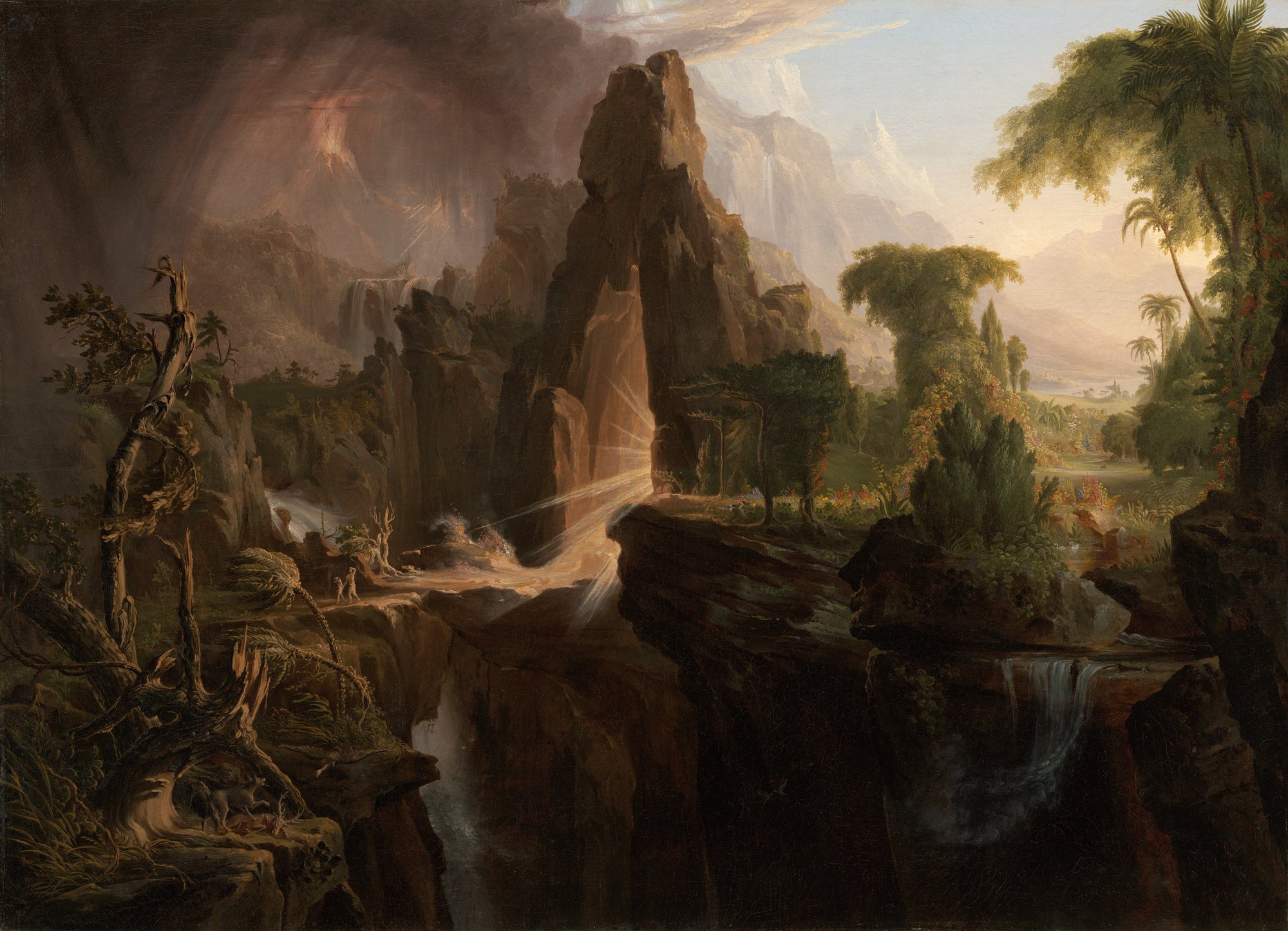
- The gate of lightA blaze of light pours out of an arch in the rock and across the chasm.Genesis 3:24
- The man and the womanTwo small figures walk out over the bridge of rock toward the dark land.Genesis 3:23
- The gardenPalms, flowers and a still lake lie in sunlight at the right.Genesis 2:8 to 9
- The fallsWater pours from the garden's edge into the gorge below.Genesis 2:10
- The volcanoA volcano smokes under a storm at the upper left.Genesis 3:17
- The wolfAt the lower left a wolf stands over a fallen animal among broken trees.Genesis 3:19
Thomas Cole, Expulsion from the Garden of Eden, 1828. Public domain.
Each of the six parts answers to a verse.
The Tree of Life Through Scripture
Eleven verses in three books name the tree, from Genesis 2 to the last chapter of Revelation.
The phrase stands three times in Genesis, four in Proverbs and four in Revelation.
- Genesis 2In the middle of the garden, Genesis 2:9
- Genesis 3Lest he take and live forever, Genesis 3:22
- Genesis 3The way guarded, Genesis 3:24
- Proverbs 3Wisdom to those who embrace her, Proverbs 3:18
- Proverbs 11The fruit of the righteous, Proverbs 11:30
- Proverbs 13Desire fulfilled, Proverbs 13:12
- Proverbs 15A soothing tongue, Proverbs 15:4
- Revelation 2In the Paradise of God, Revelation 2:7
- Revelation 22On either side of the river, Revelation 22:2
- Revelation 22The right to the tree, Revelation 22:14
- Revelation 22The last warning, Revelation 22:19
Each stop opens its verse in the reader.
Cherubim in the tabernacle and the templeExodus 25:22, Exodus 26:31 and 1 Kings 6:29
And I will meet with you there above the mercy seat, between the two cherubim that are over the ark of the Testimony; I will speak with you about all that I command you regarding the Israelites.The ark's cherubim are the first that Scripture names after the cherubim of Eden.
Make a veil of blue, purple, and scarlet yarn, and finely spun linen, with cherubim skillfully worked into it.The veil closed the Most Holy Place, which the high priest entered once a year, as Hebrews 9:7 says.
Then he carved the walls all around the temple, in both the inner and outer sanctuaries, with carved engravings of cherubim, palm trees, and open flowers.The temple's walls set the guardians of Eden among carvings of a garden.
Ets, Chay, Kerub, Xylon and Zoe
Five words name the tree, life and the cherub, each with its count.
ets
a tree, wood
chay
alive, life
kerub
a cherub
xylon
timber, a tree
zoe
life
The lexicon in full1 table or figure
The word for life is used more often than the word for tree in both Testaments.
| Word | Meaning | Uses |
|---|---|---|
| ets, H6086 | a tree, wood | 328 |
| chay, H2416 | alive, life | 498 |
| kerub, H3742 | a cherub | 91 |
| xylon, G3586 | timber, a tree | 20 |
| zoe, G2222 | life | 135 |
What Scripture Does Not Say
Genesis and Revelation leave four questions about the tree open.
Genesis never names the fruit of the tree of life, and it never says whether the man ate from it before he was sent out. Genesis does not say how long the cherubim stood at the garden. Revelation does not say whether the tree of the city is the tree of Eden.
The Right to the Tree
The last chapter of Revelation returns to the tree three times.
Then the angel showed me a river of the water of life, as clear as crystal, flowing from the throne of God and of the Lamb down the middle of the main street of the city. On either side of the river stood a tree of life, bearing twelve kinds of fruit and yielding a fresh crop for each month. And the leaves of the tree are for the healing of the nations.The tree stands inside the city, where Eden's guardians had stood outside the garden.
Blessed are those who wash their robes, so that they may have the right to the tree of life and may enter the city by its gates.This is the seventh blessing of Revelation and the last.
“Blessed is he who was pierced and so removed the sword from the entry to paradise.”
Ephrem the Syrian · Hymns on Paradise 2.1 · on Genesis 3:24Patristic
The curse ended in the cityRevelation 22:3 and Revelation 22:19
No longer will there be any curse. The throne of God and of the Lamb will be within the city, and His servants will worship Him.The verse after the tree ends the curse that Genesis 3:17 laid on the ground.
And if anyone takes away from the words of this book of prophecy, God will take away his share in the tree of life and the holy city, which are described in this book.The book closes with a warning that a share in the tree can be taken away.
Voices on the Tree of Life
Four teachers from the fourth century to the eighteenth wrote on the tree and the guarded way.
died 373 · Ephrem the Syrian
Ephrem the Syrian, in his Commentary on Genesis, reasons that if Adam had rashly eaten from the forbidden tree, he would hasten all the faster to the tree he had not been forbidden.
died 430 · Augustine of Hippo
Augustine of Hippo, in his Two Books on Genesis against the Manichaeans, takes the flaming sword as the punishments of this life, and he notes that a fire may burn to consume or to purify.
1662 to 1714 · Matthew Henry
Matthew Henry, in his Commentary on the Whole Bible, on Proverbs 3:18, writes that true grace is to the soul what the tree of life would have been.
1703 to 1791 · John Wesley
John Wesley, in his Explanatory Notes upon the Old Testament, observes that God might justly have cast the man out of the world. He says God sent the man out of the garden to till the ground, a place of toil.
Matthew Henry, John Wesley
Where Careful Readers Differ
Readers answer two questions about the tree of life in different ways.
What the tree of Eden gaveMatthew Henry; Jamieson, Fausset and Brown; Cosmas Indicopleustes
Matthew Henry, in his Commentary on the Whole Bible, holds that the man might have eaten of the tree and lived for ever, never dying. The objection is that Genesis gives no account of how the fruit worked.
Jamieson, Fausset and Brown, in their Commentary Critical and Explanatory, read the tree's place in the middle of the garden as a daily reminder of God and of the life to come. Cosmas Indicopleustes, in his Christian Topography, reads the two trees as two states, one mortal and one immortal. The objection is that Genesis 3:22 speaks of eating and living forever.
What the tree of Revelation 22:2 isAdam Clarke, John Wesley, Caesarius of Arles and Bede
Adam Clarke, in his Commentary on the Bible, takes the singular tree for trees of life along both banks, and John Wesley, in his Explanatory Notes upon the New Testament, reads it the same way. The objection is that the verse then speaks of the leaves of the tree, again in the singular.
Caesarius of Arles, in his Exposition on the Apocalypse, holds that the tree is the cross of the Lord. Bede, in his Commentary on Revelation, allows it to be read as the cross or as Christ. The objection is that the verse names neither the cross nor Christ.
Books to Read Next
Both works are in the public domain, and each has a free copy to read.
Christ the Tree of Life, Sermon 3251
Charles Spurgeon · 1911
The sermon is on Revelation 22:2, and it starts from the tree in the first Paradise.
Read at Spurgeon GemsCommentary on the Whole Bible
Matthew Henry · 1708 to 1710
His notes on the second and third chapters of Genesis follow the tree from the grant of the garden to its loss.
Read at CCELThe Way Open Again
The Bible's last chapter ends with an invitation.
The Spirit and the bride say, “Come!” Let the one who hears say, “Come!” And let the one who is thirsty come, and the one who desires the water of life drink freely.The Spirit and the bride speak here, in the chapter that sets the tree by the river.
Sources
Scripture is the Berean Standard Bible.
- The Berean Standard Bible, every verse carrying the words tree of life.
- James Strong, Exhaustive Concordance of the Bible, 1890, entries H6086, H2416, H3742, G3586 and G2222.
- Ephrem the Syrian, Commentary on Genesis 2.35.1, on Genesis 3:22; Hymns on Paradise 2.1.
- Augustine of Hippo, Two Books on Genesis against the Manichaeans 2.23.35, on Genesis 3:24.
- Matthew Henry, Commentary on the Whole Bible, 1710, on Genesis 2:9; on Proverbs 3:18.
- John Wesley, Explanatory Notes upon the Old Testament, 1765, on Genesis 3:24.
- John Wesley, Explanatory Notes upon the New Testament, 1755, on Revelation 22:2.
- Jamieson, Fausset and Brown, Commentary Critical and Explanatory on the Whole Bible, 1871, on Genesis 2:9.
- Cosmas Indicopleustes, The Christian Topography, Book 6, on Genesis 2:9.
- Adam Clarke, Commentary on the Bible, 1832, on Revelation 22:2.
- Caesarius of Arles, Exposition on the Apocalypse, Homily 19, on Revelation 22:2.
- Bede, Commentary on Revelation, on Revelation 22:2.
- Charles Spurgeon, Christ the Tree of Life, Metropolitan Tabernacle Pulpit, Sermon 3251, 1911, on Revelation 22:2.
Keep Studying
People and groups4
Symbols7
Doctrines7
Values1