
John 18-19, Luke 22-23 · Featured Study
The Trial of Jesus
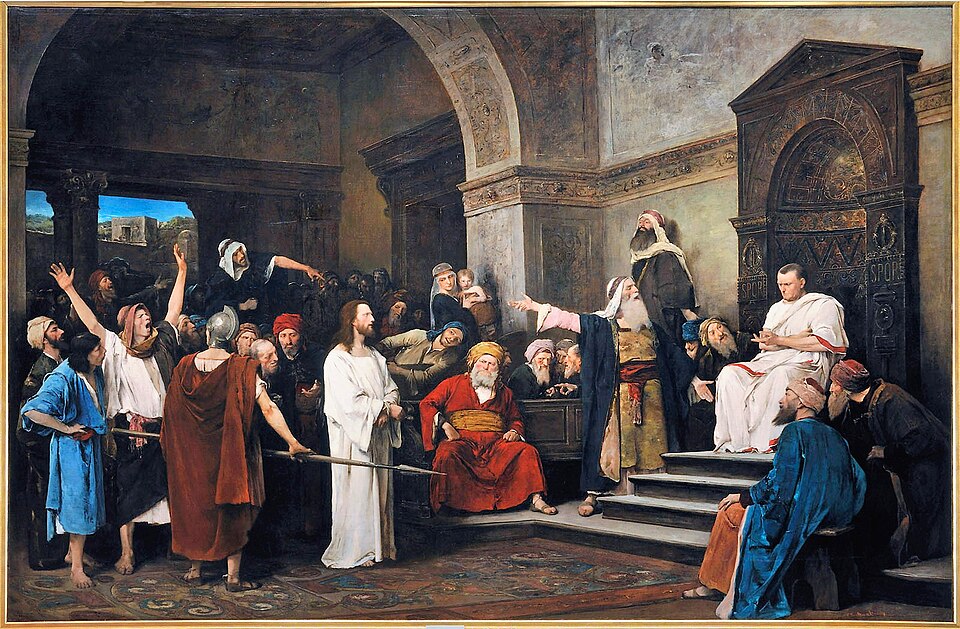
In one night and the morning that followed, Jesus stood before six hearings: Annas, Caiaphas and the council, the full Sanhedrin at daybreak, Pilate, Herod, and Pilate again. The charge shifts as the hearings shift, from blasphemy to sedition, because the men bringing it needed a charge Rome would act on. This page walks all six phases in the text’s own order, names the legal irregularities honestly, and closes where the text itself closes the question of blame: no one takes his life from him.
Summary
Jesus stood before six hearings in about twelve hours: Annas, Caiaphas and the council by night, the full Sanhedrin at daybreak, Pilate, Herod, and Pilate a second time. The charge shifted from blasphemy to sedition because the second charge was the one Rome would act on.
- Annas questions him first, off the record of any formal charge, before sending him bound to Caiaphas (John 18:13, 18:24)
- The night session before Caiaphas and the council seeks testimony rather than presenting evidence, and one officer strikes Jesus before any verdict is reached (John 18:19-23)
- A morning session at daybreak ratifies the night's verdict, since a capital sentence needed daylight standing (Luke 22:66-71)
- Pilate finds no fault in him three times over two separate hearings, once before Herod and once after (John 18:38, 19:4, 19:6)
- The charge shifts at Pilate's bar from blasphemy, a Jewish religious matter Rome would not touch, to sedition, a claim to kingship Rome would (John 19:7, 19:12)
Annas First
John 18:13-14, 24: the informal hearing before the formal one
They brought Him first to Annas, who was the father-in-law of Caiaphas, the high priest that year. Caiaphas was the one who had advised the Jews that it would be better if one man died for the people.Annas, father-in-law to Caiaphas, questions Jesus first, though he holds no formal office that year.
Annas had been high priest himself years earlier, and five of his sons and now his son-in-law Caiaphas had held the office after him. Bringing Jesus to Annas first was a mark of respect to his standing, not a formal legal step. John records no content from this interview beyond noting that it happened, and that Caiaphas is the one who had already said, before any trial, that it was expedient for one man to die for the people.
“NOTE the words in verse 13—‘and led him away to Annas first.’ This man, Annas, has not become so infamous as Pontius Pilate because his name did not happen to be mentioned in the Creed, but, in some respects, he was even more guilty than the Roman governor. He was one of those who handed over our Lord to Pilate and he is included in the judgment, ‘he that delivered Me unto you has the greater sin.’”
Charles Spurgeon · The Metropolitan Tabernacle Pulpit, Sermon No. 2820, "Christ Before Annas", 1903Reformed Baptist
John 18:13
“Now Caiaphas was he which gave council to the Jews,.... The chief priests and Pharisees, who met in council about Jesus, Joh 11:47, the counsel he gave was, that it was expedient that one man should die for the people; and which advice was given out of ill will and malice to Christ, and to prevent, as he thought, the people of the Jews being destroyed by the Romans; though the words have a very good sense which he did not understand.”
John Gill · Exposition of the New Testament, 1771Reformed Baptist
John 18:14
The Council by Night
John 18:19-24: the interrogation, and the illegal blow
Meanwhile, the high priest questioned Jesus about His disciples and His teaching. “I have spoken openly to the world,” Jesus answered. “I always taught in the synagogues and at the temple, where all the Jews come together. I said nothing in secret. Why are you asking Me? Ask those who heard My message. Surely they know what I said.” When Jesus had said this, one of the officers standing nearby slapped Him in the face and said, “Is this how You answer the high priest?” Jesus replied, “If I said something wrong, testify as to what was wrong. But if I spoke correctly, why did you strike Me?” Then Annas sent Him, still bound, to Caiaphas the high priest.The high priest asks of his disciples and his doctrine; Jesus is struck before any verdict.
The session runs at night, before Caiaphas and a gathered council, and John records the high priest questioning Jesus directly rather than producing witnesses. Jesus answers by appealing to his own public record: he taught openly, in the synagogue and the temple, and said nothing in secret. For that answer an officer strikes him, before any charge has been proven and before any sentence has been passed.
What the Mishnah's later rules add, and what they do not proveMishnah Sanhedrin, compiled c. 200 AD
The Mishnah’s tractate Sanhedrin lays out rules for capital cases that a night session, a search for testimony rather than a presentation of evidence, and a verdict on the eve of a feast would all violate: no capital trial at night, no verdict on a feast day, unanimity for conviction. Those rules were written down roughly a century and a half after this trial, by rabbis working after the Temple’s destruction, codifying practice as they understood or wished to reform it. They are named here dated and placed, not read back into the first century as a transcript this trial is checked against. What the Gospel text itself records, a night session, a search for testimony, and a blow landed before any verdict, is troubling on its own terms without needing a later law code to make it so.
“Why askest thou me? Ask them ... - Jesus here insisted on his rights, and reproves the high priest for his unjust and illegal manner of extorting a confession from him. If he had done wrong, or taught erroneous and seditious doctrines, it was easy to prove it, and the course which he had a right to demand was that they should establish the charge by fair and incontrovertible evidence. We may here learn: 1. That, though Jesus was willing to be reviled and persecuted, yet he also insisted that justice should be done him.”
Albert Barnes · Notes, Explanatory and Practical, on the Old and New Testaments, 1870Evangelical
John 18:21
“If I have spoken, &c.--‘if I spoke’ evil, in reply to the high priest. (Also see on Mr 14:54.) if well--He does not say ‘If not’ evil, as if His reply were merely unobjectionable: ‘well’ seems to challenge more than this as due to His remonstrance [BENGEL]. This shows that Mt 5:39 is not to be taken to the letter.”
Jamieson, Fausset & Brown · Commentary Critical and Explanatory on the Whole Bible, 1871Reformed
John 18:23
The Morning Ratification
Luke 22:66-71: the full council meets again at daybreak
At daybreak the council of the elders of the people, both the chief priests and scribes, met together. They led Jesus into their Sanhedrin and said, “If You are the Christ, tell us.” Jesus answered, “If I tell you, you will not believe.As soon as it was day, the full assembly of elders, chief priests, and scribes gathers.
So they all asked, “Are You then the Son of God?” He replied, “You say that I am.” “Why do we need any more testimony?” they declared. “We have heard it for ourselves from His own lips.”Ye say that I am: the council hears this as the confession it wanted.
Luke records a second, formal session at daybreak, the full assembly of elders, chief priests, and scribes together. This session gives the night’s proceedings the daylight standing a capital verdict was thought to require. Jesus answers their question about his identity directly, and the council treats his own words as all the testimony it needs.
Pilate
John 18:28-38: the charge shifts from blasphemy to sedition
So Pilate went out to them and asked, “What accusation are you bringing against this man?” “If He were not a criminal,” they replied, “we would not have handed Him over to you.” “You take Him and judge Him by your own law,” Pilate told them. “We are not permitted to execute anyone,” the Jews replied.Pilate tells them to judge Jesus by their own law; they answer that they have no power to put a man to death.
Blasphemy meant nothing to Rome. Before Pilate the accusers need a charge a Roman governor will act on, and the charge becomes sedition: a claim to kingship that threatens Caesar. Pilate questions Jesus directly about that claim, and hears an answer that removes the political threat without settling the deeper question Pilate never quite asks.
Pilate went back into the Praetorium, summoned Jesus, and asked Him, “Are You the King of the Jews?” “Are you saying this on your own,” Jesus asked, “or did others tell you about Me?” “Am I a Jew?” Pilate replied. “Your own people and chief priests handed You over to me. What have You done?” Jesus answered, “My kingdom is not of this world; if it were, My servants would fight to prevent My arrest by the Jews. But now My kingdom is not of this realm.” “Then You are a king!” Pilate said. “You say that I am a king,” Jesus answered. “For this reason I was born and have come into the world, to testify to the truth. Everyone who belongs to the truth listens to My voice.”My kingdom is not of this world: the answer that ends Pilate's fear of an uprising.
“It is not lawful for us to put any man to death - The power of inflicting capital punishment had been taken from them that very year. So the scepter was departed from Judah, and transferred to the Romans.”
John Wesley · Explanatory Notes upon the New Testament, 1755Wesleyan
John 18:31
“This was all that Pilate had to do with. The positive nature of His kingdom He would not obtrude upon one who was as little able to comprehend it, as entitled officially to information about it. (It is worthy of notice that the ‘MY,’ which occurs four times in this one verse--thrice of His kingdom, and once of His servants--is put in the emphatic form).”
Jamieson, Fausset & Brown · Commentary Critical and Explanatory on the Whole Bible, 1871Reformed
John 18:36
Herod
Luke 23:6-12: the one hearing John's Gospel does not carry
When Pilate heard this, he asked if the man was a Galilean. And learning that Jesus was under Herod’s jurisdiction, he sent Him to Herod, who himself was in Jerusalem at that time.Hearing Jesus is a Galilean, Pilate sends him to Herod, who governs Galilee and is in Jerusalem for the feast.
And even Herod and his soldiers ridiculed and mocked Him. Dressing Him in a fine robe, they sent Him back to Pilate. That day Herod and Pilate became friends; before this time they had been enemies.Herod's soldiers mock him and send him back; Herod and Pilate become friends that same day.
Only Luke records this phase. Pilate, hearing that Jesus is a Galilean, sends him to Herod Antipas, who governs Galilee and happens to be in Jerusalem for the feast. Herod had wanted to see Jesus perform a sign; instead he gets silence, mocks him with his soldiers, and sends him back dressed in a gorgeous robe. Luke notes the strange result plainly: two men who had been enemies became friends that day, over the shared spectacle of a man neither one would take responsibility for.
Pilate Again
John 19:1-16: three declarations of innocence, and the crowd that will not accept one
Once again Pilate came out and said to the Jews, “Look, I am bringing Him out to you to let you know that I find no basis for a charge against Him.”I find no fault in him: the first of three such statements from Pilate.
“We have a law,” answered the Jews, “and according to that law He must die, because He declared Himself to be the Son of God.”The charge returns to blasphemy here, then shifts back to treason at verse 12.
Jesus answered, “You would have no authority over Me if it were not given to you from above. Therefore the one who handed Me over to you is guilty of greater sin.”Thou couldest have no power at all against me, except it were given thee from above.
At this, they shouted, “Away with Him! Away with Him! Crucify Him!” “Shall I crucify your King?” Pilate asked. “We have no king but Caesar,” replied the chief priests.We have no king but Caesar: the chief priests answer their own charge in the end.
Pilate declares Jesus innocent three separate times across these hearings and cannot make it hold. When Pilate warns Jesus of his own power to crucify or release him, the answer he gets reframes the entire proceeding: no power reaches Jesus except what is given from above. Rome’s authority is real, and it is also derivative, answerable to a higher court than Caesar’s. The chief priests close the exchange with a line that answers their own charge against Rome more than it answers Pilate: called to say whether they want their own king crucified, they say plainly that they have none but Caesar.
“No power - No such power as you claim. You have not originated the power which you have. You have just as much as is given, and your ability extends no further. Except it were given thee - It has been conceded or granted to you. God has ordered your life, your circumstances, and the extent of your dominion. This was a reproof of a proud man in office, who was forgetful of the great Source of his authority, and who supposed that by his own talents or fortune he had risen to his present place.”
Albert Barnes · Notes, Explanatory and Practical, on the Old and New Testaments, 1870Evangelical
John 19:11
- 6hearings, one night and morning
- 3times Pilate declares him innocent
- 2charges: blasphemy, then sedition
- John 19:11power given from above
The Silent Lamb
Isaiah 53:7 and John 10:18: the theological center, and the claim the text itself makes
He was oppressed and afflicted, yet He did not open His mouth. He was led like a lamb to the slaughter, and as a sheep before her shearers is silent, so He did not open His mouth.As a lamb that is led to the slaughter... so he opened not his mouth.
No one takes it from Me, but I lay it down of My own accord. I have authority to lay it down and authority to take it up again. This charge I have received from My Father.”No one taketh it away from me, but I lay it down of myself.
Across six hearings, in the face of false witnesses, an illegal blow, and a charge that shifts to fit whichever court he stands before, Jesus answers directly only when directly asked who he is. Isaiah’s servant, oppressed and afflicted, opens not his mouth, like a lamb led to slaughter. The trial’s own silence is not the silence of a victim with no options. John has already recorded the claim that governs the whole night and morning: no one takes this life from him. He lays it down of himself. Annas, Caiaphas, the council, Pilate, and Herod each play a real part in what happens, and none of them, on the text’s own claim, is the one actually in control of it.
The Voices
with the work named
Commentary on the Whole Bible (1710) · public domain
Reads Caiaphas's own "expedient" counsel (John 18:14) as an unwitting testimony to Christ's innocence, said out of malice yet true in a sense its speaker never intended.
Notes, Explanatory and Practical, on the Old and New Testaments (1832-1869) · public domain
Traces the charge's shift from blasphemy before the council to sedition before Pilate, since Rome had no interest in a Jewish religious dispute.
Commentary Critical and Explanatory on the Whole Bible (1871) · public domain
Names "my kingdom is not of this world" (John 18:36) as the answer that ends Pilate's fear of insurrection without answering the deeper question Pilate never asks.
The Metropolitan Tabernacle Pulpit, Sermon No. 2820, "Christ Before Annas" (1903, CCEL edition) · public domain
Names Annas's own guilt plainly, without softening it, and without excusing Pilate for what follows.
Marcus Brown's own commentary leads above all; within a tier, all voices are equal. No party is stamped with the cross on this page: the text's own claim is that all who took part bear real responsibility, and that Christ laid down his life of himself.
Keep Studying
On this page
Places2