

Léon Lhermitte, The Harvesters' Pay, 1882. Public domain.
Genesis 8:22 · Symbol · Featured Study
The Harvest
The reaper's calendar, the words for the work, and how teachers read the sickle of Revelation 14.
Scripture takes the farmer's year of sowing and reaping and makes it a picture of the end of history.
As long as the earth endures, seedtime and harvest, cold and heat, summer and winter, day and night shall never cease.”
- The word
- קָצִיר (qatsir), H7105
- First appears
- Genesis 8:22 “…the earth endures, seedtime and harvest, cold and…”
Scripture takes the farmer's year of sowing and reaping and makes it a picture of the end of history.
Summary
A harvest in Scripture is the gathering of a crop that was sown and waited for. Israel's year turns on its harvests. A feast marks the barley, the wheat and the last gathering of the fruit. The Law says how the field is reaped and how the reapers are paid. The prophets use the reaping as a picture of judgment. Jesus uses it for the work of gathering people and for the close of the age.
- The Law told an employer to pay a hired worker the same day, before sunset. The worker depends on his wages (Deuteronomy 24:15).
- The Law leaves the edges of the field and the forgotten sheaf behind. They are for the poor, the foreigner, the fatherless and the widow (Leviticus 19:9; Deuteronomy 24:19).
- The Hebrew word qatsir, harvest, stands 54 times in the Old Testament. The Greek word therismos stands 13 times in the New.
Seedtime and Harvest
Genesis records four harvests after the promise God made at the flood.
The word harvest first appears in the Bible in the promise God makes after the flood. The flood had stopped the year itself, and Ephrem the Syrian notes that there was neither planting nor reaping while the waters stood. God's answer is a pledge that the order of the farmer's year will hold as long as the earth lasts.
From there Genesis measures blessing and want by what the fields give, and the story of one family runs from Canaan to Egypt on the strength of its crops.
As long as the earth endures, seedtime and harvest, cold and heat, summer and winter, day and night shall never cease.”The list sets seedtime and harvest first among four pairs.
Genesis tells its blessings and its famines by the harvest.
| Harvest | What the text records |
|---|---|
| Isaac in Gerar | He sowed and reaped a hundredfold that very year, and the LORD blessed him. |
| Joseph's dream | In the field his sheaf stood upright and the others bowed to it. |
| The years of abundance | Grain was stored in the cities like the sand of the sea, beyond measure. |
| The years of famine | Joseph tells his brothers that five more years will pass without plowing or harvesting. |
The Harvesters' Pay
Léon Lhermitte's farmyard after the reaping is done.
Lhermitte set the wages, the blades and the bound sheaves in one farmyard.
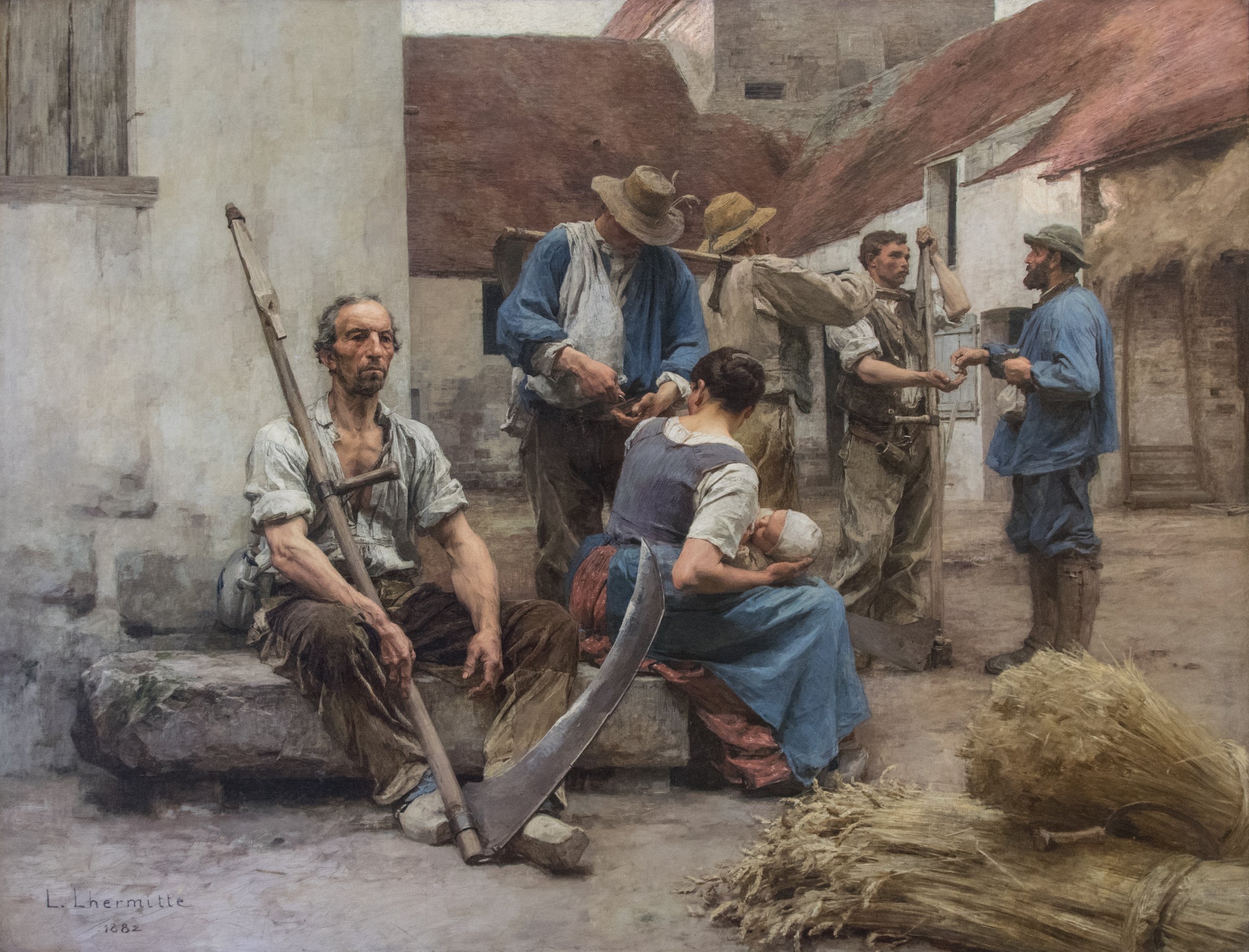
- The wagesA farmer counts coins into a harvester's open hand.Deuteronomy 24:15
- The tired reaperAn old man rests after a day in the sun.Matthew 20:12
- The bladeA long reaping blade leans against the bench.Deuteronomy 16:9
- The sheavesBound wheat lies ready to be carried in.Psalm 126:6
- The householdA mother nurses her child among the workers.Ruth 2:23
Léon Lhermitte, The Harvesters' Pay, 1882. Public domain.
Five parts of the canvas, each numbered where it stands, with the verse it answers to.
The Harvest Through Scripture
Nine places in canon order, from the feasts of Exodus to the sickle over the earth.
The reaping is a law, a festival, a warning and finally the close of history.
- Exodus 23:16two festivals of the farmer's year
- Leviticus 19:9the corners of the field left unreaped
- Deuteronomy 24:19a forgotten sheaf left for the widow
- Ruth 2:23a Moabite widow gleaning to the end of two seasons
- Joel 3:13the sickle swung over the nations
- Matthew 9:37 to 38plentiful fields and few workers
- Matthew 13:30wheat and weeds left together until the end
- James 5:4the withheld wages crying out
- Revelation 14:14 to 16a sickle in the hand of One like a son of man
Each stop opens its verse in the reader.
What Scripture Says and What Readers Have Heard
Five verses say what the harvest means, and one reading comes from the rabbis.
THE END OF THE AGE
Jesus decodes His own parable and names the reapers as angels.
SOWING AND REAPING
Paul makes the farmer's rule a law of the moral life.
TEARS AND JOY
The psalm promises a glad return to those who went out weeping.
IN SAMARIA
Jesus tells His disciples not to wait four months for the crop He means.
A HARVEST MISSED
The people mourn a season that ended with them still unsaved.
Tears and joy, In Samaria, A harvest missed
Joseph's bundles of grainRashi and Radak on Genesis 37
Rashi, in his commentary on Genesis 37:7, explains the binding of bundles as sheaves and sets beside it the sheaves of Psalm 126:6. Radak, on Genesis 37:5, reads the dream as a sign of Joseph's success. His later rise in Egypt came through the harvest he stored, and that grain is what brought the family before him.
The Harvest Year
Three festivals mark the barley, the wheat and the ingathering of the fruit.
Israel's festivals follow the order of the crops, so the farmer's calendar and the worship of the sanctuary run together.
(Now the flax and barley were destroyed, since the barley was ripe and the flax was in bloom; but the wheat and spelt were not destroyed, because they are late crops.)The plague of hail dates itself by the state of the crops.
The harvest year runs from the first barley to the ingathering at the year's end.
- The first sheafA sheaf of the new barley is waved before the LORD on the day after the Sabbath.Leviticus 23:10 to 11
- The countIsrael counts seven weeks from the first sickle in the standing grain.Deuteronomy 16:9
- The Feast of WeeksTwo leavened loaves of the new wheat are offered as firstfruits.Leviticus 23:16 to 17
- The Feast of IngatheringAt the year's end, after the threshing floor and the winepress, Israel keeps Tabernacles.Deuteronomy 16:13
Four stops of the farmer's year in the order the Law gives them.
What the reapers leave behindLeviticus 19:9 to 10 and Deuteronomy 24:19 to 21
Deuteronomy 24:20 to 21 carries the gleaning law into the olive and grape harvests, so the trees are beaten once and the vines picked once, and the rest is left for the poor.
You must not strip your vineyard bare or gather its fallen grapes. Leave them for the poor and the foreigner. I am the LORD your God.The vineyard is named in the same law as the field.
Qatsir, Qatsar, Therismos and Therizo
Two Hebrew words and two Greek words, the harvest and the act of reaping it.
קָצִיר qatsir
54 uses in the canon
The harvest, the crop or the season of cutting it.
קָצַר qatsar
49 uses in the canon
To cut short, and especially to reap grain.
θερισμός therismos
13 uses in the canon
The reaping, the word of the plentiful harvest and its few workers.
θερίζω therizo
21 uses in the canon
To reap, the verb of Paul's rule that a man reaps what he sows.
What the Text Does Not Say
Four questions about the harvest that Scripture leaves open.
The harvest passages leave the date of the end and the size of each year's crop unstated.
| What is not said | What the verse does say |
|---|---|
| Will every year bring a good crop? | It names the cycle of sowing and reaping and no yield. |
| When will the end of the age come? | It ties the reaping to the moment the angel announces. |
| How wide must the unreaped border be? | The Law gives no measure for the corner of the field. |
| Who are the workers of Matthew 9:38? | The command is to pray, and the answer is left to God. |
The Harvest at the End of the Age
Matthew 13:30 and Revelation 14:16, the crop left to ripen and then reaped.
The farmer of the parable will not let his servants pull the weeds early, because the wheat would come up with them. Revelation shows the same patience ending: the One seated on the cloud reaps only when the crop of the earth is ripe. Between the two lies the present season of sowing and reaping.
Let both grow together until the harvest. At that time I will tell the harvesters: First collect the weeds and tie them in bundles to be burned; then gather the wheat into my barn.’”The owner of the field fixes the time of separating, and it is the harvest.
So the One seated on the cloud swung His sickle over the earth, and the earth was harvested.John sees that time arrive in his vision.
Voices on the Harvest
Three teachers from the second century to the nineteenth, each with the work named.
died 215 · Clement of Alexandria
“During the harvest, [the law] forbids owners to gather up the bits which fall from the sheaves and similarly advises that in harvesting something should be left behind unreaped. By this it gives excellent teaching to owners in the practice of generous sharing by leaving some of their property for those in need and providing the poor with a chance for food.”
Clement of Alexandria · The Stromata Book 2 · on Leviticus 19:9 to 10Patristic
1662 to 1714 · Matthew Henry
“Our present time is seed-time: in the other world there will be a great harvest; and, as the husbandman reaps in the harvest according as he sows in the seedness, so we shall reap then as we sow now.”
Matthew Henry · Commentary on the Whole Bible · on Galatians 6:7Puritan
1834 to 1892 · Charles Spurgeon
“They that sow in tears shall reap in joy. Hence, present distress must not be viewed as if it would last for ever; it is not the end, by any means, but only a means to the end. Sorrow is our sowing, rejoicing shall be our reaping. If there were no sowing in tears there would be no reaping in joy. If we were never captives we could never lead our captivity captive. Our mouth had never been filled with holy laughter if it had not been first filled with the bitterness of grief.”
Charles Spurgeon · The Treasury of David, Vol. 7 · on Psalm 126:5
Where Careful Readers Differ
What the reaping of Revelation 14:14 to 16 gathers.
The righteous gathered inJamieson, Fausset and Brown, Commentary Critical and Explanatory, 1871
Jamieson, Fausset and Brown read the grain harvest as the gathering of the elect, with the Son of Man Himself reaping, and the vintage of verses 17 to 20 as the removal of the wicked. The objection: Joel 3:13 uses the sickle and the ripe harvest for judgment on the nations.
Judgment on the nationsVictorinus of Pettau, Commentary on the Apocalypse
Victorinus of Pettau reads both the sickle and the grapes of the vine as the nations that perish at the Lord's coming. The objection: the harvest of verses 14 to 16 is reaped by the One on the cloud and has no winepress of wrath, which the vintage alone receives in verse 19.
Both at onceAndreas of Caesarea, Commentary on the Apocalypse
Andreas of Caesarea reads the angel's cry as the heavenly powers asking for the honouring of the saints and the separation of sinners in one act. The objection: John describes two reapings in two scenes, a harvest and then a vintage.
Books to Read Next
Three works a student reads next, each free to read.
The Treasury of David
Charles Spurgeon · 1885
Its seventh volume holds Psalm 126 and its sowing in tears.
Read his Psalms notesCommentary on the Whole Bible
Matthew Henry · 1708 to 1710
The notes run verse by verse through Genesis and Galatians.
Read his Genesis notesCommentary on the Apocalypse
Victorinus of Pettau · third century
It is set out under the chapters of Revelation, from the first chapter on.
Read at New AdventThe Lord of the Harvest
God kept the seasons turning after the flood, and Jesus tells His disciples to ask the Lord of the harvest for workers in a field that is already ripe. The text asks the reader to pray that prayer and to sow now what will be reaped at the end.
Ask the Lord of the harvest, therefore, to send out workers into His harvest.”Sources
Scripture is the Berean Standard Bible.
- James Strong, Exhaustive Concordance of the Bible, 1890, entries H7105, H7114, G2326 and G2325, with their occurrence counts.
- Ephrem the Syrian, Commentary on Genesis 6.13.3, on Genesis 8:22.
- Matthew Henry, Commentary on the Whole Bible, 1710, on Galatians 6:7.
- Clement of Alexandria, The Stromata, Book 2, on Leviticus 19:9 to 10.
- Charles Spurgeon, The Treasury of David, volume 7, 1885, on Psalm 126:5.
- Rashi on Genesis 37:7, in the Pentateuch with Rashi's Commentary, translated by M. Rosenbaum and A. M. Silbermann, 1929 to 1934.
- Radak on Genesis 37:5, translated by Eliyahu Munk, HaChut Hameshulash.
- Jamieson, Fausset and Brown, Commentary Critical and Explanatory, 1871, on Revelation 14:15.
- Victorinus of Pettau, Commentary on the Apocalypse, on Revelation 14:15.
- Andreas of Caesarea, Commentary on the Apocalypse, on Revelation 14:15 to 16.
Keep Studying
People and groups3
Places1