
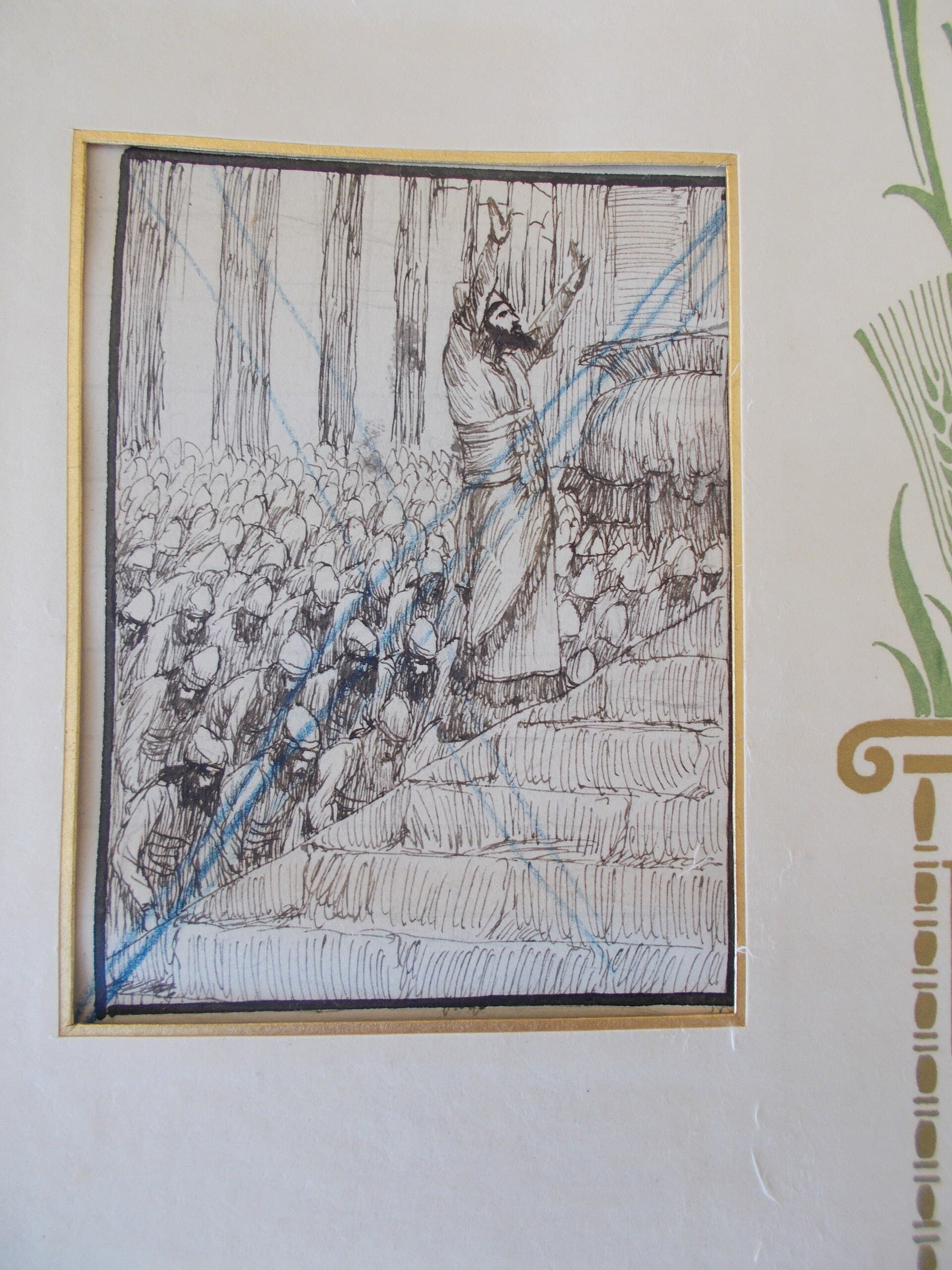
Psalm 141:2 · Symbol · Prayer
The Words Tefillah and Proseuche
Tefillah and proseuche run through Scripture from the prayers of Israel's kings and psalmists to the worship of heaven.
Jonah prayed from inside a fish with the same Hebrew verb Hannah used at Shiloh.
May my prayer be set before You like incense, my uplifted hands like the evening offering.
- The word
- תְּפִלָּה (tefillah), H8605
- First appears
- 2 Samuel 7:27 “For You, O LORD of Hosts, the God…”
Summary
The Hebrew noun tefillah names a prayer made to God, and its verb palal means to pray and to intercede. The Greek noun proseuche and its verb proseuchomai are the New Testament's words for prayer and for praying. Each of the four words takes its sense from the verse in which it stands, and none of them is to be read from its root alone.
- The Psalms hold more uses of tefillah than any other book of the Bible.
- The New Testament verb proseuchomai stands most often in Luke and Acts.
- The two verbs stand more often than the two nouns in the tagged text.
Prayer in the Hebrew Bible
The noun and the verb each have a first use, one in a king's prayer and one in a patriarch's story.
Prayer is one of the values Scripture asks of every believer, and the words the writers chose for it show what they meant by it. An English Bible often reads prayer or pray where the Hebrew and Greek writers chose between several words, and each word had its own range of use.
The question this study answers is what tefillah, palal, proseuche and proseuchomai meant to the writers who used them and where they gather in the canon. It gives the count of each word, the books that hold it most and its first use. It then follows the words to the temple, the Psalms and the prayers of the saints in Revelation, with their neighbouring words.
For You, O LORD of Hosts, the God of Israel, have revealed this to Your servant when You said, ‘I will build a house for you.’ Therefore Your servant has found the courage to offer this prayer to You.This is the first use of tefillah in the order of the canon, and the tagged Hebrew sets the verb palal beside it in David's prayer.
Now return the man’s wife, for he is a prophet; he will pray for you and you will live. But if you do not restore her, be aware that you will surely die—you and all who belong to you.”This is the first use of the verb palal, spoken of Abraham as one who intercedes for another.
Where Tefillah and Proseuche Stand
The books of 2 Chronicles and 1 Kings are among those that hold both Hebrew words most often.
The Hebrew noun gathers in the Psalms and the Greek verb in Luke.
| Word | Sense | Uses | Books with the most verses |
|---|---|---|---|
| tefillah, תְּפִלָּה, H8605, noun | intercession, supplication; by implication, a hymn | 72 | Psalms 26, 2 Chronicles 11, 1 Kings 7; 14 books in all |
| palal, פָּלַל, H6419, verb | to judge; by extension, to intercede, pray | 84 | 2 Chronicles 14, 1 Samuel 10, 1 Kings 10, Jeremiah 10; 18 books in all |
| proseuche, προσευχή, G4335, noun | prayer to God; a place of prayer | 35 | Acts 9, Luke 3, Revelation 3; 15 books in all |
| proseuchomai, προσεύχομαι, G4336, verb | to pray to God, supplicate, worship | 85 | Luke 18, Acts 16, Matthew 13; 15 books in all |
Tefillah at the Temple and in the Psalms
The noun stands in Solomon's plea, in the LORD's name for the temple and in the Psalms.
Yet regard the prayer and plea of Your servant, O LORD my God, so that You may hear the cry and the prayer that Your servant is praying before You today.The tagged Hebrew has tefillah twice in Solomon's plea and the verb palal once, so the two Hebrew words stand together in one verse.
Through Isaiah the LORD called the temple “a house of prayer for all the nations” (Isaiah 56:7), and the noun tefillah stands twice in that verse.
Then Jesus began to teach them, and He declared, “Is it not written: ‘My house will be called a house of prayer for all the nations’? But you have made it ‘a den of robbers.’”Jesus quotes Isaiah's line in the temple courts, where the Greek gives proseuche for the Hebrew noun.
In return for my love they accuse me, but I am a man of prayer.Where the Berean text reads a man of prayer, the tagged Hebrew line ends with the noun tefillah alone.
The noun also names written prayers. The second book of the Psalms closes, “Thus conclude the prayers of David son of Jesse” (Psalm 72:20), and Habakkuk's song is headed “a prayer of Habakkuk the prophet” (Habakkuk 3:1).
Palal, to Pray and to Intercede
The verb is used of one grieving woman and of a whole people in exile.
The STEP Bible lexicon glosses palal as “to judge (officially or mentally)” and defines it, by extension, as to intercede and pray. A word's meaning is set by its use, so the gloss cannot carry a teaching that prayer is a kind of judging.
In her bitter distress, Hannah prayed to the LORD and wept with many tears.Hannah's verse shows palal used of one person's own request, apart from the public prayers of the temple.
Through Jeremiah the LORD told the exiles, “Then you will call upon Me and come and pray to Me, and I will listen to you” (Jeremiah 29:12), where pray renders palal.
The Neighbouring Words
The Greek and the Hebrew have further words for prayer beside the main four.
First of all, then, I urge that petitions, prayers, intercessions, and thanksgiving be offered for everyone—The verse holds deesis and enteuxis beside proseuche, so three of the Greek words can be read in one line.
The Greek deesis (G1162) is a petition, and the STEP Bible lexicon notes that in the New Testament it is always addressed to God. Enteuxis (G1783) is rendered intercessions in 1 Timothy 2:1 and prayer in 1 Timothy 4:5. Euche (G2171) can mean a prayer, as in James 5:15, or a vow, as in Acts 18:18 and Acts 21:23. The Hebrew athar (H6279) means to pray, and Strong's gloss ties it to burning incense in worship.
Proseuche and Proseuchomai
In the New Testament the words stand at a river outside Philippi, at the first church's gatherings and in Jesus' teaching.
On the Sabbath we went outside the city gate along the river, where it was customary to find a place of prayer. After sitting down, we spoke to the women who had gathered there.The STEP Bible lexicon cites this verse for the noun's second sense, a place of prayer, beside its first sense, prayer to God.
The first church “devoted themselves to the apostles’ teaching and to the fellowship, to the breaking of bread and to prayer” (Acts 2:42), where the noun is plural, prayers.
So then, this is how you should pray: ‘Our Father in heaven, hallowed be Your name.Matthew gives Jesus' words to the disciples with the verb as a command, just before the prayer itself begins.
The Prayers of the Saints
Revelation joins proseuche to incense, as Psalm 141:2 had joined tefillah to it.
When He had taken the scroll, the four living creatures and the twenty-four elders fell down before the Lamb. Each one had a harp, and they were holding golden bowls full of incense, which are the prayers of the saints.Here proseuche stands in the plural, the first of its uses in Revelation.
Then another angel, who had a golden censer, came and stood at the altar. He was given much incense to offer, along with the prayers of all the saints, on the golden altar before the throne. And the smoke of the incense, together with the prayers of the saints, rose up before God from the hand of the angel.The noun stands in each of these two verses, which hold its last two uses in the canon.
Voices on the Words
Two voices read the incense of Psalm 141:2 and of Revelation 8.
1662 to 1714 · Matthew Henry
Henry stands here for how the saints' prayers come to be received by God.
Read the page on Matthew Henry
“The prayers of the saints themselves stand in need of the incense and intercession of Christ to make them acceptable and effectual, and there is provision made by Christ for that purpose; he has his incense, his censer, and his altar; he is all himself to his people.”
Matthew Henry · Commentary on the Whole Bible · on Revelation 8:3Puritan
1834 to 1892 · Charles Spurgeon
Spurgeon stands here for what the incense picture asks of the one who prays.
Read the page on Charles Spurgeon
“Let my prayer be set forth before thee as incense. As incense is carefully prepared, kindled with holy fire, and devoutly presented unto God, so let my prayer be. We are not to look upon prayer as easy work requiring no thought.”
Charles Spurgeon · The Treasury of David, Vol. 7 · on Psalm 141:2
The God Who Turns Toward Prayer
The study closes on Psalm 102, the plea of an afflicted psalmist.
Across both Testaments these four words name speech addressed to God, by one person or by His gathered people.
He will turn toward the prayer of the destitute; He will not despise their prayer.Psalm 102 holds tefillah in its first verse and twice in this one.
Sources
Scripture is the Berean Standard Bible.
- STEP Bible TBESH and TBESG glosses (Tyndale House, Cambridge, CC BY 4.0), the Greek glosses based on Abbott-Smith (1922), with the Strong's definitions (1890) the rows carry.
- STEP Bible, Translators Amalgamated Hebrew Old Testament and Greek New Testament, the tagged texts (Tyndale House, Cambridge), CC BY 4.0.
- James Strong, The Exhaustive Concordance of the Bible, with its dictionaries of the Hebrew and Greek words of the original (1890)
- Charles Spurgeon, The Treasury of David, volume 7 (1885), on Psalm 141:2.
- Matthew Henry, Commentary on the Whole Bible (1710), on Revelation 8:3.
Keep Studying
Studies1
In this value4
People and groups10
Symbols5