
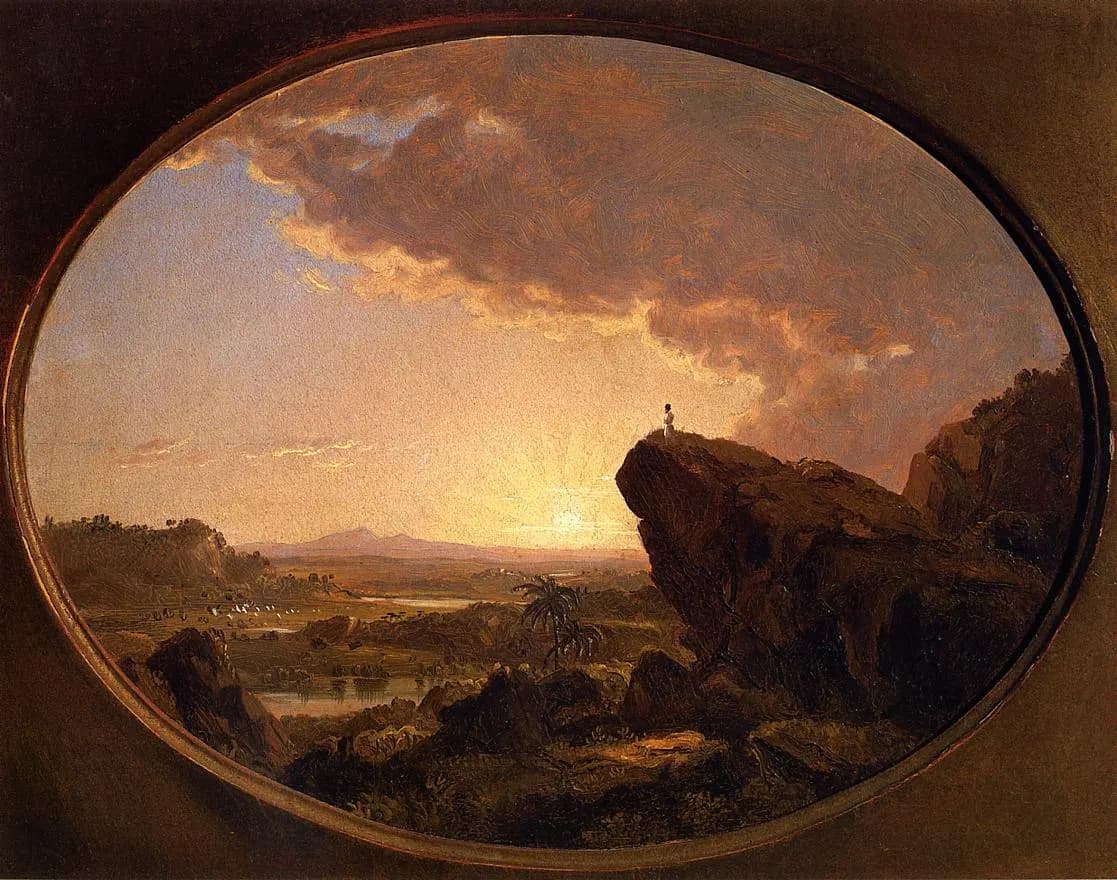
Moses Viewing the Promised Land, Frederic Edwin Church, 1846. Public domain.
Old Testament · Book 5 of 66
Deuteronomy
Deuteronomy records the speeches Moses gave Israel on the plains of Moab before they crossed the Jordan. He restates God's law for the new generation, and the book ends with his death on Mount Nebo.
Deuteronomy records the speeches Moses gave Israel on the plains of Moab before they crossed the Jordan. He restates God's law for the new generation, and the book ends with his death on Mount Nebo.
What is Deuteronomy about?
Deuteronomy is the last words of Moses. He speaks east of the Jordan in the land of Moab to the children of the generation that died in the wilderness. He retells the road from Horeb, gives the law again for life in the land, and sets the blessing and the curse before the people. Then he calls heaven and earth to witness and tells them to choose life. The book ends with Moses on Nebo, where the LORD shows him the land he will not enter, and he dies there in Moab.
All 34 chapters
Every chapter of the book, in one grid. Each cell opens that chapter.
- The roadDeuteronomy 1 to 4
- The great commandmentDeuteronomy 5 to 11
- The statutesDeuteronomy 12 to 26
- Blessing and curseDeuteronomy 27 to 28
- The covenant in MoabDeuteronomy 29 to 30
- Last wordsDeuteronomy 31 to 34
The colour is the movement of Moses' speeches the chapter stands in, and every cell opens that chapter's Study level. Chapter 4 stands in The road; the second speech begins at 4:44.
Who wrote it, where, when, for whom, and why?
Deuteronomy says that Moses spoke these words to all Israel east of the Jordan (1:1) and began to explain the law in the land of Moab (1:5). It says that he wrote the law and gave it to the priests (31:9) and finished writing its words in a book (31:24). The rest of Scripture names these as the words of Moses: Numbers closes with the commands given on the plains of Moab (Numbers 36:13), Joshua is told to keep the Book of the Law (Joshua 1:8) and reads it aloud at Ebal (Joshua 8:34), Hilkiah finds the Book of the Law in the temple (2 Kings 22:8), and Ezra reads the Book of the Law of Moses to the people (Nehemiah 8:1). The Gospels and Acts name Moses as the one who gave its commands (Matthew 19:7; Acts 3:22).
The whole book stands in one place: the land of Moab east of the Jordan (1:5), in the valley opposite Beth-peor (3:29). From there Moses climbs Nebo at the end (34:1).
The book gives its own date: the first day of the eleventh month of the fortieth year after Israel left Egypt (1:3). Israel crosses the Jordan on the tenth day of the first month after it (Joshua 4:19), so the book stands in the last weeks before the crossing. How that year falls on a calendar, and when the book was written, is set out under Where do readers disagree.
Moses speaks to the generation alive at the border. The fathers who refused to enter the land had died in the wilderness (1:35 and 2:14), and Moses tells their children that the covenant was made with them, the people alive that day (5:3). The book is also for every generation after them: the law is to be read to all the people, men, women, children and foreigners, every seventh year at the Feast of Booths (31:10 to 12).
The book says why it was given: so that Israel would listen to the statutes and follow them and live, and go in and take the land (4:1), love the LORD their God with all their heart (6:4 to 5), and choose life (30:19). Moses had the finished book placed beside the ark of the covenant as a witness (31:26).
“Take this Book of the Law and place it beside the ark of the covenant of the LORD your God, so that it may remain there as a witness against you.
Deuteronomy 31:26, Berean Standard Bible.
Deuteronomy stands at the edge of Canaan after forty years in the wilderness. Israel has passed Edom, Moab and Ammon, defeated Sihon and Og, and settled two and a half tribes east of the Jordan (3:12 to 13). Across the river lie the nations of Canaan and their gods (7:1 to 5), and Jericho stands opposite the camp (34:1).
Sources. Deuteronomy 1:1, 1:3, 1:5, 1:35, 2:14, 3:12 and 13, 3:29, 4:1, 5:3, 6:4 and 5, 7:1 to 5, 30:19, 31:9, 31:10 to 12, 31:24, 31:26 and 34:1; Numbers 36:13; Joshua 1:8, 4:19 and 8:34; 2 Kings 22:8; Nehemiah 8:1; Matthew 19:7; Acts 3:22. Every verse is read in the Berean Standard Bible.
How is Deuteronomy arranged, and what is it for?
The six movements of the speeches, the theme, the purpose and the treaty form.
- The road1:1 to 4:43, 161 verses in chapters 1 to 4, turning at 4:1
Moses retells the forty years from Horeb to the valley opposite Beth-peor, then turns at 4:1 to call Israel to listen and obey. The second speech begins at 4:44.
- The great commandment4:44 to 11:32, 187 verses in chapters 5 to 11, turning at 6:4
The Ten Commandments are given again, and at 6:4 the LORD is confessed as one and loved with the whole heart. Israel is warned not to forget him in the land.
- The statutes12:1 to 26:19, 345 verses in chapters 12 to 26, turning at 12:1
The laws for life in the land, from the one place of worship and the four offices to the household, the neighbour and the firstfruits.
- Blessing and curse27:1 to 28:68, 94 verses in chapters 27 to 28, turning at 28:15
The law is to be written on stones beyond the Jordan and the curses read out between two mountains. Chapter 28 sets fourteen verses of blessing against fifty-four of curse.
- The covenant in Moab29:1 to 30:20, 49 verses in chapters 29 to 30, turning at 30:19
The covenant is made in the land of Moab with the generation standing there, and at 30:19 life and death are set before them to choose.
- Last words31:1 to 34:12, 123 verses in chapters 31 to 34, turning at 34:5
Joshua is commissioned, the law is written and laid beside the ark, Moses sings and blesses the tribes, and he dies on Nebo in sight of the land.
The book marks its own parts with four headings: These are the words (1:1), This is the law (4:44), These are the words of the covenant (29:1), and This is the blessing (33:1). The second speech runs from 4:44 to 28:68 and takes three movements here, because its parts do three different things.
The theme
The LORD who brought Israel out of Egypt is one, and he asks for the love of the whole heart. The covenant made at Horeb is made again with the children in Moab, with its terms for life in the land and its blessing and curse. The book sees past its own law to a day when the LORD will circumcise the heart of his people so that they love him (30:6).
The purpose
Deuteronomy was given so that a new generation would own the covenant before it crossed the Jordan without Moses. It is written down, laid beside the ark and read aloud every seven years, so that each generation after would hear it too. It closes the five books of Moses, and Joshua opens with the command to keep this Book of the Law.
The parts of a covenant document, and where Deuteronomy has them
| The part of the covenant | Where Deuteronomy has it |
|---|---|
| The speaker named Who speaks, to whom, where and when. | 1:1 to 5, The road |
| What the LORD has done The road from Horeb retold, the kings defeated and the land given east of the Jordan. | 1:6 to 4:43, The road |
| The terms The Ten Commandments, the love owed to the LORD, and the statutes for the land. | 4:44 to 26:19, The great commandment and The statutes |
| The deposit and the public reading The law written, laid beside the ark, and read to all Israel every seventh year. | 31:9 to 13 and 31:26, Last words |
| The witnesses Heaven and earth called to witness, and the Song taught as a witness. | 30:19, 31:19 and 32:1, The covenant in Moab |
| The blessings and the curses The ceremony at Ebal and Gerizim, then the blessing and the curse of chapter 28. | 27 to 28, Blessing and curse |
The road remembered, Deuteronomy 1:1 to 4:43
What the text says in these 4 chapters, and the pages they open on.
Moses speaks in the land of Moab on the first day of the eleventh month of the fortieth year. He begins with the road. The LORD told Israel to leave Horeb and take the land, but at Kadesh-barnea the people refused to go up, and that generation died in the wilderness. Their children went around Seir, passed Edom, Moab and Ammon without a fight, and defeated Sihon and Og east of the Jordan. Moses asked to cross and was told to look from Pisgah instead. At 4:1 he turns from the past to the law: listen, obey, and live.
Hear now, O Israel, the statutes and ordinances I am teaching you to follow, so that you may live and may enter and take possession of the land that the LORD, the God of your fathers, is giving you.
- Study
Deuteronomy 1the words spoken in Moab, and the refusal at KadeshShow the summary and 3 pagesShow summary, 3 pagesHide the summary
Moses' first sermon opens on the east side of Jordan in the fortieth year. ‘The LORD our God said to us at Horeb … You have stayed at this mountain long enough. Resume your journey’. The appointment of the judges of thousands, hundreds, fifties, and tens (a recap of Exodus 18). The sending of the spies from Kadesh-barnea at the people's request; the evil report; the unbelief; the LORD's anger; Moses' exclusion. The presumptuous push forward rebuked at Hormah. The first generation must die in the wilderness. The chapter is retrospective. Sermon by a man about to die, facing a congregation that did not see these things and must be told.
On this chapter (3)
- The exodus
The rescue from Egypt followed as the pattern of later redemption.
- Who wrote Deuteronomy, and when?
Answered under Where do readers disagree, lower on this page, with each reading and who holds it.
- Deuteronomy 1:3
The verse on its own page, with the commentators on it by era.
- The exodus
- Study
Deuteronomy 2around Seir, and Sihon defeatedShow the summary and 2 pagesShow summary, 2 pagesHide the summary
The wilderness journey continued. The march around Mount Seir: ‘You have been wandering around this hill country long enough’. The command not to meddle with Esau (Edom), with Moab, or with Ammon. Their land is not Israel's portion. The long list of peoples who succeeded one another in those lands shows that God disposes the nations. The crossing of the brook Zered forty-eight days after Kadesh closed the first generation's dying. Then Sihon king of Heshbon refuses passage; the LORD hardens his spirit; Israel takes his cities. The whole chapter is a retelling with theological emphasis: every step was under divine appointment; every withheld hand was a withheld hand.
On this chapter (2)
- The Canaanite conquest
The command against the cities of Canaan and the grounds the text gives.
- Deuteronomy 2:14
The verse on its own page, with the commentators on it by era.
- The Canaanite conquest
- Study
Deuteronomy 3Og defeated, and Moses sees from PisgahShow the summary and 2 pagesShow summary, 2 pagesHide the summary
Og king of Bashan defeated. Sixty cities walled with high walls, gates, and bars; all taken. Og's bedstead of iron. Nine cubits by four. Was still in Rabbath of the children of Ammon. The land east of Jordan given to Reuben, Gad, and half Manasseh, with the charge that they cross armed before their brethren until all have their inheritance. Moses pleads to cross himself: ‘Please let me cross over and see the good land beyond the Jordan’. The LORD's answer: ‘Do not speak to Me again about this matter. … Go to the top of Pisgah’. Joshua charged; the people will follow him in.
On this chapter (2)
- The Watchers and the Nephilim
The giants of Genesis 6 and the peoples of Og's line.
- Deuteronomy 3:11
The verse on its own page, with the commentators on it by era.
- The Watchers and the Nephilim
- Study
Deuteronomy 4hear and obey, and the turn at 4:44Show the summary and 3 pagesShow summary, 3 pagesHide the summary
The exhortation. ‘Hear now, O Israel, the statutes and ordinances I am teaching you … You must not add to or subtract from what I command you’. The LORD spoke out of the midst of the fire; no form was seen. Therefore no graven image, no bowing to the host of heaven. Scattering and restoration foretold for Israel. ‘Has a people ever heard the voice of God speaking out of the fire, as you have, and lived?’ Three cities of refuge east of Jordan appointed by Moses. Bezer, Ramoth, Golan. The chapter closes the first sermon with a double warning and a double grace. Remember what you have seen; the LORD is God in heaven above, and upon the earth beneath: there is none else.
On this chapter (3)
- The Mosaic covenant
The covenant made at Sinai, its terms and its sign.
- The Ten Commandments
The ten words, how they are numbered, and how the New Testament uses them.
- Deuteronomy 4:1
The verse on its own page, with the commentators on it by era.
- The Mosaic covenant
The road as Moses retells it
- Station 1HorebDeuteronomy 1:6The LORD tells Israel to leave the mountain and go up.
- Station 2Kadesh-barneaDeuteronomy 1:19The spies sent, and the refusal to go up.
- Station 3Around SeirDeuteronomy 2:1Many days circling the hill country of Edom.
- Station 4The ZeredDeuteronomy 2:14Thirty-eight years, until the fighting men had died.
- Station 5The Arnon and SihonDeuteronomy 2:24The first king east of the Jordan given into their hand.
- Station 6Bashan and OgDeuteronomy 3:1The second king, and sixty cities taken.
- Station 7Opposite Beth-peorDeuteronomy 3:29The camp where Moses speaks.
Characters (2)
Who the text follows. A name with a page carries its door.
- Moses
The speaker of the whole book, who is not allowed to cross the Jordan.
- Caleb
The one spy of the first generation promised the land he walked on (1:36).
Places (2)
Where the chapters stand.
- Kadesh-barnea
Where the spies were sent out and the people refused to go up.
- Pisgah
The height from which Moses was told to look at the land.
Themes (2)
What these chapters raise, each on its own page.
- shama, to hear
The verb of 4:1 and 6:4, which in Hebrew also means to obey.
- The Canaanite conquest
The command about the nations and the grounds the text gives.
The great commandment, Deuteronomy 4:44 to 11:32
What the text says in these 7 chapters, and the pages they open on.
The second speech opens with the Ten Commandments given again to the generation that did not stand at Horeb as adults, and Moses says the covenant was made with the people alive that day. At 6:4 he names the heart of it: the LORD is one, and Israel is to love him with all its heart, soul and strength, and to teach his words to its children. He warns that the land will bring plenty and plenty will bring forgetting. He reminds them that the land is not a reward for their righteousness, since they rebelled at Horeb, and that the LORD gave the tablets a second time. The section ends with a blessing and a curse set before them.
Hear, O Israel: The LORD our God, the LORD is One.
- Study
Deuteronomy 5the Ten Commandments given againShow the summary and 4 pagesShow summary, 4 pagesHide the summary
The Decalogue restated. The LORD's covenant at Horeb with ‘us, even us, who are all of us here alive this day’. The ten words again, with slight differences (the Sabbath now grounded in Egyptian deliverance as well as creation; covetousness phrased with wife first). The people's plea: ‘let me not hear again the voice of the LORD my God, neither let me see this great fire any more, that I die not’. Moses as mediator receives the covenant's expansions. ‘O that there were such an heart in them, that they would fear me, and keep all my commandments always’. The second sermon begins.
On this chapter (4)
- The Ten Commandments
The ten words, how they are numbered, and how the New Testament uses them.
- Sabbath rest
The seventh day from creation to the rest that remains.
- The Mosaic covenant
The covenant made at Sinai, its terms and its sign.
- Deuteronomy 5:15
The verse on its own page, with the commentators on it by era.
- The Ten Commandments
- Study
Deuteronomy 6the Shema, and teaching the childrenShow the summary and 3 pagesShow summary, 3 pagesHide the summary
The Shema. ‘Hear, O Israel: The LORD our God, the LORD is One. And you shall love the LORD your God with all your heart and with all your soul and with all your strength.’ (6:4–5). These words shall be in your heart; teach them diligently to your children; talk of them when you sit in your house, when you walk by the way, when you lie down, when you rise up. Bind them as a sign upon your hand, as frontlets between your eyes; write them on the posts and gates. Beware lest in the land of milk and honey you forget the LORD. When your son asks you, ‘What is the meaning of the decrees and statutes and ordinances that the LORD our God has commanded you?’. Tell him the story. Jesus cites 6:5 as the first great commandment (Mark 12:29–30).
On this chapter (3)
- The Shema
Hear, O Israel, and the love of God with the whole heart.
- The greatest commandment
The love of God and neighbour, the law's summary.
- Deuteronomy 6:4
The verse on its own page, with the commentators on it by era.
- The Shema
- Study
Deuteronomy 7A chosen peopleShow the summary and 3 pagesShow summary, 3 pagesHide the summary
The election of Israel and the driving out of the nations. Seven nations greater and mightier than Israel. Hittite, Girgashite, Amorite, Canaanite, Perizzite, Hivite, Jebusite. The LORD will deliver before them. No covenants with them, no intermarriage, no compromise with their altars. ‘The LORD did not set His affection on you and choose you because you were more numerous than the other peoples, for you were the fewest of all peoples. … because the LORD loved you and kept the oath He swore to your fathers’. Cursed things are not to be brought into the house; the gold and silver of their gods are an abomination.
On this chapter (3)
- Predestination and election
Why God chooses a people, and what the choice is for.
- The Canaanite conquest
The command against the cities of Canaan and the grounds the text gives.
- Deuteronomy 7:6
The verse on its own page, with the commentators on it by era.
- Predestination and election
- Study
Deuteronomy 8the manna, and the danger of plentyShow the summary and 2 pagesShow summary, 2 pagesHide the summary
‘man does not live on bread alone, but on every word that comes from the mouth of the LORD’. Moses remembers the manna, the clothes that did not wear out, the feet that did not swell. The wilderness was a school. Humbling, proving, teaching dependence. A good land is coming. Brooks, fountains, wheat, barley, vines, figs, pomegranates, oil olive, honey; iron and brass for tools. Beware of full stomachs: ‘Be careful not to forget the LORD your God … when you eat and are satisfied, when you build fine houses in which to dwell … then your heart will become proud’. Jesus' first wilderness answer comes from this chapter (Matt 4:4).
On this chapter (2)
- Manna
The bread from heaven and the bread of life.
- Deuteronomy 8:3
The verse on its own page, with the commentators on it by era.
- Manna
- Study
Deuteronomy 9not for your righteousness, and the golden calfShow the summary and 2 pagesShow summary, 2 pagesHide the summary
Israel not righteous. A hard chapter to hear. The LORD will drive out nations greater than Israel, but ‘it is not because of your righteousness that the LORD your God is giving you this good land to possess, for you are a stiff-necked people’. Moses recalls the golden calf, the breaking of the tables, the forty days on his face pleading, the grinding of the calf to powder, the waters drunk in judgment. Taberah, Massah, Kibroth-hattaavah, Kadesh. The catalogue of rebellions. ‘Remember this, and never forget how you provoked the LORD your God in the wilderness.’ The inheritance is not wages; it is covenant. Henry: repentance is the door of inheritance, not merit.
On this chapter (2)
- The golden calf
The calf at the mountain's foot, the broken tablets and the intercession.
- Deuteronomy 9:5
The verse on its own page, with the commentators on it by era.
- The golden calf
- Study
Deuteronomy 10new tablets, and what the LORD asksShow the summary and 4 pagesShow summary, 4 pagesHide the summary
The second tables and the Levites. Moses hewed two tables like the first; the LORD wrote the ten words upon them; they were put in the ark Moses had made. The Levites set apart to bear the ark and to minister. Then the grand summary: ‘what does the LORD your God ask of you but to fear the LORD your God by walking in all His ways, to love Him, to serve the LORD your God with all your heart and with all your soul’. Circumcise the foreskin of your heart; stop being stiffnecked. The God who is God of gods loves the stranger; love the stranger because you were strangers in Egypt. The moral argument is grounded in memory.
On this chapter (4)
- The Ten Commandments
The ten words, how they are numbered, and how the New Testament uses them.
- The priest
The tribe of Levi set apart to carry the ark and serve.
- Circumcision of the heart
The heart the LORD asks for at 10:16 and promises at 30:6.
- Deuteronomy 10:12
The verse on its own page, with the commentators on it by era.
- The Ten Commandments
- Study
Deuteronomy 11Blessing or curseShow the summary and 2 pagesShow summary, 2 pagesHide the summary
Ebal and Gerizim previewed. Remember the chastening, the wonders in Egypt, Pharaoh, the Red Sea, Dathan and Abiram. The land is not like Egypt. Watered by foot with a shaduf. But a land of hills and valleys, drinking water of the rain of heaven. Early and latter rain given if you obey. ‘See, today I am setting before you a blessing and a curse’. The blessing if you obey, the curse if you will not. When the LORD brings you in, put the blessing on Mount Gerizim and the curse on Mount Ebal. Love the LORD, walk in his ways, hold fast to him; and no man shall be able to stand before you.
On this chapter (2)
- The two ways
The way of life and the way of death, from Deuteronomy to the Psalms.
- Deuteronomy 11:26
The verse on its own page, with the commentators on it by era.
- The two ways
The Ten Words twice, Exodus 20 and Deuteronomy 5
- The SabbathExodus 20:8 to 11 and 5:12 to 15Exodus opens with remember and Deuteronomy with observe. Deuteronomy adds the ox and the donkey to those who rest, and so that your servants may rest as you do. Exodus gives the six days of creation as the reason (20:11); Deuteronomy gives the slavery in Egypt (5:15).
- Father and motherExodus 20:12 and 5:16Deuteronomy adds as the LORD your God has commanded you, and that it may go well with you.
- CovetingExodus 20:17 and 5:21Exodus names the neighbour's house first and then his wife; Deuteronomy names the wife first, and adds his field.
The same wording in both: The LORD who brought you out of Egypt (20:2 and 5:6); No other gods (20:3 and 5:7); No idol, and no bowing to one (20:4 to 6 and 5:8 to 10); The name of the LORD (20:7 and 5:11); Murder (20:13 and 5:17); Adultery (20:14 and 5:18); Stealing (20:15 and 5:19); False witness (20:16 and 5:20).
Characters (2)
Who the text follows. A name with a page carries its door.
- Aaron
Moses' brother, whose death is noted at 10:6.
- The fathers
Abraham, Isaac and Jacob, to whom the LORD swore the land (6:10).
Places (2)
Where the chapters stand.
- Horeb
Where the tablets were broken and written again (9:8 to 10:5).
- Massah
Where Israel tested the LORD, named at 6:16 and 9:22.
Themes (2)
What these chapters raise, each on its own page.
- berith, covenant
The word for the covenant made at Horeb and in Moab.
- ahav, to love
The love the LORD commands at 6:5.
Where the New Testament uses these chapters (4)each marked as a quotation or an allusion, with the evidence
- Explicit quotationThe Shema, Deuteronomy 6:4 to 5 at Mark 12:29 to 30. Asked which commandment is first, Jesus answers with the Shema and the command to love the LORD with the whole heart. Held by Jesus, as Mark records him.
- Explicit quotationBread alone, Deuteronomy 8:3 at Matthew 4:4. Jesus answers the first temptation with the words given to Israel about the manna. Held by Jesus, as Matthew records him.
- Explicit quotationDo not test the LORD, Deuteronomy 6:16 at Matthew 4:7. Jesus answers the second temptation with the command given after Massah. Held by Jesus, as Matthew records him.
- Explicit quotationWorship and serve him only, Deuteronomy 6:13 at Matthew 4:10. Jesus answers the third temptation with the command to fear and serve the LORD alone. Held by Jesus, as Matthew records him.
The statutes for the land, Deuteronomy 12 to 26
What the text says in these 15 chapters, and the pages they open on.
At 12:1 Moses gives the statutes and ordinances Israel is to keep in the land. Worship is gathered to the one place the LORD will choose to put his Name. The laws set out who governs the people: judges in every town, a king who must write out a copy of the law, the priests and Levites, and a prophet like Moses whom the LORD will raise up. Then come the laws of life, land and war, and the laws of the household and the neighbour, with a care that runs through them for the foreigner, the fatherless and the widow. The statutes end with a basket of firstfruits and a confession of the story from a wandering Aramean to the land.
Instead, you must seek the place the LORD your God will choose from among all your tribes to establish as a dwelling for His Name, and there you must go.
- Study
Deuteronomy 12the place the LORD will chooseShow the summary and 3 pagesShow summary, 3 pagesHide the summary
One place of worship. ‘Destroy completely’ the altars and pillars and groves of the nations; do not worship the LORD in their manner. He will choose a place to set his name there. There you shall come, there you shall bring your burnt offerings and sacrifices and tithes and vows and freewill offerings and the firstlings of your herds and flocks. Eat of them before the LORD and rejoice. Blood not eaten; poured on the earth as water. ‘Do not inquire about their gods, asking, “How do these nations serve their gods? I will do likewise.”’ The religion of Israel is worship at the LORD's altar, not imitation of the surrounding altars.
On this chapter (3)
- The altar
The altars of Scripture, and the one place the LORD chooses.
- Does the one chosen place contradict the altar law of Exodus 20?
Answered under Where do readers disagree, lower on this page, with each reading and who holds it.
- Deuteronomy 12:5
The verse on its own page, with the commentators on it by era.
- The altar
- Study
Deuteronomy 13False prophetsShow the summary and 2 pagesShow summary, 2 pagesHide the summary
False prophets and tempters within the family. If a prophet or a dreamer says ‘Let us follow other gods’ and gives a sign. Even one that comes to pass. He is not to be heard; he is a testing from the LORD. Such a prophet must be put to death. If your brother, son, daughter, wife of your bosom, or friend as your own soul entice you secretly: ‘Your hand must be the first against him to put him to death’. If a whole city is drawn away, the city is to be utterly destroyed. The chapter's severity is proportionate to the stakes: idolatry is not a private matter; it poisons the covenant community.
On this chapter (2)
- How prophecy works
The prophet like Moses and the test of a true word.
- Deuteronomy 13:3
The verse on its own page, with the commentators on it by era.
- How prophecy works
- Study
Deuteronomy 14Clean food, tithesShow the summary and 4 pagesShow summary, 4 pagesHide the summary
The dietary reminder and the tithe. ‘You are sons of the LORD your God’. Do not mar yourselves for the dead as the nations do. The clean and unclean list from Leviticus 11 recapitulated. ‘You must not cook a young goat in its mother’s milk’ (third appearance). The tithe eaten before the LORD at the place he chooses, or converted to money and spent there when the distance is too great (for wine, strong drink, oxen, sheep, whatever your soul desires). The third-year tithe kept at home for the Levite, the stranger, the fatherless, and the widow. Worship and charity intertwined in the rhythm of harvest.
On this chapter (4)
- The widow, the orphan and the stranger
The three the law protects, and the tithe set aside for them.
- The law fulfilled
How the law of Moses stands after Christ.
- Which of these laws bind the church?
Answered under Where do readers disagree, lower on this page, with each reading and who holds it.
- Deuteronomy 14:2
The verse on its own page, with the commentators on it by era.
- The widow, the orphan and the stranger
- Study
Deuteronomy 15Year of releaseShow the summary and 3 pagesShow summary, 3 pagesHide the summary
The Sabbatical-year release and the Hebrew servant. Every seventh year, every creditor who has lent shall release what he has lent to his neighbour and brother. Lending to the stranger may continue. ‘There will be no poor among you’. The ideal and the realism in the same breath: ‘there will never cease to be poor in the land’. Therefore open your hand wide. The Hebrew servant freed in the seventh year goes out free with liberal provision; if he chooses to stay, his ear is bored through with an awl at the door-post. Firstlings of the herd and flock eaten before the LORD at the chosen place. Gill notes the chapter's twin stress: release liberally, free liberally.
On this chapter (3)
- Jubilee
The years of release in Israel's law.
- The Bible and slavery
The servant laws of Israel read beside the New Testament.
- Deuteronomy 15:1
The verse on its own page, with the commentators on it by era.
- Jubilee
- Study
Deuteronomy 16Passover, Weeks and BoothsShow the summary and 4 pagesShow summary, 4 pagesHide the summary
The three pilgrimage feasts and the charge to judges. Passover at the place the LORD shall choose. No leaven seen within all your borders seven days. Weeks. Seven weeks from the sickle put to the standing corn; rejoicing before the LORD with household, Levite, stranger, fatherless, widow. Tabernacles. Seven days from the ingathering. Three times a year all males shall appear before the LORD; none shall appear empty. ‘You are to appoint judges and officials for your tribes in every town … Do not deny justice or show partiality. Do not accept a bribe … Pursue justice, and justice alone, so that you may live, and you may possess the land’.
On this chapter (4)
- Tabernacles
The feast of booths at the end of the harvest.
- Firstfruits
The first of the harvest brought to the LORD.
- Unleavened bread
The week of bread without yeast after the Passover.
- Deuteronomy 16:16
The verse on its own page, with the commentators on it by era.
- Tabernacles
- Study
Deuteronomy 17the courts and the law of the kingShow the summary and 2 pagesShow summary, 2 pagesHide the summary
Courts and the king. Sentences not resolved in the gates shall come up to the priests and the judge at the central place. Their verdict binding. Should Israel ask for a king, three strictures: no multiplying horses (no return to Egypt); no multiplying wives (his heart turn not away); no multiplying silver and gold. The king shall write for himself a copy of this law in a book from the priests' original: ‘and it shall be with him, and he shall read therein all the days of his life: that he may learn to fear the LORD his God’. The chapter anticipates the kingship of Israel's later centuries; every king is to be a covenant reader.
On this chapter (2)
- Jubilee
The years of release in Israel's law.
- Deuteronomy 17:18
The verse on its own page, with the commentators on it by era.
- Jubilee
- Study
Deuteronomy 18the priests' portion and the prophet like MosesShow the summary and 4 pagesShow summary, 4 pagesHide the summary
The priests' portion and the prophet like Moses. Levites have no part among their brethren; the LORD is their inheritance. They receive shoulder, cheeks, maw, firstfruits, the firstfleece. False practice. Divination, observers of times, enchanters, witches, charmers, consulters with familiar spirits, wizards, necromancers. Is an abomination. ‘The LORD your God will raise up for you a prophet like me from among your brothers. You must listen to him.’ (18:15). The mark of the true prophet: what he speaks in the name of the LORD comes to pass. Peter cites this verse of Christ in Acts 3:22.
On this chapter (4)
- How prophecy works
The prophet like Moses and the test of a true word.
- Moses wrote of me
The prophet like Moses and the Gospels that name him.
- The priest
The priests and Levites and their portion.
- Deuteronomy 18:15
The verse on its own page, with the commentators on it by era.
- How prophecy works
- Study
Deuteronomy 19Cities of refugeShow the summary and 2 pagesShow summary, 2 pagesHide the summary
Cities of refuge in the land; the landmark; the false witness. Three cities within the land on this side of Jordan (with three more if the LORD enlarges the coast). The manslayer with unintentional death flees there; the avenger of blood will not prevail; the high priest's death ends the refuge. The deliberate murderer, though he flee, is fetched thence and given to the avenger's hand. ‘You must not move your neighbor’s boundary marker’. A false witness must bear the penalty he sought to bring on the accused: ‘You must show no pity: life for life, eye for eye, tooth for tooth, hand for hand, and foot for foot’.
On this chapter (2)
- The cities of refuge
The three cities where the manslayer may flee.
- Deuteronomy 19:15
The verse on its own page, with the commentators on it by era.
- The cities of refuge
- Study
Deuteronomy 20Rules of warShow the summary and 3 pagesShow summary, 3 pagesHide the summary
Laws of war. ‘When you go out to war against your enemies and see horses, chariots, and an army larger than yours, do not be afraid of them … for the LORD your God, who brought you out of the land of Egypt, is with you’. A priest encourages; officers release. The new-house man, the new-vineyard man, the newly-betrothed man, the fearful. When approaching a far city, proclaim peace first; if refused, besiege. Cities of the seven nations of the land. Destroy utterly. Do not destroy fruit trees: ‘Are the trees of the field human, that you should besiege them?’ The chapter is Israel's war manual; its constraints are as notable as its permissions.
On this chapter (3)
- The Canaanite conquest
The command against the cities of Canaan and the grounds the text gives.
- Why did God command the destruction of the Canaanite cities?
Answered under Where do readers disagree, lower on this page, with each reading and who holds it.
- Deuteronomy 20:16
The verse on its own page, with the commentators on it by era.
- The Canaanite conquest
- Study
Deuteronomy 21Unsolved murderShow the summary and 2 pagesShow summary, 2 pagesHide the summary
The unsolved murder, the captive wife, the rebellious son, and the hanging on a tree. A corpse in the field. The nearest city's elders break a heifer's neck at an unploughed stream; they wash their hands over it and testify that this blood is not theirs. A captive woman taken as wife. Thirty days of mourning; then a full wife, not to be sold. A firstborn of two wives. The beloved's son does not supplant the hated's son if he is the firstborn. A stubborn, rebellious son. The elders of his city stone him. A hanged man: ‘he that is hanged is accursed of God; his body shall not remain all night upon the tree’. Galatians 3:13 reads this verse to the cross.
On this chapter (2)
- The tree
The tree from Eden to the cross, and the curse on one hung on a tree.
- Deuteronomy 21:23
The verse on its own page, with the commentators on it by era.
- The tree
- Study
Deuteronomy 22Marriage lawsShow the summary and 2 pagesShow summary, 2 pagesHide the summary
Community laws. The brother's ox or sheep gone astray. Bring it home. The brother's ass fallen. Lift it up. Women's clothes on a man, men's on a woman. Abomination. The mother bird spared on the nest: ‘so that it may be well with you and that you may prolong your days’. Battlements on new house-roofs. No seed mixed in one vineyard, no ox and ass yoked together, no garment of wool and linen together. Fringes on the four corners of your cloak. Laws of virginity, adultery, rape, and the betrothed damsel. The tokens of virginity preserved by the parents, the elders at the gate as judges. The covenant community's fabric protected.
On this chapter (2)
- Marriage and the household
The laws of the home read across Scripture.
- Deuteronomy 22:1
The verse on its own page, with the commentators on it by era.
- Marriage and the household
- Study
Deuteronomy 23The assemblyShow the summary and 2 pagesShow summary, 2 pagesHide the summary
The assembly, the camp's purity, and various laws. Castrated and bastards barred from the assembly of the LORD; Ammonite and Moabite to the tenth generation; Edomite and Egyptian admitted in the third generation. The camp must be kept clean. A place outside for nature, a paddle on the weapon to cover it: ‘For the LORD your God walks throughout your camp’. The escaped slave finds asylum. No harlots, no sodomites, no usury to a brother. Vows to be paid promptly. Eating freely in a neighbour's vineyard or cornfield as you pass through, but not filling a vessel or putting a sickle to his grain.
On this chapter (2)
- The widow, the orphan and the stranger
The three the law protects, and the tithe set aside for them.
- Deuteronomy 23:3
The verse on its own page, with the commentators on it by era.
- The widow, the orphan and the stranger
- Study
Deuteronomy 24Divorce and justiceShow the summary and 3 pagesShow summary, 3 pagesHide the summary
Divorce, gleanings, labour, and the pledge. Divorce permitted but not encouraged; a second husband's divorce does not restore the first. The newly-wed man free from war and public charge for a year. No handmill or upper millstone taken as a pledge: ‘that would be taking one’s livelihood as security’. Kidnapping punished with death. Leprosy: ‘Remember what the LORD your God did to Miriam’. Lending without entering the debtor's house to fetch a pledge; the poor man's garment returned at sundown. Wages paid the same day. No perverting the judgment of the stranger, fatherless, widow; no pledge from the widow. Gleanings of field, olive, vine left for the poor.
On this chapter (3)
- Divorce
The certificate of 24:1 and what Jesus said of it.
- The widow, the orphan and the stranger
The three the law protects, and the tithe set aside for them.
- Deuteronomy 24:1
The verse on its own page, with the commentators on it by era.
- Divorce
- Study
Deuteronomy 25Fair weightsShow the summary and 2 pagesShow summary, 2 pagesHide the summary
Various laws; levirate marriage; Amalek. Forty stripes by number, not more. Lest the brother be degraded. The ox not muzzled that treads out the corn (Paul in 1 Cor 9:9 reads this pastorally). The brother who dies without a son. His widow marries his brother, and the firstborn succeeds in the dead brother's name; the brother's refusal met by the plucking off of his shoe. A just weight and a just measure (‘everyone who behaves dishonestly in regard to these things is detestable to the LORD your God’. The chapter closes: ‘Remember what the Amalekites did to you along your way from Egypt’) blot out the remembrance of Amalek.
On this chapter (2)
- The kinsman-redeemer
The brother's duty to the widow and the redeemer of Ruth.
- Deuteronomy 25:5
The verse on its own page, with the commentators on it by era.
- The kinsman-redeemer
- Study
Deuteronomy 26the firstfruits and the confessionShow the summary and 3 pagesShow summary, 3 pagesHide the summary
The confession at the firstfruits. The Israelite shall take of the first of all the fruit of the earth, put it in a basket, come to the place the LORD shall choose, and recite before the priest the little creed: ‘My father was a wandering Aramean, and he went down to Egypt few in number and lived there … But the Egyptians mistreated us … So we called out to the LORD, the God of our fathers … Then the LORD brought us out of Egypt … And He brought us to this place and gave us this land, a land flowing with milk and honey’. The third-year tithe testified. None to the dead, none unclean. ‘And today the LORD has proclaimed that you are His people and treasured possession’.
On this chapter (3)
- Firstfruits
The first of the harvest brought to the LORD.
- The widow, the orphan and the stranger
The three the law protects, and the tithe set aside for them.
- Deuteronomy 26:5
The verse on its own page, with the commentators on it by era.
- Firstfruits
The plan of the statutes
- The place and its worshipDeuteronomy 12:1 to 16:17The one place the LORD chooses, false prophets, clean food, the tithe, the year of release and the three feasts.
- The four officesDeuteronomy 16:18 to 18:22Judges (16:18), the king (17:14), the priests (18:1) and the prophet (18:15).
- Life, land and warDeuteronomy 19:1 to 21:23Cities of refuge, boundary stones, witnesses, the rules of war and the unsolved murder.
- Household and neighbourDeuteronomy 22:1 to 25:19Lost property, marriage, the assembly, loans, wages, gleaning and honest weights.
- The firstfruits and the confessionDeuteronomy 26:1 to 19The basket brought to the place and the confession of 26:5.
Characters (2)
Who the text follows. A name with a page carries its door.
- The prophet like Moses
The one the LORD promises to raise up (18:15).
- The foreigner, the fatherless and the widow
The three the statutes return to again and again.
Places (2)
Where the chapters stand.
- The place the LORD will choose
The one place of worship, named from 12:5 to 26:2 and never named by town.
- The cities of refuge
Three cities for the manslayer who killed without intent (19:2).
Themes (2)
What these chapters raise, each on its own page.
- bachar, to choose
The LORD chooses the place and Israel chooses life.
- Firstfruits
The first of the harvest brought to the LORD.
Where the New Testament uses these chapters (5)each marked as a quotation or an allusion, with the evidence
- Explicit quotationA certificate of divorce, Deuteronomy 24:1 at Matthew 19:7. The Pharisees ask why Moses commanded a certificate of divorce, and Jesus answers from the beginning of creation. Held by the Pharisees and Jesus, as Matthew records them.
- Explicit quotationThe prophet like Moses, Deuteronomy 18:15 at Acts 3:22. Peter quotes the promise of a prophet like Moses and applies it to Jesus; Stephen quotes it again at Acts 7:37. Held by Peter and Stephen, as Luke records them.
- Explicit quotationHanged on a tree, Deuteronomy 21:23 at Galatians 3:13. Paul cites the curse on one hung on a tree and says Christ became a curse for us. Held by Paul.
- Explicit quotationTwo or three witnesses, Deuteronomy 19:15 at Matthew 18:16. Jesus applies the rule of two or three witnesses to a brother who will not listen; Paul uses it at 2 Corinthians 13:1. Held by Jesus and Paul.
- Explicit quotationDo not muzzle the ox, Deuteronomy 25:4 at 1 Corinthians 9:9. Paul cites the law of the threshing ox for the right of those who preach to be paid; he cites it again at 1 Timothy 5:18. Held by Paul.
Blessing and curse, Deuteronomy 27 to 28
What the text says in these 2 chapters, and the pages they open on.
Moses and the elders command that once Israel crosses the Jordan the law is to be written on plastered stones and an altar built on Mount Ebal. Six tribes are to stand on Gerizim to bless and six on Ebal for the curse, and the Levites are to read out twelve curses, each answered by the people's amen. Chapter 28 sets out what follows obedience: blessing in the town and the field, rain in season and victory over enemies. From 28:15 it sets out what follows disobedience: disease, drought, defeat, siege, and at the last a scattering among the nations and a return to Egypt in ships.
“Now if you faithfully obey the voice of the LORD your God and are careful to follow all His commandments I am giving you today, the LORD your God will set you high above all the nations of the earth.
- Study
Deuteronomy 27the stones, the altar and the twelve cursesShow the summary and 2 pagesShow summary, 2 pagesHide the summary
Ebal and Gerizim. The third sermon begins. Great stones to be set up on Mount Ebal with all the words of this law written upon them, plastered with plaster. An altar of unhewn stones. Six tribes (Simeon, Levi, Judah, Issachar, Joseph, Benjamin) on Mount Gerizim to bless; six (Reuben, Gad, Asher, Zebulun, Dan, Naphtali) on Mount Ebal to curse. Twelve curses pronounced by the Levites with loud voice, each answered with ‘Amen’. The graven image, the despiser of parents, the mover of the landmark, the misleader of the blind, the perverter of judgment, the incestuous, the smiter of the neighbour secretly, the confirmer of blood. The covenant's sanctions spoken.
On this chapter (2)
- The two ways
The way of life and the way of death, from Deuteronomy to the Psalms.
- Deuteronomy 27:26
The verse on its own page, with the commentators on it by era.
- The two ways
- Study
Deuteronomy 28the blessing and the curseShow the summary and 3 pagesShow summary, 3 pagesHide the summary
The blessings and the curses in full. Fourteen verses of blessings: blessed in the city and in the field, in the fruit of body, ground, cattle, store. Enemies smitten; blessings on the goings out and comings in. Then fifty-four verses of curses: cursed in city and field, in body, ground, cattle, store; consumption, fever, blasting, mildew, enemies, madness, blindness, oppression; wife taken, son taken, crops eaten by locust and palmer-worm; exile; serving gods of wood and stone; the besieged eating the flesh of their children. The prophets will quote this chapter for centuries. Moses publishes in advance the twin futures of obedience and apostasy, blessing and covenant curse.
On this chapter (3)
- The two ways
The way of life and the way of death, from Deuteronomy to the Psalms.
- The land covenant
The promise of the land and its return after exile.
- Deuteronomy 28:1
The verse on its own page, with the commentators on it by era.
- The two ways
The two mountains and the ledger of chapter 28
Simeon, Levi, Judah, Issachar, Joseph, Benjamin
Reuben, Gad, Asher, Zebulun, Dan, Naphtali
Characters (2)
Who the text follows. A name with a page carries its door.
- The Levites
Who read the curses aloud to all Israel (27:14).
- The twelve tribes
Divided six and six between the two mountains.
Places (2)
Where the chapters stand.
- Mount Ebal
Where the stones are written and the altar built, and the curse is spoken (27:4).
- Mount Gerizim
Where six tribes stand to bless the people (27:12).
Themes (2)
What these chapters raise, each on its own page.
- The two ways
The way of blessing and the way of the curse.
- The land covenant
The land promised, lost and restored.
Where the New Testament uses these chapters (1)each marked as a quotation or an allusion, with the evidence
- Explicit quotationCursed is everyone who does not continue, Deuteronomy 27:26 at Galatians 3:10. Paul cites the last curse of the Ebal ceremony against relying on the works of the law. Held by Paul.
The covenant in Moab, Deuteronomy 29 to 30
What the text says in these 2 chapters, and the pages they open on.
The third speech opens at 29:1 with the words of the covenant the LORD commanded Moses to make in the land of Moab, in addition to the covenant at Horeb. It is made with everyone standing there, from the leaders to the water carrier, and with those not yet born. Moses foresees exile and a return, when the LORD will gather his people and circumcise their hearts so that they love him (30:6). The command is not too hard or far away, but near, in the mouth and the heart. He calls heaven and earth to witness, and sets life and death before the people, and tells them to choose life.
I call heaven and earth as witnesses against you today that I have set before you life and death, blessing and cursing. Therefore choose life, so that you and your descendants may live, and that you may love the LORD your God, obey Him, and hold fast to Him. For He is your life, and He will prolong your life in the land that the LORD swore to give to your fathers, to Abraham, Isaac, and Jacob.”
- Study
Deuteronomy 29the covenant made in MoabShow the summary and 4 pagesShow summary, 4 pagesHide the summary
The covenant renewed in the land of Moab. ‘All of you are standing today before the LORD your God … you leaders of tribes, elders, officials … your children and wives, and the foreigners in your camps’. The covenant is with those present and ‘with those who are not here today’. The secret things belong to the LORD our God; but those things which are revealed belong to us and to our children for ever. Warning against the one whose heart turns aside (‘no root among you that bears such poisonous and bitter fruit’) whose presumption the LORD will not spare. The future exile anticipated, and the Gentiles' question, ‘Why has the LORD done such a thing to this land?’ answered in advance.
On this chapter (4)
- The covenants
The covenants God makes in Scripture, read in order.
- The land covenant
The promise of the land and its return after exile.
- Does 29:1 close the second speech or open a covenant of its own?
Answered under Where do readers disagree, lower on this page, with each reading and who holds it.
- Deuteronomy 29:1
The verse on its own page, with the commentators on it by era.
- The covenants
- Study
Deuteronomy 30return, the circumcised heart, and choose lifeShow the summary and 4 pagesShow summary, 4 pagesHide the summary
‘I have set before you life and death, blessing and cursing’. When the blessings and the curses have come upon Israel and they are scattered, ‘return to the LORD your God and obey His voice … then He will restore you from captivity’. The word is not hidden, not far off, not beyond the sea: ‘the word is very near you; it is in your mouth and in your heart, so that you may obey it.’ (Paul quotes in Rom 10). ‘I have set before you today life and goodness, as well as death and disaster. … Therefore choose life, so that you and your descendants may live … and that you may love the LORD your God, obey Him, and hold fast to Him. For He is your life’.
On this chapter (4)
- The two ways
The way of life and the way of death, from Deuteronomy to the Psalms.
- The land covenant
The promise of the land and its return after exile.
- Circumcision of the heart
The heart the LORD asks for at 10:16 and promises at 30:6.
- Deuteronomy 30:19
The verse on its own page, with the commentators on it by era.
- The two ways
Characters (2)
Who the text follows. A name with a page carries its door.
- Those not here today
The later generations the covenant is made with (29:15).
- The leaders and the water carrier
Everyone standing in Moab, named from the heads of the tribes down (29:10 to 11).
Places (1)
Where the chapters stand.
- The land of Moab
East of the Jordan, where Moses speaks the whole book (1:5).
Themes (3)
What these chapters raise, each on its own page.
- The covenants
The covenants God makes in Scripture, read in order.
- Circumcision of the heart
The promise of 30:6, taken up by the prophets and by Paul.
- chayyim, life
Life set against death at 30:15 and 30:19.
Where the New Testament uses these chapters (1)each marked as a quotation or an allusion, with the evidence
- Explicit quotationThe word is near you, Deuteronomy 30:12 to 14 at Romans 10:6 to 8. Paul reads the nearness of the commandment as the word of faith he preaches. Held by Paul.
Last words and the death of Moses, Deuteronomy 31 to 34
What the text says in these 4 chapters, and the pages they open on.
Moses is a hundred and twenty years old and will not cross the Jordan. He charges Joshua before all Israel to be strong and courageous, writes the law and gives it to the priests, and orders it read to all the people every seventh year at the Feast of Booths. The LORD tells him that Israel will turn to other gods, and gives him a song to teach them as a witness. Moses speaks the Song, blesses the tribes one by one, and climbs Mount Nebo. The LORD shows him the land from Gilead to the sea, and Moses dies there in Moab, and no prophet has arisen in Israel like him.
So Moses the servant of the LORD died there in the land of Moab, as the LORD had said.
Since that time, no prophet has risen in Israel like Moses, whom the LORD knew face to face— no prophet who did all the signs and wonders that the LORD sent Moses to do in the land of Egypt to Pharaoh and to all his officials and all his land, and no prophet who performed all the mighty acts of power and awesome deeds that Moses did in the sight of all Israel.
- Study
Deuteronomy 31Joshua charged, and the law laid beside the arkShow the summary and 2 pagesShow summary, 2 pagesHide the summary
Joshua commissioned publicly; the Law written; the reading every seven years. Moses is 120; he cannot any more go out and come in; the LORD has said he will not cross Jordan. ‘Be strong and courageous; do not be afraid or terrified of them, for it is the LORD your God who goes with you; He will never leave you nor forsake you.’ The Law is written and delivered to the priests and elders; read every seven years at the Feast of Tabernacles before all Israel. Men, women, children, strangers. That they may hear and learn. The LORD foretells the people's future apostasy; Moses is to write a song that will testify against them in the evil day to come.
On this chapter (2)
- The Torah
The five books of Moses read as one.
- Deuteronomy 31:26
The verse on its own page, with the commentators on it by era.
- The Torah
- Study
Deuteronomy 32the Song of MosesShow the summary and 4 pagesShow summary, 4 pagesHide the summary
The song of Moses. ‘Give ear, O heavens, and I will speak; hear, O earth, the words of my mouth’. A covenant lawsuit in verse. The Rock of Israel; his work is perfect; his ways are judgment. Jeshurun waxed fat and kicked. The LORD will provoke them with a foolish nation; fire kindled to the lowest hell; arrows drunk with blood. ‘See now that I am He; there is no God besides Me. I bring death and I give life; I wound and I heal’ (32:39). Vengeance is mine, and recompence. ‘Rejoice, O nations, with His people’. Cited in Rom 15:10. Moses teaches the song so that Israel cannot unlearn it. ‘Go up into the Abarim Range to Mount Nebo … And there on the mountain that you climb, you will die’.
On this chapter (4)
- Moses strikes the rock
The rock in the wilderness and the Rock of the Song.
- The covenant lawsuit
God bringing his case against his people, heaven and earth as witnesses.
- Does 32:8 read the sons of God or the sons of Israel?
Answered under Where do readers disagree, lower on this page, with each reading and who holds it.
- Deuteronomy 32:8
The verse on its own page, with the commentators on it by era.
- Moses strikes the rock
- Study
Deuteronomy 33Moses blesses the tribesShow the summary and 2 pagesShow summary, 2 pagesHide the summary
The blessing of the tribes. ‘The LORD came from Sinai and dawned upon us from Seir; He shone forth from Mount Paran’. Reuben: ‘Let Reuben live and not die’. Judah. Bring him to his people. Levi. Your Urim and Thummim with your holy one; teach Jacob your judgments. Benjamin. The beloved of the LORD shall dwell in safety by him. Joseph. Blessed of the LORD be his land for the precious things of heaven, the earth, the sun, the moon, the ancient mountains, the fulness thereof, and the good will of him that dwelt in the bush. Zebulun and Issachar. Gad. Dan. Naphtali. Asher. ‘There is none like the God of Jeshurun, who rides the heavens to your aid … The eternal God is your dwelling place, and underneath are the everlasting arms’.
On this chapter (2)
- The Torah
The five books of Moses read as one.
- Deuteronomy 33:1
The verse on its own page, with the commentators on it by era.
- The Torah
- Study
Deuteronomy 34Nebo, and the death of MosesShow the summary and 3 pagesShow summary, 3 pagesHide the summary
Moses' death. He goes up from the plains of Moab to Mount Nebo to the top of Pisgah, that is over against Jericho. The LORD shows him all the land. Gilead, Dan, Naphtali, Ephraim, Manasseh, Judah to the utmost sea, the south, the plain of the valley of Jericho, the city of palm trees, to Zoar. ‘This is the land that I swore to give Abraham, Isaac, and Jacob … I have let you see it with your own eyes, but you will not cross into it’. So Moses the servant of the LORD died there in the land of Moab, according to the word of the LORD; he buried him in a valley in the land of Moab, over against Beth-peor: but no man knows of his grave to this day. Moses was 120; his eye not dim, nor his natural force abated. Israel wept for him thirty days. ‘Since that time, no prophet has risen in Israel like Moses, whom the LORD knew face to face’.
On this chapter (3)
- The exodus
The rescue that began at the bush and ends on Nebo.
- Who wrote the account of Moses' death?
Answered under Where do readers disagree, lower on this page, with each reading and who holds it.
- Deuteronomy 34:5
The verse on its own page, with the commentators on it by era.
- The exodus
What Moses saw from Nebo
- 1Gilead to Danverse 1
- 2Naphtaliverse 2
- 3Ephraim and Manasseh
- 4Judah to the Western Sea
- 5The Negevverse 3
- 6Jericho to Zoar
Characters (2)
Who the text follows. A name with a page carries its door.
Places (2)
Where the chapters stand.
Themes (2)
What these chapters raise, each on its own page.
- tsur, rock
The name the Song gives the LORD (32:4).
- The Torah
The five books of Moses, which end here.
Where the New Testament uses these chapters (3)each marked as a quotation or an allusion, with the evidence
- Probable allusionI will never leave you, Deuteronomy 31:6 at Hebrews 13:5. Hebrews gives the promise made to Israel and to Joshua as a word to believers; the same promise stands at Joshua 1:5. Held by the writer to the Hebrews.
- Explicit quotationVengeance is mine, Deuteronomy 32:35 at Romans 12:19. Paul cites the Song of Moses to forbid taking revenge; Hebrews 10:30 cites the same line. Held by Paul and the writer to the Hebrews.
- Explicit quotationRejoice, O nations, Deuteronomy 32:43 at Romans 15:10. Paul cites the Song's call to the nations among the texts that show the Gentiles praising God. Held by Paul.
- Author
- Moses, the sermons on the plains of Moab; ch. 34 (his death) traditionally attributed to Joshua
- Date
- The final weeks of Moses' life on the plains of Moab, c. 15th–13th century BC
- Audience
- The new generation of Israel, standing east of the Jordan, about to cross into the land
Where do readers disagree?
One list: the readings with their holders, and what the evidence does not settle.
Who wrote Deuteronomy, and when?
- Moses, on the plains of Moab. Argued from the treaty form by Meredith G. Kline, Treaty of the Great King (1963), and Kenneth A. Kitchen, On the Reliability of the Old Testament (2003).
- A seventh-century book, the scroll of Josiah's reform. Held by W. M. L. de Wette, Dissertatio critico-exegetica (1805), and Julius Wellhausen, Prolegomena to the History of Israel (1878).
What the evidence does not settle: The book's own claim stands against comparison with treaties of two eras, and no copy is older than the Qumran scrolls.
The argument in full
Moses, on the plains of Moab. The book says Moses spoke and wrote it (1:1, 1:5, 31:9, 31:24), Joshua reads it as the Book of the Law of Moses (Joshua 8:34), and Jesus speaks of Moses commanding what Deuteronomy 24:1 says (Matthew 19:7 to 8).
A seventh-century book, the scroll of Josiah's reform. The one chosen place of chapter 12 is read as the programme of Josiah's reform, and the curses of chapter 28 are set beside the Assyrian loyalty oaths of the seventh century.
The witnesses to the text, 5
The Nash Papyrus (c. 150 to 100 BC). A single sheet from Egypt carrying the Ten Commandments followed by the Shema of Deuteronomy 6:4 to 5. Before the Dead Sea Scrolls it was the oldest known Hebrew biblical manuscript. The Qumran Deuteronomy scrolls (c. 250 BC to AD 68). More than thirty copies of Deuteronomy were found in the caves at Qumran, among the most copied books there with Psalms and Isaiah. Most agree closely with the Masoretic Text; 4QDeut-j and 4QDeut-q carry the readings of the Song of Moses at 32:8 and 32:43. The Masoretic Text (c. AD 900 (the Leningrad and Aleppo Codices)). The standard Hebrew text behind English translations of Deuteronomy. At 32:8 it reads the sons of Israel. The Samaritan Pentateuch (an independent tradition, its manuscripts medieval). A Hebrew Torah kept outside rabbinic Judaism. Where the Masoretic Text at 27:4 names Ebal for the altar, it names Gerizim. The Septuagint (c. third century BC). The Greek Torah the apostles most often quote. Its Song of Moses is the wording behind Romans 15:10 and Hebrews 1:6.
The finds, 2
The structure on Mount Ebal (excavated 1982 to 1989 by Adam Zertal, dated by him to c. 1200 BC). A large stone installation with a ramp, ash and the bones of clean animals on the mountain Deuteronomy names for the curse (27:13). Zertal identified it as the altar of Joshua 8:30 to 31; others read it as a watchtower or a farmstead, and the identification is disputed. The Arad temple and the Beersheba horned altar (excavated 1962 to 1967 (Arad) and 1969 to 1976 (Beersheba)). A Judahite sanctuary whose altar went out of use, and a horned altar found taken apart with its stones built into a wall. Both are read on the one chosen place of chapter 12, one way as a late reform and the other as the putting down of altars that had always been irregular.
What does the treaty match prove about the date?
- It points to the second millennium. Held by Kline and by Kitchen in the works named above.
- It points to the seventh century. Held by Moshe Weinfeld, Deuteronomy and the Deuteronomic School (1972).
What the evidence does not settle: Both bodies of parallels are real, and a form can outlive its age, so the parallels alone do not fix a date.
The argument in full
It points to the second millennium. The Hittite treaties of about 1400 to 1200 BC carry a historical prologue and blessings as well as curses, and so does Deuteronomy; the later Assyrian treaties drop both.
It points to the seventh century. Several curses of chapter 28 sit close in wording and order to the Succession Treaty of Esarhaddon of 672 BC.
The Hittite vassal treaties, Hittite, from the archives at Hattusa, c. 1400 to 1200 BC. A fixed order of parts: the great king named, what he has already done for the vassal, the terms, the deposit and public reading of the text, the witnesses, and the blessings and the curses. Meredith G. Kline (Treaty of the Great King, 1963) and Kenneth A. Kitchen (On the Reliability of the Old Testament, 2003) argue that this form belongs to the second millennium, since the historical prologue and the blessings drop out of the later Assyrian treaties. The Succession Treaty of Esarhaddon and the Sefire treaties, Neo-Assyrian and Aramaean, 672 BC (Esarhaddon); eighth century BC (Sefire). Loyalty oaths sworn to a king, heavy with curse lists, in which the vassal is bound to love the king. Several curses of Deuteronomy 28 sit close in wording and order to curses in Esarhaddon's treaty. Moshe Weinfeld (Deuteronomy and the Deuteronomic School, 1972) reads these first-millennium parallels as evidence for a seventh-century book.
Who wrote the account of Moses' death?
- Joshua or a later hand added it. Held by Rabbi Judah in the Babylonian Talmud, Bava Batra 15a, and by Adam Clarke, Commentary on the Bible (1832), on 34:1.
- Moses wrote it at God's word. Held by Rabbi Simeon in the Babylonian Talmud, Bava Batra 15a, the same passage.
What the evidence does not settle: The chapter names no writer, and the phrase to this day (34:6) is read by both sides.
The argument in full
Joshua or a later hand added it. The chapter reports Moses' death and burial (34:5 to 6) and looks back across time to say no prophet has arisen like him (34:10).
Moses wrote it at God's word. Moses wrote the closing verses as the LORD spoke them, before the events, and wrote them in tears.
Was the scroll found in Josiah's temple Deuteronomy?
- A copy of the book of Moses, lost and found. Held by Matthew Henry, Commentary on the Whole Bible (1710), on 31:9, and John Wesley, Explanatory Notes upon the Old Testament (1765), on 31:26.
- The book was written in that age and published by the find. Held by W. M. L. de Wette, Dissertatio critico-exegetica (1805).
What the evidence does not settle: Both readings agree the scroll matched Deuteronomy; they differ on how old it was when it was found.
The argument in full
A copy of the book of Moses, lost and found. Deuteronomy orders a copy laid beside the ark (31:26) and a copy written by every king (17:18), so a scroll in the temple is what the book expects.
The book was written in that age and published by the find. The reforms that follow 2 Kings 22:8 track Deuteronomy closely: the high places torn down, worship gathered to Jerusalem, and the Passover kept as chapter 16 orders.
Does the one chosen place contradict the altar law of Exodus 20?
- Two laws for two situations. Held by J. G. McConville, Deuteronomy (2002), and by Kitchen.
- A later reform replacing an older law. Held by de Wette and by Wellhausen in the works named above.
What the evidence does not settle: Altars stand at Ebal, Shiloh, Mizpah and Carmel after Moab, and both readings have to account for them.
The argument in full
Two laws for two situations. Exodus 20:24 governs the wilderness and the years before the land is at rest; Deuteronomy 12:9 to 10 binds the one place to the rest the LORD will give.
A later reform replacing an older law. Chapter 12 is read as the charter of Josiah's centralizing reform.
Why did God command the destruction of the Canaanite cities?
The Canaanite conquest, argued in full→- Judgment on the grounds the text gives. Set out by Christopher J. H. Wright, The God I Don't Understand (2008).
- The wording follows the conventions of ancient war reports. Held by K. Lawson Younger, Ancient Conquest Accounts (1990).
What the evidence does not settle: The command at 20:16 to 18 stands; the readings differ on how its wording was meant, and chapter 28 puts Israel under the same judgment.
The argument in full
Judgment on the grounds the text gives. Deuteronomy gives the wickedness of the nations (9:5) and the danger that they teach Israel their practices (20:18), and Genesis 15:16 had said the sin of the Amorites was not yet full.
The wording follows the conventions of ancient war reports. Egyptian, Hittite and Assyrian campaign texts use the same total language, and Joshua and Judges report survivors in cities said to be wholly destroyed.
Does 29:1 close the second speech or open a covenant of its own?
The covenants, read in order→- It opens the covenant in Moab, the covenant of Horeb made again. Held by Wesley and Henry, each on 29:1, and by Peter C. Craigie, The Book of Deuteronomy (1976).
- It closes the speech before it. Held by Clarke, Commentary on the Bible, on 29:1.
What the evidence does not settle: The verse can stand as the colophon of what goes before or the heading of what follows, and the Hebrew and English numbering divide on it.
The argument in full
It opens the covenant in Moab, the covenant of Horeb made again. The verse names a covenant made in Moab in addition to the one at Horeb; Wesley and Henry read it as the one covenant proclaimed and ratified again for the second generation.
It closes the speech before it. A new subject begins at 29:2, and the Hebrew Bible numbers the verse 28:69, the last line of the blessings and the curses.
Does 32:8 read the sons of God or the sons of Israel?
The Watchers and the Nephilim→- The sons of God. Read by the Septuagint and the Qumran fragment 4QDeut-j, printed by the Berean Standard Bible, and argued by Michael S. Heiser (The Unseen Realm, 2015).
- The sons of Israel. Read by the Masoretic Text, printed by the King James and American Standard versions, and taken so by Henry, Commentary on the Whole Bible, on 32:8.
What the evidence does not settle: Both readings are old; which one the Song first carried is argued from the witnesses and not settled by them.
The argument in full
The sons of God. The nations are divided according to the number of the heavenly host, and the LORD keeps Israel as his own portion (32:9).
The sons of Israel. The bounds of the nations are set according to the number of Israel, and Henry reads the verse as God ordering the nations with a regard to his people.
Which of these laws bind the church?
- The moral law binds, and the ceremonial and civil laws are fulfilled. Set out in the Westminster Confession of Faith (1646), chapter 19, and held by Henry, Commentary on the Whole Bible, on 13:17.
- The civil penalties would still serve a people well. Held by Clarke, Commentary on the Bible, on 19:21 and 21:18.
What the evidence does not settle: Where each law falls between moral, ceremonial and civil is argued law by law, and the New Testament names only some of them.
The argument in full
The moral law binds, and the ceremonial and civil laws are fulfilled. Jesus declares all foods clean (Mark 7:19), and the council at Jerusalem lays on Gentile believers no more than a few necessary things (Acts 15:28 to 29).
The civil penalties would still serve a people well. Clarke writes that the law of like for like and the law of the rebellious son restrained crime, and that a people would be better for them if they were in force.
The pages Deuteronomy opens on
Studies224
- The Shema
- The Greatest Commandment
- The Ten Commandments
- The Mosaic Covenant
- The Land Covenant
- The Covenants
Show the next 6 titles
Show the next 6 titles
Show the next 6 titles
- The Altar
- The Watchers and the Nephilim
- The Torah
- The Bible and the Ancient Near East
- Circumcision of the Heart
- Gerizim and Ebal: the blessing and the curse
Show the next 6 titles
- Hanged on a tree
- Joshua son of Nun
- The Nephilim and the Giants
- Prophet, Priest and King: The Threefold Office of Christ
- The Bible and Slavery
- The Blessing of Jacob: Genesis 49 Tribe by Tribe
Show the next 6 titles
- The early and the latter rain
- The Farmer's Creed
- The forbidden arts
- The Numbering of the Ten Commandments
- The prophet like Moses
- The Prosperity Message
Show the next 6 titles
- The rules of war
- The Song of Moses
- The stubborn and rebellious son
- The Temptation in the Wilderness: Matthew 4
- The Three Forbidden Mixtures
- The Three Pilgrim Feasts
Show the next 6 titles
- The Treaty Form of Deuteronomy
- Two or three witnesses
- War and Peace: Just War and Christian Nonresistance
- Who Wrote the Pentateuch
- Mazzaroth
- Trees: Eden, Cross, New Jerusalem
Show the next 6 titles
- Justice and Righteousness: Mishpat and Tsedaqah
- Put That on Mine Account: Imputation
- The God Who Sings: Zephaniah 3:17
- Caleb
- Caleb and the Twelve Spies
- Moses Strikes the Rock
Show the next 6 titles
- Paran
- Sinai, the Mountain of God
- The Elders of Israel
- The Judge
- The Large Numbers of the Old Testament
- The Wilderness Itinerary
Show the next 6 titles
Show the next 6 titles
- The Philistines
- Mount Hermon: the Oath
- Gilead
- The death of Moses
- The Register of the Thirty-One Kings
- Baal of Peor
Show the next 6 titles
- The Divine Council
- Fire
- How Scripture Shapes Christian Ethics
- Mouth to Mouth: How God Spoke with Moses
- The Brickfields of Egypt
- The Furnace & the Refiner's Fire
Show the next 6 titles
- The Sun
- Six Days You Shall Labor
- Sunday and the Sabbath
- The Sabbath in Jewish Practice
- The Designer's Fingerprint
- Trust in the LORD with All Your Heart
Show the next 6 titles
- Gematria and Its Limits
- It Is Written
- Jesus on the Scriptures
- Marriage and the Household
- Obedience
- The Words Shama and Hypakoe
Show the next 6 titles
- Faith
- God Is Love
- Rebekah
- The devoted thing (herem)
- The nations left in the land
- Why God Is Not Finished With Israel
Show the next 6 titles
Show the next 6 titles
- The Intercession of Moses
- The Quail at Kibroth-hattaavah
- Hospitality in Israel and the Early Church
- To Act Justly, to Love Mercy, and to Walk Humbly
- The Heavens
- The Levites
Show the next 6 titles
- The Priestly Blessing
- The Seventy Who Went Down and the Seventy-Five of Acts
- The Widow, the Orphan & the Stranger
- The Twelve Tribes
- Egypt
- The Farmer Waits for the Rain
Show the next 6 titles
- Shechem
- The Nile
- Jephthah's vow
- Micah's idol and the migration of Dan
- No king in Israel: the refrain that closes Judges
- The blood rule after the cross
Show the next 6 titles
Show the next 6 titles
- The Death Penalty in the Law of Moses
- True and false prophets
- Clean and Unclean
- Mourning and Burial in Israel
- The Tithe
- Lending, Pledges and the Year of Release
Show the next 6 titles
- The Book of the Covenant
- The Eye as the Lamp of the Body
- The Hebrew Feasts
- Who May Dwell on Your Holy Mountain?
- Jesus at Twelve (Luke 2)
- David Danced Before the Ark
Show the next 6 titles
- The Joy of the LORD Is Your Strength
- The Words Simchah and Chara
- The Words Mishpat and Tsedaqah
- Money, Law and Power
- Pentecost
- The Hebrew Calendar
Show the next 6 titles
- The Passover and the First Month
- The Seder, the Meal Exodus 12 Is Kept By
- Solomon
- Solomon and the Two Mothers: 1 Kings 3
- The King
- The Rise of the Monarchy and the Law of the King
Show the next 6 titles
- The Watchers' Secrets
- Feeding the Five Thousand, John 6:1-15
- Moses
- Samuel Hears His Name: 1 Samuel 3
- Saul at Endor: 1 Samuel 28
- The teraphim
Show the next 6 titles
- The Transfiguration: Matthew 17 · Mark 9 · Luke 9
- An Eye for an Eye in the Law of Moses
- Naboth's Vineyard: 1 Kings 21
- Susanna and the Two Judges
- The Floating Axe Head: 2 Kings 6
- The Levitical Towns
Show the next 6 titles
- The Ordeal of the Suspected Wife
- The Prayer of Agreement
- Gideon's Fleece
- Hard Questions in the Old Testament
- Jacob
- The Birthright
Show the next 6 titles
- The Crucifixion
- The Firstborn
- The Tree
- The Younger Set Before the Elder
- Dinah at Shechem
- The Tassels and the Blue Cord
Show the next 6 titles
- Unequally Yoked
- Gleaning and the corner of the field
- Judith
- Mesopotamia
- Philip and the Ethiopian: Acts 8
- Ruth
Show the next 6 titles
- The Mixed Multitude and the Foreigner
- Vows in Israel
- A Day in the Life
- Divorce: What Jesus Said
- Generational Curses
- Ruth's Kindness to Naomi
Show the next 6 titles
- The Harvest
- Tsara'at: the affliction of Leviticus 13 and 14
- Work and Vocation
- Amalek and the Standing War
- Just Weights
- Levirate Marriage
Show the next 6 titles
- The Body and Sexual Ethics in Scripture
- The city gate as the court
- Weights, Measures, and Money in Scripture
- Haran
- Laban
- The Woman at the Well: John 4
Show the next 6 titles
Places10
Show the next 4 titles
Sources for this page
The painting in the band is Moses Viewing the Promised Land, Frederic Edwin Church, 1846. Public domain. The movements, the chapter entries, the figures and the Context are read off the text of Deuteronomy. The works behind the readings under Where do readers disagree are W. M. L. de Wette, Dissertatio critico-exegetica (1805); Julius Wellhausen, Prolegomena to the History of Israel (1878); Meredith G. Kline, Treaty of the Great King (1963); Moshe Weinfeld, Deuteronomy and the Deuteronomic School (1972); Peter C. Craigie, The Book of Deuteronomy (1976); K. Lawson Younger, Ancient Conquest Accounts (1990); J. G. McConville, Deuteronomy (2002); Kenneth A. Kitchen, On the Reliability of the Old Testament (2003); Christopher J. H. Wright, The God I Don't Understand (2008); Michael S. Heiser, The Unseen Realm (2015); Matthew Henry, Commentary on the Whole Bible (1710); John Wesley, Explanatory Notes upon the Old Testament (1765); Adam Clarke, Commentary on the Bible (1832); the Babylonian Talmud, Bava Batra 15a; and the Westminster Confession of Faith (1646).