
Deuteronomy 17 and 19 · Subject · Featured Study
Two or three witnesses
The rule of Deuteronomy 17 and 19 passed into the teaching of Jesus and the letters of Paul.
The witnesses who convicted a man had to raise the first hands against him.
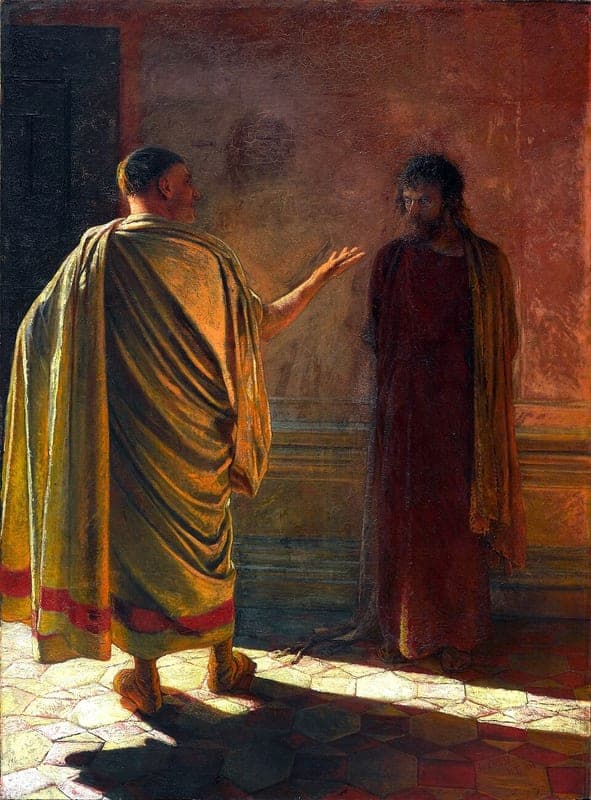
Nikolai Ge, "What is truth?" Christ and Pilate, painted in 1890 and now in the public domain (PD-old-100-expired; PD-Art), from the Wikimedia Commons file What_is_truth.jpg.
THE ARTWORKGe painted Pilate in the light with his hand raised as he speaks, and Jesus standing in shadow against the wall. The painting stands here for the trial of Jesus, where the rule of witnesses was put to the test.
Summary
Under the law of Moses no one could be put to death, or found guilty of any wrong, on the testimony of a lone witness.
- The law turned a false witness's own scheme back on him.
- Jesus and Paul both cite the rule, and Hebrews argues from it to the judgment on rejecting the Son of God.
- Rashi, after the Talmud, built a body of rules on these verses, from the meaning of the word witness to the sentence of plotting witnesses.
Why the Law Asked for Two Witnesses
Numbers and Deuteronomy give the rule three times, and two readers give the reason for it.
If anyone kills a person, the murderer is to be put to death on the testimony of the witnesses. But no one is to be put to death based on the testimony of a lone witness.On the testimony of two or three witnesses a man shall be put to death, but he shall not be executed on the testimony of a lone witness.A lone witness is not sufficient to establish any wrongdoing or sin against a man, regardless of what offense he may have committed. A matter must be established by the testimony of two or three witnesses.Adam Clarke explains why two were needed: one witness might be deceived, or prejudiced, or malicious. Rashi, on Deuteronomy 17:4, takes the report found true to mean that the evidence of the witnesses agrees.
The case in Deuteronomy 17Deuteronomy 17:2 to 5
If a man or woman among you in one of the towns that the LORD your God gives you is found doing evil in the sight of the LORD your God by transgressing His covenant and going to worship other gods, bowing down to them or to the sun or moon or any of the host of heaven—which I have forbidden—The charge is the breach of the covenant itself, by a man or woman of Israel.
and if it is reported and you hear about it, you must investigate it thoroughly. If the report is true and such an abomination has happened in Israel, you must bring out to your gates the man or woman who has done this evil thing, and you must stone that person to death.The inquiry comes before the sentence, and the witnesses of verse 6 are the evidence it weighs.
The charge to the first judgesDeuteronomy 1:16 to 17
At that time I charged your judges: “Hear the disputes between your brothers, and judge fairly between a man and his brother or a foreign resident. Show no partiality in judging; hear both small and great alike. Do not be intimidated by anyone, for judgment belongs to God. And bring to me any case too difficult for you, and I will hear it.”The rule of witnesses serves the charge Moses gave the first judges, to show no partiality because judgment belongs to God.
Nine Texts That Carry the Rule
The rule runs from the law of murder in Numbers to a warning in Hebrews.
- A killer is put to death only on more than one witness
- A death sentence needs two or three witnesses
- Any charge stands on two or three witnesses
- One or two others are taken along
- False witnesses come before the council
- Jesus cites the law that two witnesses suffice
7Paul's third visit to Corinth
- The rule governs Paul's dealing with the church
- No accusation is received without two or three witnesses
- The law's death sentence rested on two or three witnesses
A chain of nine texts in canon order, and each name opens its verse.
The rule in the GospelsMatthew 18, Matthew 26 and Mark 14; Origen
If your brother sins against you, go and confront him privately. If he listens to you, you have won your brother over. But if he will not listen, take one or two others along, so that ‘every matter may be established by the testimony of two or three witnesses.’ If he refuses to listen to them, tell it to the church. And if he refuses to listen even to the church, regard him as you would a pagan or a tax collector.The private word comes first, and the witnesses come only if the brother will not listen.
Again, I tell you truly that if two of you on the earth agree about anything you ask for, it will be done for you by My Father in heaven. For where two or three gather together in My name, there am I with them.”The two or three return in His promise to be present where they gather in His name.
Now the chief priests and the whole Sanhedrin were seeking false testimony against Jesus in order to put Him to death. But they did not find any, though many false witnesses came forward. Finally two came forward and declared, “This man said, ‘I am able to destroy the temple of God and rebuild it in three days.’”Matthew shows the council seeking false witnesses, the abuse Deuteronomy 19:16 to 19 punishes.
Now the chief priests and the whole Sanhedrin were seeking testimony against Jesus to put Him to death, but they did not find any. For many bore false witness against Jesus, but their testimony was inconsistent. Then some men stood up and testified falsely against Him: “We heard Him say, ‘I will destroy this man-made temple, and in three days I will build another that is made without hands.’” But even their testimony was inconsistent.Under Deuteronomy 19:15, testimony that did not agree could establish nothing.
Origen reads the failure of the witnesses as evidence of the innocence of Jesus.
“False witnesses have place when there is any good colour for their testimony. But no pretext was found which could further their falsehoods against Jesus; notwithstanding there were many desirous to do a favour to the Chief Priests. This then is a great testimony in favour of Jesus, that He had lived and taught so irreproachably, that though they were many, and crafty, and wicked, they could find no semblance of fault in Him.”
Origen of Alexandria · Catena Aurea by Aquinas · on Matthew 26:59 to 60Patristic
The rule in the letters2 Corinthians 13:1, 1 Timothy 5:19 and Hebrews 10:28; Ambrosiaster
This is the third time I am coming to you. “Every matter must be established by the testimony of two or three witnesses.”Paul quotes Deuteronomy 19:15 as he warns the church at Corinth that he will not spare those who sinned.
“Paul is here appealing to the law, saying that it applies to the Corinthians as well.”
Ambrosiaster · Commentary on Paul's Epistles · on 2 Corinthians 13:1Patristic
Do not entertain an accusation against an elder, except on the testimony of two or three witnesses.Paul writes this to Timothy, whom he had left at Ephesus to instruct the church there.
Anyone who rejected the law of Moses died without mercy on the testimony of two or three witnesses. How much more severely do you think one deserves to be punished who has trampled on the Son of God, profaned the blood of the covenant that sanctified him, and insulted the Spirit of grace?Hebrews reasons from the lesser case to the greater, from the law of Moses to the Son of God.
The False Witness and the First Hands
Two laws bind the witnesses themselves, and an eighteenth-century commentator gives the reason for the second.
If a false witness testifies against someone, accusing him of a crime, both parties to the dispute must stand in the presence of the LORD, before the priests and judges who are in office at that time. The judges shall investigate thoroughly, and if the witness is proven to be a liar who has falsely accused his brother, you must do to him as he intended to do to his brother. So you must purge the evil from among you.These verses are the law's answer to the false witness the ninth commandment forbids.
Then the rest of the people will hear and be afraid, and they will never again do anything so evil among you. You must show no pity: life for life, eye for eye, tooth for tooth, hand for hand, and foot for foot.The sentence is made known so that others fear to lie, and verse 21 sets its measure.
The hands of the witnesses shall be the first in putting him to death, and after that, the hands of all the people. So you must purge the evil from among you.John Wesley, in his Explanatory Notes upon the Old Testament (1765), gives two reasons for this order. A witness who had lied out of malice or anger would fear to stain his hands with innocent blood, and the people could carry out the sentence with confidence.
How the judges test a witnessMatthew Henry on Deuteronomy 19:18
“A diligent inquisition must be made into the characters of the persons, and all the circumstances of the case, which must be compared, that the truth might be found out, which, where it is thus faithfully and impartially enquired into, Providence, it may be hoped, will particularly advance the discovery of.”
Matthew Henry · Commentary on the Whole Bible · on Deuteronomy 19:18Puritan
The same order in Deuteronomy 13Deuteronomy 13:9
Instead, you must surely kill him. Your hand must be the first against him to put him to death, and then the hands of all the people.The same order binds the one whom a close relative tried to draw into the worship of other gods.
Rashi on two witnesses and threeRashi on Deuteronomy 19:15 and Deuteronomy 17:6
Rashi, Rabbi Shlomo Yitzchaki of Troyes (1040 to 1105), reads Deuteronomy 19:15 with the Babylonian Talmud, Sanhedrin 30a. Wherever the Torah says witness, he writes, it means two, unless it adds the word one.
On Deuteronomy 17:6 he asks why three are named when two are enough. His answer, from Makkot 5b, is that three witnesses give one testimony as two do, so a group of witnesses is proved false only when every one of them is proved false.
The Court in Every Town
Local judges heard most cases, and the hardest went up to the place the LORD would choose.
You are to appoint judges and officials for your tribes in every town that the LORD your God is giving you. They are to judge the people with righteous judgment.These town courts are the courts that applied the rule of witnesses.
| Safeguard | What the law requires | Verse |
|---|---|---|
| One witness is not enough | Two or three witnesses before a death sentence or a finding of any wrong | Deuteronomy 17:6 |
| A thorough inquiry | The report is investigated, and the judges examine a charge of false witness | Deuteronomy 19:18 |
| The false witness repaid | The liar receives what he planned for the accused | Deuteronomy 19:19 |
| The witnesses' hands first | Those who testified begin the execution, and the people follow | Deuteronomy 17:7 |
| The hard case sent up | A case too difficult for the town goes to the Levitical priests and the judge at the chosen place | Deuteronomy 17:8 to 9 |
The high court sat at the same chosen place where Deuteronomy 16 sends Israel for the three pilgrim feasts.
The high court at the chosen placeDeuteronomy 17:8 to 13, with Rashi on its verses
If a case is too difficult for you to judge, whether the controversy within your gates is regarding bloodshed, lawsuits, or assaults, you must go up to the place the LORD your God will choose. You are to go to the Levitical priests and to the judge who presides at that time. Inquire of them, and they will give you a verdict in the case.But the man who acts presumptuously, refusing to listen either to the priest who stands there to serve the LORD your God, or to the judge, must be put to death. You must purge the evil from Israel. Then all the people will hear and be afraid, and will no longer behave arrogantly.Rashi, on Deuteronomy 17:8, takes the Hebrew for too difficult to mean a matter set apart and hidden from the judge. On verse 11 he holds the court's verdict binding even when it seems to call right left. On verse 13 he cites Sanhedrin 89a: the sentence on an elder who defied the court waited for the next festival, when all Israel was gathered in Jerusalem.
Two false witnesses against Naboth1 Kings 21:10 to 13
But seat two scoundrels opposite him and have them testify, ‘You have cursed both God and the king!’ Then take him out and stone him to death.”Jezebel's letter asks for two witnesses, the number the law required.
And the two scoundrels came in and sat opposite Naboth, and these men testified against him before the people, saying, “Naboth has cursed both God and the king!” So they took him outside the city and stoned him to death.The two keep the form of the rule and break the ninth commandment, and the LORD calls Naboth's death murder in verse 19.
The Words of Witness
Four Hebrew words from Deuteronomy 19 and two Greek words from Matthew and John.
ED, WITNESS (H5707)
The lexicon glosses ed concretely, a witness, and abstractly, testimony, and counts 70 occurrences. In this verse it is followed by the word for one, the lone witness who is not enough.
CHAMAS, VIOLENCE (H2555)
The lexicon glosses chamas violence, and by implication wrong, and counts 60 occurrences. This verse calls the false witness a witness of chamas.
DARASH, TO SEEK (H1875)
The lexicon glosses darash to seek or ask, and counts 164 occurrences. Joined to a verb for doing well, it gives the thorough investigation of this verse and of Deuteronomy 17:4.
ZAMAM, TO PLAN (H2161)
The lexicon glosses zamam to plan, usually in a bad sense, and counts 13 occurrences. It is the verb of this verse, for what the false witness intended to do to his brother.
MARTYS, WITNESS (G3144)
The lexicon glosses martys a witness, and by analogy a martyr, and counts 35 occurrences. This verse uses it for the two or three witnesses.
MARTYRIA, TESTIMONY (G3141)
The lexicon glosses martyria evidence given, and counts 37 occurrences. This verse uses it for the testimony of two men.
Who Could Testify, and How a Witness Was Proved False
Two later readers supply rules on questions the verses leave to the judges.
The method of proving a witness false comes from the Talmud. Rashi, in his note on the false witness of Deuteronomy 19, gives its case from Makkot 5a. In that case two other witnesses say that the first pair were with them in another place on the day of the crime.
The rules on who may testify also come from later readers. The Berean text of Deuteronomy 19:17 reads both parties to the dispute, and the Hebrew reads the two people. Rashi writes there that "Scripture here is referring to the witnesses". He takes the verse to teach "that no evidence is valid when given by women", and that witnesses "must submit their testimony while standing". John Wesley's note on the two or three witnesses reports that Jewish courts would not hear children, women, servants, close friends, enemies, or men of dissolute life.
The Father and the Son Testify
In John 5 and John 8 Jesus answers the charge that He testifies about Himself alone.
So the Pharisees said to Him, “You are testifying about Yourself; Your testimony is not valid.”The Pharisees' objection rests on the rule that one voice alone establishes nothing.
Even in your own Law it is written that the testimony of two men is valid. I am One who testifies about Myself, and the Father, who sent Me, also testifies about Me.”The verses prove His testimony valid by the law's own count of two, with the Father as the second witness.
Alcuin on the greater testimonyAlcuin of York, in the Catena Aurea
Alcuin of York argues from the lesser to the greater.
“Or it is as if He said, If your law admits the testimony of two men who may be deceived, and testify to more than is true; on what grounds can you reject Mine and My Father's testimony, the highest and most sure of all?”
Alcuin of York · Catena Aurea by Aquinas · on John 8:17 to 18Patristic
The witnesses of John 5John 5:31 to 39; John Chrysostom
Earlier, in John 5, Jesus had named the witnesses who stood with Him: John the Baptist, the works the Father gave Him to do, the Father Himself and the Scriptures.
John Chrysostom sets three of them in order of strength.
“In answer then, he puts forth three clear and irrefragable proofs, three witnesses as it were, to the truth of what He had said; the works which He had done, the testimony of the Father, and the preaching of John: putting the least of these foremost, i. e. the preaching of John: There is another that beareth witness of Me: and I know that the witness which he witnesseth of Me is true.”
John Chrysostom · Catena Aurea by Aquinas · on John 5:32Patristic
In your own LawAugustine, Tractates on John 36
Augustine answers readers who took the words your own Law to set Jesus apart from the law of God.
“Likewise, let it not surprise you that He says, ‘In your law it is written that the testimony of two men is true,’ that any man should hence suppose that this was not also the law of God, because it is not said, In the law of God: let him know that, when it is said thus, In your law, it is just as if He said, ‘In the law which was given to you;’ given by whom, except by God? Just as we say, ‘Our daily bread;’ and yet we say, ‘Give us this day.’”
Augustine of Hippo · Tractates on John 36 · on John 8:17Patristic
The Trinity as witnessAugustine; Maximus of Turin
Augustine, in the same tractate on John, reads the two or three witnesses of the law as the Father, the Son and the Holy Spirit.
Maximus of Turin, in his Sermon 61B, applies the same verse to the birth of Christ, with the Trinity as witness to the Word.
Teachers on the Rule
Three teachers, from Cyril of Jerusalem in the fourth century to Matthew Henry in the eighteenth.
Cyril of Jerusalem on the witnesses of the resurrectionCatechetical Lecture 4.12
Cyril of Jerusalem uses the rule to answer doubt about the resurrection.
“[Christ] did then truly rise, and after he had risen, he was seen again by his disciples. And the twelve disciples were witnesses of his resurrection, testifying not with words meant to please but contending for the truth of the resurrection even unto torture and death. Further, ‘on the word of two or three witnesses every word may be confirmed,’ according to Scripture. There are twelve witnesses to the resurrection of Christ, and do you still disbelieve in the resurrection?”
Cyril of Jerusalem · Catechetical Lecture 4.12 · on Deuteronomy 19:15Patristic
Augustine on one witness and a crowdAgainst Faustus 16.13
Augustine observes that numbers alone do not make testimony true.
“As a matter of fact, a single witness generally speaks the truth, while a mob may tell lies. And the world, in its conversion to Christianity, believed one apostle preaching the gospel rather than the mistaken multitude who persecuted him.”
Augustine of Hippo · Against Faustus, a Manichaean 16.13 · on Deuteronomy 19:15Patristic
Matthew Henry on proof in the gravest caseCommentary on the Whole Bible, on Deuteronomy 17:6
Matthew Henry holds the rule firm even for the gravest crime.
“How heinous and dangerous soever the crime is, yet they must not punish any for it, unless there were good proof against them, by two witnesses at least.”
Matthew Henry · Commentary on the Whole Bible · on Deuteronomy 17:6Puritan
When the False Witness Is Repaid
Two readings of the false witness's sentence, each with its holders and the objection raised against it.
Before the sentence on the accused is carried outRashi; the Babylonian Talmud, Makkot 5b
Rashi, on Deuteronomy 19:19, holds with the Talmud, Makkot 5b, that plotting witnesses are put to death only if the accused has not yet been executed on their word.
The objection: Matthew Henry, in his Commentary on the Whole Bible (1710), and Adam Clarke, in his Commentary on the Bible, read the verse with no such exception, and the verse itself names none.
The penalty of the crime he chargedMatthew Henry; Adam Clarke
Matthew Henry, on Deuteronomy 19:19, matches the false witness's sentence to the crime he charged: death for a capital charge, stripes where the charge carried stripes, and a fine where it carried a fine.
Adam Clarke, on the same verse, calls it the most equitable rule that a man who tried to harm his neighbor should suffer the evil he intended for him.
The objection is Rashi's own note on the verse, which adds to its words, "but not as he has done!"
Books to Read Next
Four older commentaries that read Deuteronomy 17 and 19 verse by verse.
Pentateuch with Rashi's Commentary
Rashi, translated by M. Rosenbaum and A. M. Silbermann · 1929 to 1934
This translation sets Rashi's notes beside each verse, with the Talmud passages he draws on.
In print: find it wherever books are sold.
Commentary on the Whole Bible
Matthew Henry · 1710
Henry comments on both chapters and on the Gospel texts that take up the rule.
Exposition of the Old Testament
John Gill · 1748 to 1763
Gill cites the Targum of Jonathan and Aben Ezra on these verses.
Explanatory Notes upon the Old Testament
John Wesley · 1765
Wesley explains the reasons behind the court's rules, among them the order of the hands.
The Faithful Witness
Four verses carry the rule to Christ and then to every reader.
The law of witnesses was given to keep the innocent from death on a lie.
“I am,” said Jesus, “and you will see the Son of Man sitting at the right hand of Power and coming with the clouds of heaven.” At this, the high priest tore his clothes and declared, “Why do we need any more witnesses? You have heard the blasphemy. What is your verdict?” And they all condemned Him as deserving of death.Jesus was condemned for His own confession that He is the Christ.
“Then You are a king!” Pilate said. “You say that I am a king,” Jesus answered. “For this reason I was born and have come into the world, to testify to the truth. Everyone who belongs to the truth listens to My voice.”Before Pilate, Jesus names His own mission in the language of the court.
and from Jesus Christ, the faithful witness, the firstborn from the dead, and the ruler of the kings of the earth. To Him who loves us and has released us from our sins by His blood,Revelation opens by giving Him the title the law looked for in every witness.
You shall not bear false witness against your neighbor.The ninth commandment asks every reader for the same faithfulness in speaking of a neighbor.
Keep studying
Studies7
Doctrines12