
Deuteronomy 31 and 34 · Debate · Featured Study
Who Wrote the Pentateuch
The Mosaic, documentary, fragmentary, supplementary and mediating readings of the five books of Moses, with their holders, their case and the objection each answers.
The Torah says that Moses wrote the words of the law in a book, and its last chapter tells of his death and burial in Moab.
- The question
- Did Moses write the five books that bear his name, and if others wrote parts of them, who were they and when did they write?
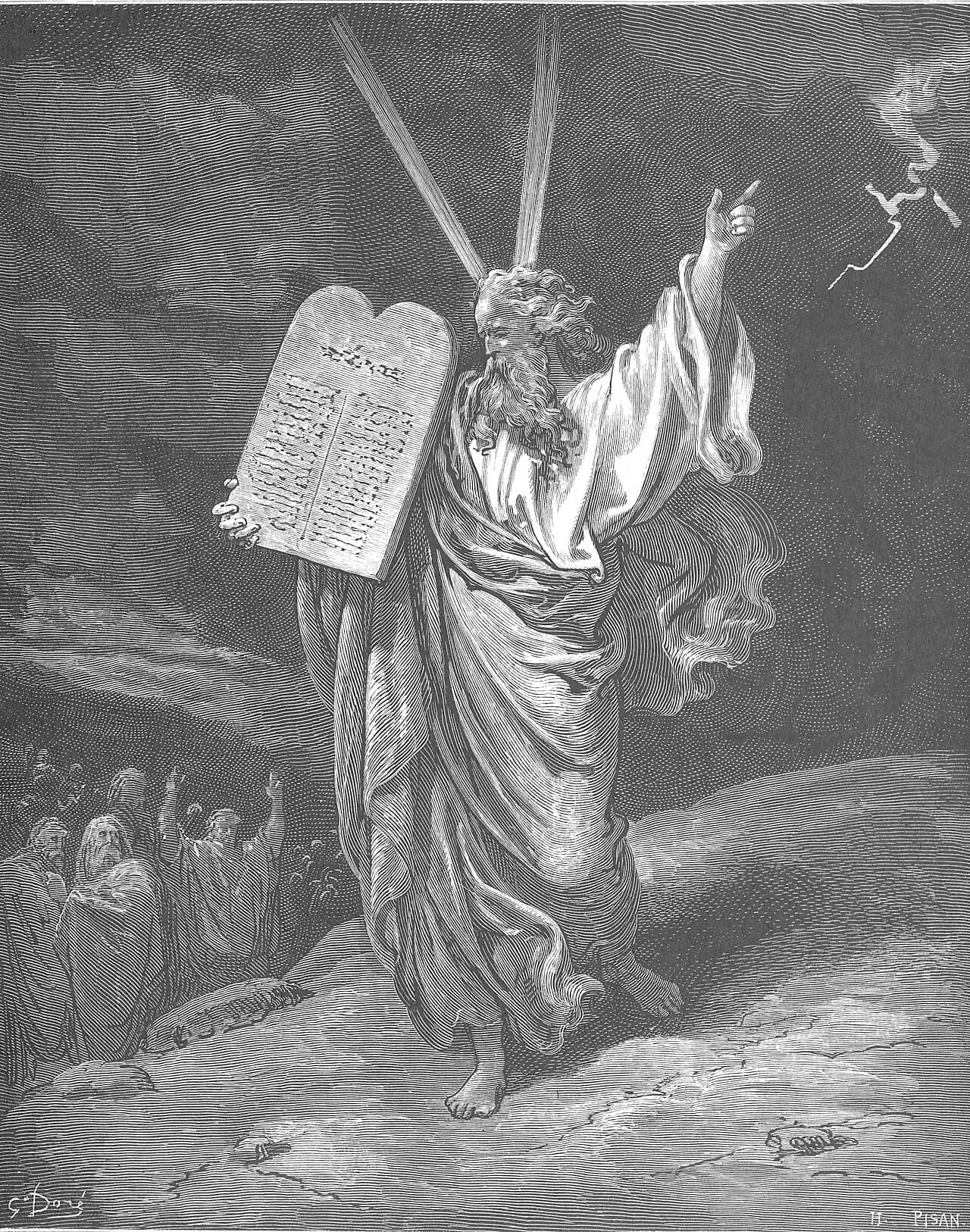
Gustave Doré, Moses Comes Down from Mount Sinai, La Grande Bible de Tours, 1866. Public domain: published before 1930.
THE ARTWORKDoré engraved Moses coming down from Mount Sinai with the two tablets, the scene of Exodus 34:29, which follows the LORD's command to Moses in Exodus 34:27 to write down the words of the covenant.
Summary
Five readings answer who wrote Genesis, Exodus, Leviticus, Numbers and Deuteronomy, from Moses as the one writer to many writers whose work later editors joined.
- The Talmud, Philo and Josephus held that Moses wrote the Torah, and William Henry Green defended that reading in 1895.
- Julius Wellhausen and S. R. Driver divided the books into sources written and joined long after Moses.
- Alexander Geddes and J. S. Vater saw a collection of separate pieces, and the supplementary reading saw one groundwork enlarged by later hands.
- James Orr held in 1906 that the books are Mosaic in substance, with editorial revision allowed.
The Texts Where Moses Writes
Ten texts, from Exodus to the Gospel of John, speak of Moses as a writer.
Then the LORD said to Moses, “Write this on a scroll as a reminder and recite it to Joshua, because I will utterly blot out the memory of Amalek from under heaven.”The LORD commands Moses to write on a scroll, so the Torah itself names Moses as a writer.
And Moses wrote down all the words of the LORD. Early the next morning he got up and built an altar at the base of the mountain, along with twelve pillars for the twelve tribes of Israel.Moses writes down the words the people promised in verse 3 to keep, so the covenant at Sinai rests on a written record.
The LORD also said to Moses, “Write down these words, for in accordance with these words I have made a covenant with you and with Israel.”Exodus 24:4 only reports that Moses wrote, and here the LORD Himself gives the command to write.
At the LORD’s command, Moses recorded the stages of their journey. These are the stages listed by their starting points:The list of Israel's camps in the wilderness is marked as a record Moses made at the LORD's command.
So Moses wrote down this law and gave it to the priests, the sons of Levi, who carried the ark of the covenant of the LORD, and to all the elders of Israel.Moses hands the written law to the priests and the elders, and every reading must say what this law contained.
When Moses had finished writing in a book the words of this law from beginning to end,Adam Clarke's Commentary on the Bible takes the law Moses wrote to be Deuteronomy. Albert Barnes's Notes on the Old and New Testaments take this book to be the whole Pentateuch up to this verse.
just as Moses the servant of the LORD had commanded the Israelites. He built it according to what is written in the Book of the Law of Moses: “an altar of uncut stones on which no iron tool has been used.” And on it they offered burnt offerings to the LORD, and they sacrificed peace offerings.In the next generation Joshua builds an altar by what is written in a book that already carries the name of Moses.
At that time all the people gathered together in the square before the Water Gate, and they asked Ezra the scribe to bring out the Book of the Law of Moses, which the LORD had commanded for Israel.After the exile the law is read to all the people under the name it carried in the days of Joshua.
But concerning the dead rising, have you not read about the burning bush in the Book of Moses, how God told him, ‘I am the God of Abraham, the God of Isaac, and the God of Jacob’?Jesus answers the Sadducees from the account of the burning bush and calls the book that holds it the Book of Moses.
If you had believed Moses, you would believe Me, because he wrote about Me. But since you do not believe what he wrote, how will you believe what I say?”Green's Higher Criticism of the Pentateuch rejects Jean Le Clerc's view that Christ and the apostles accommodated their teaching to the errors of their time.
Five Readings at a Glance
The readings differ on how many hands wrote the five books and when they wrote.
| Reading | Held by | Representative work | Who wrote the five books | Objection raised by |
|---|---|---|---|---|
| Mosaic authorship | The baraita of the Talmud, Bava Batra 14b; Philo; Josephus; William Henry Green | William Henry Green, The Higher Criticism of the Pentateuch (1895) | Moses, with the account of his death written by Joshua or by Moses himself | Thomas Hobbes, Leviathan (1651); Benedict Spinoza, Theological-Political Treatise (1670) |
| Documentary | Julius Wellhausen; S. R. Driver; J. Estlin Carpenter and G. Harford-Battersby; Richard Elliott Friedman, Who Wrote the Bible? (1987) | Julius Wellhausen, Prolegomena to the History of Israel (English 1885) | Several writers in the sources J, E, D and P, joined by editors long after Moses | James Orr, The Problem of the Old Testament (1906) |
| Fragmentary | Alexander Geddes; J. S. Vater | J. S. Vater, Commentar über den Pentateuch (1802 and 1805) | Many separate pieces gathered by a later compiler | William Henry Green (1895) |
| Supplementary | Friedrich Bleek; Friedrich Tuch; W. M. L. de Wette; Heinrich Ewald; John Van Seters, Abraham in History and Tradition (1975) | Friedrich Tuch, Kommentar über die Genesis (1838) | A first writer, and a second who added to his work | William Henry Green (1895) |
| Mosaic substance with later editing | James Orr; Gordon J. Wenham, Genesis 1 to 15 (1987); Duane Garrett, Rethinking Genesis (1991); Kenneth A. Kitchen, On the Reliability of the Old Testament (2003) | James Orr, The Problem of the Old Testament (1906) | Moses and those who worked with him, with later editorial revision | S. R. Driver, An Introduction to the Literature of the Old Testament (1891) |
- Reading
- Mosaic authorship
- Held by
- The baraita of the Talmud, Bava Batra 14b; Philo; Josephus; William Henry Green
- Representative work
- William Henry Green, The Higher Criticism of the Pentateuch (1895)
- Who wrote the five books
- Moses, with the account of his death written by Joshua or by Moses himself
- Objection raised by
- Thomas Hobbes, Leviathan (1651); Benedict Spinoza, Theological-Political Treatise (1670)
- Reading
- Documentary
- Held by
- Julius Wellhausen; S. R. Driver; J. Estlin Carpenter and G. Harford-Battersby; Richard Elliott Friedman, Who Wrote the Bible? (1987)
- Representative work
- Julius Wellhausen, Prolegomena to the History of Israel (English 1885)
- Who wrote the five books
- Several writers in the sources J, E, D and P, joined by editors long after Moses
- Objection raised by
- James Orr, The Problem of the Old Testament (1906)
- Reading
- Fragmentary
- Held by
- Alexander Geddes; J. S. Vater
- Representative work
- J. S. Vater, Commentar über den Pentateuch (1802 and 1805)
- Who wrote the five books
- Many separate pieces gathered by a later compiler
- Objection raised by
- William Henry Green (1895)
- Reading
- Supplementary
- Held by
- Friedrich Bleek; Friedrich Tuch; W. M. L. de Wette; Heinrich Ewald; John Van Seters, Abraham in History and Tradition (1975)
- Representative work
- Friedrich Tuch, Kommentar über die Genesis (1838)
- Who wrote the five books
- A first writer, and a second who added to his work
- Objection raised by
- William Henry Green (1895)
- Reading
- Mosaic substance with later editing
- Held by
- James Orr; Gordon J. Wenham, Genesis 1 to 15 (1987); Duane Garrett, Rethinking Genesis (1991); Kenneth A. Kitchen, On the Reliability of the Old Testament (2003)
- Representative work
- James Orr, The Problem of the Old Testament (1906)
- Who wrote the five books
- Moses and those who worked with him, with later editorial revision
- Objection raised by
- S. R. Driver, An Introduction to the Literature of the Old Testament (1891)
Each Reading as Its Holders State It
Each fold gives one reading's case with its holders and the work where they made it.
Moses wrote the TorahThe Talmud, Bava Batra 14b; Josephus, Against Apion 1.8; William Henry Green (1895)
A baraita in the Babylonian Talmud asks who wrote the books of the Bible and answers that Moses wrote his own book, the portion of Balaam and the book of Job. Josephus counted twenty-two sacred books in Against Apion and gave five of them to Moses, which contain his laws and the traditions of the origin of mankind until his death. William Henry Green wrote that, apart from some ancient heretics who took offence at its contents, the authorship of Moses went unchallenged until recent times.
Sources joined after MosesJulius Wellhausen, Prolegomena (1885); S. R. Driver, Introduction (1891)
Julius Wellhausen named the Jehovist history book JE, made of a Jehovist part J and an Elohist part E, and called the priestly main stock of the law the Priestly Code. He took up Karl Heinrich Graf's view that the law came later than the prophets. His thesis was that the law of Moses is the starting point for the history of Judaism, the community that survived the fall of the nation, rather than for the history of ancient Israel. S. R. Driver held that Deuteronomy was written before 621 BC, when Hilkiah found the book of the law in the temple, and considerably later than the age of Moses. Driver wrote that these conclusions affect the form of revelation and leave its authority and its inspiration untouched.
A collection of separate piecesAlexander Geddes (1792); J. S. Vater (1802 and 1805)
Alexander Geddes, a Roman Catholic priest, laid down three propositions in 1792. He held that the Pentateuch in its present form was not written by Moses and that it was written in Canaan, most probably at Jerusalem. He dated it no earlier than the reign of David and no later than that of Hezekiah. He held that it was compiled from ancient documents, some of them as old as Moses and some older. J. S. Vater took up his work in a commentary published at Halle and treated the Pentateuch as a great number of separate compositions. Green counts thirty-eight fragments in Vater's Genesis.
A groundwork enlarged by a later writerFriedrich Tuch, Kommentar über die Genesis (1838)
The supplementary reading kept the Elohist and the Jehovist of the older documentary theory and joined them in another way. In it the Elohist wrote the groundwork of the Pentateuch, and the Jehovist, who lived later, made an enlarged edition that kept all of the earlier work in its form and language. Green names Friedrich Bleek, Friedrich Tuch, J. J. Stähelin, W. M. L. de Wette and August Knobel among its holders. Heinrich Ewald later made the supplementers a series of writers working at different periods, a scheme Green calls the crystallization hypothesis.
Mosaic in substanceJames Orr, The Problem of the Old Testament (1906)
James Orr held that tradition and a strict use of critical method both lead to what he called an essential Mosaicity of the Pentateuch. He described the making of the books as the collaboration of original composers working toward a common end, in contrast with the idea of late redactors combining, altering and enlarging at pleasure. He held that Moses could have written the discourses of Deuteronomy in their present form, and he did not deny their editorial revision and annotation.
The site's tradition is Wesleyan-Pentecostal, and on this question it gives no verdict.
The Death of Moses and the Kings of Edom
Two passages are read as written after Moses, and the holders of his authorship answer each.
So Moses the servant of the LORD died there in the land of Moab, as the LORD had said. And He buried him in a valley in the land of Moab facing Beth-peor, and no one to this day knows the location of his grave. Moses was a hundred and twenty years old when he died, yet his eyes were not weak, and his vitality had not diminished. The Israelites grieved for Moses in the plains of Moab thirty days, until the time of weeping and mourning for Moses came to an end. Now Joshua son of Nun was filled with the spirit of wisdom because Moses had laid his hands on him. So the Israelites obeyed him and did as the LORD had commanded Moses. Since that time, no prophet has risen in Israel like Moses, whom the LORD knew face to face—Verse 10 compares Moses with every prophet who came after him, and Spinoza read that comparison as the judgment of a writer who lived centuries later.
Philo wrote that Moses, while still alive and filled with the Holy Spirit, prophesied his own death, his burial in a tomb no one knew and the month of mourning that followed. Josephus wrote that Moses recorded his own death in the holy books, lest the people say that because of his virtue he had gone to God.
These are the kings who reigned in the land of Edom before any king reigned over the Israelites:The verse turns on the words before any king reigned over the Israelites, which one reading takes as written after Israel had kings and the other as written before.
Spinoza held in chapter 8 of his Treatise that the verse lists the kings of Edom before David conquered that land, as 2 Samuel 8:14 records, and so was written long after Moses. Green held in The Higher Criticism of the Pentateuch that the kings of Edom reigned before Moses. He read the verse as Moses remarking that Jacob, who had the promise of kings in Genesis 35:11, had none yet, while Esau already counted several.
The Question Through the Centuries
The timeline runs from Philo to Kenneth Kitchen, and the folds give the arguments of the first critics.
- First century ADPhilo of Alexandria, On the Life of Moses
- About AD 95Josephus, Against Apion
- About 450 to 550The Babylonian Talmud, Bava Batra 14b and 15a
- About 1155 to 1165Abraham ibn Ezra, Commentary on Deuteronomy
- 1651Thomas Hobbes, Leviathan, chapter 33
- 1670Benedict Spinoza, Theological-Political Treatise, chapter 8
- 1685Jean Le Clerc, Sentimens de quelques théologiens de Hollande
- 1753Jean Astruc, Conjectures on the original memoirs Moses appears to have used for Genesis
- 1792Alexander Geddes, A new translation of the Scriptures, volume 1
- 1806W. M. L. de Wette, Contributions to the Introduction to the Old Testament
- 1853Hermann Hupfeld, Die Quellen der Genesis
- 1866Karl Heinrich Graf, The historical books of the Old Testament
- 1878Julius Wellhausen, History of Israel, volume 1, in English as Prolegomena (1885)
- 1891S. R. Driver, An Introduction to the Literature of the Old Testament
- 1895William Henry Green, The Higher Criticism of the Pentateuch
- 1900J. Estlin Carpenter and G. Harford-Battersby, The Hexateuch
- 1906James Orr, The Problem of the Old Testament
- 1975John Van Seters, Abraham in History and Tradition
- 1977Rolf Rendtorff, The Problem of the Process of Transmission in the Pentateuch (English 1990)
- 1987Richard Elliott Friedman, Who Wrote the Bible?
- 1987Gordon J. Wenham, Genesis 1 to 15
- 1991Duane Garrett, Rethinking Genesis
- 2003Kenneth A. Kitchen, On the Reliability of the Old Testament
A timeline of the debate on the authorship of the Pentateuch, each row a date, a writer and the work.
Ibn Ezra and the secret of the twelveCommentary on Deuteronomy 1:2
In his commentary Ibn Ezra wrote that a reader who understands the secret of the twelve would recognize the truth. Beside it he set four more places, Deuteronomy 31:22, Genesis 12:6, Genesis 22:14 and Deuteronomy 3:11. His translators H. Norman Strickman and Arthur M. Silver take the twelve to be the last twelve verses of the Torah, which record the death of Moses.
Hobbes on the grave of MosesLeviathan (1651), chapter 33
Thomas Hobbes argued that the words of Deuteronomy 34:6 on the grave of Moses were written after his burial. He added Genesis 12:6, which says that at that time the Canaanites were in the land, and Numbers 21:14, which cites the Book of the Wars of the LORD. He concluded that the five books were compiled in the form we have them after Moses died. In his view Moses still wrote everything the five books credit to him, such as the writing that Deuteronomy 31:9 says he gave to the priests.
Spinoza and Ezra the scribeTheological-Political Treatise (1670), chapter 8
Benedict Spinoza began from Ibn Ezra's hints and added evidence of his own, among which is the way the books speak of Moses in the third person. He concluded that the Pentateuch was written by someone who lived long after Moses, and he suspected that the writer was Ezra.
Astruc and the two names of GodConjectures (1753)
Jean Astruc, a physician of Montpellier, published his Conjectures anonymously in 1753. He saw that some parts of Genesis use the name Elohim and others the name Yahweh, and he took them to be separate documents that Moses had arranged in parallel columns.
How the Teachers Read It
Irenaeus and the commentary of Jamieson, Fausset and Brown read the words of Jesus about Moses.
Irenaeus on the writings of Moses as the words of ChristAgainst Heresies, Book IV
“But since the writings of Moses are the words of Christ, He does Himself declare to the Jews, as John has recorded in the Gospel: ‘If ye had believed Moses, ye would have believed Me: for he wrote of Me. But if ye believe not his writings, neither will ye believe My words.’ He thus indicates in the clearest manner that the writings of Moses are His words. If, then, [this be the case with regard] to Moses, so also, beyond a doubt, the words of the other prophets are His [words], as I have pointed out.”
Irenaeus · Against Heresies Book IV · on John 5:46Patristic
Jamieson, Fausset and Brown on the Pentateuch in the answer to the SadduceesCommentary Critical and Explanatory on the Whole Bible (1871)
“It was because the Pentateuch was regarded by all classes as the fundamental source of the Hebrew religion, and all the succeeding books of the Old Testament but as developments of it, that our Lord would show that even there the doctrine of the Resurrection was taught.”
Jamieson, Fausset & Brown · Commentary Critical and Explanatory on the Whole Bible · on Mark 12:27Reformed
The Objection Each Reading Answers
Each fold names who raised the objection and in which work.
Deuteronomy 34 and a later hand
The Mosaic reading must answer the argument from Deuteronomy 34 in Hobbes's Leviathan and Spinoza's Treatise. In The Higher Criticism of the Pentateuch, Green answered that a later paragraph would prove only that it did not belong to the Pentateuch as it came from Moses. He held it far easier to assume slight additions here and there than to set aside the whole.
J and E as one narrative
The documentary reading must answer James Orr's Problem of the Old Testament. Orr found no good reason to separate J and E as independent documents or to date them as late as the ninth or eighth century. It must also answer the words of Jesus about what Moses wrote. Driver answered in the preface to his Introduction that the purposes for which our Lord appealed to the Old Testament are not affected by critical inquiry.
Sections that refer to one another
The fragmentary reading must answer Green's Higher Criticism of the Pentateuch, which finds that the sections refer to one another throughout. That cannot be so if each came from an independent source. Green adds that Heinrich Ewald refuted the fragmentary reading in his first publication, Die Composition der Genesis (1823).
A scheme too simple for the text
The supplementary reading must answer Green, who judged in The Higher Criticism of the Pentateuch that its simplicity proved inadequate to the complications that beset the critics who divided the text. Ewald and Hermann Hupfeld each tried to remedy it, and Hupfeld's Die Quellen der Genesis (1853) proposed a modified documentary reading.
P and JE as independent sources
The mediating reading must answer S. R. Driver, who held in An Introduction to the Literature of the Old Testament that P and JE form two clearly definable, independent sources and called that conclusion abundantly justified by the facts.
Read the Great Books
These eight books, in editions published from 1651 to 1906, are each free to read online.
Leviathan
Thomas Hobbes · 1651
Its chapter 33 treats the number, the age, the scope, the authority and the interpreters of the books of Scripture.
Read at Project GutenbergA Theologico-Political Treatise
Benedict Spinoza · 1670
R. H. M. Elwes translated it, and its eighth chapter is titled Of the Authorship of the Pentateuch and the Other Historical Books of the Old Testament.
Read at Project GutenbergThe Works of Philo Judaeus, volume 3
Philo of Alexandria, translated by C. D. Yonge · 1855
This volume holds Philo's On the Life of Moses in Yonge's translation.
Read at the Internet ArchiveProlegomena to the History of Israel
Julius Wellhausen · 1885
W. Robertson Smith wrote the preface to the English edition.
Read at Project GutenbergAn Introduction to the Literature of the Old Testament
S. R. Driver · 1891
Its first chapter treats the Hexateuch, the Pentateuch with Joshua.
Read at the Internet ArchiveThe Higher Criticism of the Pentateuch
William Henry Green · 1895
Green wrote it as professor of Oriental and Old Testament literature at Princeton Theological Seminary.
Read at the Internet ArchiveThe Hexateuch
J. Estlin Carpenter and G. Harford-Battersby, editors · 1900
Its title page says the Revised Version is arranged in its constituent documents by members of the Society of Historical Theology, Oxford.
Read at the Internet ArchiveThe Problem of the Old Testament
James Orr · 1906
The book won the Bross Prize of 1905.
Read at the Internet ArchiveBeginning with Moses
On the day He rose, Jesus taught two disciples from the books of Moses.
Whatever a reader concludes about the hands that wrote the five books, Jesus read them as Scripture that speaks of Him. Every reader of Moses is asked to look in the Law for the Christ of whom Moses wrote.
And beginning with Moses and all the Prophets, He explained to them what was written in all the Scriptures about Himself.Keep studying
Read it1
Studies19
Show the next 6 titles
Places3
Peoples and groups1