

Claude Lorrain, Jacob with Laban and his Daughters, 1676. Public domain.
Genesis 11:31 to 12:5 · Place · Featured Study
Haran
Abram's kin stayed at Haran when he went on to Canaan, and Isaac and Jacob both married into that household.
Jacob crossed the Jordan with only a staff and came back from Haran as two camps.
And Terah took his son Abram, his grandson Lot son of Haran, and his daughter-in-law Sarai the wife of Abram, and they set out from Ur of the Chaldeans for the land of Canaan. But when they arrived in Haran, they settled there. Terah lived 205 years, and he died in Haran.
- Today
- Harran, in Şanlıurfa province, Turkey
- Region
- Upper Mesopotamia, east of the Euphrates
- Site
- 36.864, 39.032
- First named
- Genesis 11:31 “…his grandson Lot son of Haran, and his…”
- Last named
- Acts 7:4 “…the Chaldeans and settled in Haran. After his…”
Jacob crossed the Jordan with only a staff and came back from Haran as two camps.
Summary
Haran is a city east of the Euphrates, named in Scripture from Genesis to Acts.
- Terah died in Haran. Abram left it at seventy-five with Sarai and Lot.
- Abraham's servant found Rebekah in the same family. Her brother Laban still lived at Haran a generation later.
- Jacob served Laban twenty years for his two wives and his flocks, then fled with all he had.
- The Assyrian envoy named Haran among the cities whose gods had not saved them. Ezekiel lists it among the traders of Tyre.
The Household Settles at Haran
Terah's household stops at Haran, and Abram leaves it at the LORD's word.
And Terah took his son Abram, his grandson Lot son of Haran, and his daughter-in-law Sarai the wife of Abram, and they set out from Ur of the Chaldeans for the land of Canaan. But when they arrived in Haran, they settled there. Terah lived 205 years, and he died in Haran.Terah heads the household, and he dies in the city where the family stopped.
So Abram departed, as the LORD had directed him, and Lot went with him. Abram was seventy-five years old when he left Haran.Abram left at the LORD's word, and Genesis gives his age on the day.
Terah's verse uses two Hebrew words that English spells alike. Lot's father Haran is hārān, the name of a man, and the city is ḥārān, spelled with a different first letter.
Haran on Hurlbut's Map
Hurlbut's plate prints Haran in its top corner and draws Abraham's road from it to Canaan and Egypt.
The road from Haran to Shechem ran south by Damascus, and Jacob took it both ways.
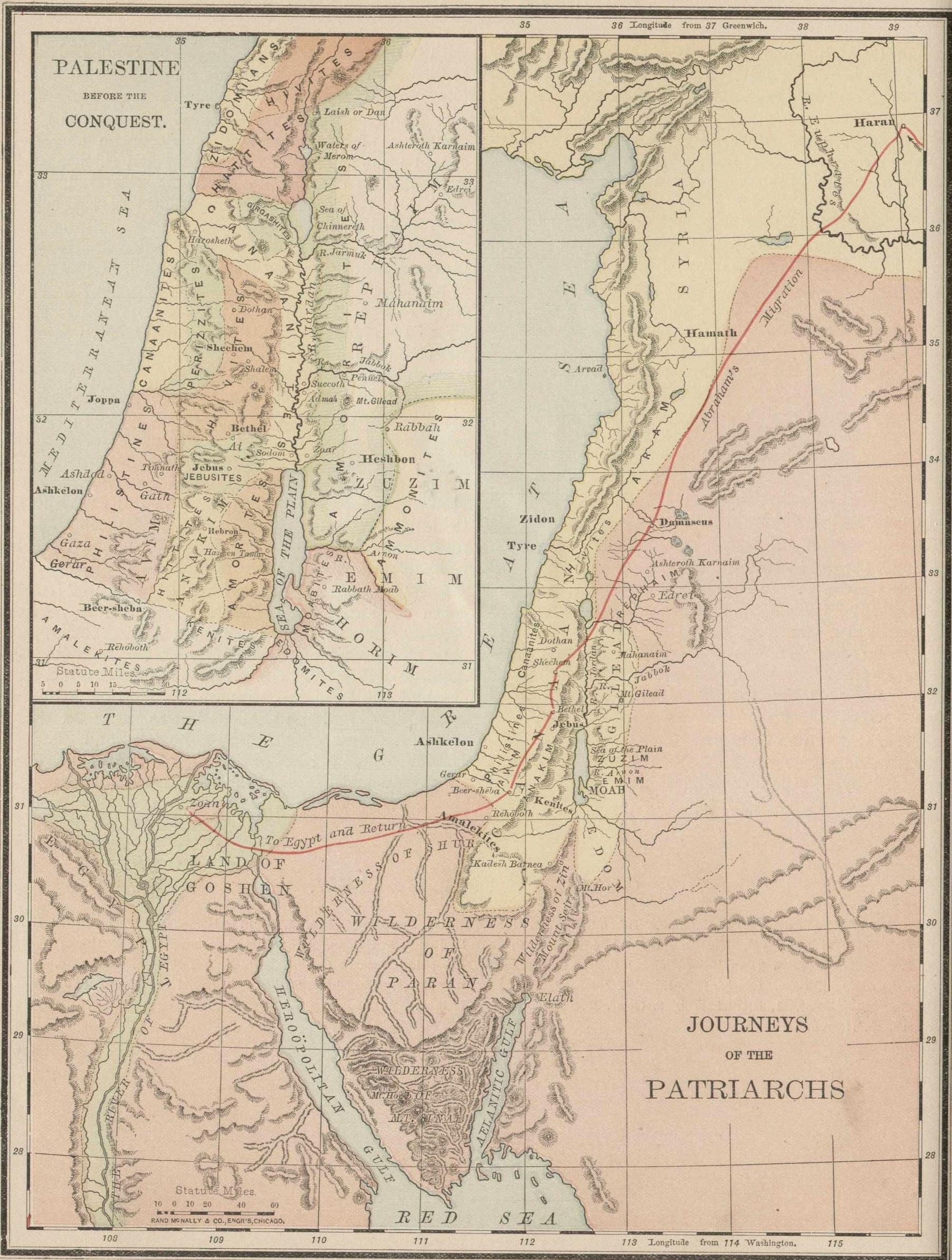
- HaranThe plate prints Haran on the upper Euphrates country, where the red line begins.Genesis 29:4
- The EuphratesJacob crossed the river when he fled from Laban.Genesis 31:21
- Abraham's migrationHurlbut's red line carries Abram south toward Canaan.Genesis 12:5
- DamascusAbram's steward Eliezer came from Damascus, on the road south.Genesis 15:2
- Mount GileadLaban reached Jacob in the hill country of Gilead.Genesis 31:23
- MahanaimThe angels of God met Jacob on the way home.Genesis 32:2
- ShechemAbram reached it first after leaving Haran.
- BethelJacob spent his first night there on the road to Haran.
- Beer-shebaJacob started from Beersheba for Haran.
Jesse Lyman Hurlbut, Journeys of the Patriarchs, from his Manual of Biblical Geography, Rand McNally, 1887, National Library of Israel, Eran Laor Cartographic Collection. Public domain by date; Wikimedia Commons, File:Jesse Lyman Hurlbut, Journeys of the Patriarchs (FL36567326 3908839).jpg.
Eight places and the red line of Abraham's migration, each numbered where the plate prints it.
What Happened at Haran, in Order
Genesis tells ten events at Haran, from Terah's arrival to Jacob's flight.
The family lived at Haran from Terah's day until Jacob fled, and nobody in the line went back after him.
- Terah's journeyThe household leaves Ur for Canaan and settles at HaranGenesis 11:31
- Terah's deathTerah dies in Haran at 205Genesis 11:32
- The callAbram leaves Haran for Canaan with LotGenesis 12:4
- Isaac's marriageAbraham's servant goes to Nahor's hometown in Aram-naharaimGenesis 24:10
- Esau's angerRebekah sends Jacob to her brother Laban in HaranGenesis 27:43
- At the wellShepherds tell Jacob they are from HaranGenesis 29:4
- The first seven yearsJacob serves seven years for RachelGenesis 29:20
- After the week of feastingLaban gives Rachel to Jacob as his wifeGenesis 29:28
- The shearingRachel takes her father's household idolsGenesis 31:19
- The flightJacob crosses the Euphrates with all he hasGenesis 31:21
Each row gives the event and the verse that tells it.
The first seven years, After the week of feasting, The shearing, The flight
Seven years and then seven moreGenesis 29:25 to 30
When morning came, there was Leah! “What have you done to me?” Jacob said to Laban. “Wasn’t it for Rachel that I served you? Why have you deceived me?”Jacob's question is the first protest Genesis records from him at Haran.
Finish this week’s celebration, and we will give you the younger one in return for another seven years of work.”Laban offers Rachel at the end of Leah's week, with the second seven years to be worked afterward.
Jerome, in his Hebrew Questions on Genesis, reads Laban's words the same way: the second wedding came seven days after the first.
Twenty years, by Jacob's own countGenesis 31:38 to 42
Thus for twenty years I have served in your household—fourteen years for your two daughters and six years for your flocks—and you have changed my wages ten times!Jacob gives this tally to Laban's face, and Laban's answer does not dispute it.
If the God of my father, the God of Abraham and the Fear of Isaac, had not been with me, surely by now you would have sent me away empty-handed. But God has seen my affliction and the toil of my hands, and last night He rendered judgment.”Jacob credits his wealth to divine protection rather than to his own skill.
Three Things the Text Says Plainly
Three facts of the text that retellings often miss, each with its verse.
THE WITNESS HEAP HAD TWO NAMES
Laban called the heap of stones Jegar-sahadutha and Jacob called it Galeed, each in his own tongue.
JACOB DECEIVED LABAN TOO
Jacob left without telling Laban he was going, and Genesis calls that a deception in so many words.
JACOB DID NOT KNOW ABOUT THE IDOLS
Jacob swore that whoever had Laban's gods would die, because he had no idea Rachel had taken them.
Haran after Genesis
Second Kings and Ezekiel name Haran as a city of the Assyrian world and a market of Tyre.
Did the gods of the nations destroyed by my fathers rescue those nations—the gods of Gozan, Haran, and Rezeph, and of the people of Eden in Telassar?Sennacherib's envoy lists Haran among the cities whose gods could not save them.
Haran, Canneh, and Eden traded with you, and so did the merchants of Sheba, Asshur, and Chilmad.Ezekiel's lament for Tyre counts Haran among the cities that traded there.
Albert Barnes, on 2 Kings 19:12, identifies Haran with the Carrhae of the Greeks and Romans and counts it among the earliest conquests of the Assyrians. John Gill, on Ezekiel 27:23, calls the same city famous for the defeat of Crassus.
What Genesis Leaves Unsaid
Genesis leaves two questions about the city open.
Genesis never says why Terah settled at Haran instead of going on to Canaan, and it describes no building, wall or temple in the city.
And Joshua said to all the people, “This is what the LORD, the God of Israel, says: ‘Long ago your fathers, including Terah the father of Abraham and Nahor, lived beyond the Euphrates and worshiped other gods.Joshua supplies the one fact Genesis leaves out about the family's religion.
Where Scripture Returns to Haran
Deuteronomy, Hosea, Acts and Hebrews each look back to the years at Haran.
and you are to declare before the LORD your God, “My father was a wandering Aramean, and he went down to Egypt few in number and lived there and became a great nation, mighty and numerous.Every Israelite bringing firstfruits confessed a father who had been a wandering Aramean.
“Jacob is here called an Aramite, or Syrian, because he lived twenty years in Padan-Aram; his wives were of that country, and his children were all born there, except Benjamin; and perhaps the confessor means not Jacob himself, but that son of Jacob who was the father of his tribe.”
Matthew Henry · Commentary on the Whole Bible · on Deuteronomy 26:5Puritan
Jacob fled to the land of Aram and Israel worked for a wife—for a wife he tended sheep.Hosea remembers the years in Aram as the time Israel tended sheep for a wife.
And Stephen declared: “Brothers and fathers, listen to me! The God of glory appeared to our father Abraham while he was still in Mesopotamia, before he lived in Haran,Stephen uses the call to show that the family's first meeting with the LORD needed no land and no temple.
They could have gone backHebrews 11:15 to 16
If they had been thinking of the country they had left, they would have had opportunity to return.The country this verse has in view is the one Abram left at Haran, where his kin stayed.
“He retained his affection for the land of Canaan, not only because it was the land of his nativity, and his father and mother were there, whom he longed to see, but because it was the land of promise; and, in token of his dependence upon the promise of it, though he sojourn in Haran he can by no means think of settling there.”
Matthew Henry · Commentary on the Whole Bible · on Genesis 30:25Puritan
Hosea 12:12, Acts 7:2
The Voices on Haran
Ambrose, Henry, Wesley, and Jamieson, Fausset and Brown each wrote on Jacob's years in Laban's house.
died 397 · Ambrose of Milan
Ambrose of Milan reads Jacob's work with Laban's flocks as a figure of the flock the gospel gathers.
“The just man Jacob comes in like a hired hand and yet is the master who, in his ministry of preaching the gospel, gathered together a flock that is resplendent in the brilliance of its many signal virtues. Thus, when the flock came to drink, he would set before them in the troughs the bough of storax and walnut and that from the plane tree; those who felt desire for the mysteries of the most blessed Trinity that were prefigured there could engender offspring that were not at all discolored, by conceiving them in a devout mind.”
Ambrose of Milan · On Jacob and the Blessed Life · on Genesis 30:37Patristic
1662 to 1714 · Matthew Henry
Matthew Henry doubts that Laban's custom of the elder daughter was real.
“We have reason to think there was no such custom of his country as he pretends; only he banters Jacob with it, and laughs at his mistake. Note, Those that can do wickedly and then think to turn it off with a jest, though they may deceive themselves and others, will find at last that God is not mocked.”
Matthew Henry · Commentary on the Whole Bible · on Genesis 29:26Puritan
1703 to 1791 · John Wesley
John Wesley weighs Jacob's peeled rods against an uncle who looked only to himself.
“Here is Jacob's policy to make his bargain more advantageous to himself than it was likely to be: and if he had not taken some course to help himself, it would have been an ill bargain indeed; which he knew Laban would never have considered, who did not consult any one's interest but his own.”
John Wesley · Explanatory Notes upon the Old Testament · on Genesis 30:37Evangelical
1802 to 1910 · Jamieson, Fausset & Brown
Jamieson, Fausset and Brown draw a lesson from Laban's admission that he had been blessed for Jacob's sake.
“This was a remarkable testimony that good men are blessings to the places where they reside. Men of the world are often blessed with temporal benefits on account of their pious relatives, though they have not always, like Laban, the wisdom to discern, or the grace to acknowledge it.”
Jamieson, Fausset & Brown · Commentary Critical and Explanatory on the Whole Bible · on Genesis 30:27Reformed
John Wesley, Jamieson, Fausset & Brown
When Did Abram Leave Haran?
Genesis gives three ages, and Stephen says Abraham left after his father died.
So Abraham left the land of the Chaldeans and settled in Haran. After his father died, God brought him out of that place and into this land where you are now living.Stephen's order of events is what raises the question.
Read with Genesis 11:26 and 11:32, Genesis 12:4 puts the departure sixty years before Terah's death.
Abram the youngest sonAdam Clarke, 1832; Albert Barnes
The objection: Genesis 11:26 names Abram first among the three sons.
An unsolved questionJerome, Hebrew Questions on Genesis
Jerome, in his Hebrew Questions on Genesis, counts 135 years from Abram's birth to Terah's death and calls the matter a question that cannot be solved.
The objection: Genesis 6:10 lists Noah's sons as Shem, Ham and Japheth, and Genesis 9:24 calls Ham the youngest, so a list of sons need not follow the order of their births.
Called Out of Haran
Abram left Haran on a promise, and Paul says the seed of that promise is Christ. The text asks the reader to go where God sends, as Abram did, and to look for the better country of Hebrews 11:16.
The promises were spoken to Abraham and to his seed. The Scripture does not say, “and to seeds,” meaning many, but “and to your seed,” meaning One, who is Christ.Paul's argument turns on a single word of Genesis being singular.
Sources
Scripture is the Berean Standard Bible.
- James Strong, Exhaustive Concordance of the Bible (1890), Hebrew dictionary, entries 2039 and 2771.
- Matthew Henry, Commentary on the Whole Bible (1710), on Genesis 30:25.
- Matthew Henry, Commentary on the Whole Bible (1710), on Deuteronomy 26:5.
- Jamieson, Fausset and Brown, Commentary Critical and Explanatory on the Whole Bible (1871), on Genesis 30:27.
- John Wesley, Explanatory Notes upon the Old Testament (1765), on Genesis 30:37.
- Albert Barnes, Notes, Explanatory and Practical, on the Old and New Testaments, on 2 Kings 19:12.
- John Gill, Exposition of the Old Testament, on Ezekiel 27:23.
- Ambrose of Milan, On Jacob and the Blessed Life, on Genesis 30:37.
- Matthew Henry, Commentary on the Whole Bible (1710), on Genesis 29:26.
- Jerome, Hebrew Questions on Genesis, on Genesis 12:4 and 29:27.
- Adam Clarke, Commentary on the Bible (1832), on Genesis 12:4.
- Albert Barnes, Notes, Explanatory and Practical, on the Old and New Testaments, on Acts 7:4.
Keep Studying
Read it4
Studies5
Places8