
Judges 17 to 21 · Subject · Featured Study
No king in Israel: the refrain that closes Judges
Judges 17:6, 18:1, 19:1 and 21:25, read beside the law of the one place of worship and Gideon's answer in Judges 8:23, with four readings of what the refrain argues.
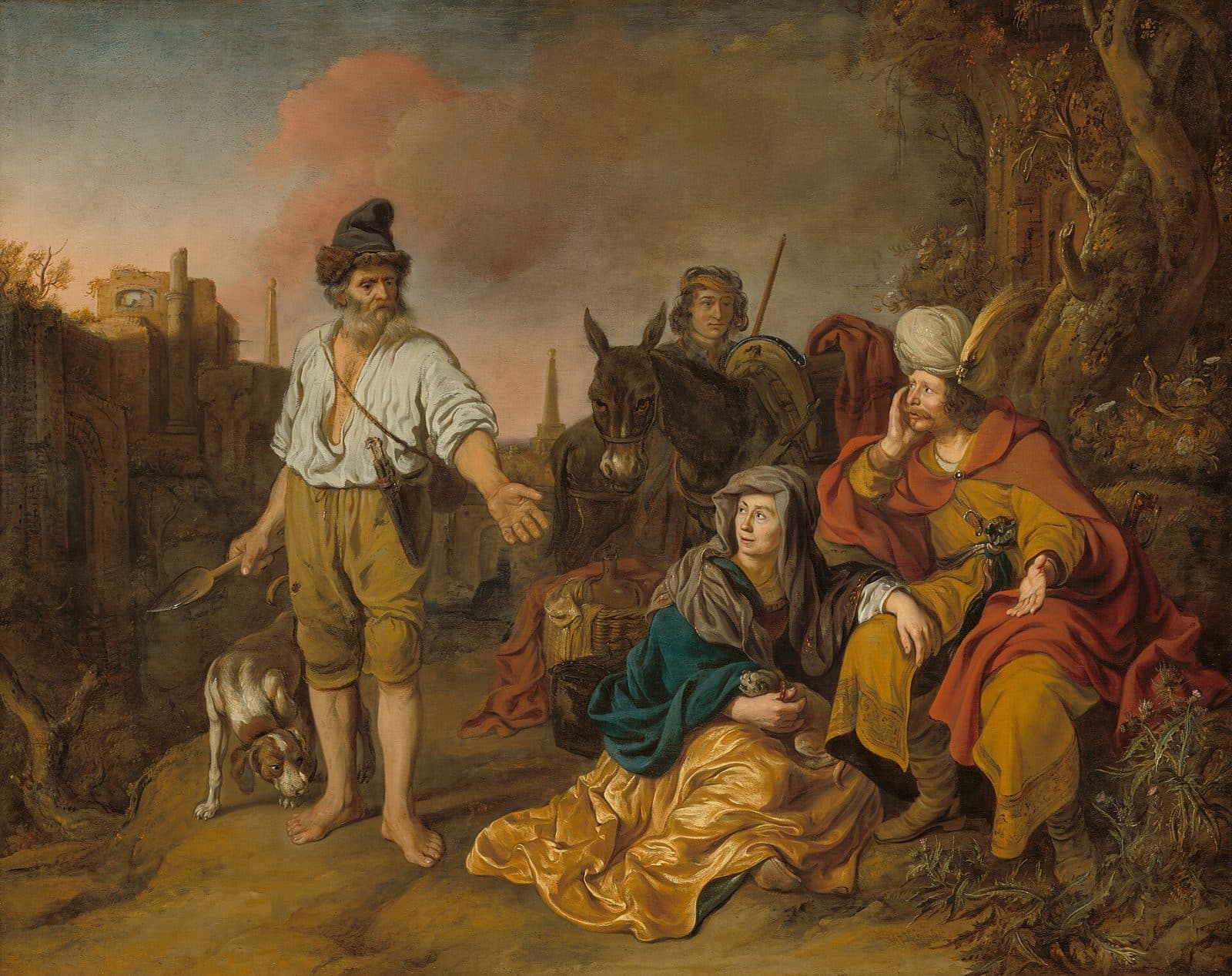
Gerbrand van den Eeckhout, The Levite at Gibeah, early 1640s, oil on canvas, National Gallery of Art, Washington. Public domain (published before 1930), via Wikimedia Commons, File:The_Levite_at_Gibeah_A33096.jpg.
THE ARTWORKEeckhout painted the old man of Judges 19:16 to 20 coming in from his field with his spade and offering the Levite and his concubine a night's lodging. He set the meeting at dusk before ruined walls, with the servant and the donkey waiting behind the travellers.
In those days there was no king in Israel; everyone did what was right in his own eyes.
Summary
Four times in its last five chapters the book of Judges says that Israel had no king.
- Two verses give the refrain in full and two give it in short, and the full form is the last verse of the book.
- The refrain frames the last two stories of the book, one in chapters 17 and 18 and one in chapters 19 to 21.
- The words right in his own eyes repeat Deuteronomy 12:8, where Moses forbade worship of that kind once Israel was in the land.
- Some readers hear in the refrain a case for the kingship, or for David's house over Saul's. Others hear a lament for any ruler before Samuel, or a charge that Israel neglected the LORD as King.
Where the Refrain Stands
Keil and Delitzsch read the plan of the book around the refrain's four places.
Now in those days, when there was no king in Israel, a Levite who lived in the remote hill country of Ephraim took for himself a concubine from Bethlehem in Judah.The short form returns at the head of the second story, so the Levite's journey falls in the same years without a king as the first story.
C. F. Keil and F. Delitzsch, in the English edition of their commentary (1872), divide Judges into an introduction (Judges 1:1 to 3:6), the history of the judges (Judges 3:7 to 16:31) and two appendices (Judges 17 to 21). The refrain stands only in the appendices, and they found it in both, with the will of God sought through a priest in both, and judged that one author wrote the two.
The Refrain Drawn
A ladder of the refrain's four places and the centre between its two stories, and an atlas plate with six places of the second story.
A ladder of five rungs: the four places of the refrain paired by their wording, and at the centre in the accent colour the verse where Keil and Delitzsch's first appendix ends.
The Levite went north from Bethlehem past Jebus to Gibeah, and the tribes later gathered at Bethel and found wives for Benjamin at Shiloh.
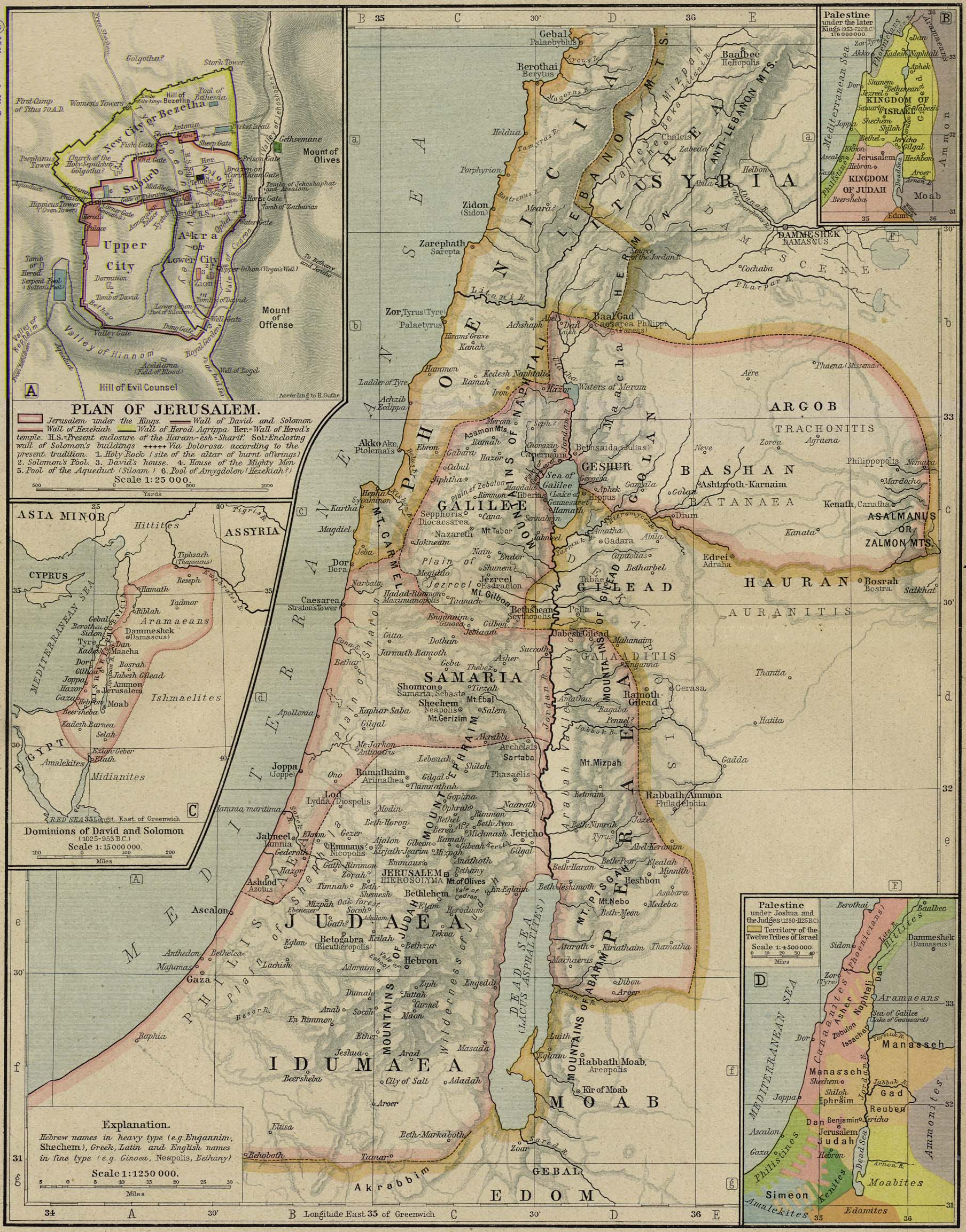
- 1Bethlehem, The concubine's father kept the Levite at his house in Bethlehem in Judah into the fifth day. Judges 19:3 to 8
- 2Jerusalem, The Levite refused to spend the night in Jebus, a city of foreigners. Judges 19:10 to 12
- 3Ramah, The Levite named it as the other town where they could spend the night. Judges 19:13
- 4Gibeah, No one in the square of this town of Benjamin would take the travellers in, until an old man of Ephraim did. Judges 19:14 to 21
- 5Bethel, The Israelites went up here and asked God which tribe should go first against Benjamin. Judges 20:18
- 6Shiloh, The Benjamites hid in the vineyards at the yearly feast and caught wives from the dancers. Judges 21:19 to 23
Base map: Reference map of ancient Palestine, Rand McNally reference map (1926), public domain. Each place stands at its place page's coordinates, set on the plate by Jerusalem and Damascus, as the plate prints them.
Six places of Judges 19 to 21 stand so close on this plate of the whole land that their marks overlap, and the key gives them in the order the text reaches them. Mizpah, Jabesh-gilead and the rock of Rimmon are not placed.
The Two Stories under the Refrain
Both stories turn on a Levite, in the first a hired priest and in the second a traveller from Ephraim.
In the first story a man of Ephraim named Micah sets up an image and hires a Levite as his priest, and the Danites carry both away to Laish, which they rename Dan. In the second the men of Gibeah abuse a Levite's concubine through the night, and the tribes go to war against Benjamin when it will not hand the men over.
And everyone who saw it said, “Nothing like this has been seen or done from the day the Israelites came out of the land of Egypt until this day. Think it over, take counsel, and speak up!”Israel judges the crime at Gibeah to be without equal since the Exodus, and the call to take counsel leads to the war.
“Why, O LORD God of Israel,” they cried out, “has this happened in Israel? Today in Israel one tribe is missing!”The victors weep before the LORD because one tribe is missing, so the war ends in grief over its own result.
The six hundred at the rock of RimmonJudges 20:46 to 48
That day 25,000 Benjamite swordsmen fell, all men of valor. But 600 men turned and fled into the wilderness to the rock of Rimmon, where they stayed four months. And the men of Israel turned back against the other Benjamites and put to the sword all the cities, including the animals and everything else they found. And they burned down all the cities in their path.Of Benjamin only six hundred men survive, and the tribes burn every Benjamite town in their path.
Wives taken at ShilohJudges 21:19 to 23
“But look,” they said, “there is a yearly feast to the LORD in Shiloh, which is north of Bethel east of the road that goes up from Bethel to Shechem, and south of Lebonah.” So they commanded the Benjamites: “Go, hide in the vineyards and watch. When you see the daughters of Shiloh come out to perform their dances, each of you is to come out of the vineyards, catch for himself a wife from the daughters of Shiloh, and go to the land of Benjamin. When their fathers or brothers come to us to complain, we will tell them, ‘Do us a favor by helping them, since we did not get wives for each of them in the war. Since you did not actually give them your daughters, you have no guilt.’” The Benjamites did as instructed and carried away the number of women they needed from the dancers they caught. They went back to their own inheritance, rebuilt their cities, and settled in them.The elders keep the letter of their oath against giving their daughters by letting the Benjamites seize the dancers of Shiloh.
Right in His Own Eyes
The long form of the refrain takes its words from the law of the one place of worship in Deuteronomy 12.
You are not to do as we are doing here today, where everyone does what seems right in his own eyes.Moses names the worship each man chooses for himself as the practice Israel must leave behind in the land.
Deuteronomy 12:5 to 14 tells Israel to bring its offerings to the place the LORD would choose. In Judges 17 Micah makes his own shrine in his own house, and in Judges 21:4 the people build an altar at Bethel, so the refrain's words fit both stories.
The worship of the wilderness yearsAlbert Barnes on Deuteronomy 12:8
Albert Barnes explains why Moses could say that Israel was doing what seemed right in its own eyes on the plains of Moab.
“Moses points out that heretofore they had not observed the prescribed order in their worship, because during their migratory life in the wilderness it had been impossible to do so. During their wanderings there were doubtless times when the tabernacle was not set up for days together, and when the daily sacrifice Num 28:3, together with many other ordinances, were necessarily omitted (compare Jos 5:5). This consideration must be carefully borne in mind throughout Deuteronomy.”
Albert Barnes · Notes, Explanatory and Practical, on the Old and New Testaments (1832-1869) · on Deuteronomy 12:8Evangelical
What the LORD counts as goodDeuteronomy 12:28
Be careful to obey all these things I command you, so that it may always go well with you and your children after you, because you will be doing what is good and right in the eyes of the LORD your God.Deuteronomy sets doing what is right in the eyes of the LORD against what is right in a man's own eyes.
Who Ruled Israel before the Refrain
The kings Judges names before chapter 17, and when and by whom the book was written.
Every king Judges names before Abimelech is a foreign king.
- Adoni-bezekThe Canaanite king says seventy kings gathered scraps under his table.Judges 1:7
- Cushan-rishathaimThe LORD sells Israel to this king of Aram-naharaim for eight years.Judges 3:8
- EglonThe LORD gives the king of Moab power over Israel.Judges 3:12
- JabinThe LORD sells Israel to the king of Canaan who reigned in Hazor.Judges 4:2
- Zebah and ZalmunnaGideon pursues the two kings of Midian.Judges 8:5
- AbimelechThe leaders of Shechem make Gideon's son their king.Judges 9:6
Six numbered steps in the order of the book, each with the verse that records it.
Jotham's fable of the treesJudges 9:8 to 15
One day the trees set out to anoint a king for themselves. They said to the olive tree, ‘Reign over us.’ But the olive tree replied, ‘Should I stop giving my oil that honors both God and man, to hold sway over the trees?’ Then the trees said to the fig tree, ‘Come and reign over us.’ But the fig tree replied, ‘Should I stop giving my sweetness and my good fruit, to hold sway over the trees?’ Then the trees said to the grapevine, ‘Come and reign over us.’ But the grapevine replied, ‘Should I stop giving my wine that cheers both God and man, to hold sway over the trees?’ Finally all the trees said to the thornbush, ‘Come and reign over us.’ But the thornbush replied, ‘If you really are anointing me as king over you, come and find refuge in my shade. But if not, may fire come out of the thornbush and consume the cedars of Lebanon.’The olive, the fig and the vine refuse to reign, and only the thornbush accepts, which is Jotham's verdict on Abimelech's kingship.
When the two stories happenedJudges 18:1 and 20:27 to 28
And the Israelites inquired of the LORD. (In those days the ark of the covenant of God was there, and Phinehas son of Eleazar, the son of Aaron, served before it.) The Israelites asked, “Should we again go out to battle against our brothers the Benjamites, or should we stop?” The LORD answered, “Fight, for tomorrow I will deliver them into your hand.”Phinehas the grandson of Aaron still serves before the ark, which places the war early in the period.
Keil and Delitzsch date both stories to the earliest part of the period of the judges. They set Judges 18:1 beside 1:34 for the first, and Judges 20:28 beside Joshua 22:13 and 24:33 for the second. Rashi, on Judges 17:1, sets both stories at the beginning of the period, in the days of Othniel son of Kenaz. For the second he reasons from Judges 19:12, where Jerusalem is not yet in Israel's hands. Adam Clarke, on Judges 20:28, reasons from Phinehas that the war came shortly after the death of Joshua, and John Gill that it came long before the times of Samson.
Who wrote the book, and whenBava Batra 14b; Keil and Delitzsch
The Babylonian Talmud, in Bava Batra 14b, names Samuel as the writer of his own book, of Judges and of Ruth. Keil and Delitzsch held that the refrain shows the book was written when Israel already enjoyed the benefits of a king, and before the kingdom was divided.
The Words of the Refrain
Three Hebrew words carry the refrain and the question of who rules Israel.
MELEK
The word for king in all four places of the refrain, used in Judges also of Eglon, Jabin and the kings of Midian.
MASHAL
Strong's gives to rule as the sense of the verb, which stands in both verses of Gideon's exchange with Israel.
YASHAR
The adjective straight or right, used in the refrain of what each man judged right in his own eyes.
What the Text Leaves Unsaid
The closing chapters leave three questions open.
The refrain names no king, neither Saul nor David, and gives no hint of which tribe a king should come from. It does not say whether a king would have prevented Micah's shrine or the crime at Gibeah.
The book does not say whether the LORD approved the elders' plan at Shiloh. It records the LORD's answers at Bethel in Judges 20:18, 20:23 and 20:28, and after the war it records none.
The King Israel Already Had
Two passages outside the closing chapters answer the refrain's lack of a king.
Then the Israelites said to Gideon, “Rule over us—you and your son and grandson—for you have saved us from the hand of Midian.” But Gideon replied, “I will not rule over you, nor will my son. The LORD shall rule over you.”Gideon turns down the crown for himself and his sons, and the book has named the LORD as sovereign before the refrain begins.
But when you saw that Nahash king of the Ammonites was moving against you, you said to me, ‘No, we must have a king to rule over us’—even though the LORD your God was your king.Samuel reminds the people at Saul's renewal that the LORD their God was their king when they asked for a man.
Voices on the Closing Chapters
Matthew Henry on the Levite's complaint, and Albert Barnes on the cry of Judges 21:3.
Where the Levite could appealMatthew Henry on Judges 19:28
Matthew Henry asks where the Levite could have taken his complaint, and finds no court in the land above the tribes.
“There was no king in Israel, nor (for aught that appears) any sanhedrim, or great council, to appeal to, and demand justice from. Phinehas is high priest, but he attends closely to the business of the sanctuary, and will be no judge or divider.”
Matthew Henry · Commentary on the Whole Bible · on Judges 19:28Puritan
One tribe missingAlbert Barnes on Judges 21:3
Albert Barnes hears in the people's cry a plea from the covenant itself.
“The repetition of the name of Israel is very striking in connection with the title of Yahweh as ‘God of Israel.’ It contains a very forcible pleading of the covenant, and memorial of the promises. The very name ‘Israel’ comprehended all the twelve tribes; with one of them blotted out, the remnant would not be Israel.”
Albert Barnes · Notes, Explanatory and Practical, on the Old and New Testaments (1832-1869) · on Judges 21:3Evangelical
What the Refrain Argues
Four readings of the refrain, each with its holders and the objection to it
A case for the kingshipAlbert Barnes; O. von Gerlach; Keil and Delitzsch
Keil and Delitzsch quote O. von Gerlach that both appendices show the misery of the period for want of a governing, royal authority. Albert Barnes, on Judges 21:25, reads the repetition the same way.
“The repetition of this characteristic phrase (compare Jdg 17:6; Jdg 18:1; Jdg 19:1) is probably intended to impress upon us the idea that these disorders arose from the want of a sufficient authority to suppress them. The preservation of such a story, of which the Israelites must have been ashamed, is a striking evidence of the divine superintendence and direction as regards the Holy Scriptures.”
Albert Barnes · Notes, Explanatory and Practical, on the Old and New Testaments (1832-1869) · on Judges 21:25Evangelical
The objection rests on Judges 8:23 and 1 Samuel 8:7, where Gideon and the LORD Himself treat the wish for a human king as a turning from the LORD's rule.
A case for David's house over Saul'sKarl August Auberlen, as Keil and Delitzsch report him
Keil and Delitzsch report that Karl August Auberlen, in the Theologische Studien und Kritiken of 1860, read the second appendix as proof that the kingdom before David, the kingdom of Saul, began in sin. The text gives this reading its ground, since the crime happens at Gibeah of Benjamin, Saul's home in 1 Samuel 10:26, against a woman of Bethlehem in Judah. Jabesh-gilead, struck down in Judges 21:8 to 12, is the town Saul rescues in 1 Samuel 11.
The objection is Keil and Delitzsch's own, that the appendices tell events from the start of the period and give no ground for the conjecture.
A lament for any ruler until SamuelAdam Clarke; Radak
Radak, on Judges 17:6, writes that no one could restrain Micah because there was neither king nor judge in those days. On Judges 21:25 he adds that there was no king, judge or officer to turn the people back to good until Samuel came, whose story the next book tells. Adam Clarke reads melek at Judges 17:6 in the same wide sense, as a ruler of any kind.
The objection rests on the word itself, since the refrain says king and the next book tells how Israel asked for exactly that (1 Samuel 8:5).
A charge that Israel neglected the LORD as KingBasil of Caesarea
Basil of Caesarea remembered the refrain while he sought the cause of the quarrels among the churches. In W. K. Lowther Clarke's translation of his Preface on the Judgment of God (1925), Basil finds the cause in the neglect of the one great, true and only King and God of all. Each man, he wrote, wished to rule rather than be ruled by Him. Gideon's answer in Judges 8:23 and the LORD's word in 1 Samuel 8:7 give the reading its ground in the text.
The objection is that the refrain itself speaks of a human king, and that Deuteronomy 17:14 to 15 allows Israel a king the LORD would choose.
Books on the Close of Judges
Four works on the refrain and the two stories it frames, three of them free to read.
Biblical Commentary on the Old Testament: Joshua, Judges, Ruth
C. F. Keil and F. Delitzsch, translated by James Martin · 1872
Keil and Delitzsch set out the plan of Judges and argue for the unity of its three parts.
Read on archive.orgThe Ascetic Works of Saint Basil
Basil of Caesarea, translated by W. K. Lowther Clarke · 1925
In this volume the ascetic writings of Basil begin with his Preface on the Judgment of God.
Read on archive.orgNotes, Explanatory and Practical, on the Old and New Testaments
Albert Barnes · 1832 to 1869
Barnes writes short notes on Judges 19 to 21 that follow the text verse by verse.
Radak on Judges
David Kimhi · about 1185 to 1235
Sefaria holds the Hebrew of Kimhi's commentary on Judges, verse by verse, and places its writing in Provence.
Read on SefariaThe King Who Reigns Forever
Luke 1 answers the last verse of Judges.
Judges ends with a people who had the law and the ark and still did what each thought right. The refrain asks the reader whose judgment rules his own life, and the Gospel names the King to whom that rule belongs.
He will be great and will be called the Son of the Most High. The Lord God will give Him the throne of His father David, and He will reign over the house of Jacob forever. His kingdom will never end!”The throne of David passes to Mary's Son, and the house of Jacob, which once had no king, is promised a reign that never ends.
Keep studying
Studies5
Peoples and groups2