
2 Kings 17 · Story · Featured Study
The Fall of Samaria and the Indictment of 2 Kings 17
The Assyrian siege of Samaria in the reign of Hoshea, the deportation of Israel, and the settlers brought into its towns.
Hoshea was a better king than those who reigned before him, yet Samaria fell in his ninth year, and the writer of Kings stops the story to say why.
- Where
- Samaria, Assyria
- Who
- Hoshea
- When
- 722 to 720 BC (probable)
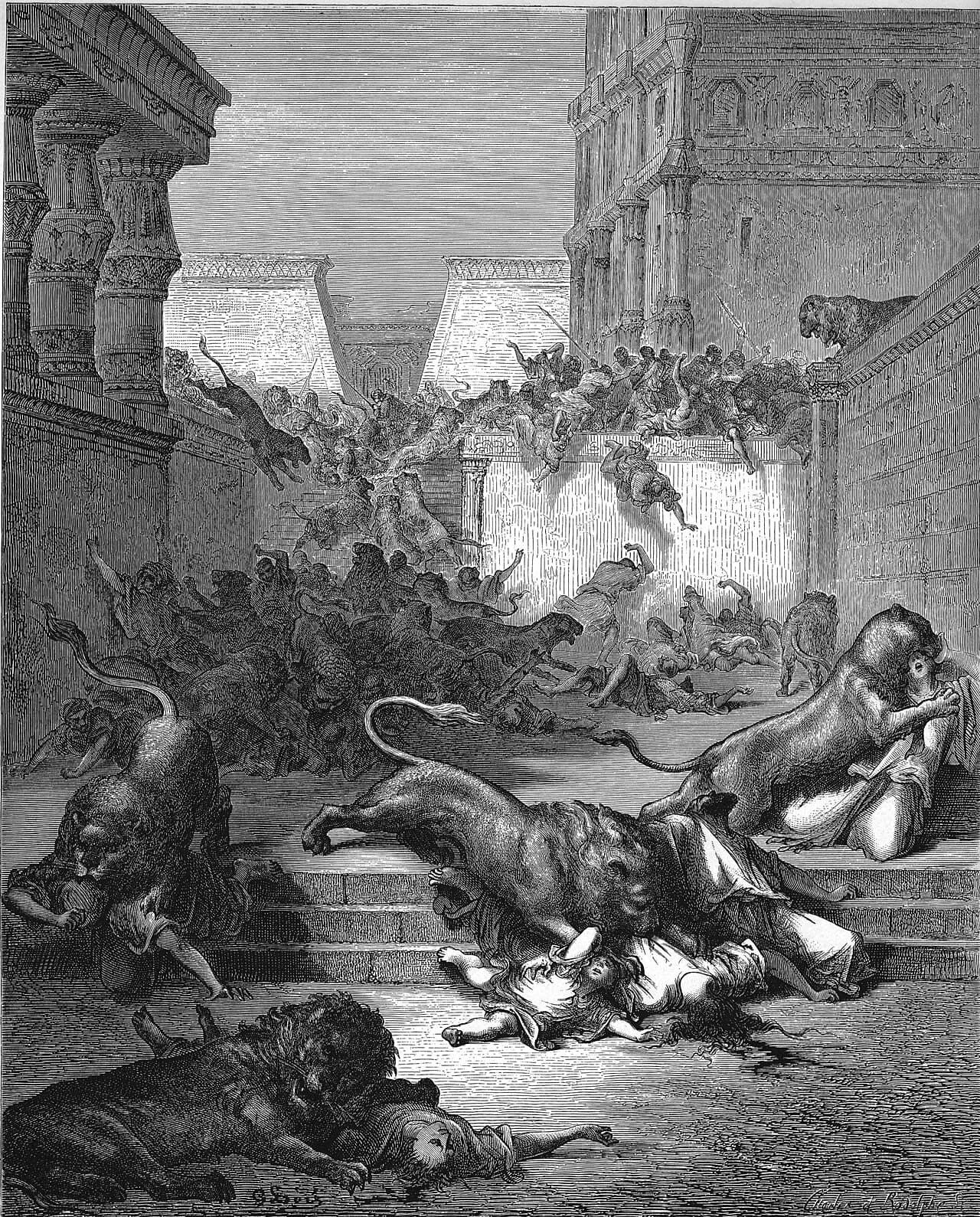
Gustave Doré, Foreign Nations Are Slain by Lions in Samaria, 1866. Public domain, via Wikimedia Commons.
THE ARTWORKDoré engraved the lions the LORD sent among the peoples Assyria had settled in Samaria's towns, because at first they did not worship Him (2 Kings 17:25). The lions pour down the steps and through the streets of the city and kill some of them.
Summary
Samaria was the capital of Israel's northern kingdom, and the siege that ended the kingdom lasted three years, to about 722 BC.
- Hoshea son of Elah, the last king of Israel, withheld his tribute from Assyria and sent envoys to Egypt.
- Peoples from five cities were settled in the towns the Israelites had left.
- Verses 7 to 23 name the reason: other gods, the calves of Jeroboam, and the prophets' warnings refused.
- Which Assyrian king took the city, Shalmaneser V or Sargon II, is still argued.
The Siege and the Fall
Hoshea's reign and the capture of Samaria, told in 2 Kings 17:1 to 6.
Hoshea son of Elah reigned nine years in Samaria. His is the last reign the book gives for the northern kingdom.
Then the king of Assyria invaded the whole land, marched up to Samaria, and besieged it for three years. In the ninth year of Hoshea, the king of Assyria captured Samaria and carried away the Israelites to Assyria, where he settled them in Halah, in Gozan by the Habor River, and in the cities of the Medes.Chapter 18 tells these two verses a second time, dated by Judah's king.
From the First Deportation to the Settlers
The end of the northern kingdom in the order Kings gives it.
- Galilee takenNaphtali carried to Assyria, 2 Kings 15:29
- Hoshea a vassaltribute paid to Shalmaneser, 2 Kings 17:3
- Envoys to King So of Egyptthe yearly tribute stopped, Hoshea put in prison, 2 Kings 17:4
- The siege beginsHezekiah's fourth year, Hoshea's seventh, 2 Kings 18:9
- Samaria takenHezekiah's sixth year, 2 Kings 18:10
- The settlersfive peoples in Samaria's towns, 2 Kings 17:24
The kingdom fell in stages, from the loss of Galilee under Pekah to the resettling of Samaria's towns.
The Verdict of 2 Kings 17:7 to 23
Seventeen verses that give the reason for the fall.
All this happened, the writer says, because Israel sinned against the LORD who brought them out of Egypt.
He lists what they did: they worshiped other gods, followed the customs of the nations, and built high places, pillars and Asherah poles on every high hill.
They made two calves of cast metal, bowed to the host of heaven, served Baal, and burned their sons and daughters in the fire.
The speech ends where the northern kingdom began, with Jeroboam son of Nebat, who drove Israel from following the LORD.
Yet through all His prophets and seers, the LORD warned Israel and Judah, saying, “Turn from your wicked ways and keep My commandments and statutes, according to the entire Law that I commanded your fathers and delivered to you through My servants the prophets.” But they would not listen, and they stiffened their necks like their fathers, who did not believe the LORD their God.The whole verdict rests on these two verses.
Finally, the LORD removed Israel from His presence, as He had declared through all His servants the prophets. So Israel was exiled from their homeland into Assyria, where they are to this day.Its last words, to this day, show that the exile had not ended when the writer set the book down.
What the Chapter Says and What Is Often Said
Four common readings that the verses of Kings and Chronicles correct.
OFTEN SAID: ASSYRIA ENDED THE KINGDOM
In verse 18 the LORD is the one who acts.
OFTEN SAID: EVERY ISRAELITE LEFT THE LAND
Chronicles later records men of Asher, Manasseh and Zebulun who came to Jerusalem for Hezekiah's Passover.
OFTEN SAID: JUDAH WAS BLAMELESS
Judah heard the same warnings and, the writer says, lived by the customs Israel had introduced.
OFTEN SAID: VERSES 33 AND 34 DISAGREE
Verse 33 says the settlers worshiped the LORD, and verse 34 says none of them worship Him. The Hebrew uses one verb, yare, to fear, in both.
The Assyrian Record
What Sargon II's scribes and the Babylonian Chronicle say of the fall.
Sargon II, who followed Shalmaneser on the Assyrian throne, claims the capture of Samaria in his own annals from Khorsabad.
His scribes date it to the beginning of his reign and count 27,290 people carried away, with fifty chariots taken for his army.
They add that he rebuilt the city, settled people from other conquered lands in it, and set his own officer over them as governor. His Display Inscription repeats the count of 27,290.
The Babylonian Chronicle, under Shalmaneser V, records that a city read as Shabarain was destroyed, and that Shalmaneser died in the month of Tebet in his fifth year.
Sargon's annals for his second year list Samaria among the cities that Ilu-bi'di of Hamath stirred up against him.
The Covenant Behind the Verdict
The warnings in the law and the prophets that the chapter's words echo.
Deuteronomy told Israel to destroy the places where the nations served their gods on the hills and under every green tree, the words verse 10 uses.
The law also named the cost of breaking the covenant. Exile among the nations stands in the curses of Leviticus 26 and Deuteronomy 28.
Ahijah the prophet had foretold Israel's uprooting in Jeroboam's own reign. He spoke it at Shiloh to Jeroboam's wife, when she came to ask about their sick son.
The writer of Kings points back to such words in verse 23.
The warnings of exileLeviticus 26:33; Deuteronomy 28:36 and 28:64; 1 Kings 14:15
But I will scatter you among the nations and will draw out a sword after you as your land becomes desolate and your cities are laid waste.The LORD will bring you and the king you appoint to a nation neither you nor your fathers have known, and there you will worship other gods—gods of wood and stone.Then the LORD will scatter you among all the nations, from one end of the earth to the other, and there you will worship other gods, gods of wood and stone, which neither you nor your fathers have known.The penalty matches the sin: a people who chose other gods at home would serve them in exile.
For the LORD will strike Israel as a reed is shaken in the water. He will uproot Israel from this good land that He gave their fathers, and He will scatter them beyond the Euphrates, because they have made their Asherah poles, provoking the LORD to anger.The prophet who had promised Jeroboam the ten tribes now names their end.
Jeroboam's calves1 Kings 12:28 to 30
After seeking advice, the king made two golden calves and said to the people, “Going up to Jerusalem is too much for you. Here, O Israel, are your gods, who brought you up out of the land of Egypt.” One calf he set up in Bethel, and the other in Dan. And this thing became a sin; the people walked as far as Dan to worship before one of the calves.Verses 16, 21 and 22 of the verdict point back to this act.
The prophets who warnedAmos 7:17 and Hosea 10:6 to 7
Therefore this is what the LORD says: ‘Your wife will become a prostitute in the city, and your sons and daughters will fall by the sword. Your land will be divided by a measuring line, and you yourself will die on pagan soil. And Israel will surely go into exile, away from their homeland.’”Amos gave this warning at Bethel, the shrine of Jeroboam's calf, and named the exile outright.
Yes, it will be carried to Assyria as tribute to the great king. Ephraim will be seized with shame; Israel will be ashamed of its wooden idols. Samaria will be carried off with her king like a twig on the surface of the water.Hosea foretold the fall before the siege began, down to the calf sent to Assyria as tribute.
What the Text Leaves Unsaid
Three facts the chapter leaves untold.
King So of Egypt is named once and left unidentified.
Hoshea's death is left untold.
The chapter names the settlers' cities and their gods, and does not say how many were brought.
Removed from His Presence
Four Hebrew words the verdict turns on, and what they teach.
The charge is about listening. The verb in verse 14 is shama, to hear with attention.
Verse 15 plays on one word. They went after hebel, the empty thing, and became empty themselves.
The verb for the exile is galah, to strip or uncover, and the verb in verses 18 and 23 is sur, to turn aside.
Voices on the Fall of Samaria
Teachers from the third century to the eighteenth.
Matthew Henry answers the common reading that Assyria's strength ended the kingdom.
“Come and see what it was that did all this mischief, that broke their power and laid their honour in the dust; it was sin; that, and nothing else, separated between them and God. This is here very movingly laid open as the cause of all the desolations of Israel.”
Matthew Henry · Commentary on the Whole Bible · on 2 Kings 17:23Puritan
Origen on the Samaritans' namethe third century
“The Hebrews, however, call a guard somer, and thus they also hand on in their tradition that the Samaritans first received this name because the king of the Assyrians sent them to be guards of the land of Israel after the captivity, that is, that other Israel besides Judah, which was taken captive into Assyria because of their many sins.”
Origen of Alexandria · Commentary on the Gospel of John 20.321 · on 2 Kings 17:24Patristic
Chrysostom on the settlersthe fourth century
“But he carried them to Babylon and to the Medes, and having brought thence nations from divers places, planted them in Samaria, that his dominion for the future might be sure, his own people occupying the place. After this, God, desiring to show that He had not given up the Jews through weakness, but because of the sins of those who were given up, sent lions against the foreigners, who ravaged all their nation. These things were reported to the king, and he sent a priest to deliver to them the laws of God. Still not even so did they desist wholly from their impiety, but only by halves. But as time went on, they in turn abandoned their idols, and worshiped God. And when things were in this state, the Jews having returned, ever after entertained a jealous feeling towards them as strangers and enemies, and called them from the name of the mountain, ‘Samaritans.’”
John Chrysostom · Homily 31 on John · on 2 Kings 17:24Patristic
Three Questions the Chapter Raises
Who took the city, who wrote the verdict, and whom verse 34 means.
Shalmaneser V took the cityJohn Gill, Exposition of the Old Testament
Gill follows Kings and names Shalmaneser as the king who besieged the city and took it.
The objection: Rogers prints a query against one sign of the Chronicle's place name, so the record of Shalmaneser's destroyed city may not name Samaria.
Sargon II took the cityR. W. Rogers, Cuneiform Parallels to the Old Testament, 1912
Rogers takes Sargon's claim at its word and dates the conquest to 722 and 721 BC.
The objection: Kings names Shalmaneser at the siege, and the revolt of 720 BC leaves room for Sargon's claim to cover a later campaign.
Jeremiah wrote the book of KingsThe Babylonian Talmud, Bava Batra 15a
An editor in the exile wrote itGerhard von Rad, Studies in Deuteronomy, 1953
Verse 34 speaks of the settlers' fearRashi on 2 Kings 17:34, the Metsudah translation
Rashi reads verse 34 as saying that the settlers' fear of the LORD was not complete, because they did not keep the law given to the sons of Jacob.
The objection: the Metsudah note gives Radak's other reading, that verse 34 speaks of the Israelites in exile.
Books on the Fall of Samaria
Three works that give the Assyrian texts and a reading of Kings.
Cuneiform Parallels to the Old Testament
Robert William Rogers · 1912
Rogers sets the transliterated cuneiform under each English rendering, so a reader can check the signs.
Read it free at the Internet ArchiveAncient Records of Assyria and Babylonia, Volume 2
Daniel David Luckenbill · 1927
Luckenbill translates the inscriptions of Sargon II, including the Display Inscription.
Read it free at the Internet ArchiveStudies in Deuteronomy
Gerhard von Rad · 1953
Its seventh chapter reads the books of Kings as a history judged by the law of Deuteronomy.
Read it at the Internet ArchiveToday, If You Hear His Voice
2 Kings 17 asks its reader to listen.
The prophets also promised a return. Ezekiel saw Israel and Judah made one nation again, under one king, David the LORD's servant, one shepherd over them all.
The Gospels name Jesus the son of David.
As it has been said: “Today, if you hear His voice, do not harden your hearts, as you did in the rebellion.”Hebrews gives the warning of the wilderness to the church.
I have other sheep that are not of this fold. I must bring them in as well, and they will listen to My voice. Then there will be one flock and one shepherd.Jesus takes that office for Himself.
Keep studying
Read it1
Studies9
Doctrines2
Peoples and groups2
Symbols1